
Medical Coding After Nursing: Reddit RN/LPN Career-Change Experiences, Credential Choices & Salary Trade-Offs
Leaving bedside or direct patient care for medical coding can turn years of nursing knowledge into a different kind of healthcare career, yet the financial and employment trade-offs deserve careful calculation. An RN or LPN already brings clinical vocabulary, chart familiarity, and workflow knowledge that many new medical coders must build from scratch. Coding still demands separate expertise in guidelines, reimbursement, and code selection. Before choosing a CPC pathway, compare the medical coding salary reality, credential fit, first-job risk, and whether a coding-adjacent role could preserve more of your nursing earning power.
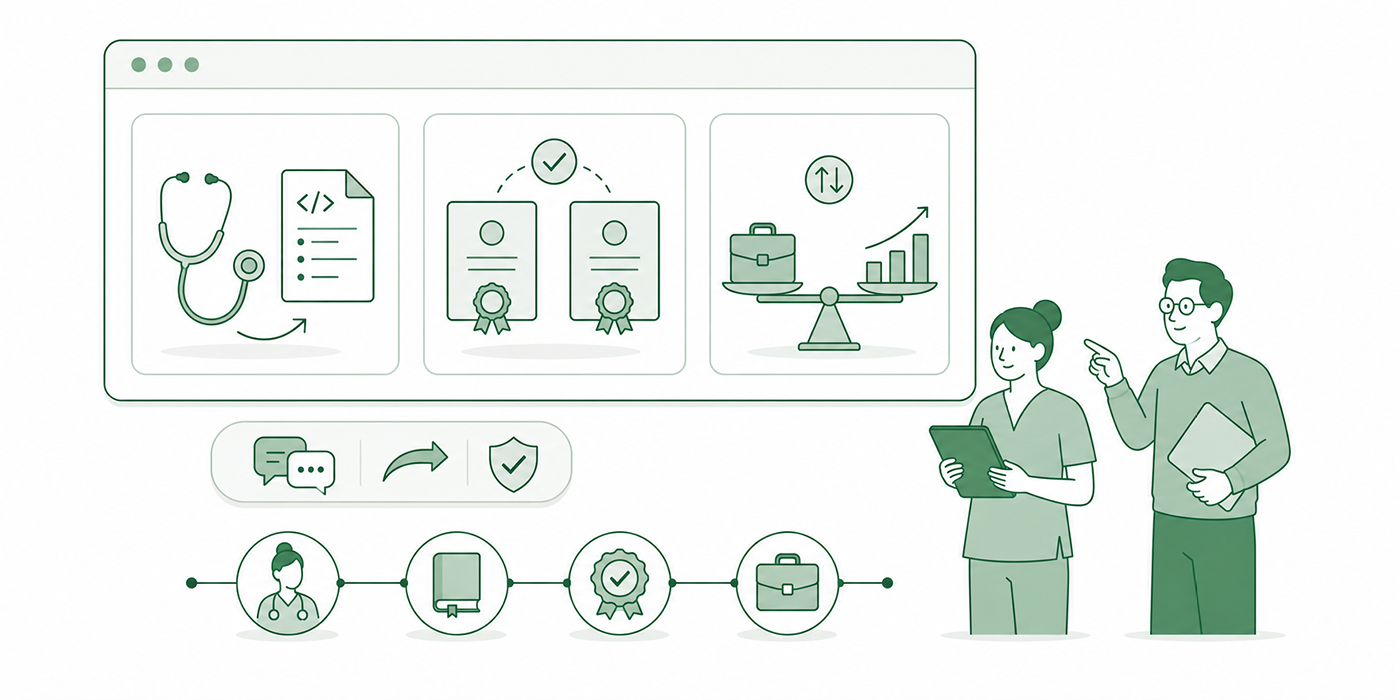
1. Medical Coding After Nursing: How Much of Your RN or LPN Experience Actually Transfers?
A nurse entering coding begins with several meaningful advantages. Years spent reading histories and physicals, operative reports, medication lists, laboratory results, discharge summaries, problem lists, and physician documentation create clinical fluency that supports medical terminology mastery. Nurses frequently recognize disease relationships, understand why procedures occur, interpret abbreviations, and follow the sequence of a patient encounter faster than a complete healthcare beginner. That clinical background can shorten the learning curve for CPC preparation and make complex charts feel less foreign.
Coding introduces a different decision framework. Clinical understanding tells you what happened to the patient. Coding rules determine what documentation supports reporting, which code set applies, how sequencing works, what can be inferred, and when clarification is required. A nurse may understand a disease perfectly and still miss a coding question because the documentation fails to support the specificity the clinician knows is clinically likely. Strong CPC exam preparation, repeated coding practice questions, and guideline-driven chart work close that gap.
This distinction matters enormously for nurses who assume several years of bedside experience will automatically qualify them as experienced coders. AAPC's current CPC-A removal rules rely on verified professional coding experience using applicable code sets, education, and qualifying practicum pathways. Nursing employment itself does not automatically become professional coding experience. A nurse who performed legitimate coding duties within a role may be able to document applicable experience, while ordinary bedside charting alone does not satisfy that requirement. AAPC currently recognizes qualifying combinations involving verified coding employment, an 80-hour coding course, and Practicode.
That means the nurse-to-coder advantage appears most strongly in knowledge transfer and employer context, rather than an automatic bypass of beginner status. An RN who understands cardiology may adapt rapidly to cardiology coding. An LPN who spent years in long-term care may understand chronic-disease documentation far better than someone encountering it for the first time. A perioperative nurse may recognize procedures quickly when studying CPT coding. A nurse with payer-facing experience may already understand portions of denial management, claims workflows, and reimbursement methodology.
Reddit career-change stories reflect that advantage. One former nurse described completing CPC training in roughly four months, securing an initial coding job after another few months, and finding that nursing knowledge later helped accelerate progression into a lead-coder role. Another trauma RN reported that hospital experience became a substantial hiring advantage when moving into coding. These experiences remain individual outcomes rather than guarantees, yet they illustrate why clinical knowledge can become valuable after the coder learns the actual coding system.
The strongest question therefore becomes: Which part of your nursing background can be converted into a coding specialty employers will pay for?
| Decision Point | Nursing Gives You | Coding Still Requires | Best Career Move |
|---|---|---|---|
| Medical terminology | Usually strong clinical vocabulary | Coding-specific interpretation | Test out gaps before buying prerequisites |
| Anatomy | Strong practical foundation | Procedure-level precision | Review weak body systems selectively |
| Pathophysiology | Major advantage | Documentation-driven code assignment | Leverage specialty knowledge |
| Pharmacology | Often strong | Drug-related coding rules | Use existing clinical knowledge |
| Chart navigation | Familiarity with EHR documentation | Coding-oriented abstraction | Practice finding reportable evidence |
| Provider documentation | Understands clinical intent | Must follow coding authority hierarchy | Separate clinical assumption from codable evidence |
| ICD-10-CM | Recognizes diagnoses quickly | Guidelines, sequencing, specificity | Study rules systematically |
| CPT | Recognizes many procedures | Code selection, bundling, modifiers | Build procedural coding skill separately |
| HCPCS Level II | May recognize drugs and supplies | Reporting rules and payer context | Include in CPC/COC preparation |
| ICD-10-PCS | Clinical procedure knowledge helps | Entirely separate coding logic | Prioritize for inpatient hospital coding |
| Reimbursement | Variable nursing exposure | Payment systems and payer rules | Study explicitly |
| Compliance | Strong healthcare ethics foundation | Coding-specific compliance rules | Learn documentation and reporting risk |
| CPC-A status | Clinical experience helps hiring narrative | Qualifying coding experience | Plan apprentice removal before testing |
| Physician-office coding | Strong outpatient clinical context | Professional-fee coding | Consider CPC |
| Hospital inpatient coding | Strong inpatient chart familiarity | ICD-10-PCS and inpatient guidelines | Consider CCS or CIC |
| Hospital outpatient coding | Procedure and department familiarity | Facility payment methodology | Consider COC or CCS |
| Risk adjustment | Chronic-disease knowledge | HCC and documentation rules | Consider diagnosis-focused specialization |
| Clinical documentation integrity | Excellent clinical foundation | Query, coding and reimbursement knowledge | Compare CDI with pure coding |
| Auditing | Clinical judgment | Established coding competence | Build coding experience first |
| Denials and appeals | Can interpret clinical evidence | Payer and coding knowledge | Strong hybrid option for nurses |
| Remote work | Healthcare experience strengthens profile | Independent production-level coding | Expect tougher beginner filters |
| Starting salary | Existing nurse wage may be high | Entry coding market rate | Calculate temporary pay-cut tolerance |
| Overtime income | Common in some nursing settings | May be limited in salaried coding roles | Compare total annual compensation |
| Shift differentials | Can materially raise nursing income | Less common in standard coding roles | Include lost differentials in calculation |
| Physical demands | Often significant | Primarily computer-based | Value lifestyle change separately from pay |
| Productivity pressure | Clinical workload pressure | Accuracy and charts-per-hour targets | Ask employers about metrics |
| Patient contact | High in bedside roles | Usually minimal | Confirm desk-based work fits your preferences |
| Nursing license value | Can unlock clinical roles | May carry limited premium in pure coding | Compare hybrid RN roles before leaving nursing entirely |
| Best specialty leverage | Your strongest clinical specialty | Matching coding competency | Target familiar specialties first |
| Biggest transition mistake | Assuming clinical expertise equals coding expertise | Formal code-set proficiency | Train before resigning from nursing |
2. CPC, CCS, COC, CIC or CBCS: Which Credential Makes Sense After Nursing?
The best credential depends on the records you want to code. Nurses gain more from choosing a destination first and then selecting the credential that matches it. The detailed CPC vs CCS vs CBCS comparison is especially useful here because employer recognition changes by setting.
CPC for physician and professional-fee coding
AAPC describes its CPC preparation as physician-office coding training. The credential focuses heavily on ICD-10-CM, CPT, HCPCS Level II, professional services, compliance, and related reimbursement concepts.
For an RN or LPN coming from a clinic, surgical office, specialty practice, ambulatory setting, or physician group, the CPC pathway often creates the cleanest first move. Nurses can use existing anatomy and terminology knowledge while concentrating study time on CPT coding principles, modifiers, documentation requirements, payer logic, and CPC exam strategy.
AAPC currently prices its core certification exams, including CPC, at $425 for one attempt or $499 for two attempts, with separate student pricing. Membership and educational materials can add to the total. A nurse who already has a strong command of medical terminology may be able to avoid paying for redundant foundational coursework while still investing in rigorous coding instruction.
CCS for hospital-focused coding
AHIMA's CCS targets professionals coding medical records across hospital and provider settings and tests substantial coding proficiency. AHIMA currently recommends prior coursework and/or coding experience, while those recommendations are not formal eligibility requirements. The 2026 CCS exam requires current ICD-10-CM, ICD-10-PCS, and CPT resources.
An experienced hospital RN can possess a major contextual advantage when studying CCS concepts. The nurse already knows what a complicated inpatient record looks like, understands diagnoses and procedures, and may recognize clinical relationships quickly. The remaining workload is substantial: inpatient sequencing, ICD-10-PCS construction, reimbursement methodology, coding guidelines, and coding-specific documentation rules still require dedicated preparation through a strong CCS program, CCS practice questions, and CCS exam-day preparation.
AHIMA currently lists the CCS exam at $299 for members and $399 for non-members.
COC or CIC for facility-specific paths
AAPC positions COC training around outpatient hospital and facility coding, including ambulatory surgery centers, while CIC preparation focuses on inpatient hospital coding and ICD-10-CM/PCS concepts.
A perioperative RN interested in ambulatory surgery coding could find COC especially relevant. A med-surg, ICU, trauma, or inpatient nurse targeting facility coding may find CIC or CCS preparation better aligned with familiar documentation.
CBCS for a billing-heavy transition
The NHA CBCS path can make sense when the intended role mixes claims, billing, reimbursement, front-end revenue cycle, and coding support. Nurses seeking dedicated coding positions should compare CBCS employer recognition with CPC and CCS recognition. A billing-oriented candidate can strengthen the path through medical billing concepts, CPT fundamentals, claims submission knowledge, and denial-management skills.
For many nurses, another option deserves equal attention: CDI, clinical validation, auditing, utilization review, risk adjustment, or denial/appeal work. These hybrid roles may capture more of the economic value of the nursing license than a pure entry-level coder job. Someone considering a full career change should compare these paths with the medical billing versus coding career trade-offs before committing.
3. What Reddit RN and LPN Career-Change Stories Reveal About Getting Hired
Reddit stories reveal a wider range of outcomes than training advertisements. One detailed nurse-to-CPC account described leaving nursing, completing a self-paced coding course, earning CPC certification, and then spending roughly two to three months obtaining the first coding position. The initial wage dropped from about $27 per hour as an RN to $17 per hour as a coder. Seven years later, the poster reported earning $31 per hour as a lead coder and credited nursing experience with helping career progression.
That story captures an important transition pattern: clinical experience can improve long-term leverage while the first coding job may still price you as a beginner coder.
Another Reddit discussion involved a trauma RN who moved into coding and reported receiving a remote offer quickly, attributing part of that success to hospital experience. The poster eventually reported earning more than bedside nursing, though the transition occurred in 2018 and should be treated as an individual historical outcome rather than a current hiring benchmark.
A 2024 discussion produced a different perspective. One commenter working around nurses and coders reported that nurses in the department received the same pay as other coders, meaning the nursing background did not automatically produce a wage premium.
Together, these stories show why a nurse should separate three questions:
Can my nursing background help me learn coding? Frequently, yes.
Can it help me get interviews? It can, particularly when the specialty or employer values clinical experience.
Will an employer automatically pay nurse-level wages for an entry coding role? Salary structures frequently follow the coding position rather than the previous bedside title.
That last point deserves careful planning. A nurse leaving a $40–$50-per-hour clinical position can create a large temporary income gap by accepting an entry-level coding salary. Someone already struggling with the first medical coding job market also faces the possibility of several months between certification and employment. The financial model therefore needs to include training cost, exam cost, time to certification, time to first offer, and the wage difference after hiring.
The hiring advantage becomes stronger when the nurse targets the intersection between previous specialty knowledge and the employer's coding need. An oncology nurse can build oncology coding competence. A cardiology nurse can combine existing clinical fluency with cardiovascular coding resources. An emergency nurse can strengthen procedural familiarity through emergency medicine CPT coding. A surgical nurse can emphasize operative-note comprehension while developing CPT mastery.
This targeting strategy also strengthens the resume. “RN with eight years of experience” is broad. “RN with eight years of cardiology experience, CPC, repeated cardiology chart-coding practice, EHR fluency, and payer-documentation knowledge” tells a coding manager exactly where the applicant's clinical background could reduce training time.
Applicants chasing remote work should apply the same discipline. The remote medical coding job market can impose higher experience filters because employers need coders who can maintain accuracy and productivity with less immediate supervision. Nursing experience improves the profile while verified coding competency remains essential.
4. Salary Trade-Offs: How Much Income Could an RN or LPN Give Up?
Salary comparisons need equivalent definitions. BLS categorizes medical coders within the broader medical records specialists occupation, which includes additional health-information roles. That category provides a useful national benchmark while an individual certified coder's pay can vary substantially by specialty, credential, geography, experience, employer, productivity expectations, and management responsibility.
The latest May 2025 national Occupational Employment and Wage Statistics show an annual mean wage of $101,420 for registered nurses, $67,050 for licensed practical and licensed vocational nurses, and $56,790 for medical records specialists.
Those figures immediately expose the main financial danger for RNs. A direct move from bedside nursing into an ordinary beginner coding role can create a substantial gross-income reduction. The difference may become even larger for nurses currently earning overtime, weekend premiums, night differentials, call pay, bonuses, or high-cost-market wages.
An LPN may face a smaller national-average gap, although local pay remains decisive. Someone earning $30 per hour as an LPN should compare actual local coding offers rather than assuming a medical coding salary will automatically match current nursing compensation.
Run the calculation using total annual compensation, including:
Base nursing wages
Average overtime
Shift differentials
Weekend or call premiums
Employer retirement contributions
Health-insurance differences
Licensing and credential-maintenance costs
Commuting and parking
Childcare created by shift schedules
Training and certification costs
Months of reduced income during transition
Future coding salary after one, three, and five years
This produces a far more useful answer than comparing two hourly rates.
Lifestyle also has economic value. Medical records specialists typically work extensively at computers and have no direct patient-care requirement, according to BLS. A former bedside nurse may assign significant personal value to predictable hours, lower physical demands, reduced commuting through eventual remote work, or leaving rotating shifts. Someone considering remote coding should still budget for a period of onsite or hybrid work if that creates the fastest route to credible experience.
The longer-term ceiling depends heavily on specialization. Experienced coders can move toward inpatient coding, auditing, compliance, risk adjustment, coding education, management, reimbursement, denials, and health-information roles. BLS lists a May 2025 annual mean wage of $74,970 for health information technologists and medical registrars, showing that health-information careers extend beyond entry-level records work.
A nurse can also preserve more clinical value through CDI, clinical validation, utilization review, nurse auditing, or payer-facing roles. These deserve comparison with pure medical coding, especially for an experienced RN whose existing salary is already high.

5. The Lowest-Risk RN/LPN-to-Medical-Coding Transition Plan
The safest transition begins before resigning from nursing.
Step 1: Audit 30–50 real job postings
Search employers you could realistically work for. Record which credentials appear, whether jobs are professional-fee or facility based, which specialties dominate, required years of coding experience, remote restrictions, and whether an RN/LPN background receives explicit preference.
Use that employer sample to decide among CPC, CCS and CBCS. Someone repeatedly seeing CPC in physician-group postings has a clear signal. Someone targeting hospital inpatient departments should investigate CCS programs and inpatient coding requirements before spending money on a different credential.
Step 2: Map your nursing specialty to a coding niche
List your strongest clinical domains. Cardiology, orthopedics, surgery, oncology, emergency medicine, primary care, women's health, pediatrics, behavioral health, and chronic disease management can all create specialty familiarity.
Then deliberately add coding knowledge in that same area. Combine CPC study with CPT practice, reimbursement knowledge from the physician fee schedule, Medicare billing resources, and denial-management concepts.
Step 3: Avoid rebuying nursing knowledge you already possess
A nurse who is genuinely strong in anatomy, terminology, and pathophysiology may need targeted review rather than full beginner courses. AAPC's own CPC study guide describes itself as a review resource rather than an introduction to coding.
Use diagnostic practice to identify weaknesses. If medical terminology is already strong, invest time elsewhere. If coding guidelines remain weak, double down on them. If CPT navigation is slow, use CPC practice questions and exam strategy.
Step 4: Plan apprentice status before taking the CPC
AAPC currently requires qualifying combinations of coding experience, education, and/or Practicode for CPC-A removal. Its Practicode program includes 600 cases and can satisfy one year of the apprentice-experience requirement when successfully completed.
An RN with ten years of bedside experience should therefore avoid building a financial plan around immediate full-CPC status unless qualifying coding experience already exists. Review the current rules before selecting an online CPC program.
Step 5: Keep nursing income while building coding credibility
PRN nursing, part-time nursing, weekend shifts, or a gradual transition can protect cash flow while you obtain certification and apply. This is especially valuable because the first coding job may take months to secure.
The 90-day coding employment strategy becomes useful after certification. Apply to coding, coding-adjacent, billing, reimbursement, charge capture, denials, auditing-support, documentation, and revenue-cycle roles where your nursing background strengthens the application.
Step 6: Compare coding against CDI and nurse-auditing paths
Experienced RNs should investigate clinical documentation integrity, clinical validation, utilization management, risk adjustment, appeals, nurse auditing, and payer roles alongside traditional coding. These jobs can combine clinical judgment with reimbursement and documentation knowledge while preserving more of the economic value of an RN background.
Understanding claim adjustment codes, denial management, Medicare tools, electronic claims, and reimbursement methodology can make a nurse competitive across a much larger segment of revenue cycle.
That broader strategy protects against the biggest career-change mistake: abandoning a valuable healthcare license to compete only for the narrowest entry-level coding jobs.
6. FAQs
-
It can be an excellent fit for an RN who enjoys chart review, detailed rules, independent computer-based work, and continued exposure to medicine without direct patient care. The financial case depends heavily on current nursing pay. Compare the medical coding salary landscape, first-job difficulty, and remote-work pathway against your current total RN compensation.
-
LPNs can bring valuable terminology, anatomy, medication, documentation, and patient-care knowledge into coding. The national wage gap between LPNs and the broader medical-records category is smaller than the corresponding RN gap, although local wages can differ considerably. Choose a credential based on your intended setting through the CPC, CCS and CBCS comparison and use your strongest clinical specialty as an employment advantage.
-
Regular nursing experience does not automatically satisfy AAPC's professional-coding experience requirement. AAPC requires qualifying coding experience or approved combinations involving education and Practicode. A nurse considering CPC certification should build the apprentice-removal route into the training plan before paying for the exam.
-
A hospital RN targeting inpatient coding should investigate CCS and other inpatient-focused credentials closely because hospital coding requires skills such as ICD-10-PCS and inpatient sequencing. AHIMA's CCS specifically tests broad coding proficiency and recommends substantial coursework or experience. An RN targeting physician-office or professional-fee coding may find the CPC route better aligned. Compare both through the credential guide.
-
An RN or LPN license can strengthen clinical understanding and may create access to specialized or hybrid roles. Pure coding departments may still use standard coder salary bands. Reddit contains examples of nurses receiving ordinary coder pay as well as experienced nurse-coders who later achieved stronger compensation. Specialty, coding experience, employer, credential, location, and responsibility usually determine the eventual outcome.
-
Remote hiring depends on the employer. Clinical experience can strengthen the resume, while many remote coding positions still require proven coding productivity and accuracy. The most reliable strategy is to understand the remote coding filters, gain a recognized credential, develop measurable chart-coding competence, and remain open to onsite or hybrid experience when it accelerates the transition.
