
Medical Coding Bootcamp vs Community College vs Self-Study: Reddit Outcomes, Total Cost & Employer Perception
Choosing how to learn medical coding can affect far more than exam readiness. A CPC preparation route can change your total cost, timeline, confidence with real charts, CPC-A removal options, and how quickly you become competitive for a first medical coding job. Bootcamps offer speed, community colleges offer depth, and self-study offers control. The smartest choice depends on the exact job you want, your starting knowledge, your budget, and whether you can turn education into the practical skills employers actually screen for in 2026.
1. Medical Coding Bootcamp vs Community College vs Self-Study: Which Route Actually Wins?
There is no universal winner because these three paths solve different problems. Someone already working in healthcare may need a focused CPC exam strategy, while a complete beginner may benefit from structured coursework in medical terminology, anatomy, reimbursement, and coding methodology. A student targeting hospital coding may also need a different curriculum from someone pursuing physician-office coding through an online CPC program.
A medical coding bootcamp makes the most sense when speed and structure matter. Good programs compress instruction into several weeks or months, provide assignments and instructor support, and deliberately prepare students for a specific credential. The danger appears when “bootcamp” means little more than prerecorded content attached to a large tuition bill. Before paying, compare the curriculum against the competencies covered in CPC preparation, CCS preparation, or CBCS preparation, depending on the job track you actually want.
A community college certificate generally offers the strongest academic structure. Students may receive graded instruction in anatomy, pathophysiology, medical terminology, reimbursement, ICD-10-CM, CPT, HCPCS, health information management, and sometimes billing. That wider foundation can help someone who would struggle jumping directly into CPC practice questions. Some programs also include externships, career services, credential preparation, or exam fees. The tradeoff is time. A structured certificate may require two or three academic terms when a disciplined learner could reach exam readiness faster through concentrated study.
Self-study gives the learner maximum flexibility and usually the lowest entry cost. A capable self-learner can build a curriculum around CPC terminology fundamentals, current code books, CPC exam questions, official guidelines, practice cases, and timed simulations. Reddit contains genuine examples of people passing through self-study and later finding work, including a 2024 poster who reported completing a self-paced course with no previous coding experience before obtaining a hospital-group position. Other threads contain candidates who passed independently and then spent much longer breaking into coding.
That contrast is critical. Passing a credentialing exam and becoming employable are separate problems. The harder stage for many newcomers begins after certification, which is why a route should be judged against the first-job reality, the CPC-A hiring problem, and the actual credential requirements appearing in the jobs you intend to pursue.
| Decision Factor | Bootcamp | Community College | Self-Study |
|---|---|---|---|
| Typical pace | Fast, compressed | Semester based | Completely learner controlled |
| Best for | Learners needing structure quickly | Beginners wanting a broad foundation | Disciplined independent learners |
| Upfront cost | Usually moderate to high | Highly dependent on residency and aid | Usually lowest |
| Financial aid potential | Provider dependent | Potentially strongest | Usually limited |
| Instructor access | Varies dramatically | Usually scheduled and formal | None unless purchased separately |
| Accountability | High in live programs | High | Entirely self-imposed |
| Medical terminology coverage | Verify before enrolling | Often a dedicated course | Must be planned independently |
| Anatomy coverage | Can be accelerated | Usually more comprehensive | Depends on learner discipline |
| Pathophysiology | Sometimes abbreviated | Common in stronger programs | Frequently overlooked |
| ICD-10-CM practice | Usually credential focused | Often progressive and graded | Unlimited if learner builds cases |
| CPT practice | Usually substantial for CPC tracks | Depends on curriculum | Requires deliberate practice |
| HCPCS coverage | Usually included | Usually included | Must be added manually |
| Reimbursement education | Variable | Often broader | Common self-study blind spot |
| Real-chart abstraction | Excellent only if cases are included | Program dependent | Must source legitimate practice |
| Timed exam practice | Frequently built in | Varies | Easy to build independently |
| Certification exam included | Sometimes | Sometimes | Usually purchased separately |
| Current code books included | Package dependent | Program dependent | Student responsibility |
| AAPC education-hour documentation | Possible if qualifying requirements are met | Possible with qualifying documented instruction | Pure informal study alone does not create course hours |
| Externship potential | Occasional | More likely in stronger programs | Must be pursued separately |
| Career services | Can range from excellent to superficial | Often available institutionally | None |
| Resume support | Provider dependent | Often available | Self-managed |
| Networking | Instructor and cohort dependent | Faculty, classmates and local employers | Must be created independently |
| Credential flexibility | Often centered on one exam | May support multiple credential paths | Maximum flexibility |
| Risk of overpaying | High if marketing exceeds instruction | Higher when tuition, prerequisites and books stack up | Lower financial risk |
| Risk of knowledge gaps | Moderate | Usually lower in comprehensive programs | Highest without a curriculum map |
| Best fit for career changers | Strong when well structured | Strong for complete beginners | Strong for experienced healthcare workers |
| Best fit for working adults | Good if self-paced or evening based | Depends on scheduling | Excellent flexibility |
| Employer signal | Secondary to recognized credential and competence | Can add educational depth | Credential must carry most of the signal |
| Biggest mistake | Buying speed without support | Assuming the college certificate replaces certification | Studying only what appears on practice tests |
| Best buying question | What exactly is included? | What is my net cost after aid? | Can I build and follow a complete curriculum myself? |
2. Total Cost: Calculate the Real Price, Not the Advertised Tuition
A tuition number is nearly useless until you calculate the all-in cost to credential. That calculation should include tuition, prerequisites, current code books, membership, exam fees, retakes, practice tests, software, transportation where relevant, background checks, and any income lost because the program limits your working hours.
For the CPC path, the certification exam itself is currently listed by AAPC at $425 for one core-exam attempt or $499 for two attempts, while eligible student pricing is lower. Anyone comparing a low-cost course should therefore check whether the advertised tuition actually includes the exam, current books, and CPC exam preparation. A $900 course that leaves another $800–$1,000 of necessary purchases outside the package can quickly approach the cost of a more complete CPC training option.
Community college pricing varies even more. Pima Community College estimates its 2026–2027 medical billing and coding certificate at $4,603 including tuition, specified fees, materials and a $425 professional credential cost. Clackamas Community College publishes an estimated $6,338 for its 37-credit program, while Lane Community College lists an estimated $13,682 for its one-year medical coding certificate before separately listed prerequisites. These examples show why “community college is cheaper” is too simplistic. Residency, credit requirements, financial aid, prerequisites, included exams and books can completely change the answer.
For self-study, build your budget from the bottom up. Start with the chosen exam, current code books, a legitimate study guide, practice examinations, membership where appropriate, and any prerequisite education you genuinely need. A learner who already understands anatomy and insurance workflows may be able to move directly into CPC-focused study. A complete beginner who skips medical terminology preparation to save money may simply move that cost into retakes, wasted months, or weak interview performance.
The same principle applies to a CCS pathway. AHIMA currently charges $299 for members and $399 for non-members for the CCS exam. AHIMA also describes prior coursework and coding experience as recommended preparation for CCS rather than mandatory exam eligibility. That makes independent preparation technically possible, although the breadth of CCS coding knowledge, procedural coding proficiency, and CCS practice work means beginners should judge themselves by competence rather than eligibility alone.
The most useful financial metric is cost per credible employment outcome. Spending $5,000 on training that includes strong instruction, current materials, an eligible certification exam, case practice, and meaningful placement support may produce more value than spending $1,000 and emerging unable to code unfamiliar documentation. Conversely, spending $8,000 for polished videos, generic quizzes, and vague “career coaching” creates terrible ROI when a stronger self-directed CPC plan could have built the same exam knowledge for substantially less.
Before enrolling, request an itemized answer to six questions: What credential does this prepare me for? Are current code books included? Is the exam included? How many original charts will I code? How much instructor feedback will I receive? What exactly does career support do after graduation? Those answers reveal far more than the advertised discount.
3. What Reddit Outcomes Reveal About Bootcamps, Colleges and Self-Study
Reddit is useful because prospective coders can see the messy part of career entry that program marketing rarely shows. It should be treated as a collection of individual outcomes rather than a controlled employment study. People struggling with the new-coder job search are also more likely to post than people who moved smoothly into work.
The strongest recurring lesson is that the education format does not rescue a weak employment strategy. One self-study learner reported passing the CPC and moving toward billing work without prior healthcare experience. Another self-paced learner reported being hired by a hospital group shortly after becoming a CPC-A. Recent Reddit discussions also contain people who have completed training and certification yet continue applying unsuccessfully. This is consistent with the broader CPC-A first-job challenge.
Community college experiences are similarly mixed. Some students value the instructors, financial assistance, academic pacing, and comprehensive foundation. Other Reddit posters describe completing a college certificate while remaining uncertain about certification requirements or still feeling weak on practical coding. The lesson is important: a college credential and an industry credential serve different purposes. Before assuming a certificate is sufficient, compare it with the credential expectations discussed in CPC vs CCS vs CBCS.
Bootcamp outcomes also depend heavily on instructional quality. Reddit discussions show some students praising structured AAPC-aligned programs while others complain about minimal instructor interaction or feeling unprepared despite paying for formal training. That is why the phrase “instructor-led” deserves verification. Ask whether instructors hold scheduled live sessions, answer coding questions, review incorrect cases, provide individualized rationales, and teach how to navigate the code set rather than simply supplying an answer key.
The practical dividing line is feedback. Medical coding requires judgment. If a learner chooses the wrong code, understanding why the wrong code was attractive can be as valuable as seeing the correct answer. Good instruction trains that reasoning. Strong self-study recreates it through detailed rationales, CPC question review, repeated chart abstraction, and an error log. Weak self-study simply repeats familiar quizzes until the answers become recognizable.
Students should also pay attention to the difference between coding knowledge and revenue-cycle knowledge. Someone targeting a broader medical office role may benefit from medical billing concepts, electronic claims workflows, claim adjustment reason codes, and denial management. That broader skill stack can create entry points when a pure coding role remains difficult to secure.
4. Employer Perception: What Hiring Managers Are Really Screening For
For most coding jobs, employers eventually need evidence that you can perform the work accurately. Your training provider becomes one piece of that evidence rather than the entire case. A recognized credential, relevant code-set knowledge, chart-reading ability, healthcare experience, EHR familiarity, specialty exposure, and demonstrated accuracy can carry more weight than the words “bootcamp” or “community college” on a resume.
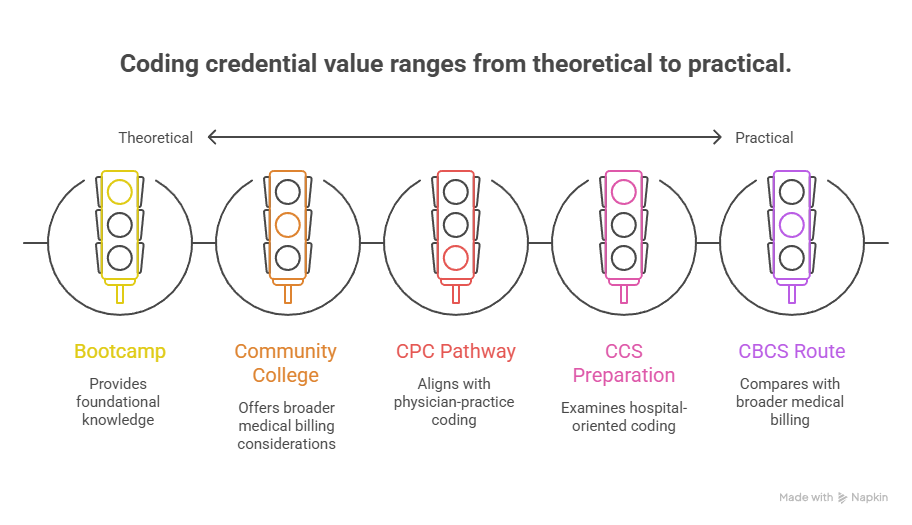
This is why applicants should choose the credential backward from the target job. Physician-practice coding often aligns naturally with a CPC pathway, while candidates investigating hospital-oriented coding should examine CCS preparation. Students interested in billing-heavy positions can compare the CBCS route with broader medical billing career considerations.
For CPC candidates, training structure can also affect the apprenticeship pathway. AAPC currently states that CPC-A removal normally requires two years of verified coding experience, while qualifying combinations of an 80-hour coding course, employment experience, and Practicode can satisfy the requirement through alternate routes. An eligible 80-hour course from a school or instructor can therefore have value beyond teaching the exam, provided its documentation satisfies AAPC requirements.
This makes one pre-enrollment question especially important:
“Will this course provide documentation that meets AAPC's current 80-contact-hour requirement?”
Do not accept “AAPC aligned,” “CPC ready,” or “industry approved” as substitutes for a specific answer. If apprentice removal is part of your plan, verify the current rules directly before paying.
Employer perception also changes by job type. A small physician practice hiring for mixed coding and billing work may value a candidate who understands CPT principles, claim submission, CARCs, payer follow-up, and denial management. A hospital coding department can place greater pressure on record abstraction, complex diagnoses, facility coding, compliance, and experience. A remote coding employer may filter beginners more aggressively because remote onboarding offers less room for continuous supervision.
This explains why someone can finish an expensive program and still encounter rejection. The gap often sits between education completed and risk reduced for the employer. Hiring managers need confidence that a new coder will recognize insufficient documentation, follow guidelines, research unfamiliar scenarios, maintain productivity, protect compliance, and know when to escalate uncertainty.
Your resume should therefore translate education into observable capability. Instead of relying on “Completed Medical Coding Program,” identify the code sets studied, chart volume completed, specialties practiced, certification earned, relevant reimbursement exposure, EHR experience, and any legitimate practicum or healthcare experience. Applicants struggling after passing should also examine the 90-day employment plan rather than continuing to submit the same resume to increasingly unsuitable positions.
5. How to Choose Your Path Without Wasting Six Months or Thousands of Dollars
Begin with job postings, then choose education. Search approximately 30–50 realistic openings in your geographic market or intended remote market. Record the requested credentials, minimum experience, coding setting, specialty, software, education requirements, and whether the role combines coding with billing. This gives you a personal employer-perception dataset far more useful than generic claims about which school is “best.”
If most target postings request CPC, build toward CPC certification. If hospital roles repeatedly request CCS, investigate CCS training, CCS practice questions, and CCS exam-day preparation. If entry-level billing jobs are more common locally, strengthening billing concepts may produce a faster healthcare entry point while you continue building coding experience.
Choose a bootcamp when:
You learn better with deadlines, need instructor access, want a compressed timeline, and have confirmed that the tuition includes substantive instruction. Compare every package with available online CPC programs before committing. Ask for a curriculum, sample lesson, instructor credentials, contact hours, chart volume, credential-exam inclusion, refund policy, and graduate-support process.
Choose community college when:
You are entering healthcare from another industry, want deeper academic foundations, qualify for financial aid, value instructor access, or may later want your credits to support broader education. A college route is particularly attractive when the net cost after grants becomes competitive with private training. Confirm whether the certificate prepares you for a recognized credential and whether the exam is included. Someone graduating without understanding the difference among CPC, CCS and CBCS has been undersupplied with essential career guidance.
Choose self-study when:
You already have healthcare knowledge, are highly disciplined, can independently identify knowledge gaps, and are willing to build a structured curriculum. Use medical terminology preparation, a formal CPC study plan, CPC practice questions, timed simulation, current code books, and case-based practice rather than relying on scattered videos.
Self-study becomes dangerous when “saving money” turns into avoiding difficult subjects. If you consistently miss anatomy-driven questions, buy anatomy instruction. If CPT navigation is slow, strengthen procedural coding principles. If reimbursement concepts remain weak, study physician reimbursement, Medicare billing resources, and claims submission workflows.
The strongest low-risk strategy is often a hybrid. A student can take prerequisite sciences or terminology through a low-cost college, use focused certification preparation for the target credential, and independently add case practice. Someone with existing clinical knowledge can skip redundant introductory education and direct money toward the exam, current resources, and employability. Someone already working in revenue cycle can use that experience while preparing for a more advanced coding credential.
Finally, remember that the first job can determine the return on your education more than the school itself. Be willing to consider onsite coding, billing, charge entry, coding-adjacent revenue-cycle work, medical records, patient accounts, or other roles that create verified healthcare experience. The path toward remote medical coding often becomes easier after you have already reduced the employer's training risk.
6. FAQs
-
A bootcamp can be worth the cost when it provides high-quality instruction, substantial case practice, direct instructor feedback, current materials, recognized credential preparation, and useful career support. Evaluate it against available CPC certification programs and the actual first-job requirements. A short completion timeline has little economic value if you finish unable to code unfamiliar charts or still need to purchase books, exams, prerequisites, and additional training.
-
Employers can value the broader education and structured coursework associated with a strong college program, especially for complete beginners. The more decisive signals usually include the credential required for the role, relevant experience, demonstrated coding competency, and knowledge of the appropriate setting. Compare CPC, CCS and CBCS employer recognition before choosing a program solely because it carries a college name.
-
Yes. Self-study can lead to certification, and Reddit includes examples of candidates who passed and later entered healthcare work. Success requires a real curriculum rather than random exam questions. Build competency in terminology, anatomy, coding guidelines, CPT, ICD-10-CM, HCPCS, reimbursement and chart abstraction, then use CPC exam preparation and timed practice questions to test readiness.
-
The decisive issue is whether your education and experience satisfy AAPC's current apprentice-removal rules. AAPC currently recognizes qualifying combinations involving verified experience, an eligible 80-hour coding course, and/or Practicode. Before enrollment, ask the college whether it documents the required contact hours. After certification, follow the current AAPC process rather than assuming the diploma itself automatically changes the credential.
-
A comprehensive community college program or a genuinely instructor-supported bootcamp often gives a complete beginner more protection against foundational gaps. You will need enough anatomy and medical terminology knowledge to understand documentation before code selection becomes reliable. If budget forces self-study, create a staged curriculum and delay intensive CPC exam drilling until the prerequisites are solid.
-
Absolutely. Credential choice should happen early because each pathway serves a different employment direction. Review CPC vs CCS vs CBCS, examine local job listings, and then select training that prepares you for the credential employers actually request. Candidates considering CBCS should also understand NHA CBCS employer perception before paying for a billing-focused program.
