
Top 30 CBCS Exam Questions and Detailed Explanations
CBCS questions become difficult when several valid concepts appear in the same scenario. A candidate may know the definitions of eligibility, authorization, medical necessity, coding, adjudication, and reimbursement while still choosing the wrong operational step. These 30 original practice questions target the decision-making skills tested across CBCS exam terminology, medical billing workflows, healthcare claims management, and billing reimbursement, with explanations showing why each correct answer fits.

1. How to Use These CBCS Practice Questions Effectively
These questions are original study materials aligned with the publicly available CBCS examination framework. They do not reproduce protected questions from a live NHA examination. Their purpose is to train the same reasoning patterns candidates need when working through revenue cycle concepts, insurance requirements, coding guidelines, and claims reimbursement.
NHA’s published CBCS test plan divides scored content into four areas: Revenue Cycle and Regulatory Compliance, Insurance Eligibility and Other Payer Requirements, Coding and Coding Guidelines, and Billing and Reimbursement. The published blueprint lists 100 scored questions, while 25 additional pretest questions are mixed into the examination. Candidates receive three hours to complete the exam.
NHA also states that candidates no longer need or receive permission to bring outside coding manuals into the CBCS examination. Coding information required for an application question is provided within the test item. This makes interpretation, documentation analysis, and guideline application more valuable than memorizing thousands of isolated code descriptions.
Use each question in four stages:
Select an answer without reviewing the explanation.
Write the rule supporting your choice.
Identify why every remaining option fails.
Create a second scenario in which one incorrect option becomes correct.
For example, when a question concerns a rejected claim, change the scenario so the payer has already adjudicated the claim. The problem then becomes a denial-management question. This technique builds flexible knowledge of clearinghouse terminology, claim adjustment codes, remittance advice codes, and claims reconciliation.
Maintain an error log with five columns: concept, selected answer, correct rule, cause of error, and corrective exercise. Label the cause as a knowledge gap, reading mistake, calculation error, sequence error, or confusion between related terms. This turns a practice score into a targeted improvement plan supported by coding competency assessments, medical coding audits, data reporting methods, and professional development planning.
2. Revenue Cycle and Regulatory Compliance Questions
Q1. Which action should occur before a scheduled patient encounter?
A. Post the payer’s remittance
B. Verify the patient’s insurance information
C. Submit a corrected claim
D. Transfer a denied balance to collections
Correct answer: B. Verify the patient’s insurance information
Detailed explanation: Insurance verification belongs near the front of the revenue cycle process. Staff should confirm demographic data, subscriber information, payer details, active coverage, and relevant benefit information before the service whenever possible.
Waiting until claim submission allows correctable errors to travel through charge capture, claim creation, and clearinghouse validation. A single incorrect member number can delay reimbursement even when the coding and clinical documentation are accurate.
Q2. Which description best defines a clean claim?
A. A claim with no patient balance
B. A claim sent directly to a government payer
C. A complete and accurate claim that can be processed without additional information
D. A claim paid at the provider’s full charge
Correct answer: C. A complete and accurate claim that can be processed without additional information
Detailed explanation: A clean claim contains the administrative, coding, provider, patient, and service information required for adjudication. It should pass applicable claim edits, support medical necessity, and follow the payer’s submission rules.
A clean claim can still result in patient responsibility, a contractual adjustment, or payment below the submitted charge. “Clean” describes claim quality and processability. It does not guarantee full reimbursement. Candidates should connect this concept to reimbursement accuracy, revenue leakage prevention, and revenue cycle KPIs.
Q3. A billing employee opens the record of a neighbour who is not receiving services from the employee’s department. Which principle has been violated?
A. Coordination of benefits
B. Minimum necessary access
C. Timely filing
D. Medical necessity
Correct answer: B. Minimum necessary access
Detailed explanation: Healthcare employees should access protected information according to their assigned responsibilities. Curiosity provides no legitimate operational purpose. HHS explains that covered entities must make reasonable efforts to limit uses, disclosures, and requests for protected health information to the minimum necessary for the intended purpose.
A candidate should connect privacy scenarios to healthcare data security, coding ethics, health information management, and medical record retention.
Q4. Which scenario is the clearest example of upcoding?
A. Correcting an incorrect insurance identification number
B. Reporting a higher-level service than the documentation supports
C. Sending a balance to the secondary insurer
D. Adding a diagnosis supplied by the physician
Correct answer: B. Reporting a higher-level service than the documentation supports
Detailed explanation: Upcoding occurs when a code represents greater complexity, intensity, severity, or reimbursement than the record supports. The problem is the mismatch between the reported service and the documented work.
The coder should apply the supported code and use a compliant coding query process when genuine clarification is necessary. Candidates should review clinical documentation improvement, coding audit terminology, regulatory compliance, and coding ethics standards.
Q5. Which action represents unbundling?
A. Reporting one comprehensive code for an inclusive service
B. Reporting separate component codes to increase reimbursement when an inclusive code applies
C. Correcting an invalid diagnosis pointer
D. Removing a duplicate charge before claim submission
Correct answer: B. Reporting separate component codes to increase reimbursement when an inclusive code applies
Detailed explanation: Unbundling separates services that coding rules or edits treat as components of a more comprehensive service. Separate reporting can be appropriate in defined circumstances, although documentation and coding guidance must support that decision.
Candidates should examine the relationship among coding edits and modifiers, CPT modifier use, surgical coding compliance, and medical coding audits. A modifier cannot serve as a routine override for a valid edit.
Q6. An audit finds that one employee repeatedly enters the wrong service location. What is the strongest corrective response?
A. Correct only the most recent claim
B. Delete the audit report
C. Correct affected claims and investigate the workflow causing the pattern
D. Transfer every balance to the patient
Correct answer: C. Correct affected claims and investigate the workflow causing the pattern
Detailed explanation: Repeated errors indicate a process weakness. Management should identify affected claims, correct them appropriately, determine whether the source is training, system configuration, workflow design, or reference misuse, and then monitor the corrective action.
This approach connects coding audit findings with competency assessments, data analytics, and revenue leakage controls. Correcting one claim leaves the recurring source untouched.
Q7. What does medical necessity address?
A. Whether the patient prefers the service
B. Whether the documented clinical circumstances support the service under applicable criteria
C. Whether the provider submitted the highest charge
D. Whether the patient has a secondary payer
Correct answer: B. Whether the documented clinical circumstances support the service under applicable criteria
Detailed explanation: Medical necessity concerns the clinical justification for a service. Correct patient data, valid codes, and active coverage cannot compensate for documentation that fails to support the service under the relevant policy.
Candidates should distinguish medical necessity from eligibility, authorization, and coding accuracy. Strengthen the distinction through the medical necessity guide, documentation requirements, SOAP-note coding, and clinical documentation improvement.
Q8. A provider discovers an error in a signed medical record. What should occur?
A. Erase the original entry completely
B. Replace the original note without retaining a trace
C. Follow the organization’s approved amendment or correction procedure
D. Ask the biller to alter the clinical conclusion
Correct answer: C. Follow the organization’s approved amendment or correction procedure
Detailed explanation: Record corrections should preserve integrity, authorship, date information, and the audit trail. The approved method depends on the record system and organizational policy. Secretly replacing or destroying the original entry weakens the reliability of the record.
Review electronic medical record documentation, EHR coding terminology, record retention standards, and healthcare data security together when studying record-integrity questions.
3. Insurance Eligibility and Payer Requirement Questions
Q9. Which action confirms that a patient’s insurance coverage is active for the date of service?
A. Charge capture
B. Eligibility verification
C. Payment posting
D. Claims reconciliation
Correct answer: B. Eligibility verification
Detailed explanation: Eligibility verification confirms enrolment or active coverage for the relevant date. A photocopied insurance card shows information previously issued to the patient. It does not prove that coverage remains active.
Eligibility should be checked alongside commercial insurance requirements, coordination of benefits, patient responsibility, and claims management. An eligibility response should also be interpreted for the correct patient, payer, plan, and service date.
Q10. A patient has active insurance, but the planned service is excluded from the benefit package. Which front-end process should have identified this issue?
A. Benefits verification
B. Payment reconciliation
C. Bad-debt collection
D. Code sequencing
Correct answer: A. Benefits verification
Detailed explanation: Eligibility asks whether coverage is active. Benefits verification examines what the plan covers, excludes, limits, or assigns to patient cost sharing. A candidate who treats these concepts as identical will miss questions where the patient has active insurance and limited benefits.
Study insurance billing terminology, patient copay concepts, utilization management terms, and accurate reimbursement as related front-end concepts.
Q11. A payer requires prior authorization for a procedure. When should the authorization decision generally be obtained?
A. After the final collection notice
B. Before the applicable service is performed
C. After the patient balance is written off
D. After the appeal deadline expires
Correct answer: B. Before the applicable service is performed
Detailed explanation: Prior authorization involves submitting information for payer review before the service under the applicable requirement. CMS describes prior authorization as a process in which the provider or supplier submits the request and receives a decision before services are rendered.
Authorization may be limited by provider, facility, diagnosis, procedure, units, date range, or service location. Candidates should link it with medical necessity criteria, utilization review, claims management, and denial management.
Q12. A patient has two active insurance plans. What should the biller determine before submitting the claim?
A. Which plan has the higher deductible
B. Which payer is primary
C. Which plan has the shortest name
D. Which payer issued the newest card
Correct answer: B. Which payer is primary
Detailed explanation: Coordination-of-benefits rules establish the order in which payers process the claim. CMS explains that when Medicare and other coverage exist, COB rules determine which entity pays first. The primary payer processes its responsibility first, followed by the applicable secondary payer.
Candidates should study payer order with coordination of benefits definitions, claim reconciliation, payment posting, and patient responsibility rules.
Q13. A payer’s allowed amount is $800. The patient has $300 remaining on the deductible, followed by 20% coinsurance. How much deductible is applied first?
A. $100
B. $160
C. $300
D. $800
Correct answer: C. $300
Detailed explanation: Apply the remaining deductible before calculating coinsurance on the amount that remains subject to the benefit design. The $300 deductible is taken from the $800 allowed amount, leaving $500. Twenty percent coinsurance on $500 would equal $100, producing total patient responsibility of $400 in this simplified scenario.
Candidates commonly calculate coinsurance from the provider’s charge or apply the percentage before the deductible. Practise with the EOB guide, patient responsibility terms, payment posting guide, and billing reconciliation.
Q14. A payer’s allowed amount is $400, and the patient owes 20% coinsurance with no remaining deductible. What is the coinsurance amount?
A. $20
B. $40
C. $80
D. $320
Correct answer: C. $80
Detailed explanation: Multiply the allowed amount by the coinsurance percentage:
$400 × 0.20 = $80
The payer’s simplified share would be $320. The provider’s submitted charge is irrelevant to this calculation when the question explicitly supplies the allowed amount.
A candidate should separate the allowed amount, contractual adjustment, patient balance, and payer payment. Mixing these figures is one of the fastest ways to miss reimbursement questions.
Q15. Which statement correctly distinguishes a referral from prior authorization?
A. Both terms always describe the same document
B. A referral commonly directs a patient to another provider, while authorization addresses payer approval requirements
C. A referral is issued only after claim denial
D. Prior authorization determines which payer is primary
Correct answer: B. A referral commonly directs a patient to another provider, while authorization addresses payer approval requirements
Detailed explanation: A referral and prior authorization may both affect access and reimbursement, although they serve different operational functions. A referral generally originates from a provider directing care to another provider or specialist. Prior authorization involves payer review under the plan’s rules.
When solving exam scenarios, ask who issues the requirement, what it authorizes or directs, when it must be obtained, and what happens when it is missing. This framework links insurance eligibility, utilization management, medical necessity, and denial prevention.
Choose the problem that appears most often in your practice-test error log.
4. Coding and Coding Guideline Questions
Q16. Which code set is primarily used to report diagnoses in US healthcare claims?
A. ICD-10-CM
B. CPT
C. HCPCS Level II
D. CDT
Correct answer: A. ICD-10-CM
Detailed explanation: ICD-10-CM reports diagnoses, conditions, symptoms, injuries, and other reasons for encounters. CPT primarily reports professional procedures and services, while HCPCS Level II covers many supplies, drugs, durable medical equipment items, and services outside the CPT range.
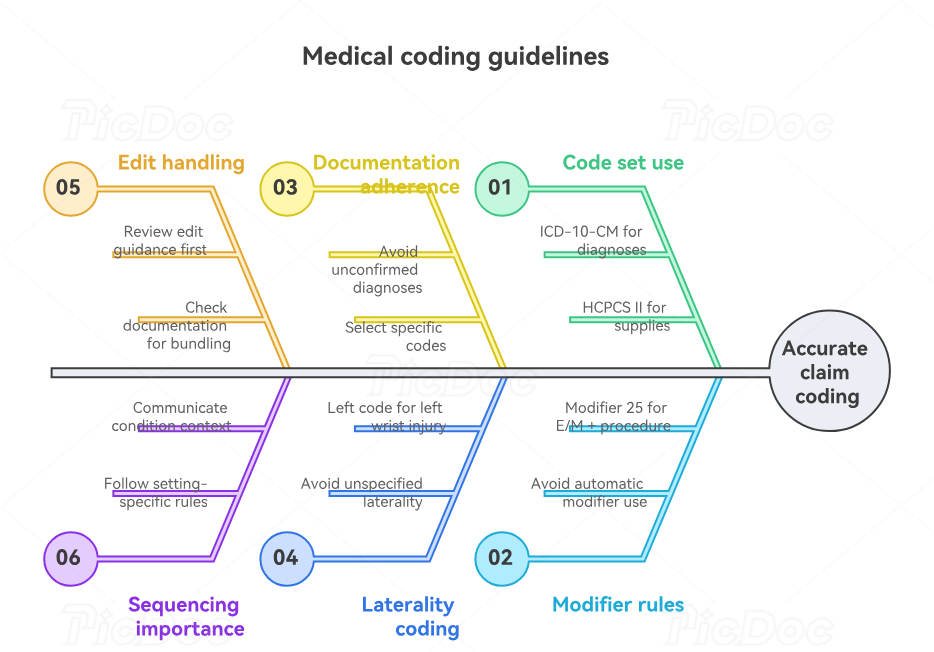
Begin coding questions by identifying what is being reported. This single step prevents confusion among diagnosis coding, CPT procedure coding, medical coding workflows, and billing acronyms.
Q17. Which code set would commonly contain codes for durable medical equipment and certain medical supplies?
A. ICD-10-CM
B. HCPCS Level II
C. ICD-10-PCS only
D. Diagnosis-related groups
Correct answer: B. HCPCS Level II
Detailed explanation: HCPCS Level II contains alphanumeric codes used for many products, supplies, drugs, ambulance services, prosthetics, orthotics, and durable medical equipment items. The exact reporting requirement still depends on the item, payer, documentation, and applicable guideline.
The strongest approach is to classify the subject before searching for a code. Ask whether the record describes a diagnosis, professional service, supply, drug, equipment item, transportation service, or institutional procedure. Link this reasoning to ambulance billing, infusion billing terms, claims management, and medical necessity.
Q18. A provider performs a minor procedure and also delivers a significant, separately identifiable evaluation and management service. Which modifier may be considered when documentation supports the distinction?
A. Modifier 25
B. Modifier 50
C. Modifier 51 in every case
D. No modifier can ever apply
Correct answer: A. Modifier 25
Detailed explanation: Modifier 25 may identify a significant, separately identifiable E/M service performed by the same physician or qualified healthcare professional on the same day as another procedure or service. The record must support meaningful E/M work beyond the usual pre-service and post-service work associated with the procedure.
Attaching the modifier automatically whenever an E/M code and procedure appear together creates compliance risk. Candidates should study modifier definitions, coding edits, documentation requirements, and coding audit terms.
Q19. The documentation says “possible tendon tear,” while the available record does not support a confirmed diagnosis under the applicable setting’s rules. What should the coder avoid?
A. Following the applicable coding guideline
B. Reviewing the entire record
C. Assuming the diagnosis is confirmed
D. Requesting clarification when appropriate
Correct answer: C. Assuming the diagnosis is confirmed
Detailed explanation: Coders should report information supported by the documentation and applicable setting-specific guidelines. They should avoid converting uncertain language into a confirmed diagnosis through personal interpretation.
When documentation is conflicting, incomplete, or clinically unclear, a compliant query may be appropriate. Queries should seek clarification without directing the provider toward a preferred response. Review coding query procedures, clinical documentation improvement, problem-list documentation, and SOAP-note coding.
Q20. Which diagnosis code should generally be selected?
A. The code producing the highest reimbursement
B. The most specific code supported by the documentation and guidelines
C. The code used during the previous year
D. The first code suggested by software
Correct answer: B. The most specific code supported by the documentation and guidelines
Detailed explanation: Specificity can include anatomical site, laterality, acuity, encounter status, manifestation, cause, or another clinically supported detail. A more detailed code becomes appropriate when the record supports that detail.
Encoder suggestions and previous claims can assist research, although the coder remains responsible for validating the choice. Study encoder software terminology, coding automation, coding competency, and coding ethics.
Q21. The note clearly documents an injury to the patient’s left wrist. Which laterality should the diagnosis code reflect when a left-specific option exists?
A. Right
B. Left
C. Bilateral
D. Unspecified
Correct answer: B. Left
Detailed explanation: Laterality should reflect the side documented in the record. An unspecified code sacrifices supported detail and may create a claim edit when the code set offers right, left, and unspecified options.
Candidates should scan documentation for laterality before code selection. This habit is especially useful in orthopedic coding, radiology coding, surgical coding, and emergency medicine coding.
Q22. A coding edit indicates that two reported procedures are normally bundled. What should the coder do first?
A. Add a modifier automatically
B. Remove both procedures without review
C. Review the edit guidance and documentation
D. Bill the patient for both procedures immediately
Correct answer: C. Review the edit guidance and documentation
Detailed explanation: The coder must understand why the edit exists, whether the services are components of one another, and whether documented circumstances justify separate reporting under the applicable rules. Modifier use should follow evidence and guidance.
Automatic modifier assignment converts an edit-resolution tool into an override habit. Use the coding edits guide, CPT modifier dictionary, surgical compliance guide, and coding audit reference to evaluate these scenarios.
Q23. Why is code sequencing important?
A. It determines the colour of the claim form
B. It communicates the required order and context of reported conditions or services
C. It removes the need for documentation
D. It guarantees payment at the full charge
Correct answer: B. It communicates the required order and context of reported conditions or services
Detailed explanation: Sequencing rules influence which diagnosis or service appears first and how other codes relate to it. The correct order depends on the setting, documentation, code-set conventions, payer rules, and applicable official guidance.
A claim can contain individually valid codes and still communicate the encounter incorrectly when those codes appear in the wrong order. Practise sequencing with medical coding workflow terms, coding competency assessments, documentation improvement, and coding compliance.
5. Billing, Reimbursement, and Claim Resolution Questions
Q24. Which claim form is associated primarily with professional or noninstitutional services?
A. CMS-1500
B. UB-04 only
C. W-2
D. Explanation of Benefits
Correct answer: A. CMS-1500
Detailed explanation: CMS describes the CMS-1500 as the standard paper claim form used by noninstitutional providers and suppliers when the applicable paper-submission conditions are met.
CBCS candidates should understand major field purposes and the electronic professional-claim workflow. Use the CMS-1500 guide, EDI terminology, encounter form reference, and electronic claims directory.
Q25. Which claim form is associated primarily with institutional facility billing?
A. CMS-1500
B. CMS-1450, commonly called the UB-04
C. Patient registration form
D. Prior authorization request only
Correct answer: B. CMS-1450, commonly called the UB-04
Detailed explanation: CMS identifies the CMS-1450, or UB-04, as the institutional paper claim form. It is used by institutional providers under applicable requirements and contains data elements associated with facility billing.
Candidates should understand why professional and institutional claims capture different information. Review the UB-04 billing form guide, CMS-1500 terminology, healthcare claims management, and EDI billing transactions.
Q26. A clearinghouse rejects a claim because the subscriber identification number is missing. What is the most appropriate response?
A. File a medical-necessity appeal immediately
B. Correct the missing information and resubmit the claim
C. Transfer the full charge to the patient
D. Post a contractual adjustment
Correct answer: B. Correct the missing information and resubmit the claim
Detailed explanation: The claim failed a front-end validation requirement before complete payer adjudication. The biller should verify the correct subscriber information, correct the claim, resubmit it, and monitor acceptance.
A denial requires a different analysis because the payer has processed the claim and issued an adverse decision. Master the distinction through clearinghouse terminology, claims management, denial-management services, and claims reconciliation.
Q27. A remittance advice contains both a CARC and a RARC. How should the biller use them?
A. Ignore the RARC
B. Review both to understand the adjustment and additional processing detail
C. Replace them with a diagnosis code
D. Bill every adjusted amount to the patient
Correct answer: B. Review both to understand the adjustment and additional processing detail
Detailed explanation: CMS explains that CARCs provide the general reason for a financial adjustment, while RARCs can supply more specific information. Group codes also indicate financial responsibility, such as contractual obligation or patient responsibility.
The codes should direct the next operational step. That step may involve correction, appeal, documentation, adjustment, patient transfer, or additional investigation. Use the CARC guide, RARC dictionary, EOB guide, and claims reconciliation terms.
Q28. Which action belongs to accurate payment posting?
A. Apply the payer payment to any open patient account
B. Post the payment, adjustments, and responsibility to the correct claim and service lines
C. Delete every unpaid amount
D. Transfer all contractual adjustments to the patient
Correct answer: B. Post the payment, adjustments, and responsibility to the correct claim and service lines
Detailed explanation: Payment posting should reproduce the payer’s adjudication accurately inside the patient accounting system. The employee must identify the correct patient, encounter, claim, service lines, payment, adjustments, and assigned responsibility.
Posting errors can create false patient debt, conceal underpayments, duplicate adjustments, or leave deposits unreconciled. Study payment posting procedures, medical billing reconciliation, advanced claims reconciliation, and revenue cycle metrics.
Q29. A fully accurate claim reaches the payer after its filing deadline. Which issue threatens reimbursement?
A. Laterality
B. Timely filing
C. Coordination of benefits only
D. Charge capture duplication
Correct answer: B. Timely filing
Detailed explanation: Payers establish deadlines for original, corrected, and appealed claims. A claim may contain perfect demographic information, documentation, diagnosis codes, procedure codes, and modifiers while remaining unpaid because it arrived after the applicable limit.
Billing teams should track unbilled encounters, rejected claims, corrected claims, and pending documentation against filing deadlines. Connect this control with claims management, revenue leakage prevention, revenue cycle KPIs, and medical billing software.
Q30. Which appeal is most likely to address a payer denial effectively?
A. A generic request saying only “Please pay this claim”
B. An appeal tied to the denial reason, payer policy, documentation, and filing requirements
C. An appeal sent after the deadline with no supporting record
D. An appeal that changes the medical record without provider involvement
Correct answer: B. An appeal tied to the denial reason, payer policy, documentation, and filing requirements
Detailed explanation: An effective appeal responds directly to the payer’s decision. It should identify the claim, service, denial reason, applicable policy or contractual rule, relevant documentation, requested reconsideration, and required supporting material.
Before appealing, determine whether the claim needs a correction, replacement, reopening, documentation submission, or formal appeal. Study denial management, medical necessity, documentation requirements, and claims reconciliation.
After completing all 30 questions, calculate accuracy by domain rather than relying only on the overall score. A result of 80% can conceal major weakness if the candidate answered nearly every coding question correctly and missed half the insurance questions. Use the published CBCS content areas to separate performance in revenue cycle compliance, insurance and payer requirements, coding guidelines, and billing reimbursement.
6. Frequently Asked Questions About CBCS Exam Practice
-
These are original practice questions developed from publicly available CBCS subject areas. They are designed to exercise exam-relevant reasoning without reproducing protected live-test content. Candidates should combine them with the official NHA test plan, legitimate study materials, and structured online exam-prep resources.
NHA explains that its public test plan maps the concepts used to develop the examination and can guide preparation.
-
The published CBCS information identifies 100 scored questions and 25 unscored pretest questions, resulting in 125 presented questions. Candidates receive three hours, and the pretest items are mixed into the examination.
This produces an average of approximately 86 seconds per question, although short definition items may require seconds while calculations and multistep scenarios require longer. Practise pacing through CBCS terminology, billing acronyms, coding workflow concepts, and claims terminology.
-
NHA’s current guidance states that CBCS candidates are not permitted to bring coding manuals into the examination. Information needed to answer coding-application questions is supplied within the question.
Preparation should develop documentation interpretation, code-set recognition, guideline reasoning, and elimination skills. Useful supporting topics include CPT modifiers, coding edits, medical necessity, and clinical documentation improvement.
-
Look for consistent results across several mixed, timed assessments. A single high score can reflect familiar questions or a strong performance in one domain. Review domain-level accuracy, repeated error categories, calculation speed, and the ability to explain why incorrect answers fail.
A useful readiness standard is stable performance with no major collapse in payer requirements, coding competency, claim adjudication, or regulatory compliance.
-
Record the concept, the clue you overlooked, the rule that controls the answer, and the reason your selected option failed. Then create a variation that changes one fact. A denial question can become a rejection question by moving the error before payer adjudication. A coordination-of-benefits question can become an eligibility question by removing the second payer.
Use coding audit methods, competency assessments, data analytics, and professional development terms to organize the review.
-
Practise allowed amount, deductible, copayment, coinsurance, contractual adjustment, payer payment, and remaining patient responsibility. Always identify the allowed amount before calculating percentage-based responsibility.
Also practise reconciling the complete account:
Allowed amount = payer payment + valid patient responsibility
The submitted charge may exceed the allowed amount, with the difference handled according to the contract and adjudication. Study the EOB process, patient responsibility, payment posting, and billing reconciliation.
