
Complete Guide to Coding Ethics & Standards
Medical coding ethics and standards are not abstract compliance slogans. They determine whether a claim is accurate, whether reimbursement is defensible, whether patient trust survives the billing experience, and whether an organization can withstand audits without panic. Most coding failures do not begin with a dramatic fraud event. They begin with smaller ethical breakdowns: coding beyond documentation, normalizing “close enough,” using vague templates to justify overstated services, ignoring edit warnings, or letting production pressure outrun professional judgment.
This guide breaks coding ethics and standards down the way serious billers, coders, auditors, and revenue leaders need them: not as moral wallpaper, but as operational rules that protect revenue, reputation, and compliance at the same time. To build that foundation, connect the principles here with medical coding regulatory compliance, medical coding audit terms, accurate medical billing and reimbursement, clinical documentation integrity, and understanding medical coding audits.
1. Why coding ethics are a revenue issue, not just a compliance issue
Organizations often talk about ethics as if it lives in a policy binder while revenue lives in dashboards. In real operations, they are inseparable. Ethical coding means the claim accurately reflects what was documented, what was medically necessary, what was actually performed, and what can be defended under payer review. The moment that chain breaks, the organization starts bleeding in ways that are not always visible on day one.
When a coder upcodes to “help reimbursement,” the risk is obvious. What gets missed more often is the quieter version of the same problem: coding from assumptions, importing diagnoses from stale problem lists, accepting cloned documentation, overlooking conflicting note elements, or ignoring payer edits because fixing them takes time. Those habits may increase short-term throughput, but they poison the claim inventory. Denials rise. Appeals weaken. Refund exposure grows. Provider trust erodes because coders are forced into reactive cleanup. Finance sees volatility without understanding that the root cause is ethical drift inside documentation and code assignment.
This is why ethical coding is directly tied to revenue leakage prevention, revenue cycle metrics and KPIs, coding denials management, claim adjustment reason codes, and RARC interpretation. An unethical code does not simply create legal exposure. It also distorts clean claim rate, days in A/R, denial volume, appeal cost, and net collection performance.
Ethics also protect the patient experience. Patients do not see coding logic directly, but they absolutely feel its consequences. An inflated claim can create avoidable balances. A mismatched diagnosis can trigger coverage denials. A weak documentation trail can lead to rebills and contradictory statements. A patient who receives confusing bills does not separate the coder from the provider or the payer from the practice. They experience the whole system as untrustworthy. That means coding ethics influence retention, reviews, and brand credibility as much as compliance outcomes.
The hardest operational truth is that many unethical coding patterns do not feel unethical in the moment. They feel efficient. A coder under pressure may rationalize a code choice because “the provider clearly meant this.” A manager may resist queries because they slow productivity. A practice may tolerate vague documentation because the claim volume is high and the denials are not catastrophic yet. That is exactly how standards decay. Not through one villain, but through repeated tolerance of “probably fine.” Organizations that stay strong do the opposite. They build cultures where medical necessity criteria, clinical documentation improvement, ethical practices in medical billing, and accurate clinical documentation are treated as production tools, not educational extras.
| Ethics / Standards Term | What It Means | Why It Hits Billing | Best Practice Action |
|---|---|---|---|
| Code to documentation | Assign codes only from what is documented and supported | Assumption-based coding creates denials and audit risk | Require clear record support before final code selection |
| Medical necessity | Services must be clinically justified | Unsupported services may be denied or refunded | Link diagnoses, findings, and treatment decisions clearly |
| Upcoding | Reporting a higher-paying code than supported | Creates false claim and repayment exposure | Audit high-risk patterns and retrain immediately |
| Undercoding | Reporting less than supported service level | Leaks revenue and distorts provider productivity | Use audits to detect chronic downcoding behavior |
| Unbundling | Separating components that should be billed together | Triggers edit failures and compliance scrutiny | Validate against code edit logic before submission |
| Modifier misuse | Appending modifiers without support | Can convert correct claims into audit targets | Require note-level evidence for modifier assignment |
| Cloned documentation | Copied note content reused without encounter-specific accuracy | Makes records unreliable and indefensible | Monitor templates and educate providers on specificity |
| Query integrity | Queries must clarify, not lead, documentation | Biased queries can manufacture reimbursement | Use compliant, neutral query formats |
| Problem list hygiene | Maintaining accurate, current diagnosis lists | Stale diagnoses can contaminate claims | Review active problems against current encounter relevance |
| Diagnosis specificity | Coding to the highest supported level of detail | Vague diagnoses weaken reimbursement and data quality | Query when documentation lacks necessary specificity |
| Timely filing integrity | Submitting claims within payer limits without cutting corners | Rush behavior often leads to unethical coding shortcuts | Balance productivity goals with accuracy checkpoints |
| Payer policy awareness | Knowing payer-specific billing rules | Correct code can still fail under plan rules | Maintain payer reference guides and update cycles |
| Audit trail | Documentation path proving how coding decisions were made | Weak trails collapse during external review | Document rationale for unusual or high-risk claims |
| Compliance escalation | Reporting unsafe billing or coding patterns | Silence allows repeat errors to spread | Create protected channels for raising concerns |
| Productivity pressure | Workload expectations that may distort judgment | Speed-only cultures increase error normalization | Track quality metrics alongside output targets |
| Confidentiality | Protecting patient information during coding work | Privacy lapses create regulatory and reputational damage | Limit access and reinforce HIPAA discipline |
| Conflict of interest | Incentives that bias coding judgment | Financial pressure can distort code selection | Separate compliance oversight from revenue-only incentives |
| Denial rebill ethics | Correcting denials without inventing new support | Rebills based on hindsight create major exposure | Rework claims only from existing record support |
| Documentation completeness | Sufficient record detail to support code choice | Incomplete notes reduce defensibility and delay billing | Set completion standards before final coding |
| Code set currency | Using current annual coding updates | Outdated codes create edit failures and bad data | Update references and education with each cycle |
| Encoder dependency | Relying on software without critical review | Automation can amplify weak judgment | Use tools as support, not substitute for analysis |
| Education maintenance | Keeping coding knowledge current | Stale knowledge leads to repeatable noncompliance | Tie CEUs and training to audit findings |
| Query turnaround discipline | Resolving documentation gaps promptly and properly | Delays can harm cash flow and filing limits | Set escalation timelines for unresolved queries |
| Internal audit culture | Routine review of claim accuracy and standards | Without audits, bad habits spread unnoticed | Schedule focused audits by risk area and provider |
| Data integrity | Accurate coded data for reporting and operations | Bad coding corrupts analytics and strategic decisions | Treat coding quality as both compliance and business intelligence |
| Professional independence | Applying standards even under pressure | Without independence, coding becomes financially manipulated | Protect coders from retaliation for accurate decisions |
2. The core ethical principles every medical coder must apply every day
The first ethical principle is accuracy over assumption. Coders do not code what “probably happened.” They code what is documented, what is clinically supported, and what can survive scrutiny. That sounds obvious until real workflow pressure enters the room. Providers are busy, notes are imperfect, edits pile up, and turnaround expectations tighten. In that environment, assumption becomes tempting because it feels efficient. But assumption-based coding is not a productivity strategy. It is a risk transfer mechanism that pushes today’s speed into tomorrow’s denials, appeals, refunds, and audit findings.
The second principle is completeness without invention. Ethical coding requires enough detail to support code specificity, but the answer to incomplete documentation is never creative interpretation. It is clarification. That is why compliant teams treat the coding query process, SOAP notes and coding, EMR documentation terms, and problem list management as guardrails against guesswork.
The third principle is neutrality. Coders cannot let reimbursement goals dictate code selection. That does not mean reimbursement is irrelevant. It means reimbursement must flow from correct coding, not drive it. The ethical coder does not chase a higher-paying result. The ethical coder pursues the most accurate representation of the encounter. That distinction matters because many unethical patterns are framed internally as “revenue optimization.” Optimization is legitimate only when it improves documentation quality, code precision, payer alignment, and denial prevention. It becomes unethical when it pushes unsupported intensity, diagnosis inflation, modifier overuse, or selective reading of the record.
The fourth principle is consistency. Standards are not real if they collapse under pressure. A department that codes strictly during audits but loosely during high-volume weeks does not have standards. It has mood-based behavior. Ethical coding requires consistent interpretation of documentation rules, consistent handling of similar cases, consistent application of payer policy, and consistent willingness to escalate unresolved risk. This is why organizations need written decision logic, training based on real examples, and quality review structures tied to coding productivity benchmarks, coding error rates, compliance audit trends, and billing compliance violations.
The fifth principle is professional independence. This is where many departments quietly break down. A coder may know the right answer but fear being labeled “slow,” “too rigid,” or “not business-minded.” A supervisor may feel pressure from finance, operations, or providers to be more flexible. A vendor may optimize for turnaround more than defensibility. Professional independence means the coder’s judgment is not for sale to convenience, status, or revenue anxiety. That does not create conflict with the business. It protects the business from short-term decisions that create long-term damage.
Finally, ethical coding requires stewardship of data and privacy. Every diagnosis assigned becomes part of the patient’s financial story and the organization’s operational data. Inaccurate coding does not just affect one claim. It affects reporting, quality measurement, reimbursement modeling, and trust. That is why ethics connects directly to HIPAA compliance in medical billing, medical record retention and storage, electronic health record coding terms, and encoder software terms. The coder is not merely assigning billable alphanumerics. The coder is protecting clinical truth as it enters the payment system.
3. The most common ethical failures in coding operations
Most coding ethics failures are not dramatic enough to trigger immediate alarms. That is why they spread. Upcoding gets attention because it sounds clearly wrong. But many of the most dangerous patterns are more subtle and more normalized. Cloned documentation is a major example. When notes are copied forward with minimal encounter-specific adjustment, coders inherit records that look complete while actually becoming less trustworthy line by line. If the note says the same things regardless of what occurred, the record stops being evidence and becomes decoration. Claims built on decorative documentation are fragile claims.
Another common failure is stale diagnosis carryover. Problem lists are valuable, but they become dangerous when coders or templates pull old diagnoses into current claims without clear encounter relevance. A diagnosis should not ride into billing merely because it exists somewhere in the chart. It must be supported, current, and connected to the service being reported. Otherwise, the organization is not just coding inaccurately. It is corrupting patient data, payer logic, and potentially risk-based payment models. That is why strong teams connect ethics with risk adjustment coding, value-based care coding terms, MACRA and quality programs, and MIPS concepts.
A third failure is modifier inflation. Modifiers are supposed to clarify legitimate coding circumstances. In many operations, they become financial rescue tools used to push claims through edits without documentation discipline. That is especially dangerous because modifier misuse often looks small at the individual-claim level while creating huge exposure in aggregate. A pattern of unsupported modifier use can reshape payer perception of the entire organization. This is why modifier ethics must be taught alongside coding edits and modifiers, clearinghouse terminology, claims submission processes, and payment posting management.
A fourth failure is denial rebilling based on hindsight. A claim denies, pressure builds, and someone tries to “fix” the record conceptually rather than operationally. Instead of asking what the current documentation supports, teams ask what the claim needs now. That is an ethical trap. Rebilling should clarify or correct from the record, not reverse-engineer support for a better payment outcome. Once teams learn to bill from desired outcomes instead of documented facts, the whole compliance structure starts bending.
The fifth failure is silence. Many coders see recurring documentation or billing problems but say nothing because escalation feels risky or futile. That silence is often misread as agreement. Unethical patterns survive when organizations fail to create credible escalation channels. A coder who cannot safely raise a concern is working inside a weak ethics system, no matter how polished the compliance manual looks. Teams that want real standards need mechanisms for reporting pressure, inconsistent guidance, suspicious patterns, and documentation manipulation without retaliation.
Quick Poll: What ethical coding pressure hits your team hardest?
4. How coding standards should work in real practice settings
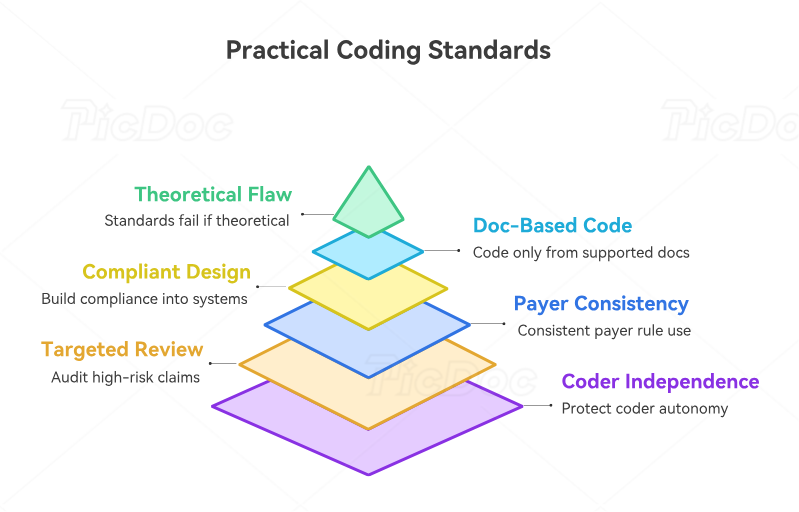
Standards fail when they stay theoretical. A real coding standard is a repeatable operational rule that tells people what to do when documentation is incomplete, when payer policy conflicts with habit, when modifiers are tempting, when time is short, or when leadership pressure rises. If the standard only works in ideal conditions, it is not a standard. It is a wish.
The first practical standard is code only from supported documentation. That means coders should have a defined threshold for when a query is required, when a claim must pause, and when a record cannot be safely interpreted. Ambiguity should not be solved with coder intuition alone. It should be resolved through process. That process needs to be fast enough to protect cash flow but disciplined enough to protect accuracy. This is where medical coding workflow terms, practice management systems, RCM software terms, and medical coding automation terms have to support judgment instead of bypassing it.
The second standard is build compliance into templates and system design. Many organizations preach ethics while using documentation structures that manufacture ambiguity. Smart phrases that default to excessive exam elements, problem lists that autopopulate irrelevant conditions, and cloned assessments that survive across months all create unethical pressure upstream. Standards should therefore include template governance, EHR field logic, documentation training, and coder-provider feedback loops. If the system keeps producing unreliable notes, coder retraining alone will never solve the problem.
The third standard is require consistency in payer rule application. Ethics do not stop at codebook language. A claim can be coded correctly by CPT logic and still be noncompliant operationally if the payer policy was ignored, if authorization rules were bypassed, or if diagnosis linkage does not support coverage. Teams need payer intelligence that is current, usable, and integrated into workflow. That connects directly to commercial insurance billing terms, Medicare reimbursement understanding, coordination of benefits, and patient responsibility terms.
The fourth standard is quality-review what matters most. Not every claim carries equal ethical risk. High-dollar procedures, modifier-heavy claims, repetitive diagnosis patterns, preventive-plus-problem visits, and denial-driven rebills deserve focused audit attention. The goal is not to audit randomly until people feel watched. The goal is to identify where pressure most often distorts judgment. This is why good compliance teams use targeted internal audits tied to known failure points, then connect findings back to education, workflow redesign, and accountability.
The fifth standard is protect coder independence. A coder should not be punished for declining an unsupported code, requesting clarification, or flagging a risky pattern. The fastest way to destroy ethics is to make accuracy feel career-threatening. The strongest teams do the opposite. They treat principled resistance as organizational protection. When coders know leadership will back accurate decisions even when they slow a claim or challenge a provider habit, standards become real.
5. How to build an ethical coding culture that survives pressure
Ethical culture is not built by telling people to “do the right thing.” It is built by designing workflows where the right thing is supported, measured, and defended. The first step is removing the false conflict between compliance and performance. In weak organizations, ethics is framed as the thing that slows everything down. In mature organizations, ethics is what keeps performance real. A fast revenue cycle built on unstable coding is not high performance. It is delayed failure.
Training has to move beyond code definitions and annual update summaries. People need scenario-based education around real gray zones: incomplete documentation, modifier questions, payer-specific conflicts, cloned notes, denial rebills, productivity pressure, and provider pushback. Teams rarely fail because they do not know the term “upcoding.” They fail because they do not know what to do when a provider says, “Just code what I meant,” or when leadership asks why claims are being held. Those are culture moments, not textbook moments. Connect that training to CEUs for coders, coding education and training terms, credentialing organizations, and medical coding education accreditation.
Measurement also matters. If managers track only coder output, ethics will erode no matter what posters are on the wall. Quality scores, query rates, denial trends, rebill rates, and audit outcomes need to sit beside productivity metrics. Otherwise, the system quietly tells people that speed is the real value and standards are optional. Ethical culture is revealed by what gets rewarded, not what gets announced.
Provider alignment is equally important. Many coding conflicts are not really coder problems. They are documentation habit problems. Providers need education that shows how vague notes, copied-forward assessments, and mixed clinical logic create billing risk and patient-confusion risk. When providers understand that better documentation protects reimbursement and reduces rework, coder-provider friction drops. This is why coding ethics should be taught alongside clinical documentation integrity terms, medicare documentation requirements, accurate clinical documentation, and medical billing software selection.
Finally, organizations need credible escalation and feedback loops. It should be normal to flag repeated risk patterns, inconsistent guidance, or inappropriate pressure. A culture without safe escalation does not have ethics. It has silence. And silence is where small billing distortions become normalized operational behavior.
6. FAQs about coding ethics and standards
-
It means assigning codes only from documentation that is accurate, specific, current, clinically supported, and consistent with payer and regulatory requirements. In practice, ethical coding rejects guessing, inflated code selection, modifier shortcuts, stale diagnoses, and denial rebills based on hindsight. It also means asking for clarification when the record is incomplete instead of “making it work.” That aligns with medical necessity criteria, coding workflow discipline, audit readiness, and accurate reimbursement control.
-
Undercoding is absolutely an ethical issue. It may seem safer because it does not overstate the claim, but it still distorts the truth. It hides the actual complexity of care, weakens provider productivity data, reduces legitimate revenue, and can corrupt operational reporting. Ethical coding is not about billing less or billing more. It is about billing accurately.
-
Not without sufficient documentation support. Coders cannot fill in clinical intent from implication alone when the record lacks the required specificity or clarity. If the likely diagnosis matters for code selection, the compliant path is clarification through a proper query, not interpretation that stretches beyond the note.
-
Because they create the appearance of reliable documentation without encounter-specific truth. A copied note may include findings, exam elements, or assessment language that are no longer accurate. When coding relies on cloned records, the claim loses defensibility. Cloned documentation also makes audits harder because reviewers quickly detect repetition patterns and begin doubting the record more broadly.
-
Accuracy has to win, but the organization should make that practical by defining escalation steps, quality thresholds, and safe reporting channels. Coders should not have to choose between professional standards and job security. Departments that want ethical consistency must measure quality alongside output and back coders when they pause risky claims.
-
An ethical query is neutral, evidence-based, timely, and designed to clarify documentation rather than steer it toward a higher-paying conclusion. It presents the issue fairly and lets the provider document the clinically accurate answer. A leading query that nudges reimbursement upward is not clarification. It is manipulation.
-
Regularly, and not only after a problem surfaces. High-risk areas such as modifier use, high-level E/M patterns, repeated diagnoses, denial-driven rebills, and specialty-specific claim trends should be reviewed on an ongoing basis. Ethics should be monitored as a routine quality function, not treated as a special emergency topic.
-
Because automation scales whatever judgment it is fed. If templates are weak, rules are outdated, or staff are using software uncritically, automation can spread noncompliance faster than manual workflows ever could. Ethical judgment becomes more important, not less, when coding technology advances. That is why teams should pair automation awareness, EHR integration logic, predictive analytics in billing, and future coding skills in the age of AI with stronger standards, not weaker ones.
