
CPT Modifiers Dictionary: Usage & Examples Explained
Medical billing teams do not lose revenue on modifiers because modifiers are “small.” They lose revenue because modifiers sit at the exact point where documentation, payer rules, code pairing, medical necessity, and claim logic collide. A modifier can rescue a valid claim, support separate reimbursement, explain unusual circumstances, or trigger an audit when used casually. That is why a real CPT modifiers dictionary must do more than define two digits. It must show what the modifier means operationally, when not to use it, what documentation protects it, and how payer edits react when it appears.
In practice, modifier accuracy touches almost every part of the revenue cycle: clean claim production, edit resolution, reimbursement defense, denial prevention, charge review, and audit readiness. Teams that already study coding edits and modifiers, strengthen medical necessity criteria, monitor revenue leakage prevention, improve accurate reimbursement, and understand RCM terms usually handle modifiers with far less rework. This guide is built to help you do exactly that.

1. CPT Modifiers Matter Because They Change Claim Meaning, Not Just Claim Format
A CPT code tells the payer what service was performed. A modifier tells the payer how that service should be interpreted in context. That context may involve a separate anatomical site, a distinct procedural session, a reduced service, bilateral performance, multiple surgeons, anesthesia complexity, a repeat service, a staged procedure, or a professional-versus-technical split. The difference sounds administrative until you see the downstream effect: the same code can be paid correctly, bundled, downcoded, denied, recouped, or audited depending on whether the modifier logic is right.
This is why modifiers sit so close to some of the most expensive failure points in the revenue cycle. A team may capture the correct CPT code yet still create preventable denials if the modifier is unsupported. That is especially true when staff are weak on charge capture terms, inconsistent with clinical documentation improvement, unclear on EMR documentation terms, careless with payment posting and management, or reactive instead of strategic in denials prevention and management.
The hardest part is that modifier misuse usually comes from one of five bad habits:
First, coders use a modifier to “fix” an edit instead of proving the clinical story. Second, billers apply default modifier patterns by specialty without validating the note. Third, providers document the procedure but not the circumstances that justify the modifier. Fourth, teams ignore payer-specific policy differences. Fifth, organizations fail to close the loop between denial data and coder education. If your claims keep bouncing for bundled services, repeat procedures, bilateral logic, assistant surgeon restrictions, or postop period confusion, the issue is not merely coding mechanics. It is a governance problem touching coding audits, regulatory compliance, medical claims submission, HIPAA compliance in medical billing, and even billing compliance violations and penalties.
A professional modifier workflow always asks four questions before the claim leaves the system:
Does the clinical record support the underlying CPT code itself?
Does the documentation clearly support the special circumstance represented by the modifier?
Does this modifier align with payer policy and edit logic for this code pair or service category?
Can the team defend it during denial appeal or audit without “explaining later”?
If the answer to any of those is weak, the modifier is weak. And weak modifiers create expensive noise across revenue cycle metrics and KPIs, CARCs, RARCs, EOB interpretation, and revenue cycle efficiency benchmarks.
2. CPT Modifiers Dictionary: What the Most Important Modifiers Mean in Real Billing Work
A dictionary becomes useful only when definitions are tied to decisions. Below is how experienced coders think about common modifiers in live claim production rather than exam-style memorization.
Modifier 25: the most abused modifier in outpatient billing
Modifier 25 does not mean “an office visit happened on the same day as a procedure.” It means the provider performed a significant, separately identifiable E/M service beyond the usual work already included in the procedure. That distinction matters. A lesion removal with a brief built-in evaluation does not automatically justify a separate E/M. But a visit where the provider evaluated multiple complaints, adjusted medications, addressed risk factors, then also performed a procedure may justify it. Strong teams connect modifier 25 decisions to SOAP note and coding guidance, problem list documentation, clinical documentation integrity terms, EHR integration terms, and medical necessity guidance.
Modifier 59 and the X modifiers: not “payment unlockers,” but bundling exceptions
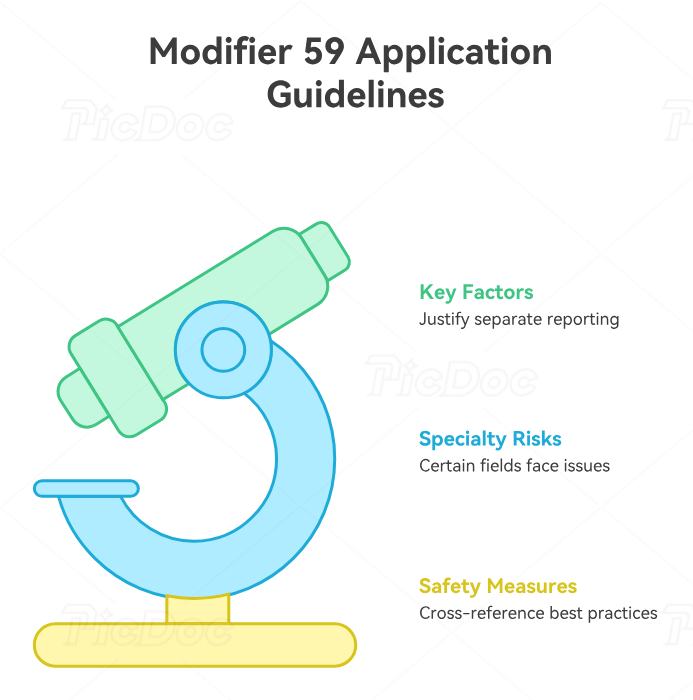
Modifier 59 is dangerous precisely because it is sometimes appropriate. It communicates that two services that usually bundle were distinct under the documented facts. But it should never be your first reflex. More specific X modifiers such as XE, XS, XP, and XU often better explain the exact reason the services were separate. When teams use 59 broadly without proving distinct lesions, structures, sessions, encounters, or practitioners, they create the kind of denial trends later visible in coding denials analysis, compliance audit trends, medical coding error reports, top coding errors, and impact of coding accuracy on revenue.
Modifier 57 versus 25: the distinction many teams mishandle
Modifier 57 is for the decision for major surgery, not a minor procedure. If the provider’s E/M resulted in the decision to perform a surgery with a 90-day global period, modifier 57 may apply. If the service was a minor procedure, modifier 25 is the modifier under consideration, assuming the separate E/M rules are met. Confusing these two is not a small detail. It misstates the reason the E/M is separately reportable and exposes the claim during surgical coding compliance review, physician fee schedule analysis, Medicare reimbursement interpretation, Medicare documentation requirements, and MACRA and quality payment program understanding.
Modifier 26 and TC: component billing requires ownership clarity
Professional and technical component splits are common in radiology, cardiology, and diagnostic testing. The logic is simple but the errors are costly. Bill modifier 26 when the provider supplies the interpretation and report only. Bill TC when the entity supplies equipment, staff, and technical resources only. Bill globally only when appropriate. Most errors happen when organizations do not clearly define who owned what in the service line. That is why staff working these claims should also understand radiology coding terms, radiology CPT guidance, cardiology CPT coding, billing software selection, and practice management system terms.
Modifier 50, RT, LT, and laterality logic
Laterality errors are infuriating because they are preventable. Modifier 50 signals a bilateral procedure, but some payers prefer RT and LT on separate lines instead of 50. Some codes have built-in bilateral logic; others do not. The correct answer depends on code definition and payer policy. This is where denial prevention stops being theoretical and becomes operational. Teams that map laterality rules into claim edits, documentation templates, and coder review steps reduce noise across clearinghouse terminology, claim adjustment reason codes, commercial insurance billing terms, coordination of benefits logic, and patient responsibility terms.
3. How to Choose the Right Modifier Without Guessing
The fastest way to misuse modifiers is to choose them from memory. The safest way is to build a sequence. High-performing coding teams often use a decision path that prevents emotional coding, appeal-driven coding, or “we always do it this way” coding.
Start with the code pair and ask whether the modifier changes reimbursement, bundling, timing, global logic, location, component split, assistant participation, or laterality. Then identify the exact clinical fact that supports the modifier. After that, confirm whether the note states that fact explicitly or only implies it. If it is implied, stop. Do not bill a modifier that the chart does not defend. Next, review payer guidance or internal edit tables. Finally, ask whether a more specific modifier exists.
That sounds disciplined because it is disciplined. Modifier chaos usually comes from skipping one of those steps. For example, a team sees an edit, chooses modifier 59, and moves on. But a stronger team asks: Were these services in separate encounters, separate structures, separate practitioners, or unusual non-overlapping work? If yes, an X modifier may be more accurate. If no, the bundling edit may be correct. That single pause can prevent avoidable risk across medical coding workflow terms, encoder software usage, coding automation terms, revenue cycle software terms, and ethical billing practices.
Here is a practical decision model many teams should adopt:
Step 1: define the service relationship.
Was the second service separate, reduced, repeated, bilateral, related, unrelated, staged, or component-based?
Step 2: define the timing.
Same encounter, same date different encounter, postop period, return to OR, preop-only, postop-only, or repeat same day?
Step 3: define who did what.
Same physician, different physician, assistant surgeon, co-surgeon, surgical team, technical entity, interpreting physician?
Step 4: define the medical reason.
Patient safety, distinct lesion, new complaint, planned staged therapy, complication, separate anatomy, repeat diagnostic need?
Step 5: define the proof.
Where in the record can an auditor see it quickly?
This approach works because modifiers are not language tricks. They are claim-level summaries of documented clinical and operational facts. That is why strong modifier usage is inseparable from accurate clinical documentation, coding query process terms, medical record retention, audit terminology, and regulatory compliance fundamentals.
Quick Poll: What is your biggest CPT modifier pain point right now?
4. High-Risk Modifier Scenarios and Real Examples That Cause Denials
The modifier cases that hurt organizations most are not obscure. They are common, repeated, and expensive precisely because teams see them every day.
Example 1: Modifier 25 on an injection visit
A patient presents for a scheduled joint injection. The provider performs the usual evaluation required to confirm site, symptoms, and appropriateness, then gives the injection. Billing the injection code plus an E/M with modifier 25 is usually risky unless the provider separately evaluated a significant additional issue, such as a new unrelated complaint, medication management problem, or broader diagnostic workup. Many organizations leak money here twice: first through denials, then through staff time spent appealing claims that were weak from the start. Better results come when teams align office procedure documentation with infusion and injection billing terms, charge capture guidance, medical necessity rules, claim submission process steps, and payment posting workflows.
Example 2: Modifier 59 on multiple lesion destruction
If multiple lesions are treated, the coder may feel pressure to add modifier 59 when edits hit. But what matters is whether the code family, lesion count logic, anatomical separation, and payer bundling rules actually support distinct reporting. Modifier 59 is not a universal “separate lesion” badge. The operative note must state enough detail to show why separate reporting is justified. Dermatology, surgery, GI, and pain cases all expose this weakness. Teams become safer when they cross-reference dermatology CPT essentials, gastroenterology CPT guidance, surgical compliance terms, coding audits, and denials management best practices.
Example 3: Modifier 78 versus 58 after surgery
Suppose a patient returns during the postoperative period. The team must decide whether the new procedure was planned or staged, or instead an unplanned operative return due to a related complication. Modifier 58 and modifier 78 communicate very different stories. Modifier 58 usually fits a planned or more extensive related follow-up procedure. Modifier 78 fits an unplanned return to the operating room or procedure room for a related service. When teams mix them up, they distort global logic and payment expectations. This is where a strong understanding of physician fee schedule rules, Medicare reimbursement concepts, compliance trends, clinical documentation integrity, and hospital reimbursement analysis pays off.
Example 4: Modifier 95 on telemedicine claims
Modifier 95 looks straightforward until teams forget that payer rules, eligible codes, audio-video requirements, POS logic, and documentation elements vary. A note saying “telehealth follow-up completed” may not be enough. The record should show modality, provider, patient participation, and compliance with telehealth rules. Telemedicine claims become safer when teams pair modifier decisions with telemedicine coding guidance, EHR documentation terms, automation terms, reimbursement trend analysis, and upcoming reimbursement model changes.
5. Best Practices to Use CPT Modifiers Safely, Defensibly, and Profitably
A good modifier culture does not depend on heroic coders. It depends on controlled systems. The organizations with the cleanest modifier performance usually do five things consistently.
They build modifier rules into the workflow before claim submission.
This means edit logic, training references, provider prompts, and claim scrubber rules are aligned before denials happen. Teams using RCM software terminology, practice management systems, encoder tools, clearinghouse terminology, and billing software selection guidance should use those tools to force cleaner modifier decisions upstream.
They treat documentation as the first modifier control.
If providers repeatedly trigger 25, 57, 59, 58, or 78 questions, the answer is often better note structure rather than more back-end correction. Cleaner note prompts, better query escalation, and clearer operative reports reduce coder guesswork. That mindset is strengthened by accurate clinical documentation guidelines, CDI resources, SOAP note guidance, problem list management, and coding query process references.
They audit modifier usage by pattern, not by anecdote.
One denial does not define a trend. But repeated 59 denials in GI, repeated 25 denials in primary care, repeated laterality mismatches in orthopedics, or repeated assistant surgeon denials in surgical specialties absolutely define a process problem. Teams should connect modifier audit patterns to coding productivity benchmarks, coding error rates, revenue leakage analysis, RCM efficiency reports, and compliance audit trends.
They maintain payer-specific modifier policies.
The same modifier may be accepted, rejected, or interpreted differently by payer, contract, and service line. Commercial plans, Medicare, Medicaid, and specialty carve-outs do not always behave the same. That is why coders who only memorize CPT definitions but ignore payer rules keep getting burned. Better teams crosswalk claims against commercial insurance billing terms, Medicare billing concepts, future regulatory change analysis, regulatory compliance guidance, and medical billing acronyms and definitions.
They train coders to know when not to append a modifier.
This sounds simple, but it is where money is saved. Not every edit should be bypassed. Not every same-day E/M deserves payment. Not every repeat service qualifies as medically necessary. Not every bilateral case needs modifier 50. A mature coder understands restraint. That maturity is shaped by coding education and training references, certification exam terms, study strategies for coding students, career development terms, and continuing education guidance.
6. FAQs About CPT Modifiers Dictionary, Usage, and Examples
-
The biggest mistake is using a modifier to solve a claims edit instead of using it to report a documented clinical fact. When modifiers become edit-bypass tools, denials, recoupments, and audit exposure rise fast. Teams avoid this by grounding every modifier in documentation, payer policy, and coding edits and modifier logic.
-
Modifier 25 supports a significant, separately identifiable E/M service on the same day as a procedure, typically a minor one. Modifier 57 supports the E/M that resulted in the decision for major surgery. The wrong choice misstates the clinical story and weakens the claim during coding audits and Medicare documentation review.
-
Avoid modifier 59 when the services are not truly distinct, when a more specific X modifier fits better, or when the second service is actually bundled under normal coding rules. Modifier 59 should never be used just because the claim did not pay. Safer billing comes from strong denials prevention, revenue leakage control, and medical necessity support.
-
No. Some payers want modifier 50, some want RT and LT on separate lines, and some have code-level exceptions. That is why laterality errors persist in otherwise strong teams. You need code knowledge plus payer-specific policy plus claim scrubber logic, supported by clearinghouse terminology and accurate reimbursement practices.
-
Audit the top five denied modifiers by payer and specialty, review whether documentation actually supported them, identify where staff use “default” modifier habits, and update templates, charge review edits, and coder education. Then connect results to RCM KPIs, payment posting analysis, CARCs, and RARCs.
-
Yes, because automation amplifies both strength and weakness. If your rules, templates, and documentation logic are clean, automation accelerates accuracy. If they are weak, automation scales denials faster. Teams preparing for that future should study AI in revenue cycle management, future skills for coders, medical coding automation terms, and the future of coding with AI.
