
Is Inpatient or Outpatient Coding Better? Reddit Experiences on Difficulty, Pay, Remote Work & Career Ceiling
Choosing between inpatient and outpatient coding can shape your daily workload, credential path, earning potential, remote opportunities, and long-term specialization. The difference runs deeper than “inpatient is harder.” Someone pursuing hospital coding faces different code sets, reimbursement systems, documentation depth, and productivity expectations from someone building a physician-office coding career. Before choosing either path, compare the medical coding salary landscape, first-job barriers, practical difficulty, and the skills that create leverage five or ten years into your career.
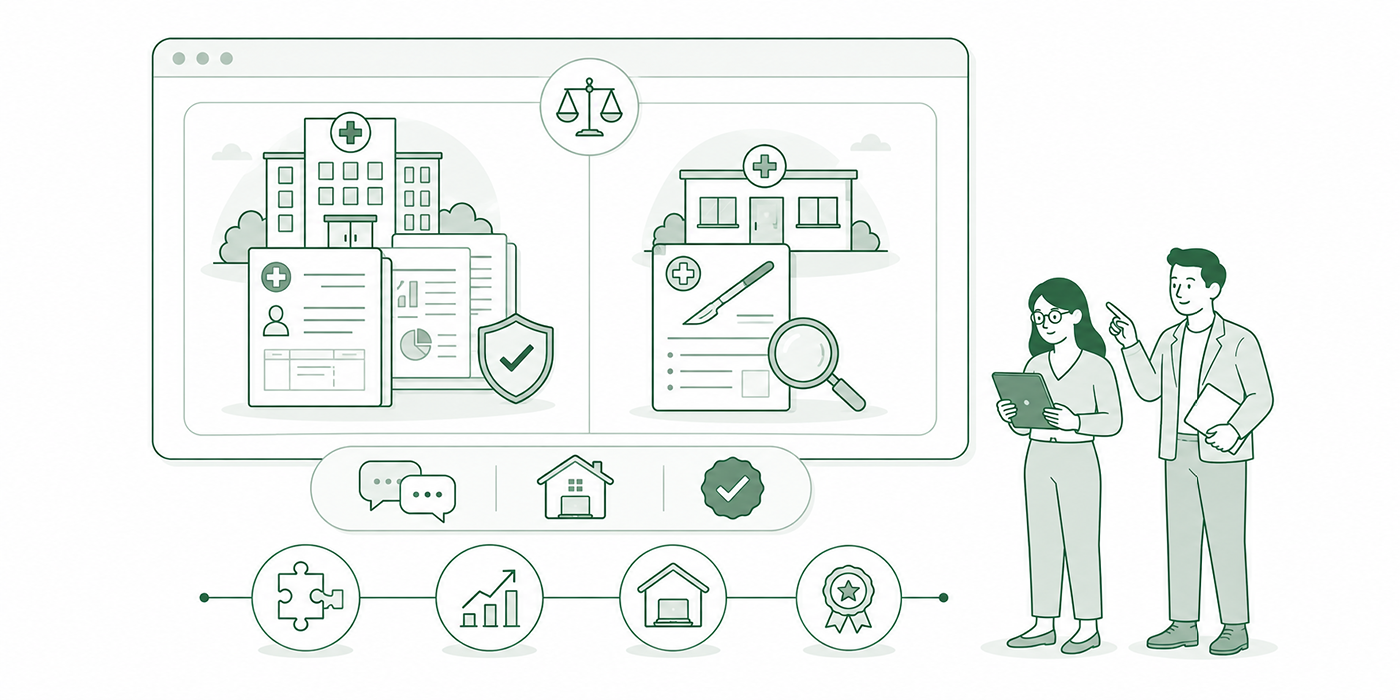
1. Inpatient vs Outpatient Coding: What Is Actually Different?
The first distinction is more important than many beginners realize: outpatient coding is not one single type of work. A coder can work in hospital outpatient facility coding, ambulatory surgery, emergency departments, physician professional-fee coding, specialty practices, diagnostic services, or other outpatient environments. Someone preparing through a CPC program may therefore be building a different skill stack from someone pursuing outpatient hospital coding, even though both are technically dealing with outpatient encounters.
Inpatient facility coding typically concerns patients formally admitted to a hospital. Coders work heavily with ICD-10-CM diagnosis coding and ICD-10-PCS procedure coding, interpret the entire inpatient record, identify the principal diagnosis and reportable secondary conditions, apply inpatient guidelines, review procedures, recognize query opportunities, and help produce data that feeds MS-DRG reimbursement. Anyone targeting this path needs significantly deeper facility knowledge than basic CPC exam preparation alone provides.
Outpatient hospital facility coding typically uses ICD-10-CM for diagnoses and CPT/HCPCS for procedures and services. Reimbursement logic differs because CMS inpatient hospital payment operates through IPPS and MS-DRGs, while hospital outpatient services generally operate under OPPS and APC methodology. AAPC's own comparison of CIC, COC, and CCS credentials explicitly distinguishes those systems. Understanding CPT coding principles, Medicare billing tools, and reimbursement methodology therefore becomes particularly important.
Professional-fee coding adds another layer. A coder working for physicians may code office visits, surgeries, procedures, consultations, diagnostics, and other professional services using ICD-10-CM, CPT, and HCPCS. Knowledge of electronic claims submission, claim adjustment reason codes, denial management, and the physician fee schedule can become highly valuable because coding choices interact directly with billing and payer rules.
Difficulty therefore depends partly on which outpatient work you are comparing against inpatient coding. Coding routine office visits differs sharply from complex ambulatory surgery, emergency department, cardiology, interventional radiology, oncology, or multi-specialty surgical coding. Reddit coders make this point repeatedly. In one discussion, an experienced commenter explained that inpatient brings extensive documentation and PCS complexity, while outpatient creates its own difficulty through CPT, medical necessity, and NCCI-related issues.
The smartest learner should therefore avoid asking only, “Which one is easier?” Ask:
Which rule system fits how my brain works?
Some coders thrive on diagnosis sequencing, long charts, clinical complexity, and inpatient reimbursement. Others prefer procedure-oriented CPT coding, faster encounters, specialty repetition, and outpatient workflows. That distinction can matter more to long-term career satisfaction than whichever route looks easier during training.
| Career Factor | Inpatient Coding | Outpatient Coding | Why It Matters |
|---|---|---|---|
| Typical patient status | Formally admitted patients | Clinic, ED, observation, surgery and other non-inpatient encounters | Patient status changes rules and reimbursement |
| Diagnosis coding | ICD-10-CM | ICD-10-CM | Guidelines differ by setting |
| Procedure coding | ICD-10-PCS for inpatient facility procedures | Usually CPT/HCPCS | Completely different procedural systems |
| Principal diagnosis | Central concept | First-listed diagnosis framework | Sequencing logic changes |
| Typical chart size | Potentially extensive | Often shorter, but highly variable | Chart volume affects productivity |
| Clinical complexity | Often high | Ranges from routine to extremely complex | Specialty matters greatly |
| Payment framework | IPPS/MS-DRG commonly relevant | OPPS/APC or professional fee methodology | Reimbursement logic shapes coding decisions |
| CPT intensity | Limited for core inpatient facility coding | Often substantial | Important for procedural learners |
| PCS intensity | High | Generally absent | Major inpatient learning curve |
| Modifier knowledge | Less central in core facility inpatient coding | Can be critical | Especially important in professional and facility outpatient coding |
| Medical necessity | Important | Often highly visible operationally | Can drive denials and edits |
| NCCI/edit knowledge | Less dominant | Frequently important | Impacts CPT reporting |
| Query recognition | Major competency | Still important | Documentation gaps can change coding |
| CDI interaction | Often extensive | Varies by organization | Can influence career progression |
| Common credential | CCS or CIC | CPC, COC, CCS or CCS-P depending on role | Credential should match job setting |
| Entry difficulty | Often higher | More entry routes exist | Important for first-job planning |
| Training time | Usually longer to reach independent proficiency | Highly dependent on specialty | Affects transition cost |
| Productivity measurement | Often records/day or equivalent weighted targets | Often charts/hour, encounters/day or specialty metrics | Work speed expectations differ |
| Accuracy pressure | Very high | Very high | Both paths are production careers |
| Repetition | Lower in complex acute-care caseloads | Can be higher in repetitive specialties | Preference differs by coder |
| Remote potential | Strong after experience | Strong but varies by specialty and employer | Experience filters remain important |
| Beginner remote access | Often difficult | Still competitive | Certification alone may not be enough |
| Typical pay tendency | Often higher for experienced facility coders | Extremely specialty dependent | Avoid relying on one national average |
| Specialty ceiling | Strong | Also strong in complex specialties | Expertise can outperform setting alone |
| Audit pathway | Strong | Strong | Experienced coders can expand beyond production |
| Management pathway | Coding manager, HIM leadership | Coding manager, revenue-cycle leadership | Both offer advancement |
| Denial expertise | Clinical validation and DRG-related denials | Medical necessity, modifiers, edits and payer denials | Both create lucrative specialist knowledge |
| Best fit for detail preference | Long-form clinical synthesis | Procedure and encounter-level precision | Cognitive fit affects burnout |
| Biggest beginner mistake | Underestimating PCS and sequencing | Assuming outpatient means simple | Both require specialized training |
| Best long-term strategy | Deep expertise plus auditing/CDI/reimbursement knowledge | Complex specialty expertise plus payer/reimbursement knowledge | Career ceiling comes from scarce skills |
2. Which Is Harder: Inpatient or Outpatient Medical Coding?
Inpatient coding generally has the steeper initial learning curve, largely because the coder must synthesize a larger record while applying inpatient-specific sequencing rules and ICD-10-PCS. An inpatient record can involve emergency documentation, history and physical, consultations, operative reports, pathology, imaging, progress notes, medication history, discharge documentation, and competing diagnoses. The coder must distinguish clinically interesting information from reportable information and determine what actually satisfies official coding requirements.
That depth makes strong CCS preparation, advanced coding practice, medical terminology knowledge, and procedural reasoning especially valuable. AHIMA currently describes CCS as a credential for professionals demonstrating coding proficiency across inpatient and outpatient records and recommends substantial coursework or direct coding experience before testing, although those recommendations are not mandatory eligibility rules.
ICD-10-PCS creates one of the biggest barriers. A procedure is built from characters representing concepts such as section, body system, root operation, body part, approach, device, and qualifier. Recognizing that surgery occurred is only the beginning. The coder must understand exactly what the surgeon accomplished. Clinical vocabulary, anatomy, operative-report interpretation, and root-operation logic all interact.
Outpatient coding can punish a different weakness: precision at speed. Someone coding surgery, cardiology, orthopedics, emergency medicine, or multi-specialty professional services may navigate large portions of CPT while handling modifiers, bundling rules, documentation requirements, medical necessity, payer policies, and potentially high encounter volume. A coder who struggles with CPT principles can find sophisticated outpatient coding just as demanding as inpatient work.
This is where claims submission knowledge, CARC interpretation, denial-management skills, and Medicare reimbursement knowledge become commercially valuable. The coder needs to understand both what documentation supports and how reporting rules affect downstream reimbursement.
Reddit experiences reflect these differences rather than producing one universal winner. In a 2026 discussion, multiple coders described moving from outpatient into inpatient for greater challenge and higher pay, while another coder returned to outpatient because inpatient specificity and productivity expectations did not fit their working style. One coder described the initial inpatient transition as extremely difficult before the logic eventually “clicked.”
Another coder transitioning after eight years of outpatient experience described inpatient as overwhelming, particularly around secondary diagnoses and query decisions. That is valuable evidence about transition cost: experience in one setting does not guarantee instant proficiency in another.
If you are deciding based on difficulty alone, use this test:
Choose inpatient if you enjoy long charts, diagnosis relationships, clinical synthesis, structured rules, PCS, query recognition, and resolving complex documentation.
Choose outpatient if you prefer CPT-intensive reasoning, faster encounter turnover, procedural detail, specialty expertise, modifiers, edits, medical necessity, and payer-facing logic.
Either path becomes difficult at the expert level. The question is which kind of difficulty you can become unusually good at.
3. Inpatient vs Outpatient Coding Pay: Where Does the Salary Advantage Really Come From?
Inpatient coding often carries a pay premium, especially once the coder becomes independently productive in complex acute-care environments. Reddit reports repeatedly describe inpatient as the better-paid side of facility coding. In the January 2026 discussion, several coders specifically cited higher compensation as one reason they moved from outpatient to inpatient. A separate 2025 salary discussion included a coder reporting a roughly $2-per-hour inpatient premium at their employer, while emphasizing that location and organization can change the difference substantially.
Current job listings show why experience matters. An August 2026 remote inpatient hospital-coder opening listed a salary range of $59,066 to $88,599 and preferred prior inpatient coding experience plus familiarity with systems including 3M 360 and Epic. A current outpatient role from another employer listed $23.36 to $31.64 per hour, while another advertised $21.97 to $34.39 depending on experience and qualifications. Individual listings cannot establish a national inpatient premium, but they demonstrate how employer, geography, experience, credential, and setting shape actual offers.
AAPC's 2025 state-level survey data also demonstrate why credential averages should be interpreted carefully. In California, reported averages were $79,661 for CPC, $89,145 for COC, and $98,125 for CIC. Minnesota showed $71,274 for CPC, $75,481 for COC, and $83,393 for CIC. Florida showed a different relationship, with COC at $74,931 and CIC at $72,778. The important lesson is that an inpatient credential does not mechanically guarantee the highest salary in every market.
The broader BLS category containing medical coders, medical records specialists, had a May 2025 mean annual wage of $56,790 and mean hourly wage of $27.30. BLS does not split that occupation cleanly into inpatient versus outpatient coders, so claims that one national government statistic proves a specific inpatient premium should be treated cautiously.
Your personal earning ceiling depends more on scarcity and complexity than the word “inpatient.”
A highly experienced inpatient coder who can handle trauma, complex surgery, long stays, quality-sensitive diagnoses, difficult PCS cases, and DRG implications can become expensive to replace. A sophisticated outpatient coder specializing in interventional radiology, cardiology, anesthesia, surgery, auditing, or multi-specialty professional coding can also command substantial value. Both paths can progress into medical coding auditing, denial management, compliance, education, consulting, and management.
For salary planning, compare five variables together:
Credential + setting + specialty + experience + responsibility.
A new CPC-A applicant and a ten-year surgical coder holding multiple credentials should never be placed into the same salary expectation simply because both perform outpatient coding. Likewise, an entry-level CCS holder should avoid assuming that the experienced-inpatient salary ceiling will be available immediately after CCS certification.
4. Which Has Better Remote Work: Inpatient or Outpatient Coding?
Both can lead to genuine remote careers. The harder issue is when an employer will trust you to work remotely without intensive supervision.
BLS reports that medical records specialists typically work at computers and identifies hospitals and physician offices among the largest employers. Remote arrangements are therefore operationally possible across multiple coding settings, but remote access should be separated from occupational suitability. A coder can perform the work remotely while an employer still chooses to hire only experienced candidates.
Current postings demonstrate both sides. The August 2026 inpatient role cited earlier is fully remote and prefers prior inpatient experience. A current outpatient listing allows remote work only for applicants located in Minnesota, North Dakota, or South Dakota and expects at least 95% accuracy plus defined productivity performance. Remote coding therefore does not automatically mean geographically unrestricted, schedule-free, or productivity-light work.
This is especially important for anyone pursuing remote coding with no experience. Employers can monitor output, accuracy, turnaround time, unbilled accounts, quality audits, attendance, and other performance measures regardless of where the coder sits. A remote coding career exchanges the physical office for a production environment that may remain highly structured.
Inpatient coding can become attractive for experienced remote workers because large hospital systems can centralize coding teams across facilities. The complexity also creates a skill barrier that reduces the pool of genuinely qualified applicants. A coder who can independently handle complex inpatient charts, facility coding rules, difficult diagnoses, procedures, and documentation questions gives the employer a reason to tolerate geographic distance.
Outpatient remote work can be excellent as well, particularly in professional-fee coding, risk adjustment, specialty coding, surgical coding, auditing, and large health-system outpatient departments. The catch is competition. Many newcomers pursuing CPC certification want exactly the same combination: entry-level, remote, flexible, good pay, and no previous coding experience. That creates a crowded applicant pool.
The fastest credible remote strategy is usually:
credential → first acceptable coding experience → measurable accuracy/productivity → specialty expertise → remote leverage
That sequence matters more than obsessing over whether inpatient or outpatient jobs have a larger remote percentage. A candidate who cannot secure a first coding role should use the 90-day employment plan, understand employer filters, and consider credible onsite or hybrid experience if that accelerates the move into remote medical coding.
Remote flexibility also improves when you possess a skill employers struggle to replace. That could be complex inpatient coding, surgical specialty coding, risk adjustment, auditing, denial analysis, or another difficult niche. In that sense, the route with the best remote future may simply be the one in which you become hardest to replace.

5. Which Path Has the Higher Career Ceiling?
Inpatient coding has a compelling ceiling because it sits close to hospital reimbursement, clinical documentation integrity, DRG validation, quality data, compliance, denials, and enterprise health-information operations. An experienced inpatient coder can move into senior coding, auditing, education, CDI-related work, clinical validation support, denials, coding quality, supervision, management, consulting, or broader HIM roles.
That makes CCS preparation particularly valuable for candidates targeting hospital environments. AHIMA's CCS specifically covers coding proficiency across inpatient and outpatient records, while AAPC's CIC focuses on inpatient facility coding.
Outpatient coding has an equally important advantage: breadth. The umbrella includes professional coding, outpatient facility coding, ambulatory surgery, emergency services, diagnostic testing, specialty practices, risk adjustment, and highly technical procedural specialties. A coder can begin with CPC preparation, strengthen CPT expertise, develop payer knowledge through Medicare resources, and eventually move into auditing, compliance, management, education, consulting, or revenue-cycle strategy.
The ceiling therefore depends on what you do after production coding.
A coder who spends ten years performing only simple repetitive encounters may have weaker leverage than someone who deliberately accumulates harder responsibilities. The high-value career stack looks more like:
coding accuracy + difficult specialty + reimbursement knowledge + audit ability + documentation judgment + denial knowledge + leadership or consulting capability
Understanding denial management, claim adjustment codes, electronic claims, Medicaid reimbursement, and physician reimbursement expands a coder's commercial understanding beyond code selection.
This matters even more as coding technology changes. Anyone concerned about whether AI will replace medical coders should deliberately move toward work requiring judgment, exception handling, complex documentation interpretation, audit capability, payer expertise, and accountability. BLS currently projects medical-records-specialist employment to grow 7% from 2024 through 2034, while also noting that AI-powered coding tools may affect demand.
For a beginner, the most practical path may therefore be outpatient first, inpatient later. Several Reddit coders describe starting outpatient and progressing into inpatient once they had enough confidence and coding experience. That strategy gives the candidate a way around the classic no-experience hiring barrier.
Someone who loves outpatient work does not need to “graduate” from it. Complex outpatient specialties can support excellent careers. The strongest long-term choice is the setting where you can build scarce, demonstrable expertise while continuing through relevant CEU education, advanced credentials, difficult cases, and broader reimbursement responsibilities.
6. FAQs
-
Inpatient coding usually has a steeper learning curve because coders must synthesize larger records, apply inpatient sequencing rules, understand ICD-10-PCS, identify reportable secondary diagnoses, and recognize query opportunities. Complex outpatient coding can still be extremely difficult because CPT, HCPCS, modifiers, medical necessity, NCCI edits, specialty rules, and payer requirements create their own technical burden. Build your foundation through medical terminology, CPC preparation, CCS training, and detailed coding practice according to the setting you want.
-
Experienced inpatient facility coding often carries a premium because the skill set is specialized and the cases can be complex. Reddit coders frequently report higher inpatient pay, and some AAPC state survey data show higher CIC averages than CPC or COC averages. Geography, experience, specialty, employer, credentials, and responsibilities can reverse that pattern. Use the broader 2026 medical coding salary guide when estimating your own earning potential.
-
For many beginners, outpatient or professional-fee coding creates more possible entry points, especially through CPC certification. Someone with strong hospital education, an HIM degree, substantial facility exposure, or excellent CCS preparation can pursue inpatient work directly. Analyze actual job requirements before choosing because the first medical coding job remains the hardest stage for many newly certified coders.
-
CPC primarily aligns with professional physician-office coding. AAPC identifies CIC as its inpatient-facility credential, while AHIMA's CCS covers substantial inpatient and outpatient facility proficiency. Individual employers can accept multiple credentials, but someone deliberately targeting inpatient coding should compare CCS pathways and inpatient-focused credential requirements rather than assuming CPC preparation covers the entire inpatient skill set.
-
The answer depends on which outpatient environment you mean. CPC is strongly associated with professional physician-office coding, COC targets outpatient hospital/facility work, CCS-P focuses physician-based coding, and CCS covers broader inpatient and outpatient record coding. AAPC describes COC training specifically around outpatient hospital and ambulatory facility work. Compare the target jobs first, then choose among CPC programs, CCS preparation, and relevant specialty education.
-
Both inpatient and outpatient coding can become strong remote careers. Experienced inpatient coders can find fully remote hospital positions, while outpatient and professional-fee coders also work remotely across health systems, practices, vendors, and specialty organizations. Current job listings show remote roles on both sides while also demonstrating experience, geography, productivity, and accuracy restrictions. Anyone starting from zero should follow a realistic remote coding pathway instead of limiting every first application to work-from-home jobs.
