
Will AI Replace Medical Coders? Reddit Reactions, Autonomous Coding Tools & the Skills Most Likely to Survive
Medical coders asking whether AI will take their jobs are asking the right question too broadly. Automation already handles selected encounters without human review, while complex records still demand judgment, compliance oversight, and clinical context. Anyone investing in CPC certification, CCS training, CBCS preparation, or continuing education in 2026 needs a clearer strategy: understand which coding work is becoming automated, then build expertise around the decisions machines still escalate.
1. Will AI Replace Medical Coders in 2026? The Real Answer Depends on the Work
Medical coding automation has moved far beyond simple code suggestions. Traditional computer-assisted coding systems generally surface possible codes for a human coder to review. Autonomous coding can process eligible encounters, assign codes, and send them toward billing without routine human intervention. KLAS Research reports that coding automation has become a leading healthcare AI use case, with early adoption especially visible in radiology and emergency departments because their high-volume workflows can contain relatively standardized coding patterns.
That creates genuine employment pressure for people whose entire value proposition is manually processing predictable charts. A coder who only performs repetitive diagnosis selection faces greater automation exposure than someone who understands medical terminology, interprets difficult CPT coding scenarios, investigates claim adjustment reason codes, and understands how coding decisions affect the physician fee schedule. The value is moving toward judgment, validation, exception handling, and revenue-cycle consequences.
The strongest evidence comes from real deployments. In March 2026, Fathom reported that Your Health achieved a 95.5% encounter-level automation rate and 98.3% coding accuracy after deploying its autonomous platform across its service lines. Those are vendor-reported results from one implementation, so they should be interpreted within that specific environment rather than projected across every hospital, specialty, payer, and chart type.
At the same time, AHIMA's August 2026 guidance says autonomous engines tend to perform best in defined, high-volume encounter types with consistent documentation. The same guidance highlights inpatient coding as substantially more difficult because an engine must interpret much larger documentation sets, apply complicated inpatient rules, achieve diagnosis specificity, and handle the consequences of systematic errors. One wrongly configured automated rule can repeat across hundreds or thousands of encounters before discovery.
This is where students considering a CCS certification path, experienced coders reviewing CCS practice questions, professional coders sharpening CPC exam knowledge, and billing professionals studying medical billing concepts should pay attention. Automation risk changes dramatically according to complexity.
A useful career question for 2026 is therefore: How often does your work require you to decide whether the machine's answer is defensible? The more often that answer is “constantly,” the stronger your position becomes.
| Coding / RCM Task | 2026 Automation Exposure | Why | Skill to Build |
|---|---|---|---|
| Routine diagnosis extraction | High | Structured documentation is easier to process at scale | Context validation |
| Simple professional claims | High | Predictable coding patterns support automation | Exception review |
| Radiology coding | High | High volume and relatively standardized encounters | Audit and specialty expertise |
| Routine ED coding | High | Existing autonomous deployments are already mature | Complex ED exceptions |
| Basic code suggestions | Very high | CAC and AI already perform this routinely | Final validation |
| Code lookup | Very high | Search and retrieval are machine-friendly | Guideline interpretation |
| Basic claim edits | High | Rules can be automated consistently | Edit-root-cause analysis |
| Denial letter drafting | High | Generative AI can prepare first drafts quickly | Appeal strategy |
| Payment posting | High | Electronic transactions are highly structured | Variance investigation |
| Basic eligibility checks | High | Standard data exchanges enable automation | Complex payer resolution |
| Charge capture review | Medium-high | AI can flag missing or unusual charges | Revenue integrity |
| Modifier suggestions | Medium-high | Rules and documentation patterns can be modeled | Modifier compliance |
| E/M suggestions | Medium-high | Documentation can be analyzed algorithmically | Medical decision-making review |
| Outpatient facility coding | Medium-high | Some encounter types automate well | Facility-specific rules |
| Risk-adjustment code capture | Medium-high | AI can identify documented conditions at scale | MEAT and documentation validation |
| Surgical professional coding | Medium | Procedural complexity creates more exceptions | Operative-note interpretation |
| Specialty coding | Medium | Automation maturity varies by specialty | Deep specialty knowledge |
| Denial root-cause analysis | Medium | Pattern detection helps, yet causes span multiple workflows | Revenue-cycle analysis |
| Appeal escalation | Medium | Payer policy and case-specific arguments matter | Evidence-based appeals |
| Provider query preparation | Medium | AI can identify gaps while compliance remains critical | CDI and query compliance |
| Coding audit | Medium-low | Independent oversight is essential for automated output | Audit methodology |
| Compliance investigation | Low | Requires risk judgment and accountability | Compliance expertise |
| Inpatient coding | Lower near-term exposure | Long, complex records and sequencing rules raise difficulty | ICD-10-PCS and DRG expertise |
| DRG validation | Low-medium | Financial consequences demand defensible review | Clinical and reimbursement reasoning |
| Clinical documentation integrity | Low-medium | Documentation gaps require clinical interpretation | CDI expertise |
| AI output validation | Low | Automation itself creates demand for quality control | AI-assisted auditing |
| Systematic error detection | Low | Repeated machine errors create enterprise-level exposure | Data and trend analysis |
| Coding policy interpretation | Low-medium | Guidelines interact with payer and organizational policy | Policy analysis |
| AI governance | Low | Organizations need humans to define acceptable use and oversight | Governance and compliance |
| Coding education and training | Low-medium | Teams still need interpretation of changing rules and errors | Teaching and policy expertise |
2. What Reddit Medical Coders Are Actually Saying About AI
Reddit discussions reveal a workforce caught between two very real experiences. Some coders work in environments where AI still feels clumsy, overinclusive, or incapable of applying nuanced coding guidelines. Others are watching organizations actively discuss eliminating large portions of manual coding through autonomous systems.
One r/MedicalCoding discussion centered on a hospital system considering the replacement of physician coding work with autonomous coding on an aggressive timeline. The discussion quickly moved toward compliance exposure, systematic error, and the danger of assuming a high vendor accuracy rate means every claim can safely bypass expert review. One commenter reported that a previous autonomous-coding implementation at their organization performed poorly enough for the contract to be terminated. That is anecdotal evidence from an individual Reddit participant, yet it captures a critical implementation risk also identified independently by AHIMA and KLAS: performance varies by workflow and specialty.
For coders, the useful lesson is to understand the full downstream chain. A questionable diagnosis can become a claim submission problem, trigger a payer adjustment, create a case for denial management, and ultimately affect Medicare reimbursement. A coder who can trace that chain contributes far more than code entry.
Another Reddit discussion asked whether future coders would increasingly move into auditing, claim edits, denials, and related oversight. Several commenters specifically identified auditing and CDI as logical directions because somebody must evaluate the output of automated systems and investigate the exceptions they cannot confidently resolve. An inpatient coder in the discussion was also encouraged to deepen inpatient expertise because complex hospital coding remains substantially harder to automate.
Those suggestions align with current professional guidance. AHIMA's AI resources explicitly discuss coders evolving toward validation, governance, documentation integrity, and higher-level revenue-cycle work. AHIMA also provides AI upskilling resources for revenue-cycle professionals and describes coding roles as changing alongside increasingly capable technology.
That makes CCS preparation, advanced CPT knowledge, billing concepts, and continuing education more valuable when they expand your decision-making range.
A separate Reddit thread discussing AI suggestions inside Epic described concerns about systems selecting diagnoses simply because the condition appeared somewhere in documentation, even when coding rules or relevance required more careful interpretation. One participant involved in compliance described their organization's approach as requiring coder verification and reported that AI-generated suggestions still created documentation-context problems.
That pain point deserves serious attention because finding a diagnosis phrase and proving that a diagnosis is reportable are different cognitive tasks. Coders who understand medical terminology, CPT principles, physician reimbursement, and denial patterns can interrogate the machine's reasoning instead of merely accepting its output.
Reddit therefore provides a useful warning from both directions. Complacency is risky because autonomous coding is already real. Panic is equally unproductive because automation is uneven across specialties, documentation quality, organizations, and use cases. The career opportunity lies inside that unevenness.
3. Autonomous Medical Coding Tools in 2026: What They Can Already Do
Three names repeatedly appear in current discussions of enterprise autonomous coding: Fathom, CodaMetrix, and Nym. KLAS specifically highlighted customer feedback around these vendors in its autonomous-coding research while also noting functionality gaps and inconsistent accuracy in certain specialties.
Nym describes its system as an autonomous engine that interprets clinical language, assigns codes, sends successfully coded encounters toward billing without routine human intervention, and routes other cases through workflow logic. The company says its technology is deployed across more than 30 health systems and physician groups. These are vendor claims, so employers evaluating such systems still need independent audits, specialty-level testing, and clearly defined accuracy methodology.
Fathom similarly markets touchless coding across ICD, CPT/HCPCS, E/M, modifiers, and other coding elements. Its 2026 Your Health deployment offers one of the sharper examples of why coders should take automation seriously: the company reported 95.5% encounter automation, 98.3% accuracy, stronger risk-adjustment capture, and major revenue effects after deployment.
CodaMetrix markets contextual coding automation and currently says its technology is used by health systems representing $180 billion in net patient revenue. It also advertises cost reductions of up to 30%, another vendor-reported figure that should be validated against the precise workflow and baseline being measured.
Epic is moving deeper into the same territory. Its Penny revenue-cycle AI currently provides coding suggestions and drafts denial appeal materials, while Epic said in March 2026 that more autonomous coding sessions and appeal submissions are part of Penny's direction within organizational guardrails. Epic also reported that organizations actively using Penny had seen coding-related denials fall by more than 20% and denial appeal drafting become 23% faster. Those figures come from Epic's own reporting.
A coder preparing for this environment should connect technology awareness with practical revenue-cycle knowledge. Learn how an automated code moves into electronic claims submission, how payer responses appear through claim adjustment codes, how incorrect coding affects Medicaid reimbursement, and how unresolved errors feed denial-management workflows.
The largest weakness of autonomous coding is also the reason human expertise becomes more strategic: machine errors can scale instantly. AHIMA's 2026 automation framework emphasizes that an individual coder error may affect a single encounter, while flawed automated logic can reproduce the same error hundreds or thousands of times. That transforms coding quality from an individual productivity issue into a governance problem.
Learning Medicare billing rules, physician reimbursement methodology, medical billing systems, and claims technology therefore gives future coders a wider operating view than code selection alone.
4. Which Medical Coding Jobs Face the Most AI Pressure?
Routine, high-volume, predictable coding carries the greatest immediate pressure. KLAS reports that radiology and emergency departments are among the most common early autonomous-coding use cases. AHIMA's 2026 guidance similarly points toward professional coding, outpatient facility coding, high-volume ED work, and selected procedural categories as areas where automated engines can perform strongly when documentation is consistent.
This should influence how a new CPC candidate studies. Memorizing enough information to pass CPC practice questions creates an entry credential. Building fluency in CPT coding, claim denials, and Medicare reimbursement creates a broader professional skillset.
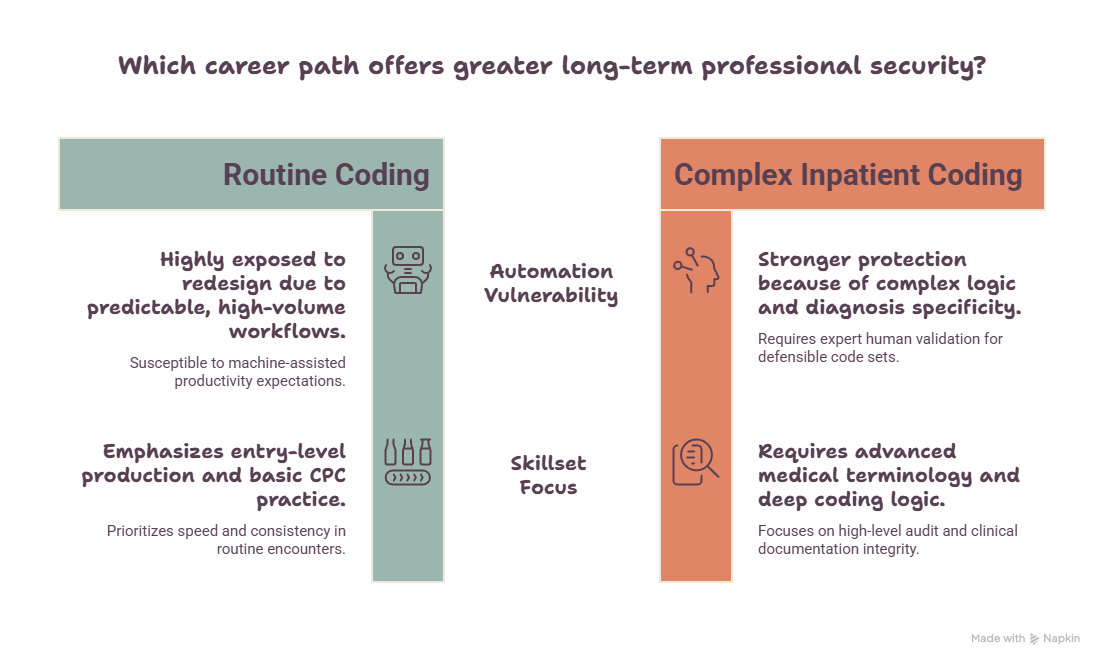
Entry-level production work is particularly exposed to redesign. A health system that once needed ten people to manually code every routine encounter may eventually need fewer people touching those charts individually while employing more specialized reviewers to manage exceptions, audit samples, investigate trends, and maintain coding quality. That does not guarantee a specific headcount outcome at any particular employer. It does mean candidates should prepare for productivity expectations that assume significant machine assistance.
Someone entering through CBCS certification can reduce that risk by understanding billing operations, electronic claim platforms, and payment adjustment logic. Broader RCM fluency gives you more places to create value when a narrow task is automated.
Complex inpatient coding currently has stronger protection. AHIMA's August 2026 framework specifically describes inpatient records as a difficult environment for autonomous engines because of documentation volume, diagnosis specificity, and complex inpatient coding logic. Earlier AHIMA analysis also envisioned inpatient coders evolving into validators who use automation to organize potential code assignments while preserving expert responsibility for the final defensible code set.
That strengthens the case for serious CCS training, CCS practice, advanced coding preparation, and medical terminology depth for candidates who want a more complex coding path.
Auditing, compliance, CDI, and denial strategy may become more important precisely because automation scales. Every autonomous system needs quality thresholds, escalation logic, audit sampling, error analysis, and governance. If an engine starts systematically applying an incorrect modifier or capturing unsupported diagnoses, somebody must recognize the pattern before it becomes a payer audit, repayment demand, or compliance investigation.
The coder who understands CARCs, insurance denial management, physician reimbursement, and Medicaid payment methodology can identify financial consequences rather than merely identifying coding differences.
5. The Medical Coding Skills Most Likely to Survive AI
The strongest long-term skill is coding judgment under ambiguity. Easy charts generate easy training data. Difficult charts contain contradictory documentation, uncertain diagnoses, unclear relationships between conditions, complicated sequencing decisions, unusual procedures, payer-specific requirements, and missing clinical detail. Those are the encounters organizations are most likely to route toward experienced humans as automation expands.
Strengthen that judgment through medical terminology, CPT principles, CCS coding preparation, and continuing education resources. The goal is to understand why a code is defensible from the record and the guideline.
The second survival skill is auditing. Automated coding increases the importance of statistically useful sampling, error categorization, trend detection, coder-versus-engine comparisons, financial impact analysis, and root-cause investigation. AHIMA's current AI material repeatedly highlights human oversight, governance, and validation as central elements of AI-enabled health information work.
The third is clinical documentation integrity. AI cannot manufacture compliant clinical support for a code. Documentation can still be incomplete, conflicting, copied forward, ambiguous, or clinically insufficient. Professionals who can recognize documentation gaps, formulate compliant queries, and understand how clarification affects coding and reimbursement become increasingly valuable.
That expertise connects naturally with medical terminology mastery, CCS certification study, physician fee schedule knowledge, and Medicare billing rules.
The fourth is denial intelligence. Generative AI can draft an appeal letter. A skilled revenue-cycle professional determines whether the denial resulted from coding, authorization, medical necessity, payer policy, documentation, eligibility, timely filing, bundling, modifier use, or another upstream failure. That diagnostic skill directly affects cash recovery.
Build it through denial-management resources, CARC interpretation, claims-submission systems, and Medicaid reimbursement analysis. A person who can tell leadership why denials are rising remains useful even when software writes the first draft of the appeal.
The fifth is AI quality control and governance. Future coding teams will need people who understand coding deeply enough to challenge an algorithm, define acceptable accuracy, compare performance by specialty, identify systematic undercoding or overcoding, and establish escalation rules. AHIMA's 2026 guidance specifically recommends defining automation success, measuring baseline human performance, establishing compliance oversight, choosing appropriate use cases, and assigning ownership before implementation.
The sixth is specialization. Expertise in inpatient coding, complex surgery, specialty-specific professional coding, audits, compliance, risk adjustment, or reimbursement creates a deeper moat than generic chart processing. Someone working toward CPC certification should eventually develop specialty depth. Someone pursuing CCS certification should strengthen complex hospital reasoning. Someone choosing CBCS training should become strong in end-to-end billing operations.
Finally, learn to use AI without surrendering judgment to it. The future coder is likely to spend less time hunting manually for every possible code and more time determining whether automated conclusions survive documentation, guideline, payer, and compliance scrutiny. AHIMA has been describing this shift toward validation, critical thinking, adaptability, and higher-level review for several years, and its 2026 resources now treat AI upskilling as an active workforce priority.
For someone studying today, the practical career plan is clear: earn the credential, learn the workflow around the code, build difficult-case expertise, understand reimbursement, learn auditing, and become comfortable supervising machine-generated work. Use CPC study resources, CCS exam preparation, CBCS coding principles, and CEU resources as the base for that progression.
6. FAQs About AI and the Future of Medical Coding
-
Current evidence points toward substantial task automation and role redesign, with the speed varying sharply across coding environments. Autonomous systems already process selected encounters without routine coder intervention, especially in higher-volume workflows. KLAS still reports functionality gaps and specialty-level accuracy differences, while AHIMA highlights the need for auditing, governance, exception handling, and expert involvement in complex cases.
Coders can improve their position through advanced certification, denial-management knowledge, reimbursement expertise, and continuing education.
-
It can still make sense when you enter the field expecting technology-assisted coding and continued specialization. Training solely for repetitive chart processing carries more career risk. Training for coding judgment, auditing, CDI, compliance, denials, complex inpatient work, or revenue integrity creates broader options.
Before paying for training, compare CPC programs, CCS programs, CBCS courses, and the medical terminology skills required by your target jobs.
-
Complex inpatient coding currently has stronger resistance because of documentation volume, sequencing, diagnosis specificity, procedure coding, and reimbursement complexity. AHIMA's August 2026 automation framework specifically identifies inpatient coding as a more difficult use case for autonomous engines.
Candidates interested in that path should focus on CCS certification, CCS practice questions, advanced coding preparation, and medical terminology.
-
CPC still demonstrates professional coding knowledge that employers can use when evaluating candidates. The career value increasingly comes from combining that credential with expertise that extends beyond routine code assignment.
Use CPC exam preparation to build the foundation, then strengthen CPT knowledge, physician reimbursement, and denial analysis.
-
Yes. Familiarity with AI-assisted coding, automated claim review, coding confidence scores, exception queues, and audit workflows is increasingly useful. AHIMA now offers dedicated AI resources and upskilling guidance for health-information and revenue-cycle professionals, showing how central the technology has become to workforce development.
Pair technology literacy with coding principles, claims platforms, CARC knowledge, and continuing education.
-
Some systems already operate autonomously on selected populations. Fathom's 2026 Your Health case study reported 95.5% encounter automation and 98.3% accuracy. KLAS also documents real autonomous deployments while highlighting accuracy variability and functionality gaps across specialties.
The correct operational question is whether a particular engine is sufficiently accurate for a defined encounter population under measurable audit controls. Understanding billing workflows, claim submissions, payer adjustments, and denial management helps coders evaluate those consequences.
