
CCS Certification: Effective Strategies for Exam Day Success
Passing the Certified Coding Specialist exam requires more than knowing ICD-10-CM, ICD-10-PCS, and CPT. Candidates must retrieve rules quickly, interpret dense documentation, control four hours of testing time, and resist changing defensible answers under pressure. Your preparation should combine coding competency assessment, medical coding workflow mastery, clinical documentation analysis, and coding ethics. This guide gives you a practical system for the final preparation period, test-center check-in, question triage, codebook navigation, medical scenarios, and final review.
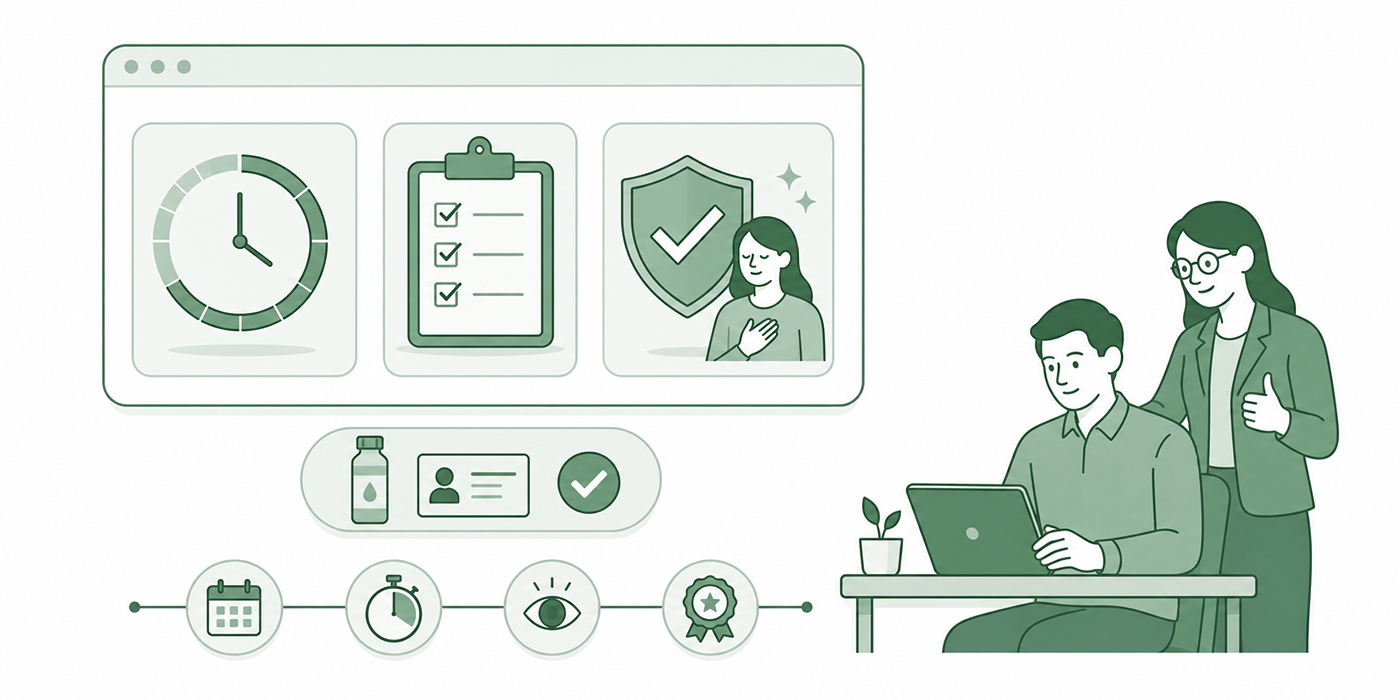
1. Understand the CCS Exam Before Building Your Exam-Day Strategy
The CCS exam tests whether you can make accurate coding decisions across inpatient, outpatient, and emergency department records. AHIMA’s current examination format contains 107 questions, including 97 scored items and 10 unscored pretest items, with four hours allowed. Candidates can move backward and forward after selecting an answer, flag questions, and revisit them before submission when time remains. The passing score is 300.
Those specifications immediately shape your strategy. Four hours for 107 questions gives an average of approximately 2 minutes and 15 seconds per item, yet the workload will not be evenly distributed. A straightforward compliance question may take 30 seconds, while an inpatient scenario involving principal diagnosis selection, ICD-10-PCS construction, clinical documentation validation, and reimbursement methodology may require several minutes.
The largest examination domain is Coding Knowledge and Skills, representing 39–41% of the content. It covers diagnosis and procedure code assignment, sequencing, modifiers, present-on-admission reporting, coding edits, medical necessity, reimbursement methodologies, data abstraction, and identification of CCs and MCCs. Coding Documentation and Regulatory Compliance each represent 18–22%. Provider Queries and Information Technologies each account for 9–11%.
Medical scenarios are divided evenly among inpatient, outpatient, and emergency department cases. Candidates who study only inpatient DRGs or only outpatient CPT leave an entire part of the examination exposed. Your final preparation must therefore include emergency medicine coding, hospital procedure coding, outpatient modifier application, and documentation query analysis.
Build your strategy around decisions, not memorized facts
CCS questions frequently require you to choose the best supported answer from several clinically plausible options. You must identify the setting, service date, documentation source, applicable classification system, governing guideline, and exact question being asked before opening a codebook. This sequence prevents wasted searching and helps distinguish a coding convention from a facility policy, a payer-specific requirement, a medical-necessity issue, or an ethical documentation concern.
A common failure pattern begins when a candidate notices one familiar diagnosis, immediately searches the index, and commits to the first code that looks suitable. The record may contain a later definitive diagnosis, a conflicting site, an unresolved complication, or documentation requiring a provider query. CCS-level judgment demands a complete record review before code assignment. Train yourself to examine the discharge summary, operative report, pathology findings, progress notes, and other permitted documentation sources in the correct hierarchy.
Your examination system should have three layers:
Immediate answers: Questions you can solve confidently without extended research.
Controlled research: Questions requiring a focused guideline, index, table, or codebook lookup.
Complex scenarios: Cases requiring record abstraction, sequencing, code validation, and elimination of competing answers.
This structure protects time for difficult items without giving away easy points. It also prevents one confusing case from damaging your performance on the next ten questions.
2. Use the Final Seven Days to Stabilize Performance
The final week should convert knowledge into reliable execution. It is too late for indiscriminate content accumulation. Candidates often damage readiness by collecting new courses, watching hours of unrelated lectures, or switching study resources because anxiety makes familiar preparation feel insufficient. Your final week should instead expose weak decisions through timed practice, repair those decisions through targeted review, and standardize the routine you will use on examination day.
Seven days before the examination
Complete a realistic four-hour simulation using your approved physical codebooks. Match the exam environment as closely as possible. Keep your phone away, avoid internet searches, sit at a desk, and use only the resources permitted by your current candidate instructions. Include inpatient coding scenarios, emergency department cases, outpatient coding decisions, and provider-query questions.
Review the mock by decision category instead of merely calculating a percentage. Determine whether each missed answer resulted from misreading documentation, choosing the wrong guideline, weak codebook navigation, inaccurate sequencing, an unsupported assumption, or poor time allocation. A 78% result caused by five repeated sequencing errors requires a different response from a 78% result scattered across unrelated topics.
Build a short repair plan. For example, a candidate struggling with operative reports should revisit anesthesia coding terminology, surgical compliance rules, charge-capture concepts, and clinical documentation requirements. A candidate missing diagnosis sequencing should spend that repair period applying conventions to complete cases rather than rereading definitions passively.
Five to six days before the examination
Perform focused drills on the two weakest domains. Limit each session to a specific skill:
Identifying the principal diagnosis from conflicting possibilities
Selecting the correct ICD-10-PCS root operation
Distinguishing CC and MCC capture from unsupported upcoding
Applying present-on-admission indicators
Recognizing compliant and leading provider queries
Resolving outpatient modifier and edit questions
Separating documentation insufficiency from code-selection uncertainty
Study the logic behind the answer through coding audit terminology, coding query standards, medical necessity guidance, coding edits and modifiers, and regulatory compliance principles.
A weak answer should lead to a repeatable correction rule. “Read more carefully” is too vague. “Before sequencing, identify whether the case is inpatient, outpatient, or emergency department and locate the highest-level confirmed diagnosis at the end of the encounter” is actionable. The purpose of review is to change future behavior.
Three to four days before the examination
Complete shorter timed sets that combine all five domains. Use blocks of 25–35 questions and enforce a strict time limit. Mixed practice trains the mental switching required when an ICD-10-PCS scenario is followed by a HIPAA question, a compliant query item, and an EHR technology question.
Include electronic health record terminology, encoder software concepts, medical coding automation, healthcare data security, and EHR integration. Information Technologies is a smaller domain, yet neglecting it can surrender answerable points.
Verify your appointment, route, identification, permitted materials, codebook versions, and test-center instructions. AHIMA’s current application guidance tells candidates to verify their materials, confirm that the ATT name matches identification, check the date and time, review directions, and arrive at least 30 minutes early with valid identification.
One to two days before the examination
Reduce volume and increase precision. Review your personal error log, high-risk guidelines, codebook landmarks, and time checkpoints. Complete a short confidence set, then stop. A final marathon simulation may create fatigue without enough recovery time.
Prepare everything physically:
Two valid forms of identification that satisfy the current requirements
Approved ICD-10-CM book
Approved ICD-10-PCS book
Approved CPT Professional Edition
Appointment confirmation and route details
Necessary prescription or comfort items handled according to current policies
Suitable clothing for a test center with unpredictable temperature
For CCS examinations delivered on or after May 1, 2026, AHIMA requires candidates to bring an approved 2026 ICD-10-CM book, an approved 2026 ICD-10-PCS book, and the AMA CPT 2026 Professional Edition. Testing staff verify the books, and candidates without the required editions can be denied testing and forfeit their fees. Candidates sitting later should always use the approved list that applies to their exact examination date because future requirements may change.
3. Control Your Codebooks and Four-Hour Time Budget
Codebooks should function like navigation systems you already know. Exam day is the wrong time to discover how your publisher organizes neoplasm tables, PCS definitions, appendices, symbols, or CPT section notes. Practice with the same editions you will carry into the center.
Use a question-first lookup sequence
Before touching a book, identify:
The setting: inpatient, outpatient, or emergency department.
The required output: diagnosis, procedure, modifier, sequencing order, query action, compliance response, or technology concept.
The controlling evidence: final diagnosis, operative objective, documented site, approach, device, clinical indicator, or payer rule.
The correct resource: ICD-10-CM, ICD-10-PCS, CPT, or conceptual knowledge.
The validation step: tabular note, PCS table, CPT guideline, modifier instruction, or documentation requirement.
This approach improves both speed and accuracy. It also prevents candidates from solving a hospital diagnosis question through outpatient logic, treating a PCS root operation as a procedure-name lookup, or applying a CPT modifier without verifying documentation.
Navigate ICD-10-CM in two stages
Use the Alphabetic Index to identify a potential code path, then verify the selection in the Tabular List. Confirm instructional notes, inclusion terms, Excludes1 and Excludes2 notes, code-first directions, use-additional-code instructions, laterality, encounter characters, and sequencing guidance.
Do not allow familiarity with a diagnosis to replace verification. Common conditions can contain uncommon documentation details. Apply the same disciplined process to cardiovascular diagnoses, oncology documentation, neurological conditions, and behavioral health records, while remembering that the CCS examination uses the code sets specified on AHIMA’s required-resource list.
Translate ICD-10-PCS cases before searching
For each inpatient procedure, state the operative objective in plain language. Identify what was done, which body part was involved, the approach, any device remaining after the procedure, and any applicable qualifier. Then choose the root operation and construct the code through the correct table.
Words such as “excision,” “drainage,” “replacement,” and “revision” may appear in ordinary clinical language without carrying the exact PCS meaning required by the classification. The surgeon’s objective and the completed procedure control the code. Use operative documentation principles, clinical documentation improvement, medical record terminology, and coding query logic to distinguish supported procedure details from assumptions.
Treat CPT instructions as part of the code
When selecting CPT codes, review section guidelines, parenthetical instructions, add-on status, component rules, bundling implications, and modifier requirements. Specialty familiarity helps, but the book must confirm the final decision. Practice through cardiology CPT coding, radiology coding, gastroenterology procedures, orthopedic surgery coding, and laboratory coding.
Use checkpoints instead of chasing a perfect average
A practical four-hour structure is:
First hour: Reach approximately question 27
Second hour: Reach approximately question 54
Third hour: Reach approximately question 81
Final hour: Complete remaining questions and conduct targeted review
These checkpoints are guides rather than rigid quotas. A cluster of medical scenarios may temporarily slow the pace. The warning appears when you remain substantially behind for more than one checkpoint.
Keep every item answered. AHIMA allows candidates to flag items and return to them, provided an answer has been selected. Choose the strongest supported response before moving forward. A flag should represent a specific unresolved issue, such as needing to verify a sequencing note or reconsider a PCS root operation. Flagging every uncomfortable question produces an unmanageable review queue.
4. Execute a Precise Test-Center and Question-Triage Plan
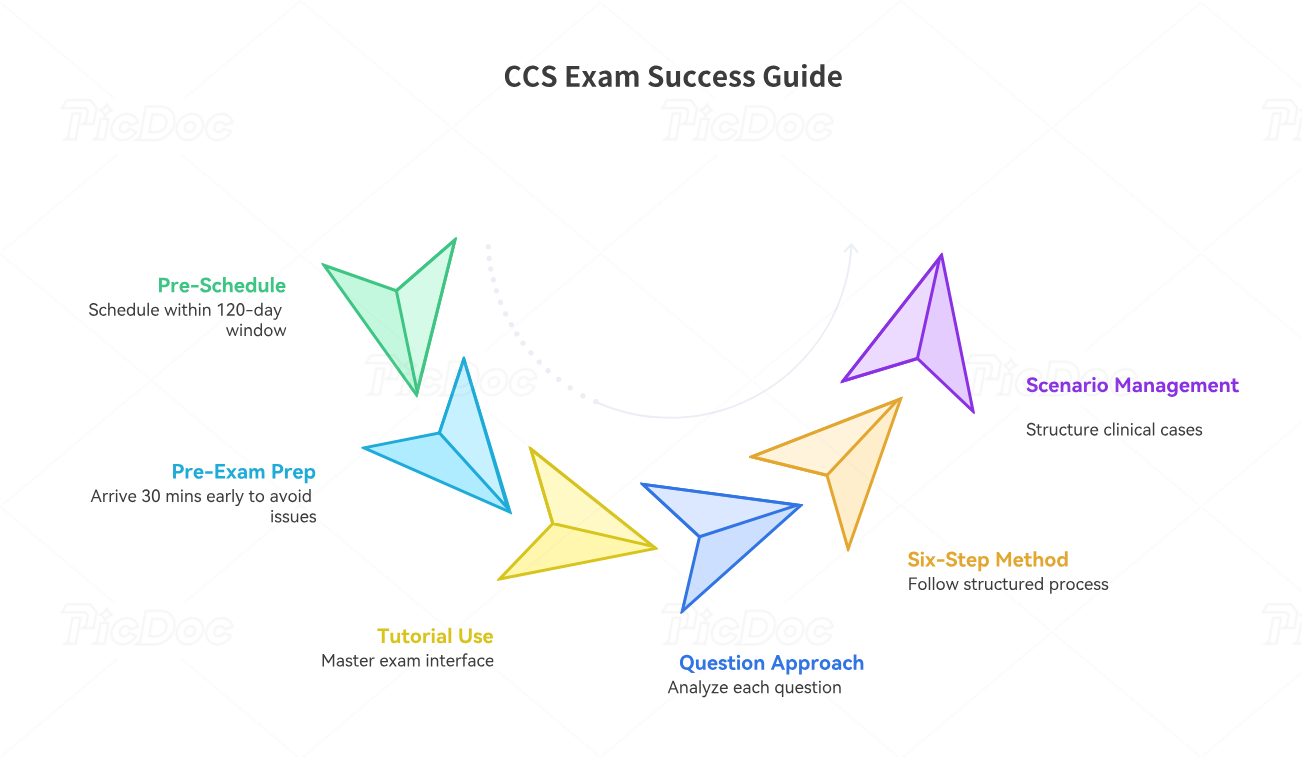
Exam-day success begins before the computer starts. AHIMA directs candidates to schedule within a 120-day eligibility period, verify the ATT information, confirm identification requirements, bring required materials, and arrive at least 30 minutes before the appointment. Pearson VUE also states that CCS testing is delivered in person at authorized test centers and requires an Authorization to Test before scheduling.
The CCS exam is currently offered globally in a computer-based format at Pearson VUE testing centers. Remote testing availability for other AHIMA credentials should never be interpreted as remote eligibility for CCS. Verify the delivery method shown in your own authorization and appointment confirmation.
Conduct a final check before leaving home
Compare both identification documents with the ATT name. Confirm that neither ID is expired. Recheck the codebook years and approved titles. Review the test-center address through the official appointment confirmation rather than relying on an old map pin. Leave enough time for traffic, parking, building security, elevators, and locating the correct suite.
The AHIMA candidate guide instructs candidates to bring two valid, non-expired forms of identification whose names match the ATT and recommends arriving 30 minutes early. It also warns that arriving more than 15 minutes late can result in no-show status and forfeiture of the examination fee. Use your latest confirmation for the controlling rules because policies may be revised.
Use the tutorial to settle your attention
Do not race through the opening interface merely to begin. Confirm how to select answers, navigate, flag items, and view remaining time. Adjust your seating position and screen before starting the scored portion. The objective is to remove avoidable uncertainty from the testing environment.
When the first question appears, avoid judging the entire examination from its difficulty. A challenging opening item says nothing about the next item or your eventual result. Read the question once for context and a second time for the task. Identify whether you need a diagnosis, procedure, sequence, modifier, query decision, compliance response, or technology concept.
Apply a repeatable six-step method
For every substantive item:
Identify the healthcare setting.
Identify the exact output requested.
Extract the controlling documentation.
Determine which rule or classification applies.
Eliminate choices that violate documentation or guidelines.
Verify the remaining answer using the appropriate resource.
This process is especially useful for medical necessity decisions, provider query scenarios, coding compliance questions, data security requirements, and coding edit problems.
Manage medical scenarios as structured abstractions
For inpatient cases, determine the reason for admission after study, identify additional reportable diagnoses, apply POA logic, review procedures, and evaluate documentation for query opportunities. For outpatient cases, identify the confirmed conditions and services for that encounter, then validate CPT instructions, modifiers, edits, and medical necessity. For emergency department cases, distinguish presenting symptoms, confirmed diagnoses, procedures, and separately reportable services.
Create a mental worksheet:
Care setting
Reason for encounter or admission
Final documented diagnoses
Principal or first-listed diagnosis
Additional reportable conditions
Procedures performed
Documentation gaps
Required sequence
Code validation notes
This prevents the record from becoming an undifferentiated block of clinical text. It also aligns with the SOAP note structure, problem-list documentation, EMR documentation terminology, and coding workflow principles.
5. Handle Difficult Questions, Anxiety, and Final Review
Difficult questions should trigger a procedure rather than an emotional response. First, determine whether the difficulty comes from unfamiliar content, conflicting documentation, multiple plausible answers, or inability to locate a rule. Each problem requires a different solution.
When content is unfamiliar, use elimination. Remove answers that use the wrong setting, code set, sequence, documentation standard, or ethical approach. When documentation conflicts, determine whether one source has priority or whether a compliant query is needed. When multiple answers look plausible, locate the controlling guideline. When a rule cannot be found within a reasonable period, choose the best supported option, flag the item, and preserve time for the rest of the examination.
Distinguish doubt from evidence
Candidates frequently change correct answers because the original choice feels too simple. Use an evidence threshold. Revise an answer only after discovering:
A missed instructional note
A misunderstood documentation fact
A more specific supported code
A sequencing requirement
A PCS definition that changes the root operation
A CPT instruction affecting code selection
A compliance rule that invalidates the first choice
Anxiety alone is not evidence. Your first answer may still be wrong, but revision should follow a reason that can be stated clearly.
Use coding ethics principles, documentation requirements, coding query terminology, and audit standards as anchors when an answer choice appears financially attractive but lacks record support.
Use a controlled concentration reset
When attention fragments, stop for 20–30 seconds. Place both feet on the floor, relax your shoulders, and take a slow breath. Then state the task mentally: “I need the principal diagnosis,” “I need the PCS root operation,” or “I need to decide whether this query is compliant.” Narrowing the task prevents the entire case from feeling unsolvable.
Avoid calculating how many questions you may have missed. The examination contains ten pretest items that are not scored, and candidates cannot identify them because they are distributed throughout the test. Treat every item seriously while refusing to let one unfamiliar question define your confidence.
Conduct a risk-based final review
After answering all questions, review in this order:
Items without a confirmed answer
Flagged questions with a specific unresolved rule
Principal diagnosis and sequencing questions
Multi-code inpatient scenarios
ICD-10-PCS root-operation decisions
Modifier and edit questions
Documentation-query and compliance questions
Check whether each proposed change has a documented reason. Avoid reopening easy questions that you answered through a clear rule. Unfocused review increases the chance of replacing a supported response with a weaker one.
Verify that every item contains an answer before submitting. Allow enough time to complete the submission process calmly. Follow the testing staff’s instructions after finishing. AHIMA reports a current CCS passing score of 300, and unsuccessful candidates must submit a new application and wait at least 30 days before retesting.
A failed attempt should generate a structured remediation plan rather than immediate repetition of the same study method. Use the score information available, reconstruct your time usage, identify weak domains, and review your error patterns. Strengthen those areas through coding competency assessment, coding education resources, professional development planning, and exam-preparation communities.
6. Frequently Asked Questions About CCS Exam-Day Success
-
The current CCS exam contains 107 questions, including 97 scored questions and 10 unscored pretest questions. Candidates receive four hours to complete the examination. The pretest items are mixed throughout the examination and cannot be identified by the candidate.
Prepare for the full examination through timed coding workflow practice, inpatient documentation analysis, outpatient modifier review, and emergency medicine coding. Your study sessions should reproduce the cognitive workload of switching between these areas.
-
AHIMA currently lists 300 as the CCS passing score. The scaled score should not be interpreted as a simple percentage of questions answered correctly. Focus your preparation on consistent competence across the examination blueprint rather than attempting to calculate how many mistakes you can afford.
Strengthen performance through coding audit review, coding regulatory compliance, coding documentation improvement, and information technology terminology.
-
For examinations delivered on or after May 1, 2026, candidates must bring one approved 2026 ICD-10-CM book, one approved 2026 ICD-10-PCS book, and the approved AMA CPT 2026 Professional Edition. AHIMA publishes specific approved publishers, editions, and ISBNs.
Verify the exact list for your test date instead of assuming that every 2026 book is accepted. Develop familiarity through encoder software concepts, coding system updates, coding edits, and physical codebook drills.
-
The current CCS examination is delivered in person through Pearson VUE authorized testing centers. Pearson VUE’s AHIMA page identifies CCS among the credentials available at test centers, while remote delivery is offered for a limited group of other AHIMA certifications under stated conditions.
Confirm the delivery method in your ATT and appointment record. Prepare for center procedures by reviewing health information terminology, data security expectations, coding credential terminology, and the official candidate instructions.
-
AHIMA advises candidates to arrive at least 30 minutes before the scheduled examination time. Its candidate guidance warns that late arrival can lead to no-show status and loss of the examination fee.
Plan for parking, building access, security, identification checks, codebook inspection, and administrative procedures. Organize your materials the previous evening and protect sleep rather than spending the morning reviewing coding abbreviations, billing acronyms, or unfamiliar specialty codes.
-
Select the strongest supported answer before flagging the item. Continue when additional research stops producing useful evidence or when the question threatens your time checkpoints. AHIMA allows candidates to flag items and return to them after selecting an answer.
Use flags for defined uncertainties involving diagnosis sequencing, PCS procedure logic, modifier selection, or query compliance. A flag should identify what needs to be resolved later.
