
Complete Reference to Speech-Language Pathology Coding Terms
Speech-language pathology billing breaks down when teams treat documentation, coding, medical necessity, payer policy, and claims workflow as separate jobs. They are not. In SLP, revenue is won or lost at the exact point where evaluation findings, functional deficits, treatment frequency, timed services, plan-of-care language, and payer edits either line up cleanly or collide. That is why coders, billers, therapists, auditors, and revenue cycle leaders need a shared vocabulary, not scattered definitions.
This reference is built to close that gap. It explains the coding terms that actually decide whether speech therapy claims move, stall, downcode, deny, or trigger rework. If your team is tired of vague documentation, modifier confusion, authorization misses, and payment leakage, this is the dictionary that turns terminology into cleaner claims and better reimbursement control.
1. Why Speech-Language Pathology Coding Terms Matter More Than Most Teams Realize
Speech-language pathology coding looks deceptively simple until the denials start. Teams assume the challenge is just selecting the right CPT code, but the real failure points usually sit upstream: incomplete functional findings, vague treatment intent, weak plan-of-care language, unclear units, unsupported frequency, and payer-specific edits that nobody translated into operational steps. That is why understanding terminology matters as much as code selection itself.
In SLP, one misunderstood term can damage the whole claim lifecycle. If a team confuses medical necessity with general therapeutic benefit, the documentation may sound clinically reasonable yet still fail payer scrutiny. If staff do not understand how clinical documentation improvement supports specificity, they may submit notes that describe effort but not impairment severity, functional limitation, or measurable progress. If they do not grasp medical necessity criteria, they may document exercises without proving why skilled intervention was required.
The same pattern repeats across the revenue cycle. Teams that do not fully understand charge capture terms miss billable services. Teams weak on coding edits and modifiers trigger avoidable rejections. Teams unfamiliar with Medicare documentation requirements for coders often think a signed note is enough when the payer needed objective support for duration, complexity, and skilled necessity.
SLP is especially vulnerable because speech therapy documentation often contains rich clinical narrative but poor billing precision. A note may explain articulation goals beautifully while failing to connect diagnosis, baseline status, intervention method, time, and progress in a way that supports payment. That disconnect is how organizations end up chasing avoidable denials, writing repetitive appeals, and suffering the kind of revenue leakage that leadership notices only after collections dip.
The fix is operational fluency. Staff need to understand how terms interact across revenue cycle management, EHR integration, claim submission workflows, and denials prevention. When everyone uses the same language, coding stops being reactive and starts becoming controlled.
Speech-Language Pathology Coding Terms Map: What They Mean and What You Must Do
| Term | What It Means | Why It Hits Billing | Best Practice Action |
|---|---|---|---|
| SLP Evaluation | Initial assessment of speech, language, voice, fluency, or swallowing deficits | Drives code selection, medical necessity, and treatment justification | Tie findings to measurable functional impairment |
| Re-evaluation | Follow-up assessment after change in status or progress review | Supports updated plan of care and continued treatment | Document why reassessment was clinically required |
| Plan of Care | Formal treatment plan including goals, frequency, and duration | Weak plans cause authorization and payment problems | Include goals, frequency, duration, and therapist signature |
| Medical Necessity | Proof that skilled therapy is required for a diagnosed condition | Without it, claims may deny even if therapy occurred | Show why a qualified clinician was needed |
| Functional Limitation | Real-world communication or swallowing deficit | Payers reimburse function-focused care, not vague effort | Document school, work, home, or safety impact |
| Timed Code | Code requiring time-based unit calculation | Wrong units lead to overbilling or underbilling | Record total treatment minutes precisely |
| Untimed Code | Code billed once regardless of session length rules | Prevents incorrect multiple-unit billing | Verify payer-specific unit rules before billing |
| Authorization | Payer approval for therapy visits or services | Expired or missing auth creates nonpayment risk | Track visits used and renewal dates |
| Certification | Physician or allowed practitioner approval of therapy plan | Required in many payer settings | Monitor signature turnaround before billing deadlines |
| Progress Note | Periodic summary of patient response and goal status | Supports continued care and audit defense | Link progress to objective measures |
| Daily Note | Session-level documentation of services performed | Missing details weaken claim support | Include interventions, time, cues, and response |
| Diagnosis Pointer | Link between procedure and diagnosis code | Improper linkage can reject claims | Match each service to the supporting diagnosis |
| Modifier | Claim suffix explaining special billing circumstances | Wrong modifiers trigger edits and denials | Apply only with payer-supported documentation |
| NCCI Edit | Bundling rule that limits separate reimbursement | Can combine or block services on the same date | Review edit logic before submitting multiple codes |
| Claim Scrubber | Software rule engine that checks claim errors | Catches preventable defects before submission | Build SLP-specific edits into workflows |
| Place of Service | Location where therapy occurred | Affects payer rules and reimbursement logic | Validate POS against rendering setting |
| Rendering Provider | Clinician who actually performed the service | Identity mismatches can delay payment | Verify NPI and credential mapping |
| Supervising Provider | Provider overseeing services where required | Supervision failures can create compliance exposure | Map payer rules to staffing models |
| Units | Billable quantity tied to code rules | Incorrect units distort reimbursement | Audit time-to-unit conversion monthly |
| Frequency | How often treatment is scheduled | Overstated frequency invites scrutiny | Base on severity and documented need |
| Duration | Length of treatment episode | Supports authorization and plan approval | Justify length with baseline deficits and goals |
| Skilled Intervention | Clinician-level judgment and treatment, not routine practice | Central to medical necessity | Document cueing, analysis, adaptation, and expertise |
| Home Program | Exercises or practice assigned outside therapy | Supports continuity but is not a substitute for skilled care | Show therapist oversight and progression |
| Denial | Payer refusal to reimburse a claim or service line | Directly harms cash flow | Track root cause, not just volume |
| CARC | Claim Adjustment Reason Code explaining payment change | Tells teams why money was reduced or denied | Create payer-specific denial playbooks |
| RARC | Remittance Advice Remark Code adding claim details | Provides deeper denial or processing context | Interpret with CARCs, not in isolation |
| Appeal | Formal request for claim reconsideration | Final chance to recover revenue | Attach concise evidence tied to payer logic |
| Audit Trail | Record of documentation, edits, and claim activity | Protects the organization during reviews | Retain source documentation and change history |
2. Core Speech-Language Pathology Terms Every Coder and Biller Must Control
The first group of SLP terms determines whether a claim is built on solid ground or on assumptions. Start with evaluation, because an evaluation is not just the clinical beginning of therapy. It is the reimbursement foundation. The evaluation must establish diagnosis, functional impairment, baseline severity, and the reason skilled treatment is needed. Without that structure, treatment notes later become hard to defend, especially when payers compare goals against objective findings. This is where strong habits from SOAP note and coding guidance and essential guidelines for accurate clinical documentation become critical.
Next is plan of care. In SLP, this term must never be reduced to a formality. The plan of care should define the treatment focus, measurable goals, frequency, duration, and expected skilled interventions. Weak plans create downstream pain: authorization mismatches, unsupported visit counts, and continued-care denials. Teams that want fewer payer disputes should align SLP plans with the discipline used in medical record retention and storage terms and EMR documentation terms, because vague records do not become stronger after submission.
Then comes medical necessity, the phrase many teams use loosely and document poorly. In speech therapy, medical necessity means the patient has a clinically supported impairment requiring skilled intervention by a qualified professional. It is not enough that therapy could be helpful. The documentation must show why the condition affects function, why the treatment requires clinical skill, and why the intensity and duration make sense. This is why teams that master accurate medical billing and reimbursement outperform teams that merely document attendance.
Another essential concept is skilled intervention. Payers want proof that the clinician did more than supervise repetition. The note must show assessment, cueing strategy, adaptation, therapeutic reasoning, and progression. If a note says the patient “worked on expressive language tasks,” that is weak. If it says the clinician modified verbal prompts, adjusted task complexity, and used errorless learning to improve functional recall in a work-related communication setting, that sounds skilled and billable.
Finally, teams must understand functional limitation. Payers pay for deficits that affect communication, safety, swallowing, work, school, or daily living. Documentation that describes isolated symptoms without functional impact often loses force. Strong SLP coding is not just about language impairment labels. It is about proving what the impairment is costing the patient in real life.
3. Documentation, Time, and Modifier Terms That Make or Break SLP Claims
This is where many speech therapy organizations start bleeding money. They may choose the right general service but fail on the operational vocabulary that governs billing precision. The first of these is timed versus untimed coding. If staff do not understand which services are tied to documented treatment minutes and how those minutes convert into units under payer policy, claims become inconsistent fast. Some organizations underbill because they fear scrutiny. Others overstate units and end up exposed in audits. Both are expensive.
That is why a clean SLP workflow should borrow discipline from medical coding workflow terms, encoder software terms, and practice management systems terminology. Time should be documented in a way that survives review, supports units, and matches the claim exactly.
Next is the term modifier. Modifier misuse is one of the fastest ways to turn a valid service into a preventable denial. In SLP, modifiers may be required to explain distinct services, assistant involvement, telehealth circumstances, or other special conditions depending on payer rules. The key danger is reflexive modifier use. If teams add modifiers because “that is what we usually do,” they create audit risk. If they fail to add them when edits require clarification, they create denial risk. Either way, the problem is vocabulary without operational control.
Then there is certification and recertification, which many teams treat as paperwork instead of payment infrastructure. If the plan of care needs physician or allowed practitioner certification and the organization fails to secure it on time, the claim may be technically supported clinically but still financially vulnerable. That is why organizations serious about clean SLP reimbursement build controls around regulatory compliance, HIPAA compliance in medical billing, and ethical billing practices, because sloppy governance usually appears first in therapy documentation lag.
Another term that matters is place of service. SLP services delivered in outpatient clinics, schools, homes, hospitals, or telehealth settings may follow different reimbursement logic. When POS, rendering provider, and payer policy do not line up, even clinically valid claims can stall in clearinghouse edits or payer review. Strong teams prevent this by tightening coordination between documentation and claim submission processes, not by waiting for denials to teach the lesson.
Quick Poll: What is your biggest speech therapy billing pain right now?
4. Denial, Remittance, and Revenue Cycle Terms Every SLP Team Must Know
If your organization wants fewer surprises after submission, your SLP billing vocabulary must extend beyond clinical terms into denial and payment language. This is where many therapy teams are weakest. They know what they treated, but they do not fully understand what the remittance is telling them or how to translate denials into process fixes.
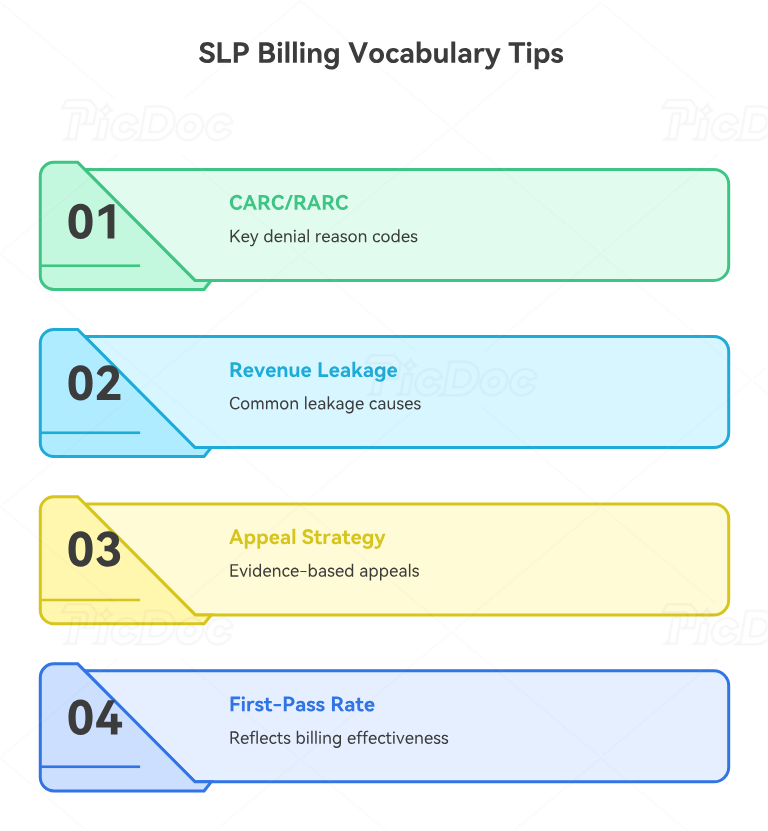
Start with CARC, or Claim Adjustment Reason Code. This explains why a payment changed, reduced, or denied. CARCs are not administrative clutter. They are revenue intelligence. When analyzed properly, they show patterns in authorization failures, bundling issues, coverage limitations, diagnosis mismatches, and documentation gaps. Pair them with RARC, the Remittance Advice Remark Code, for more context. Teams that understand both terms and map them against payment posting and management and EOB interpretation recover faster because they stop treating every denial like a new mystery.
Then there is revenue leakage, a term leadership often uses broadly without diagnosis. In SLP, leakage usually happens through authorization lapses, missed charges, unsupported units, silent underbilling, avoidable write-offs, untimely filing, and weak appeals. It is not always dramatic. Often it is death by a thousand small process failures. That is why teams should connect SLP denial review to revenue cycle metrics and KPIs, RCM software terms, and mastering revenue cycle management. What gets measured gets fixed. What gets described vaguely keeps recurring.
Appeal is another term teams underuse strategically. A strong appeal is not emotional and not generic. It is a disciplined packet of evidence showing diagnosis support, functional limitation, skilled intervention, treatment minutes, authorization compliance, and payer-rule alignment. The best appeals connect the denial language directly to the documentation language. They do not simply resubmit notes and hope someone reads them differently.
Finally, understand first-pass resolution. This term matters because it reflects whether your SLP documentation, coding, edits, and claim build are working before rework begins. When first-pass performance is weak, staff burnout rises because people spend their time repairing preventable failures instead of improving throughput.
5. Best Practices for Building an SLP Coding Workflow That Holds Up Under Audit
The strongest SLP billing operations do not rely on heroics. They rely on standard definitions, shared rules, and repeatable checkpoints. First, create one internal SLP coding vocabulary that therapy, coding, billing, and compliance all use. When one department says “progress,” another says “continued need,” and a third says “medical necessity,” the organization creates interpretation gaps that show up in notes and claims.
Second, audit the alignment between evaluation findings, diagnosis coding, goals, treatment notes, units, and billed services. This is the single most important workflow test. If the evaluation describes expressive language deficits but the notes drift into general cognitive work without clear linkage, you have audit risk. If the plan says twice weekly for eight weeks and the claim pattern shows something else, you have payment risk. Pull those threads early using techniques from medical coding audits, compliance audit trends, and billing compliance violations and penalties.
Third, train clinicians to document for function, skill, and payer defense rather than for narrative completeness alone. Good clinical writing is not always good reimbursement writing. The note must answer practical questions fast: What was impaired, how severe was it, why was skilled therapy necessary, what exactly was done, how long did it take, how did the patient respond, and what measurable progress or continued need exists?
Fourth, use denial intelligence as a training engine. If the same SLP denials keep appearing, the problem is not just payer behavior. It is a process design issue. Feed CARC and RARC patterns back into templates, edit logic, authorization tracking, and staff education. Teams that do this well usually also improve coding productivity benchmarks because they reduce time lost to cleanup.
Fifth, protect your records. Audit-ready SLP billing depends on durable documentation, traceable edits, and accessible supporting evidence. Strong retention and retrieval practices matter just as much as strong coding knowledge because unsupported truth is still financially weak in payer review.
6. FAQs About Speech-Language Pathology Coding Terms
-
The biggest mistake is assuming that selecting a therapy code is the main challenge. In reality, the larger problem is failing to connect diagnosis, functional deficit, skilled intervention, time, goals, and payer requirements into one coherent claim story. When those elements do not align, denials follow.
-
It should show the diagnosed impairment, explain the functional impact on communication or swallowing, establish why skilled treatment is required, and document measurable clinical reasoning during treatment. Notes must make it obvious why a licensed professional was needed rather than unsupervised practice alone.
-
Because treatment delivery and payment support are not the same thing. Claims may deny due to missing authorization, weak certification, unsupported units, modifier errors, diagnosis-procedure mismatch, poor functional documentation, or payer edits that were not addressed before submission.
-
Both sides should understand authorization, certification, medical necessity, plan of care, functional limitation, rendering provider, place of service, units, modifiers, CARCs, RARCs, denial categories, and appeal logic. Revenue improves when these terms are shared across therapy, coding, billing, and compliance.
-
At minimum, quarterly. Review more often when payer behavior changes, denial trends spike, or documentation templates are updated. Terminology is not static in operational use. If your workflow changes but your definitions do not, staff start making inconsistent choices.
-
Build controls before claim submission: verify authorization, align evaluation findings with billed services, confirm unit accuracy, apply modifiers correctly, run claim edits, and audit documentation against payer expectations. Organizations recover more revenue by preventing leakage upstream than by fighting every denial downstream.
