
Guide to Health Information Management (HIM) Terms
Health Information Management looks administrative on the surface, but the real work sits much deeper: it is the control center where documentation integrity, coding accuracy, privacy, data governance, reimbursement, compliance, retention, and audit readiness all intersect. When teams do not understand HIM terminology precisely, the damage spreads fast. Records become inconsistent, coding logic breaks, denials multiply, legal exposure rises, and leaders lose trust in their own data.
This guide is built to prevent that. It explains the HIM terms that matter operationally, not just academically, so billers, coders, compliance staff, auditors, educators, and revenue cycle teams can speak the same language. If your organization wants cleaner records, stronger coding, safer disclosures, better claims, and fewer downstream surprises, mastering these terms is not optional. It is infrastructure.

1. Why Health Information Management Terms Matter Across Coding, Compliance, and Revenue
Many organizations misunderstand HIM because they treat it as a records department instead of a control function. In reality, HIM governs how information is created, classified, stored, corrected, disclosed, protected, retrieved, and defended. That makes it central to clinical documentation improvement, medical coding workflow terms, medical coding audits, and even revenue cycle management. When HIM terminology is weak, the organization stops seeing information clearly, and payment problems usually follow.
A single misunderstood HIM term can create expensive confusion. If staff misuse amendment, they may alter records in a way that creates compliance risk. If they misunderstand late entry, documentation timeliness becomes hard to defend. If they do not know the operational difference between data integrity and documentation completeness, they may assume a chart is safe because it contains a lot of text, even though the information is inconsistent, duplicated, or unsupported. That is how weak record handling quietly turns into bad coding, appeal losses, and audit exposure.
HIM vocabulary also matters because healthcare organizations depend on records for more than treatment. Records support coding, billing, payer review, legal defense, utilization review, quality reporting, and operational analytics. If your team cannot explain what record retention, minimum necessary, master patient index, release of information, data governance, or audit trail actually mean in day-to-day workflow, you are not managing information. You are merely storing it.
This is why strong HIM teams do not work in isolation. They align with guide to medical coding regulatory compliance, Medicare documentation requirements for coders, essential guidelines for accurate clinical documentation, and medical record retention and storage terms. They understand that terminology drives action, and action drives revenue protection.
The hidden pain point is that many organizations only notice HIM failures after money is already lost. A disclosure mistake becomes a complaint. A chart correction becomes an audit issue. A duplicate patient record causes claim confusion. A weak retention process makes an appeal harder to win. A vague documentation policy creates revenue leakage. By the time leadership sees the problem, the real root cause is often vocabulary that never became workflow discipline.
Health Information Management Terms Map: What They Mean and Why They Matter
| Term | What It Means | Why It Hits Operations | Best Practice Action |
|---|---|---|---|
| HIM | Discipline governing healthcare information lifecycle | Touches compliance, coding, privacy, and reimbursement | Treat HIM as an enterprise control function |
| Health Record | Official clinical and administrative patient documentation | Supports care, coding, legal defense, and billing | Define what belongs in the legal record |
| Legal Health Record | Designated record released for legal or official purposes | Confusion here creates disclosure risk | Maintain a formal legal record policy |
| Designated Record Set | Records used to make decisions about individuals | Important for access and amendment rights | Map included systems clearly |
| Master Patient Index | System linking patient identities across records | Duplicate records break coding and billing continuity | Audit duplicate and overlay risks regularly |
| Overlay | Two patients combined into one record incorrectly | Severe privacy, safety, and claim risk | Escalate immediately with formal correction workflow |
| Duplicate Record | One patient has more than one medical record number | Splits documentation and reimbursement history | Run MPI cleanup processes routinely |
| Data Integrity | Accuracy, consistency, and reliability of information | Bad data weakens coding and reporting | Monitor mismatches, duplicates, and invalid fields |
| Documentation Integrity | Trustworthiness and completeness of clinical documentation | Affects coding quality and audit defense | Train providers on specificity and consistency |
| ROI | Release of Information process | Improper releases create privacy exposure | Use authorization and minimum necessary rules |
| Minimum Necessary | Disclose only the least information needed | Core privacy protection standard | Limit disclosures by role and purpose |
| Authorization | Patient permission for certain disclosures or uses | Invalid forms can nullify release workflow | Validate scope, signatures, and dates |
| Audit Trail | System record of access, edits, and actions | Critical in investigations and reviews | Retain logs and monitor abnormal access |
| Amendment | Approved addition or change request to a record | Poor handling can compromise record defensibility | Never overwrite original entries |
| Addendum | Supplemental documentation added after original entry | Needs date, time, and author clarity | Label late additions transparently |
| Late Entry | Documentation entered after the service date | High scrutiny in audits and billing reviews | Explain timing and keep clear chronology |
| Correction | Fix to inaccurate record content | Improper corrections look like tampering | Use approved correction protocol only |
| Abstracting | Extracting data elements from records | Feeds coding, registries, and analytics | Standardize abstraction rules |
| Indexing | Organizing records or data for retrieval | Poor indexing slows ROI and audits | Use consistent metadata conventions |
| Record Retention | Rules for how long records are kept | Premature destruction creates legal and financial risk | Align retention schedule with law and policy |
| Destruction Log | Documentation of records destroyed per policy | Proves compliant disposal | Maintain logs with date, type, and authority |
| EHR | Electronic Health Record platform | Primary source of documentation and access risk | Define workflows and role-based access |
| Interoperability | Ability of systems to exchange usable data | Bad exchange logic creates data errors | Validate mapping and data import rules |
| Data Governance | Oversight structure for data standards and accountability | Prevents uncontrolled documentation chaos | Assign owners for key data domains |
| Metadata | Data describing a document or data element | Important for retrieval, authorship, and timing | Preserve metadata during migrations |
| PHI | Protected Health Information | Privacy and disclosure controls depend on it | Train staff on PHI handling boundaries |
| Confidentiality | Protection against unauthorized disclosure | Trust and compliance depend on it | Restrict access by need and role |
| Availability | Information can be accessed when needed | Care and billing suffer when records are unreachable | Build downtime and recovery procedures |
| Integrity | Information remains unaltered and dependable | Critical for coding and audit defense | Use controls against unauthorized edits |
| Disclosure Accounting | Log of certain nonroutine disclosures | Supports patient rights and investigations | Track applicable releases consistently |
2. Core HIM Terms That Control the Legal Health Record and Documentation Integrity
The first HIM terms every organization must master are the ones that define the record itself. Start with legal health record. This is not just “everything in the system.” It is the officially designated set of documentation the organization recognizes as the record for legal, regulatory, and disclosure purposes. If that boundary is vague, staff may release the wrong content, omit the right content, or fail to defend the record consistently when an audit, grievance, or payer dispute arises. That is why HIM leaders must align legal record definitions with guide to electronic medical records documentation terms, electronic health record coding terms, and complete guide to electronic health record integration terms.
Then comes the designated record set, which often causes confusion because it overlaps with patient rights and disclosure obligations. This term refers to the broader body of records used to make decisions about an individual. If staff do not understand the distinction between the designated record set and the legal health record, access requests and amendment requests can be handled inconsistently. That inconsistency is not just messy. It creates regulatory risk.
Another vital term is documentation integrity. Many teams talk about it as if it means “the note looks complete,” but true documentation integrity means the record is accurate, consistent, timely, attributable, and clinically defensible. It means diagnoses align with findings, orders align with services, corrections are traceable, dates make sense, and copied content does not distort reality. Organizations that ignore this end up creating the kind of chart clutter that makes coding edits and modifiers, medical necessity criteria, and clinical documentation improvement terms much harder to apply accurately.
You also need precision around late entry, addendum, and correction. These are not interchangeable. A late entry documents something that should have been recorded earlier. An addendum supplements an earlier entry. A correction fixes inaccurate content. When staff blur these terms, they may alter records in ways that look careless or deceptive. In payer disputes, sloppy chronology is poison. It weakens the organization’s credibility fast.
Finally, understand audit trail. This is the silent witness behind the record. It shows who accessed what, when, and what they changed. In privacy complaints, compliance reviews, and disputed documentation questions, the audit trail often matters as much as the visible note itself. HIM teams that respect audit trails build safer records and stronger defenses.
3. HIM Terms That Drive Privacy, Disclosure, Access, and Information Governance
Privacy failures are often vocabulary failures first. Teams do not always violate confidentiality because they are reckless; sometimes they violate it because they do not know exactly what minimum necessary, authorization, release of information, and disclosure accounting require operationally. That confusion is dangerous because disclosure risk does not stay in the privacy lane. It spills into trust, legal exposure, and organizational reputation.
Take minimum necessary. This term does not mean “share less if possible.” It means the organization should limit uses, access, and disclosures of PHI to the smallest reasonable amount needed for the purpose. If staff interpret it loosely, they overshare. If they apply it carelessly, they slow legitimate workflows. Proper understanding lets HIM teams support both efficiency and protection, especially when paired with understanding HIPAA compliance in medical billing and impact of HIPAA compliance changes on medical billing and coding.
Now consider release of information, often shortened to ROI. This is not merely sending records on request. It involves verifying identity, checking authorization, determining what record set applies, limiting disclosure appropriately, documenting the release, and retaining defensible evidence of the transaction. If any step breaks, the organization may create a privacy incident or fail a compliance review. Teams that think ROI is clerical usually underestimate the operational stakes.
Then there is master patient index, or MPI, one of the most underrated HIM concepts. Duplicate records and overlays create massive downstream pain: fragmented documentation, coding inconsistency, patient safety risk, delayed billing, and mismatched historical data. When the same patient appears under multiple identifiers, charge capture, claims submission, and payment posting all become harder to trust.
You also need a strong grasp of data governance. This term sounds executive, but it matters at the front line. Data governance defines who owns information standards, who resolves conflicts, who approves definitions, and how systems stay aligned. Without it, every department invents its own rules, and HIM becomes cleanup instead of control. That is the breeding ground for inconsistent charts, reporting errors, broken interfaces, and weak enterprise analytics.
Quick Poll: What is your biggest HIM pain point right now?
4. HIM Terms That Shape Coding Accuracy, Reimbursement, and Audit Readiness
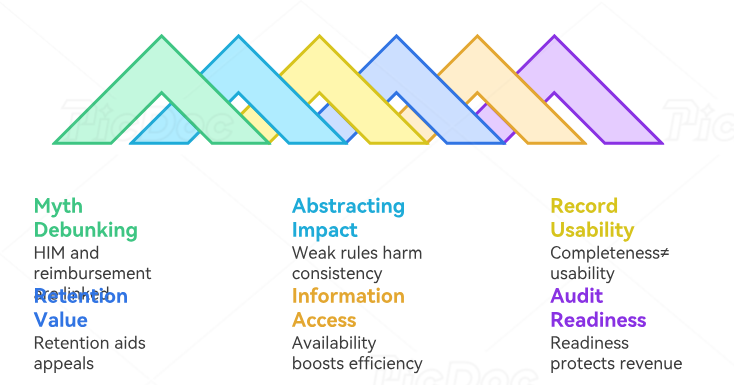
One of the costliest myths in healthcare operations is that HIM and reimbursement are separate. They are not. Coding accuracy depends on record clarity. Claim defensibility depends on documentation chronology. Denials management depends on retrievable evidence. Appeals depend on record integrity. HIM is therefore not adjacent to revenue. It is underneath it.
Start with abstracting. In HIM, abstracting means extracting required data elements from the record for coding, reporting, registries, or analytics. Weak abstraction rules produce weak output. If coders, auditors, and HIM staff are pulling different facts from the same chart, your organization has a consistency problem that will surface sooner or later in medical coding error rates, impact of coding accuracy on hospital revenue, and coding denials management.
Then consider record completeness versus record usability. A chart can be technically complete and still operationally weak. It may contain all required documents but bury the key facts in clutter, conflicting timestamps, copied-forward language, or unclear authorship. That slows coders, weakens auditor trust, and makes payer review more painful. Strong HIM programs build record structures that support accurate medical billing and reimbursement, not just regulatory minimums.
Another crucial concept is retention. Teams often treat it as a legal afterthought, but retention directly affects reimbursement defense. When payers request records, organizations need timely access to intact documentation, metadata, and supporting history. If records are archived badly, migrated poorly, or stored in fragmented repositories, appeals become harder. A valid service can still be financially lost when evidence retrieval fails.
You also need to understand availability, one side of the confidentiality-integrity-availability triangle. HIM is not only about protecting records from the wrong people. It is about ensuring the right people can access the right information at the right time. Delayed chart retrieval slows coding finalization, claim correction, denial appeals, and even provider education. That is why mature HIM strategy aligns tightly with revenue cycle metrics and KPI terms, clearinghouse terminology, and denials prevention and management.
Finally, understand audit readiness as an HIM outcome, not a compliance slogan. Audit-ready information is traceable, timely, internally consistent, properly corrected, legally retained, and easy to produce. That standard protects reimbursement and organizational credibility at the same time.
5. Best Practices for Building a Strong HIM Vocabulary Inside Your Organization
If you want HIM terminology to improve performance rather than sit in policies unread, it has to move into operations. First, define your highest-risk terms formally and train across departments. Do not assume HIM, compliance, coding, legal, and IT mean the same thing when they say legal record, amendment, minimum necessary, or data integrity. Misalignment here creates quiet operational drift that becomes expensive later.
Second, build term-based workflows. For example, if late entry is a defined concept, your EHR template, education, monitoring, and correction process should all reflect that definition. If record retention is a controlled term, your destruction logs, litigation hold process, and storage architecture should mirror it. Vocabulary without workflow is just policy theater.
Third, monitor the pain points where HIM terminology most often breaks in real life: duplicate patients, incomplete disclosures, copied-forward documentation, unsigned corrections, missing metadata after migration, inaccessible archived records, and inconsistent release practices. These are not abstract governance concerns. They are operational failures that hit cash flow, staff time, and audit exposure.
Fourth, make HIM part of coder and biller education. Staff working in medical billing practice management systems, RCM software, coding automation, and medical billing software selection still need strong HIM awareness because every automated workflow depends on trustworthy source information.
Fifth, use denial trends and compliance findings to refine HIM language. If appeals keep failing due to documentation chronology, tighten education around addenda and late entries. If disclosures are inconsistent, revisit designated record set definitions. If duplicate charts are breaking claims, strengthen MPI governance. The best HIM programs do not just define terms once. They let real operational pain sharpen the definitions continuously.
6. FAQs About Health Information Management Terms
-
The legal health record is the official record the organization designates for legal, regulatory, and disclosure purposes. The designated record set is broader and includes records used to make decisions about the individual. Confusing the two can create errors in access, amendment, and disclosure workflows.
-
Because coding and billing depend on records that are accurate, retrievable, timely, and defensible. HIM terms shape how records are corrected, stored, disclosed, and trusted. Weak HIM processes often lead to denials, appeal failures, and compliance exposure even when the clinical service itself was valid.
-
Many underestimate master patient index problems such as duplicates and overlays. These issues can fragment documentation, distort patient history, create privacy risks, and cause billing confusion that is difficult to unwind once claims and records have already spread across systems.
-
Not automatically. A late entry can be acceptable when it is clearly labeled, properly dated, attributable to the correct author, and handled according to policy. The problem arises when staff try to make late documentation look contemporaneous or use it carelessly to repair weak billing support.
-
It means staff should access, use, or disclose only the amount of PHI needed to accomplish the legitimate purpose. Operationally, that requires role-based access, disclosure review, staff training, and clear rules about what different request types should receive.
-
HIM affects reimbursement by protecting documentation integrity, supporting coding accuracy, preserving retrievable records for payer review, and maintaining audit trails that help defend claims. Poor HIM weakens the evidence chain behind reimbursement even when care was appropriately delivered.
