
Yes, a CBCS can help you qualify for medical billing work, especially when you target revenue-cycle roles where billing knowledge matters more than advanced coding specialization. The harder question is whether employers will hire you with CBCS and zero experience. Candidates comparing CBCS employer recognition, CPC vs. CCS vs. CBCS, medical billing versus coding, and the first-job reality for new coders need to understand exactly where CBCS is strong, where it becomes insufficient, and which next move produces the highest hiring return.

1. Can You Get a Medical Billing Job With CBCS Alone? Understand What the Credential Actually Proves
The NHA Certified Billing and Coding Specialist credential covers four broad domains: revenue cycle and regulatory compliance, insurance eligibility and payer requirements, coding and coding guidelines, and billing and reimbursement. Its published examination outline includes claim submission, EDI, CMS-1500 and UB-04 concepts, payment processing, denials, appeals, A/R follow-up, payer edits, reimbursement and collections.
That scope explains why CBCS can make sense for someone pursuing medical billing fundamentals, learning CMS-1500 claim workflows, developing EDI billing knowledge, or understanding healthcare claims management. The credential reaches beyond simply finding diagnosis and procedure codes in a codebook.
The employment problem appears when candidates assume that passing CBCS proves they can independently operate an employer's revenue cycle.
A billing manager hiring someone to work hundreds of accounts needs more than evidence that the applicant understands what an ERA, deductible, modifier, clearinghouse rejection or denial means. They may need proof that the applicant can investigate an unpaid claim, distinguish rejection from denial, navigate a payer portal, interpret an EOB, work an aging bucket, recognize incorrect contractual adjustments and document follow-up without damaging reimbursement.
That gap between knowledge and production readiness also explains why people can complete medical billing and coding training, build strong CBCS CPT knowledge, prepare through CBCS practice questions, and still encounter the same frustrating requirement: one or two years of experience.
Current listings demonstrate both sides of the market. Some explicitly accept or prefer CBCS. An Indeed CBCS search recently surfaced a community-health billing position where CBCS was highly preferred, while another 2026 billing-and-coding listing listed CBCS alongside CPC and CPB as preferred qualifications. A current medical-billing listing also accepts CPC, CBCS or a similar certification, yet still requires two or more years of billing experience.
That is the important distinction for anyone wondering whether medical coding remains worth entering, whether a CBCS investment produces enough ROI, or whether they should immediately pursue another credential after CBCS. CBCS can satisfy the certification portion of a billing vacancy while experience, software fluency and payer knowledge determine whether you are actually competitive.
| Job Target | CBCS-Alone Fit | Likely Employer Barrier | Best Proof or Next Move |
|---|---|---|---|
| Medical Billing Assistant | Strong beginner target | Office workflow experience | Show claims, EOB and payer knowledge |
| Junior Medical Biller | Strong | 1+ year requirement | Target employers offering training |
| Billing Specialist | Moderate to strong | Full-cycle billing experience | Demonstrate claim-to-payment workflow |
| Claims Submission Specialist | Strong | Clearinghouse familiarity | Know clean claims and rejection correction |
| Insurance Verification Representative | Strong | Payer portal experience | Practice eligibility and benefit interpretation |
| Patient Access Representative | Strong | Customer-service experience | Sell communication plus insurance knowledge |
| Medical Receptionist | Strong | Front-office skills | Use role as revenue-cycle entry point |
| Patient Billing Representative | Strong | Patient account communication | Know statements, balances and payment plans |
| Billing Call Center Representative | Strong | Call handling metrics | Show payer and patient communication ability |
| Payment Posting Specialist | Strong | ERA/EOB interpretation | Practice adjustments and reconciliation |
| A/R Follow-Up Representative | Strong | No real aging-report experience | Learn account prioritization and timely filing |
| Denial Management Assistant | Moderate to strong | Root-cause analysis | Know denial categories and corrective actions |
| Appeals Assistant | Moderate | Documentation and payer policy | Practice building evidence-based appeals |
| Collections Representative | Strong | Collection workflow experience | Understand patient vs payer balances |
| Charge Entry Specialist | Strong | Accuracy and specialty knowledge | Practice modifiers, POS and charge review |
| Prior Authorization Assistant | Moderate | Clinical and payer requirements | Learn authorization workflows |
| Revenue Cycle Representative | Strong | Breadth of RCM exposure | Market CBCS as full-cycle foundation |
| Revenue Cycle Analyst | Weak initially | Analytics and experience | Build Excel, KPI and RCM reporting skills |
| Credentialing Assistant | Moderate | Enrollment workflow knowledge | Learn payer enrollment and CAQH |
| Professional Fee Coder | Limited | CPC often preferred | Add CPC if coding is the destination |
| Outpatient Coder | Limited | Coding credential filters | Build CPT/HCPCS depth and consider CPC |
| Inpatient Coder | Weak | ICD-10-PCS and facility complexity | Prepare toward CCS or inpatient pathway |
| Risk Adjustment Coder | Limited | HCC and coding experience | Build diagnosis-coding and HCC expertise |
| Medical Coding Auditor | Weak initially | Advanced coding and audit experience | Gain production coding experience first |
| FQHC Billing Specialist | Moderate | FQHC reimbursement rules | Learn PPS, Medicaid and encounter billing |
| Home Health Biller | Moderate | Specialty experience commonly required | Learn Medicare, PDGM, NOA and ADR workflows |
| Remote Medical Biller | Limited for beginners | Independent production expectations | Gain onsite/hybrid experience first |
| Billing Team Lead | Weak initially | Leadership plus production history | Build measurable RCM results before promotion |
2. Reddit Experiences Show Why CBCS Holders Struggle Even When the Credential Is Legitimate
The most useful Reddit stories separate credential failure from job-target failure.
One CBCS-certified applicant reported applying to roughly 150 medical-billing jobs and repeatedly encountering experience requirements. The strongest advice from experienced billers was to enter through registration, front desk, patient billing, call-center work or another revenue-cycle position and then move deeper into billing. One commenter described using that route to progress from healthcare call-center work through benefits, claims and prior authorization into accounts receivable and eventually insurance-verification supervision.
That pattern matters for anyone reading about remote medical coding with no experience, trying to build a post-certification résumé, preparing for medical billing interview tests, or searching for beginner-friendly employers. The first position may exist one step sideways from the title you originally imagined.
Another 2026 Reddit discussion came from a CBCS student frustrated that remote vacancies wanted several years of prior experience. An experienced commenter explained that production work has high turnover and employers often want candidates who already understand what the work requires. This connects directly with the problems described in medical coding productivity quotas, medical coding stress, new-coder hiring barriers, and the first-job employment gap.
Remote employers have an additional reason to prefer experience: training a new employee to recognize claim problems, payer rules, documentation gaps and account priorities is harder when the person cannot easily shadow experienced staff. Someone pursuing work-from-home coding or billing may therefore improve their long-term remote prospects by accepting a strong onsite or hybrid revenue-cycle role first.
The Reddit evidence also shows why automatically replacing CBCS with another exam can be the wrong reaction.
Even candidates with CPC-A, CCA and CCS report difficulty landing first jobs. Reddit threads contain certified candidates encountering the same experience paradox, including employers that no longer train beginners and candidates forced to enter through medical records or billing before moving into coding. That means someone considering CPC after CBCS, studying a CPC exam strategy, worrying about CPC-A apprentice status, or exploring a CCS certification pathway should diagnose the actual hiring problem before spending again.
If employers reject you because your credential does not match the role, upgrading can help. If they reject you because you have never worked claims, denials, payer portals or EHR systems, a second credential may leave the original weakness untouched.
3. What Medical Billing Employers Really Want Beyond CBCS
Current medical-billing postings reveal a practical competency stack that candidates should reverse-engineer before applying.
A recent AAPC medical-biller listing required two or more years of experience and emphasized full-cycle responsibilities including submitting claims, resolving denials, payment posting, insurance updates, payer portals and patient-account management. Another current posting accepting CBCS as a preferred certification still asks for Medicare, Medicaid, commercial-insurance knowledge, A/R, denials, collections and billing-software experience.
Those requirements map closely to AMBCI resources on payment posting, claims reconciliation, medical billing reconciliation, and collections and bad debt. A CBCS holder who can discuss these processes intelligently looks materially stronger than one whose résumé contains only the credential name.
Insurance verification is another major hiring lever. You should understand active coverage, effective dates, copays, deductibles, coinsurance, authorization requirements, coordination of benefits and basic payer differences. That knowledge supports positions that can later lead into claims management, utilization-management workflows, revenue-cycle reconciliation, and more advanced HIM responsibilities.
Denial resolution may be even more valuable. Employers want someone who can determine why a claim failed, whether the issue involves eligibility, authorization, coding, medical necessity, modifier usage, timely filing, duplicate billing or payer processing, and what action should happen next. Developing that logic through healthcare claims terminology, EDI billing knowledge, CMS-1500 expertise, and coding ethics and compliance makes your credential more usable.
Software fluency also matters because billing work happens inside systems. You may encounter EHRs, practice-management software, clearinghouses, payer portals, document-management tools, spreadsheets and task queues. An employer can teach its exact platform more easily when you already understand the underlying workflow.
Finally, employers evaluate whether you understand the financial consequence of an error. A wrong subscriber ID can reject the claim. A missed timely-filing deadline can destroy collectability. An incorrect adjustment can erase valid A/R. Weak documentation can compromise an appeal. An inaccurate code can create reimbursement and compliance exposure. That is why strong candidates connect coding accuracy, billing compliance, payment posting, and claims reconciliation instead of treating them as isolated textbook chapters.
4. The Best First Jobs to Target When CBCS Is Your Only Credential
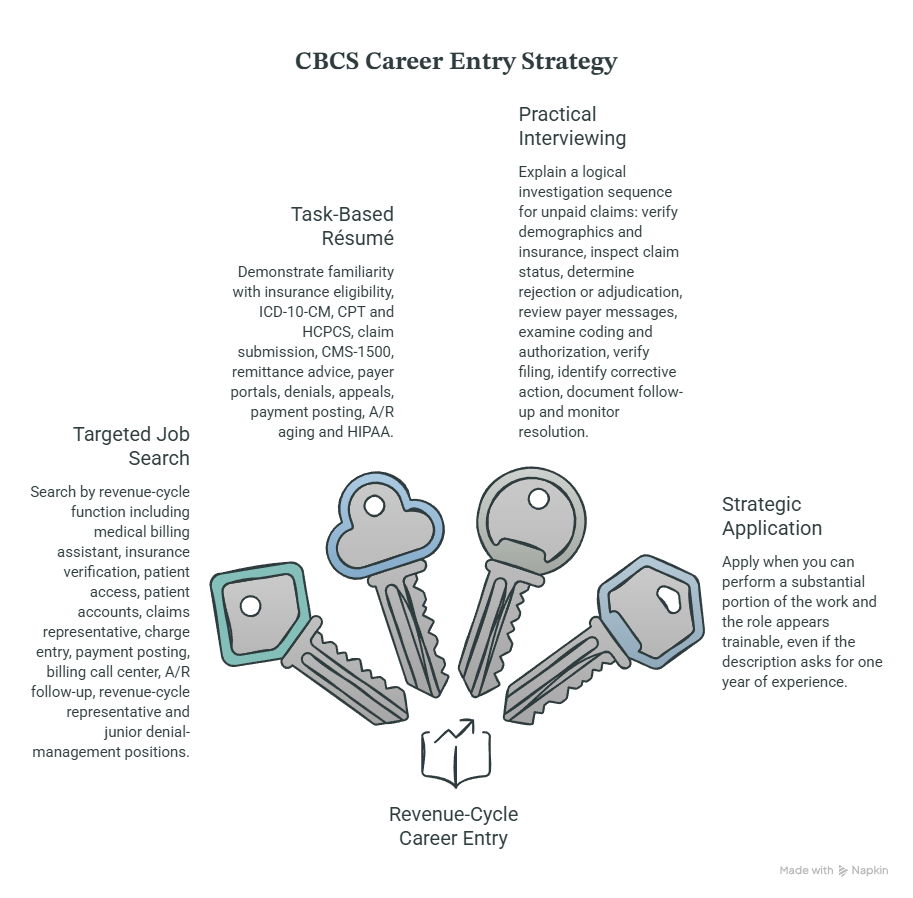
A CBCS holder with no healthcare experience should search by revenue-cycle function, not just by “medical biller.”
Start with medical billing assistant, insurance verification, patient access, patient accounts, claims representative, charge entry, payment posting, billing call center, A/R follow-up, revenue-cycle representative and junior denial-management positions. These roles use knowledge developed through CBCS billing preparation, claim-form training, payment-posting knowledge, and claims-management fundamentals while creating experience future employers can verify.
This approach is particularly important for career changers. Someone entering medical coding without a healthcare background may initially have weaker terminology and insurance exposure. A former medical assistant moving toward coding may already understand clinical workflow, documentation and patient interaction. A nurse considering medical coding after nursing may possess strong anatomy, terminology and documentation knowledge but still need payer and reimbursement exposure.
Your résumé should therefore translate CBCS into tasks, not merely list “NHA CBCS” under certifications.
Instead of relying on the credential name, demonstrate familiarity with insurance eligibility, ICD-10-CM, CPT and HCPCS, claim submission, CMS-1500, remittance advice, payer portals, denials, appeals, payment posting, A/R aging and HIPAA. Candidates can reinforce these areas through CBCS CPT principles, CBCS coding essentials, medical billing reconciliation, and EDI billing terminology.
Do the same during interviews.
If asked how you would handle an unpaid claim, explain a logical investigation sequence: verify demographics and insurance, inspect claim status, determine whether the claim rejected or adjudicated, review payer messages, examine coding and authorization issues, verify timely filing, identify the corrective action, document follow-up and monitor the account until resolution.
That answer demonstrates far more job readiness than simply saying you understand medical billing concepts. It also prepares you for the practical assessments employers use, strengthens your certification résumé evidence, and helps solve the same credibility gap described by candidates who passed certification but still cannot get hired.
Also stop automatically filtering yourself out when a genuinely junior job asks for one year of experience. Job descriptions often combine required and preferred attributes. Apply when you can perform a substantial portion of the work and the role appears trainable. Save your self-rejection for positions demanding specialty independence, complex coding, supervisory experience or several years of production.
5. CBCS Upgrade Paths: Choose the Credential or Experience That Removes Your Specific Hiring Barrier
The strongest CBCS upgrade is determined by the job you want after the next job.
If you want to stay in medical billing, spend serious effort acquiring real revenue-cycle experience before assuming you need another coding credential. Six to twelve months handling claims, insurance verification, payment posting, denials or A/R can materially change your résumé because employers can now evaluate demonstrated work rather than education alone. Building expertise through payment-posting workflows, claims reconciliation, collections management, and healthcare claims operations compounds that experience.
If job postings in your target market repeatedly prefer CPB, a billing-specific credential can make more strategic sense than adding another broad entry-level certificate. Review a meaningful sample of local and remote vacancies before paying for anything. The same cost discipline should guide anyone comparing medical-coding training costs, bootcamp versus college versus self-study, CBCS employer recognition, and credential ROI.
If your target is physician or professional-fee coding, CPC becomes more relevant. Build strong anatomy, terminology, CPT, ICD-10-CM, HCPCS and guideline knowledge before attempting the exam. AMBCI's CPC first-attempt guide, CPC study strategy, CPC terminology preparation, and CPC practice questions can support that transition.
Your billing background can then become an advantage because you understand what happens after coding. A coder who understands denials, reimbursement, claim edits and payer behavior can connect documentation decisions to financial outcomes. That broader perspective also helps when comparing professional-fee and facility coding, inpatient versus outpatient coding, and eventual medical coding auditor careers.
If you want hospital or inpatient coding, CCS is a substantially different destination. AHIMA describes CCS as a progression for professionals experienced in coding inpatient and outpatient records and recommends substantial coding education or direct coding experience as preparation. A CBCS graduate targeting that path should deepen anatomy, pathophysiology, pharmacology, reimbursement methodology, ICD-10-CM and ICD-10-PCS rather than assuming another exam alone creates inpatient readiness. Use the CCS certification directory, CCS CPT preparation, CCS practice questions, and CCS exam-day strategies to evaluate the depth required.
If your interest is risk adjustment, build diagnosis-code accuracy, documentation interpretation, HCC logic and payer-specific knowledge. The risk-adjustment first-specialty guide and HCC coding definitions are more relevant than collecting unrelated certificates. If your goal is broader RCM leadership, prioritize claims performance, denial trends, aging, reimbursement, compliance and operational metrics through claims reconciliation and billing reconciliation.
The best upgrade therefore has a simple test: What exact hiring objection will this next credential or experience remove?
If you cannot answer that question from actual job descriptions, delay the purchase and gather better market evidence.
6. FAQs About Getting a Medical Billing Job With CBCS Alone
-
Yes. Your highest-probability targets are junior billing, patient accounts, insurance verification, claims support, payment posting, charge entry, patient access and other revenue-cycle roles where employers are willing to train. Current listings show that CBCS is recognized in the market, including positions where it is preferred or accepted alongside CPC and CPB.
Your first-job strategy should combine CBCS employer-recognition research, a stronger medical billing résumé, realistic employer targeting, and preparation for practical interview tests.
-
Certification demonstrates assessed knowledge. Experience demonstrates that you can apply that knowledge while handling real payer rules, patient accounts, production expectations, EHR systems, denials and financial consequences.
This is the same certification-versus-experience gap seen in new-coder hiring struggles, post-CPC unemployment, remote job barriers, and medical coding productivity expectations.
-
Get CPC when professional coding is your destination or when a meaningful sample of your target vacancies repeatedly requires or prefers it. Strengthen your foundation through CPC terminology, CPC exam preparation, CPC study strategy, and a realistic understanding of CPC-A employment.
When your immediate goal is medical billing, real claims experience may improve employability faster than another coding examination.
-
Some remote employers accept CBCS, but remote entry-level hiring is particularly difficult because employers often expect independent productivity with minimal supervision. Candidates should study the remote-job experience barrier, strengthen claims-management knowledge, master payment-posting workflows, and build stronger A/R and reconciliation knowledge.
An onsite or hybrid first role can become the shortest credible path to remote work later.
-
Prioritize skills that appear repeatedly in vacancies: eligibility verification, CMS-1500, claim status, EOB/ERA interpretation, payment posting, denials, appeals, A/R aging, CPT, ICD-10-CM, HCPCS, modifiers, Medicare, Medicaid, commercial payers, HIPAA, EHR systems and Excel.
You can deepen those areas through AMBCI's CMS-1500 guide, EDI terminology guide, payment-posting guide, claims reconciliation guide, and billing collections guide.
-
Apply when the role is genuinely junior and you meet much of the functional requirement. A one-year preference should not automatically eliminate a CBCS candidate who can demonstrate strong billing knowledge, transferable administrative experience and credible preparation.
Focus your application on the same evidence covered in medical coding résumé strategy, first-job breakthrough planning, interview-test preparation, and beginner-employer selection.
