
Modifier 52 vs 53 is a frequent source of coding errors, claim denials, and reimbursement disputes because both describe procedures performed differently from the original plan. Modifier 52 generally identifies reduced services, while modifier 53 reports procedures discontinued because of extenuating circumstances or threats to patient safety. The correct selection also depends on physician versus facility billing, anesthesia, and procedure-specific Medicare rules. This guide provides practical coding examples, a detailed decision table, documentation requirements, and payment considerations to help coders defend their decisions during medical coding audits.

1. Modifier 52 vs 53: Key Differences and Coding Decision Rules
The most important distinction between modifiers 52 and 53 is why the procedure was performed differently from its full description.
Modifier 52, Reduced Services, generally applies when a physician or other qualified healthcare professional performs significantly less than the service ordinarily described by a procedure code. The provider deliberately limits or reduces the service, and the original code remains the appropriate starting point when a more specific code does not describe the work.
Modifier 53, Discontinued Procedure, applies when a physician starts a surgical or diagnostic procedure but terminates it because of unforeseen circumstances or conditions threatening the patient's well-being.
A coder reviewing outpatient coding scenarios must establish the distinction using clinical facts rather than relying solely on phrases such as "incomplete," "partial," or "aborted."
The Four Questions That Determine the Correct Modifier
Question 1: Did the procedure actually begin?
Determine whether meaningful procedural work started. A scheduled procedure canceled before any qualifying work generally cannot be reported on the physician's claim using modifier 53.
Facility reporting requires a separate assessment of preparation, procedure-room transfer, and anesthesia timing. This distinction is essential in professional-fee versus facility coding.
Question 2: Why was the service reduced or stopped?
A planned or discretionary reduction may support modifier 52. A procedure terminated because an unexpected clinical condition makes continuing unsafe may support modifier 53.
If the record says only "procedure stopped," investigate the reason through an appropriate physician clarification query.
Question 3: Does a more specific CPT code describe the completed work?
A reduced service may have its own CPT code. When the actual work matches a more specific code, report that code rather than automatically attaching modifier 52 to the originally planned procedure.
This is particularly important in radiology and endoscopy. Review the applicable CPT reference materials and validate the selection through a coding audit checklist.
Question 4: Is the claim professional or facility-based?
Physician claims and hospital outpatient or ambulatory surgical center claims follow different discontinued-procedure reporting rules.
A physician may appropriately report modifier 53 while the facility reports modifier 74 for the same interrupted operative session.
This distinction is fundamental to accurate medical billing workflows and effective claim denial investigations.
Why a Modifier Error Can Cost More Than a Single Claim
An incorrect modifier can lead to an unsupported full-service charge, an inaccurate payment reduction, a medical necessity review, or a denial requiring an operative report.
Repeated modifier errors may also indicate that the organization's procedure documentation, charge capture, or coding policies need improvement.
During a medical coding accuracy review, evaluate both the clinical rationale and financial consequences. The modifier 25 versus 59 guide provides additional context for distinguishing modifiers that change how procedures are reported.
Modifier 52 vs 53: 36 Coding Scenarios, Decisions & Documentation Rules
| Clinical or Billing Scenario | Coding Decision | Required Evidence | Important Coding Rule |
|---|---|---|---|
| 1. Procedure intentionally performed at reduced scope | Consider 52 | Reason and extent of reduction | Confirm a more specific code is unavailable. |
| 2. Procedure started, then stopped for dangerous hypotension | Consider 53 | Vital signs, intervention and timing | Professional claim requires supported discontinuation. |
| 3. Two-view chest X-ray ordered, one view completed | Use 71045 | Actual number of views | Specific single-view CPT code takes priority. |
| 4. Reduced radiology service without an alternative code | Consider 52 | Components actually completed | Verify descriptor and payer policy. |
| 5. Diagnostic procedure terminated after significant arrhythmia | Consider 53 | Clinical event and procedural stage | Requires a documented qualifying interruption. |
| 6. Elective cancellation before procedure begins | Generally no procedure claim | Cancellation and timing | A canceled planned procedure is generally unreportable. |
| 7. Patient refuses before surgical preparation | Generally neither | Consent and cancellation documentation | Review separately performed billable services. |
| 8. Planned bilateral service performed on one side | Code actual service first | Laterality and procedure descriptor | Consider 52 only when supported and appropriate. |
| 9. Limited procedure has a dedicated CPT code | Use specific code | Anatomic extent and service completed | Avoid reporting a larger service with 52. |
| 10. Procedure completed exactly as described | Neither | Complete operative report | Ordinary technical difficulty alone does not justify 52. |
| 11. Planned therapeutic step omitted by provider decision | Evaluate 52 | Which portion was omitted and why | Check for an accurate lesser-service code. |
| 12. Unexpected bleeding requires termination after incision | Consider 53 | Bleeding, action taken and time stopped | Professional discontinued-procedure rules apply. |
| 13. Diagnostic colonoscopy interrupted unexpectedly | 45378-53 if applicable | Scope extent and termination reason | Follow Medicare incomplete-colonoscopy policy. |
| 14. Average-risk screening colonoscopy interrupted | G0121-53 if applicable | Screening indication and incomplete extent | Check Medicare screening eligibility. |
| 15. High-risk screening colonoscopy interrupted | G0105-53 if applicable | Risk category and procedure findings | Confirm high-risk screening criteria. |
| 16. Colonoscopy through stoma interrupted | 44388-53 if applicable | Stoma route and termination details | Verify code descriptor and Medicare policy. |
| 17. Intended flexible sigmoidoscopy completed | Report actual sigmoidoscopy | Original intent and examination extent | Do not automatically report colonoscopy-53. |
| 18. Incomplete colonoscopy with biopsy performed | Review procedure-specific policy | Biopsy site, scope extent and reason stopped | Validate the appropriate completed service and payer rule. |
| 19. Operative session stopped after anesthesia begins | Facility: consider 74 | Anesthesia administration and timing | Professional claim assessed separately. |
| 20. Patient prepped and in room; anesthesia not yet given | Facility: consider 73 | Room transfer and anesthesia record | Anesthesia must have been planned. |
| 21. Facility procedure started before anesthesia | Facility: consider 74 | Actual procedure start | Procedure initiation can establish 74 eligibility. |
| 22. Facility service stopped; no anesthesia was planned | Facility: consider 52 | Preparation, room entry and work performed | Specific Medicare OPPS rules apply. |
| 23. Physician and facility bill same interrupted surgery | Different modifiers possible | Separate professional and facility records | 53 and 74 can describe the same clinical event. |
| 24. Procedure canceled before patient reaches procedure room | Generally no facility procedure claim | Cancellation point | Avoid unsupported 73/74 reporting. |
| 25. Planned procedures A and B; only A completed | Report completed A | Separate procedure documentation | Unstarted B generally is not separately reported. |
| 26. Patient discomfort leads to interrupted endoscopy | Evaluate 53 and code-specific rule | Reason, findings and scope advancement | Confirm qualifying interruption and payer guidance. |
| 27. Procedure billed at full fee after major work omitted | Audit for 52 | Extent of performed work | Reduce unsupported full-service reporting. |
| 28. Modifier 53 submitted without interruption reason | Query or documentation review | Clinical reason and procedure stage | Medical review may require operative evidence. |
| 29. Modifier 52 attached to E/M code | Correct coding approach | Supported E/M level | 52 is inappropriate for E/M reporting. |
| 30. Modifier 53 attached to anesthesia time code | Review applicable time-based rules | Anesthesia record and units | 53 generally is not used on time-based codes. |
| 31. Discontinued procedure rescheduled for another day | Code each encounter independently | Both encounter records | Do not combine work from separate dates. |
| 32. Modifier 52 applied to bypass an NCCI edit | Incorrect purpose | Code pair and actual service relationship | 52 does not establish distinct procedural service. |
| 33. Modifier 53 denied for incomplete medical record | Correct documentation and appeal if justified | Procedure report and claim narrative | Use applicable payer reconsideration process. |
| 34. Reduced-service reimbursement disputed | Review payer pricing policy | Charge, allowance and completed work | Payment is not universally a fixed 50%. |
| 35. Operative note conflicts with anesthesia record | Clarify and reconcile | Time-stamped operative and anesthesia events | Resolve evidence conflicts before submission. |
| 36. Auditor evaluates repeated 52/53 denials | Perform modifier-specific audit | Denial codes, notes and payment patterns | Correct the underlying recurring failure. |
2. Modifier 52: When to Report Reduced Services With Coding Examples
Modifier 52 applies when the actual service is significantly reduced from the work normally represented by the procedure code, and the circumstances support reporting the original code with a reduced-services modifier.
The physician's decision, the actual procedural extent, and the existence of a more appropriate CPT code determine whether the modifier is defensible.
Medicare's reduced-service reporting guidance also requires documentation describing how the service differed from the usual procedure. Review your coding audit checklist and the relevant CPT coding resources before adding 52.
Example 1: A Radiology Study Is Performed at Reduced Scope
Scenario: A physician orders a multi-component diagnostic imaging study. The provider performs a substantially reduced portion of the intended study after modifying the clinical plan. The completed service has no specific alternative CPT/HCPCS code.
Coding decision: Consider reporting the original applicable procedure code with modifier 52, provided the code descriptor and payer rules support the reduced-service designation.
Required documentation: Identify the original examination, completed components, omitted components, and reason for reducing the study.
If a dedicated code describes the completed examination, select that code. This is particularly important when applying medical coding accuracy principles to outpatient diagnostic coding cases.
Example 2: A Two-View Chest X-Ray Becomes a Single-View Study
Scenario: A two-view chest radiograph was ordered. Only a frontal view was obtained.
The applicable CPT codes are:
71046: Chest radiograph, two views.
71045: Chest radiograph, single view.
Correct coding approach: Report 71045 for the completed single-view study when applicable.
This illustrates an essential modifier 52 limitation. A specific code already describes the service actually performed.
Billing 71046-52 would misrepresent the service's available coding specificity. Coders preparing for practical coding assessments should practice this distinction using current coding reference books.
Example 3: A Bilateral Service Is Reduced to One Side
Scenario: A procedure code inherently describes bilateral work, but the surgeon performs only the right-sided component.
Coding decision: First determine whether an appropriate unilateral procedure code exists and whether payer rules require laterality reporting.
If the descriptor inherently includes bilateral work, no separate unilateral code accurately describes the completed service, and payer policy permits reduced-service reporting, modifier 52 may be appropriate.
Documentation should establish:
The original bilateral procedure.
Why one component was omitted.
The exact work completed.
Whether the change was discretionary or required by an unexpected clinical event.
A common error is treating all unilateral procedures as reduced bilateral services. Understanding modifier selection rules and professional coding documentation helps prevent this mistake.
Example 4: The Physician Intentionally Limits a Procedure
Scenario: During a surgical procedure, the physician determines that the patient's clinical condition requires a less extensive operation than originally intended. The reduced intervention is completed successfully, with no unexpected event requiring immediate termination.
Coding decision: Review whether the work performed supports a lesser CPT code. If the original procedure remains the best code and a significant portion was intentionally omitted, modifier 52 may apply.
The operative note should identify the surgical steps completed and omitted.
If the case instead describes an emergency interruption, modifier 53 may be appropriate. Review coding practice scenarios and compliant physician query examples to resolve ambiguous descriptions.
Example 5: One of Two Scheduled Procedures Is Canceled
Scenario: A surgeon plans two independently reportable procedures. The first procedure is completed, and the second is canceled before it begins.
Coding decision: Report the completed procedure according to its actual documentation. The unstarted second procedure generally has no separately reportable physician procedure service.
The completed procedure does not become a reduced service simply because the overall operative schedule changed.
Review the separate procedure reporting rules and apply the coding audit checklist to each distinct procedure.
Three Situations Where Modifier 52 Commonly Causes Errors
The first involves using modifier 52 when a more specific code already describes the work. This happens frequently when a limited examination has an established code.
The second involves adding modifier 52 to evaluation and management services or time-based codes. Medicare contractor guidance identifies E/M and time-based services as inappropriate uses of this modifier.
The third involves omitting the explanation of how much work was completed. Medicare contractors may require the operative report or appropriate supporting documentation with the claim.
Use medical coding documentation standards, claim submission resources, and denial analysis workflows to address these risks before submission.
3. Modifier 53: Discontinued Procedures, Patient Safety, and Coding Examples
Modifier 53 applies when a physician or other qualified healthcare professional begins a surgical or diagnostic procedure and stops it because of extenuating circumstances or conditions affecting patient safety.
The defining feature is the documented clinical reason for discontinuation.
This can include unexpected bleeding, severe changes in vital signs, an anatomical obstruction, or a patient response that prevents safe continuation.
A strong modifier 53 claim explains exactly what started, why it stopped, and how far the procedure progressed.
These elements should be evaluated during coding accuracy audits, particularly when claims involve repeated denials and appeals.
Example 6: Surgery Is Stopped Because of Severe Hypotension
Scenario: A surgical procedure begins. During the operation, the patient develops significant hypotension that does not respond promptly to initial treatment. The surgeon terminates the planned procedure because continuing creates unacceptable clinical risk.
Coding decision: Consider modifier 53 on the physician's applicable procedure code.
For the facility claim, determine whether modifier 74 applies based on its separate reporting requirements.
Documentation: Record the procedure start, completed surgical work, hypotensive episode, treatment, termination decision, and patient's condition.
Incomplete vital-sign or anesthesia records create a major vulnerability during medical coding audits. Coders should use physician query procedures to resolve missing details.
Example 7: A Procedure Is Terminated Because of Unexpected Bleeding
Scenario: After beginning surgery, the surgeon encounters significant unexpected bleeding. The patient's condition requires immediate control of the bleeding and termination of the original planned intervention.
Coding decision: Modifier 53 may apply to the discontinued professional procedure.
The operative report must identify which portions of the intended service were completed. Any independently reportable additional service should be evaluated under its own coding rules.
This distinction matters during surgical coding assessments and documentation compliance reviews.
Example 8: Diagnostic Colonoscopy Cannot Be Completed
Scenario: A physician attempts a diagnostic colonoscopy, but an unexpected obstruction prevents advancement to the intended endpoint. The physician discontinues the examination.
Medicare coding example: 45378-53, assuming this is the appropriate attempted diagnostic colonoscopy code and the circumstances satisfy Medicare's incomplete-colonoscopy requirements.
For applicable Medicare physician claims, the following codes have specific incomplete-colonoscopy policies:
45378-53: Incomplete diagnostic colonoscopy.
G0121-53: Incomplete average-risk screening colonoscopy.
G0105-53: Incomplete high-risk screening colonoscopy.
44388-53: Incomplete colonoscopy through an existing stoma.
The actual indication, completed procedures, and applicable billing policy determine the appropriate selection.
Medicare's incomplete-colonoscopy methodology establishes specific payment values based on half the relevant code inputs. This rule should be distinguished from general modifier 53 pricing.
The record should identify the furthest anatomical point reached, the reason the examination ended, and whether a biopsy or therapeutic intervention occurred.
Practice through outpatient medical coding scenarios, verify Medicare billing guidance, and review the coding audit checklist.
Example 9: The Physician Cannot Safely Pass an Instrument
Scenario: During an attempted diagnostic or surgical intervention, the physician encounters unexpected anatomical resistance. Further attempts could injure the patient, so the physician terminates the procedure.
Coding decision: Consider modifier 53 if procedural work began and the documentation establishes a qualifying interruption.
For example, Medicare contractor guidance recognizes discontinuation when a physician cannot safely advance a pipelle through the cervix.
The record should explain the attempted technique, the anatomical difficulty, the safety concern, and the stopping point.
Avoid interpreting every technically difficult procedure as discontinued. Apply the principles from coding case practice and physician documentation queries.
Example 10: Severe Patient Distress Interrupts an Endoscopic Examination
Scenario: An endoscopic procedure begins. The patient develops significant intolerance despite appropriate clinical management, and the physician determines that continuing would jeopardize patient safety.
Coding decision: Modifier 53 may apply, subject to the relevant code-specific and payer rules.
The documentation needs more detail than a generic statement that the patient was uncomfortable. Describe the clinical response, actions attempted, procedural extent, and reason continuation was unsafe.
This is especially important for medical coding interview tests and medical necessity or documentation appeals.
Example 11: Surgery Is Canceled Before Anesthesia or Procedural Work
Scenario: A patient is scheduled for surgery. Before the procedure begins, a new medical problem is discovered and the surgeon cancels the operation.
Professional coding decision: Evaluate the actual services performed. Modifier 53 generally requires the discontinued procedure to have started.
For the facility, eligibility for modifier 73 may depend on whether the patient was prepared and taken to the procedure room for a procedure requiring anesthesia.
The separate rules illustrate why professional-fee coding and facility billing procedures require different claim reviews.
The Incomplete Colonoscopy Trap: Intended Procedure vs Actual Examination
A planned colonoscopy and an intentionally limited sigmoidoscopy represent different coding circumstances.
When the physician intends to complete a colonoscopy and unforeseen circumstances interrupt the attempt, Medicare's incomplete-colonoscopy rules may support modifier 53.
When the physician intends to perform only a flexible sigmoidoscopy and completes that examination, the appropriate sigmoidoscopy code generally describes the actual service.
If a biopsy or therapeutic service was completed during an interrupted examination, review the full procedure documentation and applicable coding policy before assigning a code.
This prevents an especially costly mistake: using the procedure initially ordered as the sole basis for reporting.
Review CPT coding reference materials, outpatient coding cases, and claim denial investigation methods before finalizing complex interrupted-endoscopy claims.
4. Modifier 52 vs 53 vs 73 vs 74: Physician and Facility Billing Rules
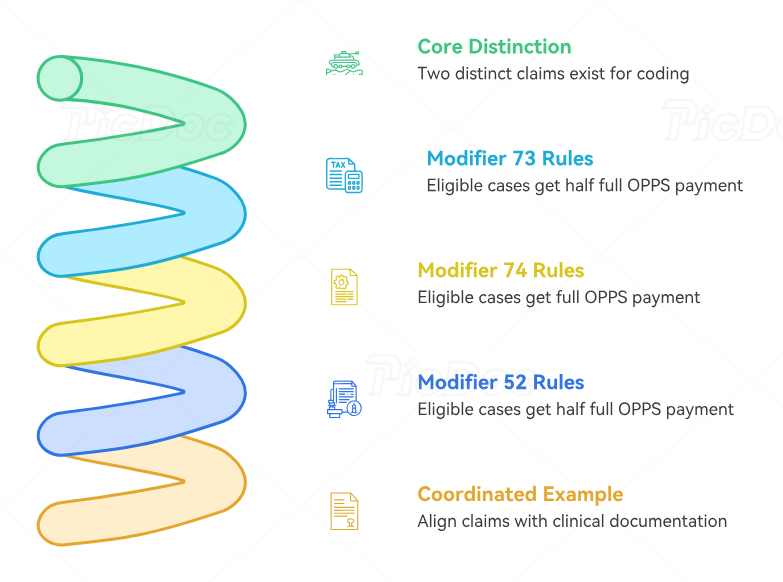
A single discontinued procedure can generate a professional claim and a facility claim. Each claim describes different services and follows its applicable modifier requirements.
This is one of the most important distinctions for coders working across hospitals, ambulatory surgery centers, and physician practices.
The correct approach begins by identifying the billing entity, followed by the actual clinical sequence.
Use professional-fee versus facility coding guidance and Medicare claim resources to distinguish these requirements.
Modifier 73: Facility Procedure Discontinued Before Anesthesia
Modifier 73 generally identifies a discontinued outpatient hospital or ASC procedure when the patient has been prepared and taken to the procedure room, but anesthesia has not yet been administered.
For this purpose, Medicare's hospital outpatient rules recognize a broad definition of anesthesia, including local anesthesia, regional blocks, moderate sedation, deep sedation, and general anesthesia.
Example: A patient enters the operating room for a procedure requiring anesthesia. Before anesthesia begins, the patient develops a serious clinical problem that requires cancellation.
The facility may report the appropriate procedure code with modifier 73 when all reporting conditions are satisfied.
Under the general Medicare hospital outpatient payment framework, eligible modifier 73 procedures receive 50% of the full applicable OPPS payment amount, subject to specific adjustments and exceptions.
A review of claim adjustment reason codes can help distinguish an expected payment adjustment from an actual billing denial.
Modifier 74: Facility Procedure Discontinued After Anesthesia or Procedure Initiation
Modifier 74 generally applies when an eligible outpatient hospital or ASC procedure is discontinued after anesthesia has been administered or the procedure has started.
A procedure can qualify as started when meaningful procedural work begins, such as an incision, scope insertion, or another qualifying intervention.
Example: General anesthesia is induced, and the surgeon begins an operation. An unexpected complication causes the procedure to be stopped.
The facility evaluates modifier 74, while the surgeon separately assesses whether modifier 53 applies to the professional service.
Under the general Medicare OPPS framework, eligible modifier 74 procedures receive the full applicable procedure payment, reflecting resources already committed to the case. Separate payment systems and code-specific rules can change the actual allowance.
Use Medicare reimbursement guidance and medical coding audit procedures to verify the setting-specific result.
When Can a Facility Use Modifier 52?
Medicare permits modifier 52 in specified hospital outpatient circumstances involving partial reductions or discontinuation of services for which anesthesia was not planned.
The conditions for facility reporting and payment differ from the professional reduced-service framework.
For example, a qualifying service without planned anesthesia may be discontinued after the patient is prepared and taken to the procedure room. In such circumstances, the applicable facility reporting pathway may use modifier 52.
Medicare OPPS generally pays qualifying cases at 50% of the full applicable amount, subject to the relevant policy.
This exception is often missed in simplified medical coding study resources and coding interview assessments.
A Complete Physician-and-Facility Coding Example
Clinical situation: A surgeon performs an outpatient procedure under general anesthesia. After the procedure begins, unexpected bleeding makes continuation unsafe.
Professional claim: The surgeon evaluates the discontinued procedure using modifier 53, provided the clinical and documentation requirements are satisfied.
Facility claim: The hospital outpatient department evaluates modifier 74 because anesthesia was administered and the procedure began.
Documentation: Both claims should align with the operative report, anesthesia record, procedural start, clinical complication, and stopping decision.
This coordination is especially important during billing compliance audits and payer reimbursement disputes.
5. Modifier 52 and 53 Reimbursement, Documentation, and Denial Prevention
Modifiers 52 and 53 can affect reimbursement, but the amount paid depends on the code, payer, setting, and applicable payment methodology.
Neither modifier creates a universal 50% payment rule for every professional claim.
Medicare establishes specific fee schedule values for certain incomplete colonoscopy services, while other discontinued procedures may be reviewed and individually priced.
Reduced-service claims may likewise require supporting documentation and payer-specific valuation.
Coders should investigate the actual payment policy through physician fee schedule resources, claim adjustment references, and denial analysis tools.
How to Estimate the Financial Impact of Reduced Procedures
Consider two illustrative scenarios.
Scenario A: Reduced service
A procedure normally carries an allowed amount of $600. The service is substantially reduced, and the payer determines an appropriate reduced allowance of $390.
The resulting difference is $210.
The calculation reflects a hypothetical payer-specific outcome rather than a standard modifier 52 percentage.
Scenario B: Discontinued service
A procedure normally carries an allowed amount of $1,200. After the work begins, an unexpected patient safety issue requires discontinuation. The payer reviews the documentation and determines an illustrative allowance of $650.
The difference is $550.
Payment must follow the actual contract or applicable Medicare policy. The coder's responsibility is to ensure that the billed procedure, modifier, and supporting documentation accurately describe the service.
Practices should incorporate these cases into reimbursement benchmarking and accounts receivable monitoring.
Seven Documentation Elements That Protect a Modifier Claim
1. Original procedure: Identify what was planned, including its purpose, intended extent, and expected anatomical scope.
2. Procedure start: Record when meaningful procedural work began. Distinguish patient preparation from actual procedure initiation.
3. Work completed: Describe the completed stages and anatomical findings. Where useful and required, estimate the percentage or extent of work performed.
4. Reason for change: Identify the clinical rationale for reduction or discontinuation.
5. Patient condition: Record unexpected bleeding, vital-sign deterioration, anatomical obstruction, intolerance, or other relevant factors.
6. Anesthesia timeline: Identify the type of anesthesia or sedation, whether it was planned, and when administration occurred.
7. Final disposition: Document how the procedure ended, patient stabilization, immediate management, and any plan for a future attempt.
These elements help coders respond to medical necessity documentation reviews and strengthen compliant physician query workflows.
What to Do When a Modifier 52 or 53 Claim Is Denied
Start by obtaining the payer remittance and identifying the exact Claim Adjustment Reason Code and any Remittance Advice Remark Codes.
Determine whether the denial concerns modifier eligibility, medical necessity, missing documentation, invalid code pairing, or a payment policy disagreement.
Next, compare the billed code and modifier against the operative report and relevant payer rules.
If the claim was coded incorrectly, follow the payer's correction process. If the coding was supported and documentation was omitted, submit a reconsideration or appeal with the required records.
Use medical billing appeal letter templates, CARC reference guidance, and the medical necessity denial checklist to prepare an evidence-based response.
Modifier Audit: A Practical Quality-Control Workflow
For a meaningful audit, sample claims containing modifiers 52, 53, 73, and 74.
Record the CPT/HCPCS code, payer, billing setting, documented reason for reduction or discontinuation, anesthesia status, and adjudication outcome.
Review each claim against four criteria:
Modifier validity: Does the clinical event match the modifier's definition?
Documentation sufficiency: Does the record explain the procedure and its stopping point?
Coding specificity: Was the most appropriate code selected for the service actually performed?
Payment correctness: Does the allowance match the applicable reimbursement policy?
A recurring pattern of 53 claims without operative detail suggests a documentation problem. Repeated 52 denials involving limited radiology may indicate that coders are overlooking specific lesser-service CPT codes.
Investigate findings through the medical coding audit checklist, calculate trends using the denial rate worksheet, and monitor collection delays with the A/R days calculator.
The strongest improvement comes from correcting recurring workflow failures, updating claim edit configurations, and teaching providers exactly which details must appear in their procedure notes.
6. Frequently Asked Questions About Modifier 52 vs 53
-
Modifier 52 generally reports a significantly reduced service, while modifier 53 identifies a surgical or diagnostic procedure that was started and then discontinued because of extenuating circumstances or patient safety concerns.
The decision depends on what work was performed, why it was reduced or stopped, whether a more specific CPT code exists, and which entity is billing.
Practice the distinction through medical coding case studies and the medical coding audit checklist.
-
For the same procedure line, these modifiers generally describe different circumstances and should not be combined as a routine reporting practice.
The coder should determine whether the service was deliberately reduced or terminated because of qualifying extenuating circumstances.
If multiple distinct procedures were attempted, analyze each separately according to the actual work and applicable reporting rules.
Review modifier coding examples and CPT reference materials when faced with complicated operative sessions.
-
Payment depends on the applicable Medicare policy, CPT/HCPCS code, and billing setting.
Professional reduced-service claims may require individual review and documentation supporting the extent of work performed. Particular facility services without planned anesthesia have separate Medicare OPPS payment rules.
Review the Medicare physician fee schedule, applicable billing resources, and claim adjustment codes before calculating a reimbursement variance.
-
For Medicare, modifier 53 applies when an attempted covered colonoscopy cannot be completed because of qualifying unforeseen circumstances.
Appropriate professional reporting may involve 45378-53, G0105-53, G0121-53, or 44388-53, depending on the indication and procedure.
The record should explain why the examination was interrupted and how far the scope advanced. If a biopsy or therapeutic intervention was performed, evaluate the appropriate procedural coding separately.
Review outpatient coding practice cases and medical coding documentation requirements.
-
The timing and circumstances of refusal determine the appropriate reporting.
A patient who withdraws consent before procedural work begins generally does not support reporting a discontinued professional procedure using modifier 53.
If the procedure has already begun and an unexpected patient response requires termination, the coder must evaluate the specific circumstances, documentation, and payer policy.
Facility rules may differ. Use physician query templates and professional versus facility coding guidance when the record is unclear.
-
Modifier 53 is used for qualifying discontinued procedures reported by physicians or other qualified healthcare professionals.
Modifier 74 is used by outpatient hospitals or ambulatory surgical centers for qualifying procedures discontinued after anesthesia administration or procedural initiation.
A single clinical event may support modifier 53 on the professional claim and modifier 74 on the facility claim.
Check the Medicare billing resource directory and the medical coding audit checklist for setting-specific validation.
