
Essential Medical Coding Exam Books & Resources Reviewed
Medical coding candidates often spend too much money on resources that duplicate the same material while missing the books they actually need to navigate under exam pressure. Your study stack should match your certification, current code year, weak domains, and exam-day reference rules. Someone preparing for the CPC needs a different setup from a CCS candidate, while a career changer may need stronger medical terminology preparation before tackling advanced cases. This guide reviews the resources worth buying, borrowing, practicing with, and skipping.
1. What Should Actually Be in a Medical Coding Exam Study Stack?
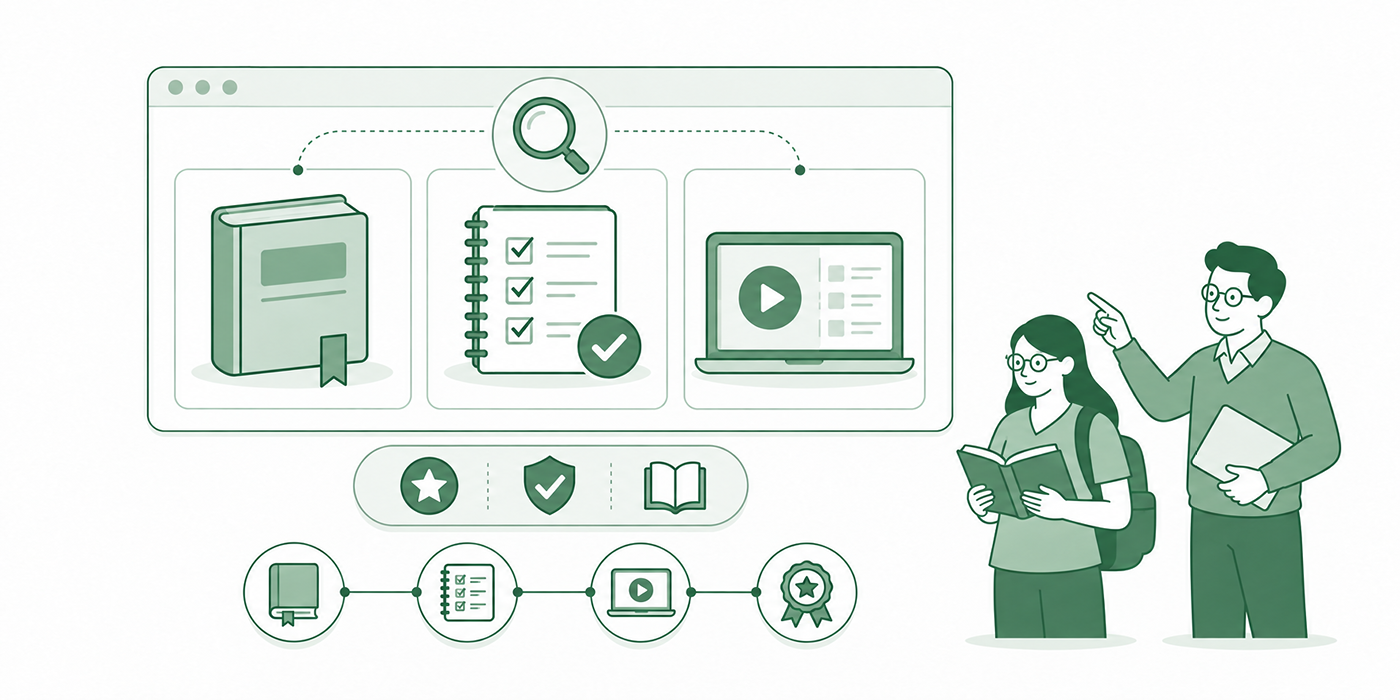
A strong study stack has four layers: the code books you must navigate, resources that teach the rules behind those books, realistic practice questions, and a system for correcting mistakes. Candidates preparing through self-study, a bootcamp, or community college often accumulate far more material than they can realistically master. That creates a painful problem: hundreds of dollars spent, multiple half-finished textbooks, and very little improvement in code-selection speed.
Start with your certification's current reference policy. For the CPC, AAPC currently lists the AMA CPT Professional Edition, an ICD-10-CM book, and a HCPCS Level II book as the approved core code books. The CPC currently contains 100 multiple-choice questions with four hours allowed, so being able to locate information quickly matters almost as much as recognizing the underlying concept. Candidates building a lean CPC study stack should therefore prioritize navigation and application over collecting another five summary books.
For AHIMA certifications, verify the exact required edition before spending anything. AHIMA requires candidates taking the CCS on or after May 1, 2026 to bring approved 2026 versions of ICD-10-CM, ICD-10-PCS, and AMA CPT 2026 Professional Edition. The organization warns that candidates arriving without the correct approved books can be refused testing and lose their exam fee. That makes ISBN verification much more important for a CCS candidate than simply finding the cheapest book advertised online.
The same principle applies to the CCA. AHIMA's 2026 CCA requirements specify a 2026 ICD-10-CM book from its approved list, an approved 2026 ICD-10-PCS book, and the AMA CPT 2026 Professional Edition. Anyone comparing coding certification costs should budget for required current books before spending heavily on optional flashcards, subscriptions, or oversized course bundles.
The second layer is concept repair. A code book tells you what codes exist; it rarely fixes weak anatomy, terminology, sequencing logic, reimbursement knowledge, modifier judgment, or interpretation of documentation. Candidates entering medical coding without a healthcare background may need an anatomy atlas and terminology resource earlier than someone transitioning from medical assisting into coding or moving from nursing into coding.
The third layer is question practice. Use questions that force you to look up codes, interpret notes, compare close answer choices, recognize guideline exceptions, and explain why the rejected options are wrong. The Top 50 CPC exam questions, a structured CPC exam strategy, and targeted CPC first-attempt preparation become useful when they are used to expose reasoning gaps rather than memorize answer patterns.
| Resource | Best For | Main Value | Priority |
|---|---|---|---|
| AMA CPT 2026 Professional Edition | CPC, CCA, CCS, physician coding | CPT codes, guidelines, modifiers and procedure navigation | Essential when required |
| 2026 ICD-10-CM code book | Diagnosis coding | Index-to-tabular diagnosis selection and conventions | Essential |
| 2026 HCPCS Level II book | CPC and outpatient coding | Supplies, drugs, DME and Level II codes | Essential for applicable exams |
| 2026 ICD-10-PCS book | CCA, CCS, inpatient coding | Inpatient procedure construction and root operations | Essential for applicable exams |
| Official ICD-10-CM Guidelines | Every diagnosis coder | Sequencing, conventions and chapter-specific rules | High |
| Official ICD-10-PCS Guidelines | Inpatient candidates | Root-operation and procedural coding rules | High |
| CPC-focused study guide | CPC candidates | Exam-domain review and applied coding practice | High |
| CCS-focused exam preparation | CCS candidates | Inpatient/outpatient integration and domain review | High |
| CCA-focused exam preparation | Entry-level AHIMA candidates | Broad coding and health-information foundation | High |
| Medical terminology reference | Beginners and career changers | Faster interpretation of clinical documentation | High if weak |
| Anatomy atlas | Procedure-heavy learners | Body systems, structures and surgical context | High if weak |
| Pathophysiology resource | CCS and advanced coding | Disease relationships and documentation interpretation | Medium-high |
| Basic pharmacology reference | Drug-heavy encounters | Medication classes, indications and clinical context | Medium |
| Reimbursement methodology guide | CCS, billing and advanced candidates | Payment systems and reimbursement logic | Medium-high |
| Timed practice exam | All candidates | Measures pace, stamina and retrieval speed | Essential |
| Topic-specific question bank | Weak-domain repair | Concentrated repetition without full-exam fatigue | High |
| Coding case workbook | Applied learners | Translates documentation into defensible code choices | High |
| E/M reference material | Physician/outpatient candidates | E/M selection and documentation reasoning | High where tested |
| Modifier drills | CPT-heavy exams | Prevents close-answer errors involving procedural circumstances | High |
| CMS NCCI resources | Advanced outpatient learning | Bundling and edit logic | Medium |
| CMS HCPCS update files | Working coders and advanced learners | Tracks quarterly Level II changes | High professionally |
| Annual code-change summary | Repeat candidates and professionals | Identifies additions, revisions and deletions | High |
| Book tabs | Slow navigators | Reduces physical search time | Useful |
| Personal error log | Every serious candidate | Converts wrong answers into targeted revision | Essential |
| Index-navigation drills | ICD beginners | Builds correct Index → Tabular workflow | Essential |
| PCS root-operation chart | Inpatient candidates | Separates commonly confused procedure objectives | High |
| Sample operative reports | Procedure coders | Builds documentation-to-code translation | High |
| Sample claim forms | Billing-oriented learners | Connects coding decisions to claim workflow | Medium |
| CARC/RARC reference | Billing and denial learners | Explains adjustment and remittance outcomes | Medium |
| One-page weak-area tracker | Final revision | Directs study time toward recurring errors | Essential |
2. The Core Code Books Reviewed: Which Ones Are Worth Your Money?
AMA CPT Professional Edition: the highest-priority procedural book
For CPC candidates, the AMA CPT Professional Edition is the procedural reference around which a large part of exam preparation revolves. AAPC specifically identifies the AMA Professional Edition for its CPC exam rather than allowing an arbitrary CPT publication. Candidates practicing CPT principles should spend less time memorizing isolated five-digit codes and more time understanding section guidelines, parenthetical instructions, add-on codes, modifier logic, bundled services, and the relationship between documentation and code selection.
The best way to review this book is through timed retrieval. Open a CPC practice question set, identify the service, locate the candidate code range, read the surrounding instructions, and eliminate choices using the guideline language. This mirrors the reasoning needed on a real exam far better than repeatedly reading chapters. It also prepares candidates for medical coding interview tests, where employers may care more about defensible lookup skills than raw memorization.
ICD-10-CM: choose for usability, then learn the official workflow
ICD-10-CM should become a navigation tool rather than a giant book you fear opening. The correct habit is to begin in the Alphabetic Index, identify the tentative code, verify it in the Tabular List, then read every applicable instructional note. Candidates who skip verification often miss Excludes notes, additional-code requirements, laterality, seventh characters, manifestation rules, or required specificity.
For AAPC examinations, candidates can choose their ICD-10-CM publisher within the organization's current rules. AHIMA candidates face a stricter approved-book list, including specific 2026 titles and ISBNs. This distinction matters when comparing coding-course costs, buying secondhand books, or building a self-study coding program.
HCPCS Level II: smaller book, expensive mistakes
HCPCS Level II receives less attention from many CPC students because CPT feels larger and ICD-10-CM feels more intimidating. That is exactly why candidates can leave easy points behind. Build familiarity with DME, supplies, ambulance services, injectable drugs, temporary codes, and common modifiers rather than treating HCPCS as an afterthought.
CMS publishes HCPCS Level II updates during the year; its official quarterly page currently includes January, April, July, and October 2026 files. For exam preparation, follow the exam administrator's required code year. For professional practice after certification, learn to monitor updates because real coding continues moving after your exam. That distinction matters for anyone thinking beyond passing into medical billing employment or comparing medical billing and medical coding careers.
ICD-10-PCS: indispensable for inpatient pathways
CPC candidates generally do not need an ICD-10-PCS book for their CPC exam. CCS and CCA candidates do. That single distinction can save a beginner from purchasing a large reference that does nothing for their immediate certification goal.
PCS requires conceptual learning because each character has meaning and the correct code depends heavily on what was actually done, especially the root operation. Candidates considering inpatient versus outpatient coding should expect PCS to demand stronger procedural interpretation than simple code recognition. The same skill becomes valuable later when pursuing higher-paying coding specialties.
3. The Best Supporting Resources for CPC, CCS and CCA Preparation
A study guide earns its place when it solves a problem the code books cannot solve efficiently. For CPC preparation, that usually means teaching you how coding domains connect, then giving you enough questions to apply the rules. A candidate who has already completed a focused 2026 CPC preparation plan may gain more from timed practice than buying another general textbook. Someone who failed the CPC previously should purchase according to the weak domains revealed by the first attempt.
For CCS candidates, the supporting stack needs broader clinical depth. AHIMA itself describes recommended preparation as including anatomy and physiology, pathophysiology, pharmacology, medical terminology, reimbursement methodology, intermediate or advanced ICD coding, and CPT/HCPCS knowledge. That explains why someone comfortable with professional-fee coding can still struggle with CCS-level inpatient scenarios.
An anatomy resource is worth buying when anatomy is slowing down code selection. You do not need a medical-school atlas. You need fast clarification of structures, systems, surgical relationships, and terminology that repeatedly appear in your coding cases. Pair that resource with focused medical terminology study instead of memorizing disconnected prefixes and suffixes.
A question bank is worth buying only when it teaches from mistakes. A thousand unexplained multiple-choice questions can create false confidence. Two hundred difficult questions with clear rationales may provide substantially more value because they expose why a code, modifier, guideline, sequencing rule, or interpretation failed. Use detailed CPC explanations, CCS practice questions, and an exam-day coding checklist as feedback tools rather than score generators.
A reimbursement resource becomes high priority when payment logic keeps costing you questions. This is especially important for candidates who understand code assignment but struggle with claims, payer rules, reimbursement structures, or denial consequences. Reviewing a physician fee schedule guide, Medicaid reimbursement concepts, and claim adjustment reason codes can connect abstract coding decisions to real revenue-cycle outcomes.
Your most valuable resource may ultimately be your own error log. Every missed question should record the domain, your chosen answer, the correct reasoning, the rule you missed, and the action needed to prevent recurrence. This method also builds the disciplined reasoning expected in coding auditor careers, where identifying why a coding decision failed matters more than simply knowing that it failed.
4. How to Use Your Books So They Actually Improve Your Exam Score
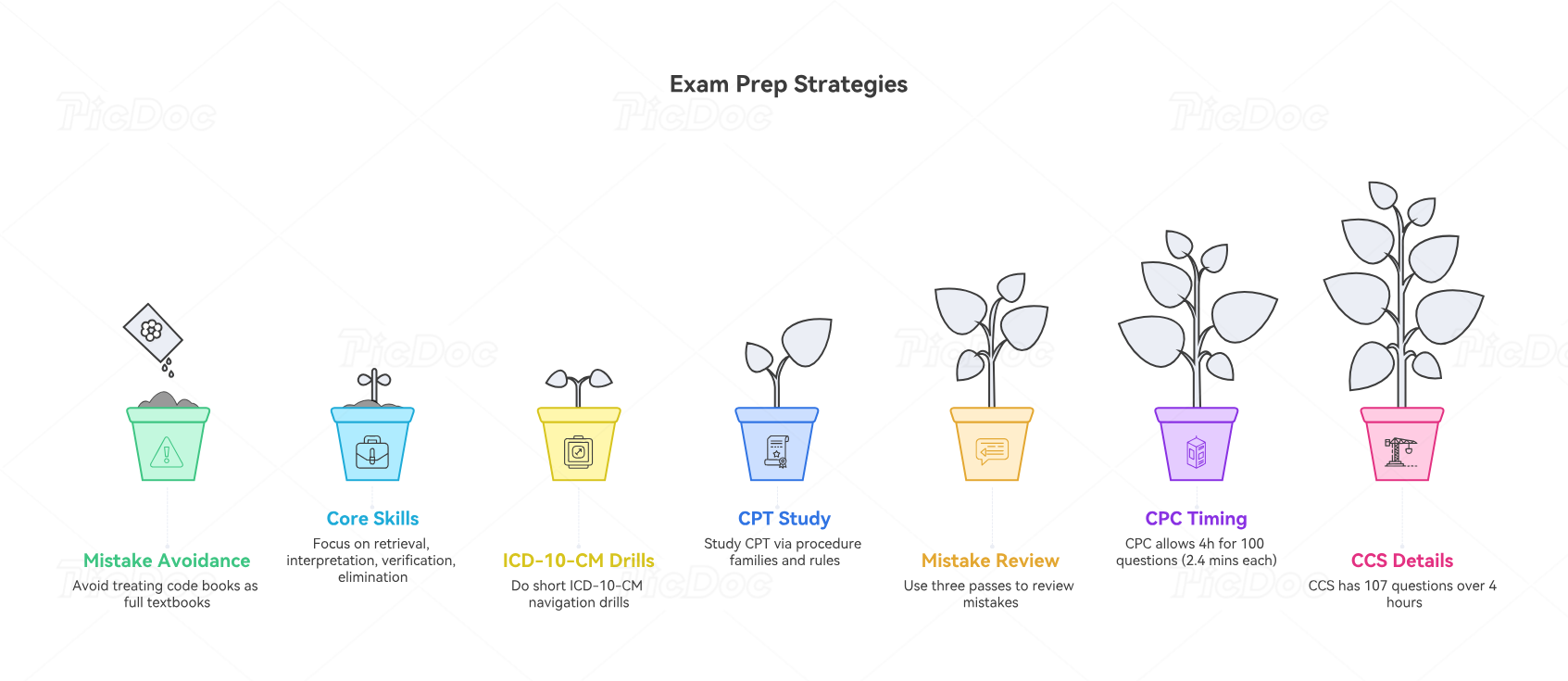
The biggest mistake is treating code books as textbooks that must be read from beginning to end. Exam performance depends on retrieval, interpretation, verification, and elimination. Build those four skills deliberately.
For ICD-10-CM, perform short navigation drills. Pick a diagnosis, locate it through the Index, verify it in the Tabular List, read every note that controls the code, and explain why neighboring codes are wrong. That process prepares you for the same precision required by coding productivity expectations later in employment while strengthening exam speed today.
For CPT, study by procedure family and rule structure. Know where sections begin, where guidelines live, what parenthetical instructions control, and which modifiers repeatedly change answer selection. Then complete mixed questions rather than endlessly drilling one chapter. The CPC exam strategy should eventually progress from section practice to mixed timed sets and finally full simulations.
Use three passes when reviewing mistakes:
Identify the knowledge error: Was the underlying rule unknown?
Identify the navigation error: Did you know the rule but fail to locate or verify it?
Identify the decision error: Did you understand the information yet choose the wrong answer because of rushing, overthinking, or missing one word?
This distinction prevents ineffective studying. A candidate who repeatedly makes navigation errors needs timed book drills. Someone repeatedly missing terminology needs medical terminology reinforcement. Someone making decision errors may need stronger practice-question analysis and better control of exam anxiety.
Your final practice phase should resemble the real examination. AAPC currently gives CPC candidates four hours for 100 questions. That creates an average of roughly 2.4 minutes per question, though individual questions vary enormously in difficulty. Spending seven minutes proving one difficult answer can destroy the time needed for several easier ones. A solid first-attempt CPC plan therefore needs pacing strategy alongside content review.
For CCS preparation, AHIMA currently lists 107 total questions, including 97 scored items and 10 pretest items, with four hours allowed. Candidates considering inpatient coding careers should use their CCS preparation to develop clinical abstraction and sequencing discipline rather than treating the exam as a larger CPC.
5. What to Buy First, What to Delay and What to Skip
If money is limited, buy in this order: required exam code books → one strong exam-specific preparation resource → targeted weak-area material → realistic practice exams. This protects you from the common trap discussed in coding-training cost decisions: spending heavily on education without knowing which purchase actually moves you closer to passing or employment.
A CPC candidate should prioritize the current AMA CPT Professional Edition, ICD-10-CM, and HCPCS Level II books permitted under AAPC rules. A CCS or CCA candidate should verify AHIMA's approved ISBN list before ordering anything. The cost of buying the wrong edition can include replacement cost, lost study time, and—in AHIMA's stated policy—the possibility of being unable to test if you arrive without the required approved books.
Avoid buying next year's book simply because it has already appeared for sale. AAPC states that its exams use the current calendar year's code sets, strongly recommends current-year books, permits the preceding year within its stated rules, and does not permit upcoming-year books for exam use. Meanwhile, real-world ICD-10 timing follows fiscal-year implementation: CMS has already published FY 2027 ICD-10-CM and ICD-10-PCS files effective October 1, 2026. The exam year and live coding implementation calendar can therefore create confusion during the fall. Check the certification body's instructions for your actual test date.
Delay specialist books until your weak-area data proves you need them. A beginner eyeing risk adjustment coding, auditing, or a particular high-paying coding specialty can pursue those resources after securing the foundational credential and understanding core coding rules.
Skip duplicate summary books. If three resources explain the same CPT chapters at roughly the same depth, owning all three rarely triples your learning. Put that money toward a question bank, realistic cases, or a weak-area resource. This matters especially for candidates trying to turn certification into a first role, because employers will eventually care about what you can demonstrate on a coding resume, during a practical coding assessment, and under real accuracy and productivity pressure.
The resource that earns the highest return is the one you use repeatedly enough to change your decisions. A $40 workbook completed, reviewed, and converted into an error log can outperform a $400 bundle that remains mostly unopened.
6. FAQs About Medical Coding Exam Books and Study Resources
-
AAPC currently identifies the AMA CPT Professional Edition, ICD-10-CM, and HCPCS Level II as the core approved code books for CPC. Use the edition rules applicable to your test date and verify AAPC's current requirements before purchasing. Combine the books with a CPC exam preparation plan, practice questions with explanations, and a structured exam-day checklist.
-
The current CPC approved-book list centers on CPT, ICD-10-CM, and HCPCS Level II. ICD-10-PCS becomes central for inpatient-focused pathways such as CCS preparation. Candidates deciding between inpatient and outpatient coding should understand this distinction before buying books. It also helps clarify the differences between professional-fee and facility coding.
-
AAPC currently permits books from the preceding year within its published rules, although it strongly recommends current-year books because the exam uses current calendar-year code sets. Books older than one year and upcoming-year books are prohibited under its current guidance. AHIMA candidates should be more cautious because its 2026 CCA and CCS requirements specify approved 2026 titles for exams delivered from May 1, 2026. Anyone trying to minimize certification expenses should verify rules before buying used books.
-
A study guide can organize the material, while passing still depends on your ability to navigate code books, apply guidelines, manage time, interpret documentation, and correct recurring mistakes. Combine your guide with CPC practice questions, a deliberate CPC study strategy, and targeted repair of medical terminology weaknesses. If you already failed the CPC once, let your error pattern determine what you add next.
-
Quality, difficulty, rationales, and review discipline matter more than raw question count. A candidate can complete 2,000 questions and repeat the same mistake 50 times. After every meaningful error, record what rule controlled the answer, where that rule can be found, why your choice failed, and how you will recognize the pattern next time. That learning process also prepares you for coding interview assessments and the reasoning expected once you begin applying to new-coder employers.
-
First identify the certification you are pursuing and purchase only the required code books for that path. Then assess whether medical terminology and anatomy prevent you from understanding documentation. Career changers starting without healthcare experience often benefit from foundational terminology and anatomy before advanced question banks. Compare the cost and structure of bootcamp, college, and self-study routes before purchasing a large training bundle.
