
Remote Medical Coding Jobs With No Experience: What Employers Actually Require
Remote medical coding looks like an ideal first healthcare career: certification, a computer, and work from home. The hiring market is more selective. Employers commonly screen for coding credentials, demonstrated accuracy, specialty exposure, productivity, EHR familiarity, and the ability to protect PHI independently. Recent remote postings range from roles accepting CPC-A among qualifying credentials to positions demanding two, three, or five years of experience. For candidates entering medical coding without healthcare experience, the challenge is learning which gaps actually block hiring and which ones can be solved before the first application.

1. Why Remote Medical Coding Jobs Are Harder to Enter With No Experience
The biggest hiring issue is trust at a distance. A remote coder may be expected to receive a work queue, interpret documentation, apply ICD-10-CM, CPT or HCPCS rules, query appropriately, meet productivity standards, protect PHI, and resolve routine ambiguity without someone sitting beside them. That makes remote hiring especially sensitive to evidence of competence. Candidates who understand medical coding productivity quotas, prepare for practical coding assessments, build a medical coding portfolio, and strengthen a post-certification coding resume can address several of those concerns before receiving a first coding paycheck.
Current postings illustrate the gap clearly. One recent nationwide remote listing accepts active credentials including CPC, CPC-A, COC, CCS, CCS-P, CCA, RHIA, or RHIT, yet still asks for at least one year of CPT and ICD-10 coding experience. It also requires a private work area and suitable high-speed internet. Another remote position asks for at least two years of Department of Defense coding experience, active certification, a private secure workspace, and a 97% minimum accuracy rating. Those details explain why a freshly certified applicant can satisfy the credential requirement while still losing during screening.
Experience expectations also rise with specialization. Recent AAPC remote postings include positions requiring three years of physician-practice coding and others demanding five years across multiple specialties and E/M. Someone comparing professional-fee and facility coding, evaluating inpatient versus outpatient coding, considering risk adjustment as a first specialty, or pursuing higher-paying coding specialties should therefore target the segment whose entry requirements match their current proof.
Certification still matters significantly. AHIMA describes the CCA as an early-career credential and requires a high school diploma to sit for the exam; six months of coding experience or formal coding education is recommended rather than mandatory. The CCS sits further along the experience continuum: AHIMA recommends pathways that commonly include one or two years of direct coding experience, although those recommendations are not formal prerequisites to test. Candidates deciding between CPC preparation, CCS preparation, training routes, and overall medical coding training costs should match the credential to the jobs they actually intend to pursue.
The practical takeaway is that “entry-level” and “remote” describe two different parts of a job. Entry-level describes required occupational experience; remote describes how the employer expects the employee to function. A candidate may be academically entry-level while the remote environment still demands independence, measurable accuracy, secure handling of records, reliable technology, and fast adaptation. Understanding that distinction makes the search far more efficient than sending identical applications to every listing containing the word “coder.”
| Employer Requirement | What It Usually Signals | No-Experience Candidate Response | Priority |
|---|---|---|---|
| CPC | Professional-fee coding foundation | Apply when the specialty and experience gap are reasonable | Very high |
| CPC-A accepted | Employer may consider apprentice-status candidates | Lead with practical casework and measurable accuracy | Excellent target |
| CCA accepted | Role may support earlier-career applicants | Emphasize coding education and setting-specific skills | Excellent target |
| CCS required | Often signals stronger hospital/inpatient expectations | Apply when your training genuinely matches the setting | Role-dependent |
| 1 year experience required | Automated or recruiter screening barrier | Target selectively; do not make these your entire search | Medium |
| 1 year preferred | Employer has flexibility | Apply when most core requirements match | High |
| 2+ years required | Independent production expected quickly | Prioritize alternatives unless you have closely related experience | Lower for beginners |
| 3–5 years required | Experienced coder pipeline | Treat as a future-target role | Low for beginners |
| 95%+ coding accuracy | Formal QA expectations | Track accuracy on timed practice cases | Very high |
| Productivity quota | Queue-based production environment | Measure cases per hour alongside accuracy | Very high |
| E/M coding | Professional-fee or clinic workflow | Build MDM and time-based case examples | High |
| Multi-specialty experience | Employer expects broad case variety | Show several specialty case sets rather than one narrow sample | High |
| Surgery coding | Operative-report abstraction required | Create audited operative-note projects | High for surgery roles |
| Risk adjustment | Diagnosis validation and documentation focus | Practice supported versus historical-condition decisions | High for HCC roles |
| Epic experience | Faster onboarding into employer workflow | List genuine EHR exposure; avoid claiming software you never used | Medium-high |
| Encoder experience | Production coding workflow familiarity | Emphasize reference navigation and comparable tools | Medium |
| Excel skills | Tracking, QA or reporting responsibilities | Demonstrate filters, sorting and basic spreadsheet competence | Medium-high |
| Provider queries | Documentation clarification responsibility | Prepare neutral query examples | High |
| NCCI knowledge | Bundling and modifier decisions matter | Practice edit research and modifier justification | High for ProFee |
| HIPAA compliance | Remote access to PHI | Know privacy, screen, paper and workspace controls | Essential |
| Private home office | Employer requires visual/audio privacy | Prepare a dedicated secure work area | Essential for many roles |
| High-speed internet | VPN/EHR reliability requirement | Verify stable service before interview | Essential |
| Dual monitors | High-volume documentation/reference workflow | Confirm whether employer supplies equipment | Medium |
| U.S. residency requirement | Payroll, privacy, contract or client limitation | Check location eligibility before applying | Essential when stated |
| State-specific residency | Tax or organizational restriction | Treat “remote” as geographically restricted | Essential when stated |
| U.S. citizenship | Government or federal-client requirement | Skip if ineligible; credential strength cannot override it | Absolute when stated |
| Security clearance eligibility | Government system access | Apply only when legally eligible | Absolute when stated |
| Background check | Data-access and employment screening | Expect standard pre-employment verification | Common |
| Independent work | Limited live supervision | Give examples of structured self-review and escalation | Very high |
| Written communication | Queries, audits and remote collaboration | Use concise professional portfolio samples | High |
| Coding assessment | Employer wants direct proof before hiring | Practice timed, mixed-documentation cases | Very high |
| Shift-specific availability | Remote role still has fixed operational hours | Confirm time-zone compatibility before applying | High |
2. What Employers Actually Require for Remote Medical Coding
Certification: the fastest credibility filter
Many remote positions use credentials as the first screening layer. Current postings frequently name AAPC or AHIMA credentials such as CPC, CPC-A, COC, CCS, CCS-P, CCA, RHIT, or RHIA. That makes certification particularly valuable for someone with no employment history. Candidates deciding whether to pass the CPC, comparing an online CPC program, evaluating a CCS program, or studying through a CBCS certification course should start from the credential pattern appearing in their target jobs rather than collecting certifications without a hiring strategy.
A CPC-A can still appear on eligible-credential lists. The nationwide remote role cited above explicitly includes CPC-A among accepted certifications, although it separately requests one year of coding experience. That is important for anyone concerned about CPC-A apprentice status. The credential can get a candidate through one gate while experience remains another gate.
Experience: read “required” and “preferred” differently
Treat required experience as a meaningful constraint. A position demanding three years of oncology or five years of multi-specialty surgery is describing the level of production the employer expects. Recent AAPC listings show exactly those patterns. A candidate currently building a medical coding portfolio, improving a new-coder resume, practicing real coding interview scenarios, and looking at employers for new coders should spend most application time on closer matches.
“Preferred” creates more room. A current remote posting requires certification while listing one year of medical coding experience as preferred. When a candidate meets the credential, coding-system knowledge, setting, software, and workflow requirements, that type of listing deserves an application even without the preferred year.
Accuracy: employers care about the percentage
Remote coding often operates through measurable quality standards. One current role requires a minimum 97% accuracy rating, while another AAPC job-board result references a 95% accuracy target. Candidates who only say “detail-oriented” on a medical coding resume are competing against candidates who can show audited practice accuracy, timed case results, and a portfolio of coding work.
Track your own practice. Code 25 cases, audit them against authoritative answers, record the error type, then repeat with another set. A result such as “completed 100 simulated outpatient cases with 96% final audited accuracy” gives an interviewer something measurable to discuss. Pair that with preparation for coding productivity quotas, coding interview tests, CPC practice questions, and strong CPT fundamentals.
Specialty knowledge: “medical coder” is often too broad a label
Employers increasingly advertise the actual workload: ProFee E/M, oncology, surgery, outpatient facility, inpatient, risk adjustment, Medicare review, or multispecialty clinic coding. Recent postings ask for experience across primary care, cardiology, orthopedics, GYN, urology, endocrinology, oncology, and other specialties.
This is where targeted preparation pays off. Someone pursuing professional-fee coding should become strong in E/M, CPT, modifiers, NCCI, and provider documentation. Someone seeking risk-adjustment work needs diagnosis validation and HCC logic. Someone targeting inpatient coding needs stronger sequencing and ICD-10-PCS. Someone planning toward coding auditing needs defensible reasoning and error analysis.
Technology: remote coding is a digital production job
Employer requirements frequently include EHR or workflow-system familiarity, Excel, secure internet, and independent remote work. Recent postings mention Epic, Athena, Microsoft applications, secure VPN-type environments, dedicated workspaces, and reliable internet. Candidates preparing through coding bootcamps or self-study should therefore build basic spreadsheet, keyboard, file-management, browser-research, and remote-communication competence alongside medical terminology and CPT coding skills.
Privacy and home-office standards: remote still means healthcare compliance
One nationwide remote listing requires a dedicated work area separated from living areas and secure handling of sensitive documents. Another requires a private secure space protecting PHI and PII. Your first coding job strategy should therefore include a realistic home-office plan, especially if you are prioritizing coding jobs with minimal phone calls because quiet, independent work appeals to you.
3. How to Build the Experience Employers Want Before Landing a Remote Coding Job
The first goal is to create credible applied evidence. Your certification proves that you passed an examination. Employers still need evidence that you can interpret documentation repeatedly and accurately. A well-built medical coding portfolio can include diagnosis cases, operative reports, E/M decisions, modifier analysis, NCCI reviews, claim exercises, audits, and specialty mini-projects. Combine that with a focused medical coding resume, realistic coding interview practice, and coding test preparation.
Next, consider a stepping-stone role that provides access to the revenue cycle. Medical billing, charge entry, claims follow-up, authorizations, patient accounts, denial management, payment posting, HIM support, coding support, or onsite coding can create healthcare-system familiarity. Someone comparing medical billing and coding careers may discover that a billing position builds valuable payer and claims knowledge. A candidate with CBCS alone may use billing as an entry point while continuing CPC preparation and developing a more coding-focused portfolio.
Applicants with previous healthcare experience should translate it aggressively. A former nurse moving through medical coding after nursing already understands clinical documentation, terminology, disease processes, and healthcare workflow. A former medical assistant pursuing coding after medical assisting may already know chart structure, provider workflow, EHRs, insurance processes, and common procedures. Those transferable skills should appear in the resume and interview rather than being buried beneath a generic “career changer” label.
CPC-A candidates should also understand how employers read the apprentice designation. Review the available paths for addressing CPC-A status, then build evidence while applications are active. Waiting until the “A” disappears can unnecessarily delay the first job, especially because some current postings explicitly list CPC-A among accepted credentials.
Finally, practice under production-like conditions. A remote employer may care whether you can maintain accuracy while moving through a queue. Build timed batches and measure both speed and error rate. Candidates who understand coding productivity quotas, prepare for coding-job stress, and practice coding interviews can demonstrate that they understand the operational side of the work as well as the code books.
4. How to Find Remote Coding Jobs That Are Realistic for Beginners
Search by workflow, not only by title. “Remote medical coder” can return everything from junior outpatient work to federal contract positions requiring years of specialty experience. Better searches include:
remote coding specialist CPC-A, remote coding associate, remote outpatient coder trainee, remote physician coding specialist, remote coding support, remote risk adjustment coder entry level, and remote medical records coding associate.
Then inspect the experience language before reading the entire description. A role requiring five years of multispecialty surgery belongs in a different application bucket from a role requiring certification and preferring one year. Recent AAPC postings demonstrate both ends of that range. This approach saves time for candidates already balancing CPC study, portfolio development, resume improvement, and interview preparation.
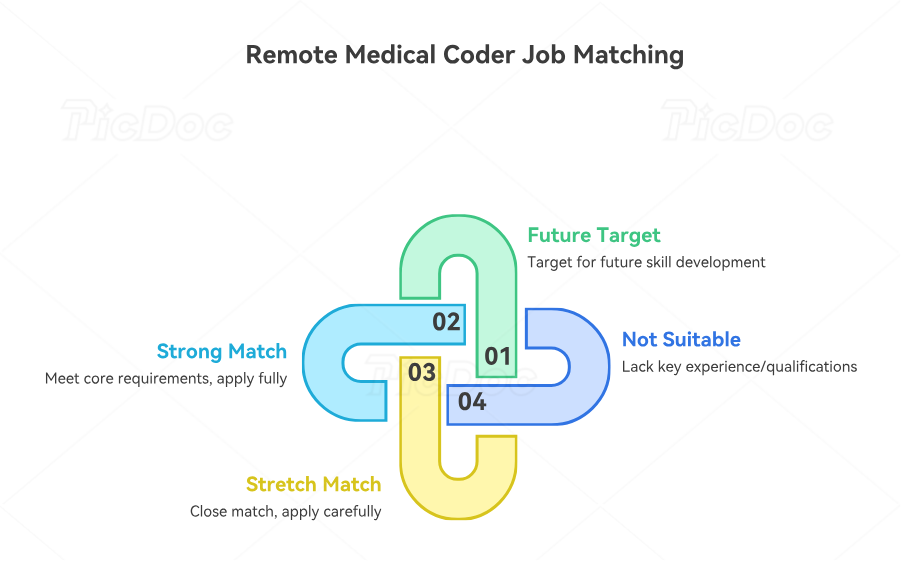
Use three application buckets.
Bucket A: Strong match. You meet the credential, code-set, setting, and location requirements. Experience is absent, listed as preferred, or close enough that your related background plausibly compensates. These jobs deserve customized applications.
Bucket B: Stretch match. The employer wants around one year, while you bring certification plus closely relevant healthcare work, a strong portfolio, specialty preparation, or structured practicum experience. Apply selectively.
Bucket C: Future target. The employer requests several years of direct specialty production, federal-client experience, advanced audit work, or a system-specific background you do not possess. Save the posting because it tells you what to build next.
That framework becomes especially valuable when evaluating best employers for new coders, comparing coding specialties by career ceiling, exploring risk adjustment, or targeting low-phone coding work.
Pay close attention to geography. “Remote” frequently means remote within a specified jurisdiction, rather than work from any country or any state. Federal contracts can add citizenship and security-clearance requirements; one current remote DoD-related coding posting requires U.S. citizenship and clearance eligibility. Another nationwide role describes company telecommuting requirements tied to approved internet and policy compliance. Location eligibility should therefore be checked before spending an hour tailoring an application.
Also separate contractor roles from employee roles. A contractor may face different equipment, scheduling, tax, benefits, productivity, and job-security arrangements. Recent AAPC listings include remote contract coding work with significant experience requirements. Candidates weighing coding stress, outsourcing concerns, remote-work career value, and career advancement should evaluate the employment structure before focusing on the word “remote.”
5. How to Make a No-Experience Candidate Look Hireable for Remote Coding
Your resume needs to convert education into evidence. “Completed CPC course” communicates less than “coded and independently audited 100 simulated physician encounters across ICD-10-CM, CPT, HCPCS, E/M and modifier scenarios.” “Familiar with medical terminology” communicates less than evidence that you used it to abstract actual practice documentation.
Build your resume around credential + setting + code systems + measurable practice + transferable experience + technology. The AMBCI guide to a medical coding resume after certification can be paired with a 20-project coding portfolio, 60 interview coding scenarios, and targeted medical coding interview-test preparation.
A useful beginner resume bullet might read:
Completed 120 simulated outpatient coding cases using ICD-10-CM, CPT and HCPCS Level II; performed independent second-pass audits, tracked recurring error categories, and maintained 95%+ final accuracy across the most recent 60 cases.
Another might read:
Built five E/M and modifier case sets covering MDM, same-day procedures, modifier 25, modifier 59/X{EPSU}, NCCI research and documentation-based code verification.
Those bullets support the skills employers are already asking for in current remote postings: current coding knowledge, documentation review, provider clarification, accuracy, productivity, and independent work. They also make preparation through CPC practice questions, CPT study, medical terminology training, and CPC exam strategy visible to a recruiter.
Prepare equally hard for the interview assessment. Employers may test code selection, documentation interpretation, E/M, modifiers, specialty knowledge, or accuracy under a time limit. Practice explaining your reasoning using documentation → governing rule → code-selection logic → verification. That approach is especially useful when you do not immediately know an answer because it demonstrates safe professional behavior rather than guessing. Use medical coding interview questions, CPC practice cases, and a coding portfolio to rehearse that thinking.
Finally, treat the first role as a bridge rather than a permanent destination. An onsite or hybrid coding job, billing position, coding-support role, risk-adjustment contract, or healthcare revenue-cycle position can provide the experience that unlocks stronger remote opportunities later. Candidates weighing medical billing against coding, studying employers friendly to newer coders, considering specialties with stronger pay, and worrying about outsourcing in medical coding should optimize for credible production experience, because that asset compounds across later applications.
6. FAQs About Remote Medical Coding Jobs With No Experience
-
Yes, some opportunities can be accessible to newly credentialed candidates, especially when experience is preferred rather than mandatory or when an employer is willing to train. The broader remote market remains experience-heavy. Current postings include one-year, two-year, three-year, and five-year requirements, while some positions accept early-career credentials such as CPC-A or CCA. A beginner should combine no-healthcare-background preparation, a strong coding portfolio, a targeted coding resume, and realistic employer targeting.
-
CPC-A can satisfy the credential requirement in some positions. A current nationwide remote listing explicitly includes CPC-A among acceptable credentials, although that job separately requests one year of coding experience. Candidates concerned about removing CPC-A status should continue building practical evidence through coding projects, coding interview practice, and focused CPC preparation.
-
The answer depends on the setting. CPC commonly aligns with physician/professional coding; CCS is strongly associated with hospital coding; CCS-P targets physician-based expertise; CCA is positioned by AHIMA for earlier-career coding professionals. Compare inpatient and outpatient coding, professional versus facility coding, CPC programs, and CCS programs before choosing.
-
The employer sets the standard, and current postings demonstrate targets around 95% to 97% in some roles. A candidate should learn to measure personal accuracy during practice rather than waiting for an employer audit. Combine that with preparation for coding productivity standards, coding interview assessments, a measurable coding portfolio, and strong CPC practice.
-
Many do. Current postings mention a dedicated or private work area, secure handling of sensitive information, PHI/PII protection, and appropriate internet access. Anyone specifically pursuing low-phone coding jobs or trying to improve medical coding work-life balance should include workspace privacy, connectivity, equipment, schedule expectations, and employer monitoring in the remote-work decision.
-
Use the wording and the rest of the job description. A preferred year of experience combined with otherwise strong alignment deserves serious consideration. A firm required year may be a stronger screen, especially when the job also expects immediate production. Strengthen the application with a targeted medical coding resume, relevant portfolio projects, interview-test preparation, and related healthcare skills.
