
CBCS Certification: ICD-11 Coding Essentials
ICD-11 introduces a digitally designed classification structure that future-focused billing and coding professionals should understand. The current CBCS exam still emphasizes ICD-10-CM, CPT, and HCPCS Level II, so candidates should keep those systems at the center of their CBCS certification preparation. ICD-11 knowledge adds long-term value by strengthening coding-system awareness, health information management skills, and readiness for increasingly digital healthcare environments.
1. What CBCS Candidates Must Understand About ICD-11
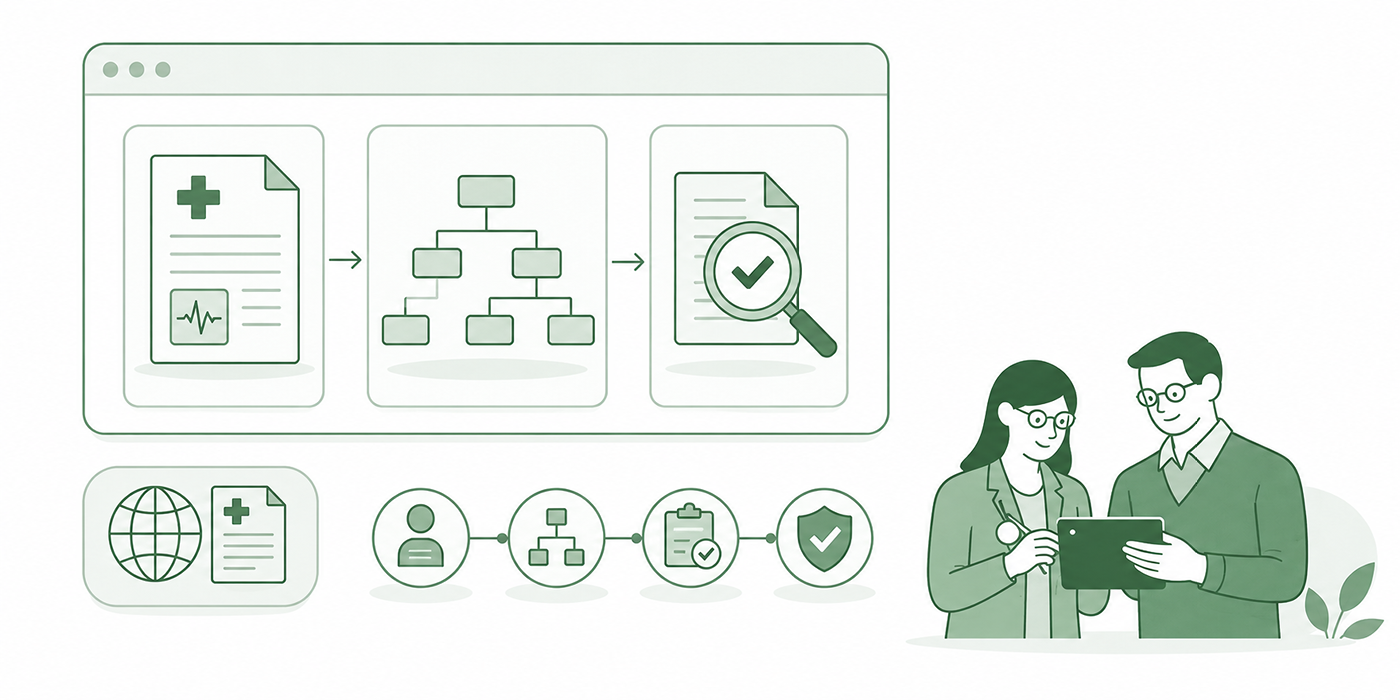
ICD-11 is the World Health Organization’s current international classification for recording, reporting, analyzing, and comparing mortality and morbidity information. Its design supports electronic use, multilingual implementation, structured clinical detail, and integration with modern health information systems. Candidates building their medical coding vocabulary should understand how those goals influence code selection, documentation review, and healthcare data reporting.
The most important exam-planning distinction concerns current CBCS coverage. NHA’s published CBCS information identifies ICD-10-CM, CPT, and HCPCS Level II as the tested code sets. CDC also continues to publish active fiscal-year ICD-10-CM files and guidelines for United States healthcare services. Candidates should therefore develop strong ICD-10 coding foundations, complete focused CBCS course preparation, and treat ICD-11 as professional-development knowledge until the relevant examination or healthcare jurisdiction formally changes its requirements.
That distinction prevents a costly study error. A candidate who spends most preparation time memorizing ICD-11 terminology may enter the CBCS exam underprepared for tested ICD-10-CM conventions. A working coder who ignores ICD-11 completely may struggle later with international records, digital classification projects, cross-border data, or classification transition discussions. A balanced plan combines CBCS exam competency, coding update awareness, and practical familiarity with WHO’s ICD-11 tools.
The conceptual shift is equally important. ICD-10-CM study often trains candidates to locate a complete code through an alphabetic index, tabular confirmation, conventions, and official guidelines. ICD-11 adds greater emphasis on digital searching, structured entities, stem codes, extension codes, and postcoordination. A coder may represent a documented condition through a single precoordinated code or a valid cluster that combines multiple components. Understanding this architecture supports stronger electronic health record literacy, clinical decision support knowledge, and coding workflow discipline.
ICD-11 Essentials Map for CBCS Learners: What Each Concept Means and What to Do
| Concept | What It Means | Why It Affects Coding | Best Study or Workflow Action |
|---|---|---|---|
| ICD-11 | WHO’s current international classification for mortality and morbidity information. | It changes how coders search, structure, combine, and exchange diagnosis information. | Study it alongside active coding-system updates. |
| Foundation Component | The multidimensional collection of ICD-11 entities, definitions, relationships, and terminology. | An entity may have several relationships even when it appears once in a reporting linearization. | Learn entity relationships through the HIM terminology guide. |
| Linearization | A purpose-specific arrangement drawn from the Foundation Component. | The correct code depends on the linearization required for the reporting purpose. | Confirm the classification context before performing reimbursement-related coding. |
| ICD-11 MMS | The Mortality and Morbidity Statistics linearization used for statistical reporting. | It provides the reportable structure most learners encounter in the ICD-11 Browser. | Practice distinguishing statistical coding from revenue-cycle processes. |
| Entity | A disease, disorder, injury, sign, circumstance, or related classification concept. | Coders must identify the documented clinical concept before searching for a code. | Strengthen concept recognition with the medical abbreviations dictionary. |
| Stem Code | A code that can stand independently and represents a reportable clinical concept. | A valid cluster generally begins with a stem code rather than an extension code. | Mark the principal clinical concept before adding descriptive detail. |
| Extension Code | A code that adds an attribute such as laterality, severity, anatomy, or timing. | It supplies specificity while depending on another code for meaning. | Connect every extension to documented evidence using EHR terminology. |
| Precoordination | A single code already containing the required clinical detail. | Selecting an unnecessary cluster can duplicate information already built into the stem code. | Search for the most complete valid concept before constructing a cluster. |
| Postcoordination | The process of combining codes to represent documented detail. | Incorrect combinations can produce invalid, unsupported, or misleading code strings. | Use permitted axes shown by the WHO Coding Tool. |
| Code Cluster | Two or more connected codes expressing one clinically meaningful statement. | Order, syntax, and relationships affect how software interprets the statement. | Build clusters from the chart, then validate the completed expression. |
| Cluster Syntax | Symbols and ordering rules that define relationships among clustered codes. | A clinically sensible selection can still fail technical validation when syntax is wrong. | Treat syntax checks like EDI validation rules. |
| Postcoordination Axis | A permitted category of added detail, such as severity or anatomical location. | Different stem codes permit different axes. | Follow the options displayed for the selected entity instead of assuming an attribute is allowed. |
| Mandatory Postcoordination | Required additional detail needed to complete a coding statement. | An incomplete cluster may fail reporting requirements. | Add a mandatory-element checkpoint to the coding workflow. |
| Optional Postcoordination | Permitted detail that may be added when documentation supports it. | Overuse creates noise, while underuse can reduce valuable specificity. | Add optional detail only when it serves the reporting purpose. |
| Laterality | An attribute identifying right, left, bilateral, or another side-related status. | Missing laterality can reduce clinical precision and expose documentation gaps. | Check examination findings, imaging, procedure notes, and the assessment. |
| Anatomical Detail | A body site or structure linked to the coded condition. | Broad terms can lead to overgeneralized code selection. | Reconcile the diagnosis with radiology documentation and operative findings. |
| Severity | A structured description of clinical intensity or disease level. | Severity must come from explicit documentation rather than coder interpretation. | Query ambiguous records through a compliant documentation process. |
| Temporality | Timing information such as acute, chronic, current, or historical status. | Incorrect timing can materially change the coded clinical statement. | Review problem lists, encounter notes, and discharge documentation together. |
| Diagnosis Timing | An attribute describing when a condition was identified relative to an encounter. | It can influence quality, utilization, and outcome interpretation. | Relate timing to quality-measure reporting. |
| Causality | A documented relationship between an underlying cause and a resulting condition. | Guessing causality can create an unsupported clinical conclusion. | Require provider-supported language before linking conditions. |
| Associated With | A relationship recognized by the classification or documentation without automatically proving causation. | Coders may confuse association with a direct cause-and-effect statement. | Read the applicable coding note and preserve the documented relationship. |
| Inclusion Term | A term showing concepts included within a category. | It helps confirm that the documented diagnosis belongs under the selected entity. | Use inclusion terms as confirmation rather than as a substitute for the full record. |
| Exclusion | A direction indicating that a concept belongs elsewhere or requires different treatment. | Ignoring exclusions can produce conflicting or duplicate classification. | Review exclusions before finalizing the coded encounter. |
| Residual Category | An “other specified” or “unspecified” option used when a more precise category is unavailable or unsupported. | Routine reliance on residual codes can hide documentation and search failures. | Investigate the record before accepting a less-specific category. |
| Other Specified | The documentation gives detail, while the classification lacks a dedicated category for it. | The documented specificity must remain visible even when no unique code exists. | Retain the provider’s wording in the audit trail. |
| Unspecified | The available documentation lacks detail needed for a more specific selection. | Repeated unspecified coding may indicate weak documentation or incomplete review. | Track patterns through coding analytics. |
| Coding Note | Instructional text governing the use, relationship, or sequencing of a concept. | Skipping notes can invalidate an otherwise plausible selection. | Read all displayed instructions before accepting the code. |
| ICD-11 Browser | WHO’s tool for navigating classification content and hierarchy. | It shows where an entity sits and what guidance surrounds it. | Use it for structure study and classification exploration. |
| ICD-11 Coding Tool | WHO’s search-oriented tool for locating and assembling coding concepts. | Search results still require documentation review and validation. | Compare search terms, synonyms, and displayed coding guidance. |
| ICD API | A programmatic service that allows authorized software to access ICD content. | It supports integration while introducing version-control and implementation risks. | Pair API knowledge with healthcare data security. |
| Version Control | The process of identifying the exact ICD-11 release used by a system or dataset. | Different releases may contain revised content, tools, or available concepts. | Record the release date in policies, testing, and audit documentation. |
| Mapping | A structured relationship between concepts in different coding systems. | A map may support conversion without establishing exact clinical equivalence. | Validate mapped output against documentation and the target classification. |
| Interoperability | The ability of systems to exchange and meaningfully use structured health information. | Reliable exchange requires shared definitions, syntax, versions, and governance. | Study it with electronic data interchange concepts. |
2. ICD-11 Architecture: Foundation, MMS, Stem Codes, and Extension Codes
A useful mental model begins with the Foundation Component. It contains ICD-11 entities, definitions, synonyms, relationships, and classification properties. A linearization draws from that larger foundation to create a purpose-specific arrangement. The Mortality and Morbidity Statistics linearization, commonly called ICD-11 MMS, provides the reportable structure used for mortality and morbidity statistics. This layered model supports richer digital relationships than a simple printed hierarchy can display.
For CBCS learners, the practical lesson is to identify the purpose of the code set before selecting a code. The classification used for international statistics, a national billing modification, a procedure system, and a quality-reporting system can organize similar clinical facts differently. Strong coders separate diagnosis classification from CPT procedure coding, HCPCS-related billing, HCC risk coding, and HEDIS reporting.
Stem codes and extension codes form the operational center of ICD-11 coding. A stem code represents a category that can stand independently. An extension code adds a permitted attribute and generally depends on a stem code or cluster for context. Extension codes can express dimensions such as laterality, anatomy, severity, temporality, diagnosis timing, and other descriptive characteristics. Their availability depends on the selected clinical entity and the applicable postcoordination axes.
This structure rewards disciplined documentation review. A coder should identify the diagnosis, clinical status, anatomical site, causal relationship, severity, and encounter context before opening the coding tool. Searching first can cause anchoring: the learner sees an appealing result and begins forcing the chart into that category. A documentation-first sequence improves claims accuracy, coding compliance, and the defensibility of claims reconciliation.
Precoordination should also receive careful attention. A precoordinated stem code may already capture the condition and its required detail. Adding further components without a permitted purpose can create duplication or an invalid cluster. The coder should search for the most complete supported concept, inspect its coding guidance, review available postcoordination axes, and add only the details documented in the record. This same restraint supports accurate surgical coding, radiology coding, and laboratory coding.
3. A Practical ICD-11 Coding Workflow From Documentation to Validation
Begin by translating the medical record into a structured clinical statement. Identify the condition being evaluated or treated, its status during the encounter, documented relationships, affected site, laterality, timing, severity, and complications. Review the assessment, plan, diagnostic reports, medication context, and procedure documentation together. Fragmented review is dangerous because a problem list may describe the condition broadly while imaging or pathology supplies the detail needed for precise classification.
Next, choose a meaningful search phrase. Search the clinical diagnosis rather than copying an entire sentence from the chart. Try accepted synonyms when the first result is weak, then inspect the hierarchy, definition, inclusions, exclusions, and coding notes. This process resembles the verification discipline used with encounter forms and superbills, CMS-1500 claim data, UB-04 fields, and EHR coding terms.
Once a stem code is selected, determine whether it already represents the documented concept completely. Review every mandatory postcoordination instruction and each permitted optional axis. Add extension codes only when the documentation clearly supports them. A coder should never infer laterality from an appointment schedule, infer severity from medication intensity, or infer causality because two conditions commonly occur together. These shortcuts can corrupt data analytics, weaken utilization review, and undermine coding ethics.
Validate the completed coding statement at four levels:
Clinical validity: The code or cluster accurately represents the provider’s documented diagnosis.
Classification validity: The stem code, extension codes, sequencing, and permitted axes follow ICD-11 rules.
Technical validity: The expression uses valid syntax and the correct classification release.
Operational validity: The receiving system can store, transmit, and interpret the coded statement correctly.
The fourth level is frequently overlooked. A theoretically correct cluster can still fail when an EHR truncates code strings, strips relationship symbols, uses an outdated release, or maps the result into an incompatible local field. Coders moving into implementation work should understand EDI terminology, healthcare data security, clinical decision support, and claims platform requirements.
Finish with an audit trail. Record the source documentation, coding rationale, classification release, query outcome, and any unresolved limitation. This habit protects the coder when a diagnosis is questioned months later and strengthens medical billing reconciliation, payment posting investigations, and denial-management analysis.
Quick Poll: What Is Your Biggest ICD-11 Learning Barrier?
4. High-Risk ICD-11 Errors and How to Prevent Them
The first major risk is confusing exam relevance with professional relevance. CBCS candidates need current tested competencies, while employed coders also need awareness of emerging classification systems. Build the exam plan from the official test outline and place ICD-11 in a separate development track. This protects preparation time while expanding coding career knowledge, professional development, and recertification planning.
The second risk is assuming one-to-one equivalence between ICD-10 and ICD-11. Classification systems differ in architecture, granularity, definitions, and coding rules. A mapped concept may be broader, narrower, conditional, or dependent on additional information. WHO provides mapping resources and advises implementers to select appropriate methods and validate intended use. Human review remains essential when mapped data affects clinical analysis, reporting, or financial workflows.
The third risk is treating extension codes as independent diagnoses. An extension code supplies an attribute and requires the appropriate coding context. Prevent this error by beginning every exercise with three questions: What is the clinical condition? Which stem code represents it? Which documented attributes are both permitted and useful? This method is valuable in behavioral health billing, palliative care coding, preventive medicine coding, and other documentation-heavy specialties.
The fourth risk is uncontrolled specificity. More detail can improve data quality when the chart supports it and the classification permits it. Unsupported detail creates false precision. Coders should avoid deriving severity from intuition, laterality from unrelated notes, or disease relationships from clinical probability. A formal query process and strong coding standards produce more defensible results than aggressive specificity.
The fifth risk is weak version governance. WHO continues to release updated ICD-11 content and digital tools, including a 2026 release. Organizations need a documented release, testing schedule, update owner, rollback plan, mapping review, and user education process. A coder should know which version the organization uses before comparing results with another tool or dataset.
The sixth risk appears at the software layer. Search algorithms can surface a clinically related term that fails to match the chart. EHR templates can omit required attributes. Interfaces can alter code strings. Reporting systems can use stale mappings. Build controls around EHR coding workflows, data-security governance, claims-management controls, and regular competency assessments.

5. How to Study ICD-11 Without Weakening Your CBCS Exam Preparation
Start with a current CBCS competency audit. Test yourself on ICD-10-CM structure, diagnosis coding conventions, CPT categories, HCPCS Level II concepts, insurance processes, claim forms, reimbursement terminology, compliance, denials, and revenue-cycle tasks. Use the results to prioritize your CBCS study resources, coding education terminology, and billing workflow review.
A practical six-week ICD-11 development plan can run beside that exam preparation:
Week 1: Classification purpose and architecture. Learn the Foundation Component, linearizations, MMS, entities, and hierarchy. Compare these concepts with your existing medical coding workflow.
Week 2: Stem codes and extension codes. Practice separating the core diagnosis from descriptive attributes. Create short documentation statements and identify which details could require postcoordination.
Week 3: Browser and Coding Tool navigation. Search diagnoses through different synonyms, examine definitions, inspect inclusions and exclusions, and trace parent-child relationships. WHO provides the Browser, Coding Tool, and API as distinct digital resources.
Week 4: Postcoordination practice. Build clusters from complete documentation, incomplete documentation, and deliberately misleading documentation. Record which additions are mandatory, optional, unsupported, or prohibited.
Week 5: Mapping and implementation. Compare sample ICD-10 and ICD-11 concepts. Identify cases where conversion requires clinical review. Connect the exercise to healthcare data analytics, HIM responsibilities, and clinical decision support.
Week 6: Quality assurance. Audit ten cases for documentation support, classification validity, syntax, release version, and reproducibility. Another coder should be able to follow your rationale and reach the same defensible result.
Keep a mistake log throughout the process. Categorize every error as a documentation miss, search-term error, hierarchy error, stem-code error, extension-code error, rule error, syntax error, version error, or mapping error. A categorized log turns vague frustration into a measurable training plan. The same technique improves CPC exam preparation, CCS coding study, and coding apprenticeship performance.
Your final goal should be operational fluency rather than isolated terminology. You should be able to explain why a stem code was selected, what every extension contributes, which chart statement supports each detail, how the completed cluster was validated, and which release governed the decision. That level of reasoning supports advanced coding career development, stronger professional competency, and safer participation in future classification transitions.
6. Frequently Asked Questions
-
NHA’s published CBCS materials identify ICD-10-CM, CPT, and HCPCS Level II as the code sets covered by the exam. Candidates should use the latest official test plan and current preparation materials as their primary authority. ICD-11 can be studied through a separate professional-development track without displacing essential CBCS exam preparation, ICD-10 workflow practice, or billing terminology review.
-
United States diagnosis coding continues to use ICD-10-CM under current CDC publications and fiscal-year coding guidance. ICD-11 is the WHO international revision, while national implementation decisions, clinical modifications, payer rules, system readiness, and transition schedules determine how it is used within each country. Coders should verify the governing code set before working on commercial insurance claims, Medicare billing, or physician reimbursement.
-
A stem code represents a reportable clinical concept and can stand independently. An extension code adds permitted detail, such as laterality, severity, anatomical information, or timing, within an appropriate coding context. Learners should identify the stem concept first, then use the Coding Tool to determine which postcoordination axes are available.
-
A dependable one-to-one relationship cannot be assumed. Differences in definitions, hierarchy, granularity, available attributes, and classification purpose can require additional documentation or human interpretation. Mapping output should be treated as a conversion candidate and validated against the record, the target classification, and the intended reporting use. This control is especially important for claims reconciliation, denial analysis, and data reporting.
-
Each extension should serve a supported classification or reporting purpose. Add mandatory detail and relevant optional detail when the record clearly supports it. Skip attributes derived from assumptions, unrelated encounters, or system defaults. Controlled specificity protects coding ethics, clinical data quality, and the integrity of utilization-management reporting.
-
Use a repeated documentation-to-validation exercise. Read the case, write a structured clinical statement, find the stem code, inspect guidance, add permitted documented attributes, validate the cluster, and explain the rationale in writing. Ten carefully audited cases teach more than memorizing disconnected terminology. Combine this method with the ICD-11 CCS guide, coding competency resources, HIM terminology, and current coding-system release guidance.
