
Medical Billing and Coding Certification in Pakistan: Complete Guide for 2026-2027
Pakistan has become one of the most active talent markets for medical billing, revenue cycle management, AR follow-up, claim submission, and U.S. healthcare support work. For 2026-2027, the best certification plan is practical: learn coding language, payer rules, claim behavior, denial logic, documentation review, and compliance habits together. A certificate can open doors, but job readiness comes from proving that you can protect revenue, fix claim friction, and work cleanly inside real billing workflows.

1. Why Medical Billing and Coding Certification in Pakistan Is a Strong 2026-2027 Career Move
Medical billing and coding certification in Pakistan is valuable because local professionals are increasingly serving international healthcare clients, especially U.S. practices, billing companies, RCM vendors, credentialing teams, AR departments, and claim follow-up operations. A beginner who studies only definitions will struggle; a stronger candidate understands how a provider note becomes a code, how a code becomes a claim, how a claim becomes payment, and how one small documentation gap can turn into denial, rework, delayed cash, or client frustration. That is why learners should connect medical coding certification terms, revenue cycle management terms, medical billing workflow terms, healthcare billing acronyms, and accurate billing and reimbursement from day one.
The real opportunity in Pakistan is wider than “coding jobs.” Many entry-level openings are in charge entry, eligibility verification, payment posting, AR follow-up, denial management, credentialing support, patient statements, claim correction, and practice management support. Coding knowledge improves all of those functions because it helps you understand why CPT, ICD, HCPCS, modifiers, diagnosis pointers, medical necessity, provider enrollment, authorization, and payer rules affect payment. A Pakistan-based learner who wants remote or office-based RCM work should study claim adjustment reason codes, remittance advice remark codes, payment posting, denial management resources, and claims reconciliation terms.
The pain point is that many beginners enter the field through night-shift billing jobs and learn fragments under pressure. They know how to check a portal, call an insurance representative, or update a claim note, but they cannot explain the root cause behind the denial. That limits growth. Certification gives structure when it teaches the full revenue path: patient demographics, insurance verification, authorization, coding, modifiers, claim forms, clearinghouse edits, payer adjudication, EOBs, denial correction, payment posting, appeals, and reporting. AMBCI learners can build this map through clearinghouse terminology, EDI billing terms, EOB fundamentals, CMS-1500 form terms, and patient responsibility terms.
For 2026-2027, the best Pakistan pathway is to become employable in layers: first medical terminology, then coding basics, then U.S. billing workflow, then payer behavior, then denial analytics, then audit-ready documentation habits. This matters because Pakistani RCM teams often serve overseas providers who judge performance through clean claim rate, days in AR, denial percentage, collection rate, aging buckets, and client communication quality. A candidate who understands revenue cycle KPIs, charge capture terms, revenue leakage prevention, medical billing reconciliation, and collections and bad debt can move beyond task execution into problem-solving.
Pakistan Billing & Coding Career Map: 25+ Terms You Must Know
| Term | What It Means | Why It Matters for Pakistan-Based RCM Work | Best Practice Action |
|---|---|---|---|
| Medical Billing | Preparing and following healthcare claims for payment | Many Pakistan roles start in billing, AR, or claim follow-up | Learn the full claim lifecycle, not only data entry |
| Medical Coding | Turning documented services and conditions into standard codes | Improves claim accuracy and denial prevention | Connect every code to provider documentation |
| RCM | Revenue cycle management from registration to final payment | Core outsourcing service line for many Pakistan teams | Study front-end, mid-cycle, and back-end workflows together |
| AR Follow-Up | Working unpaid claims until they are resolved | Common entry-level and growth role in Pakistan | Track payer action, next step, deadline, and owner |
| Eligibility Verification | Checking patient insurance coverage before billing | Prevents avoidable denials and patient-balance disputes | Verify plan, dates, copay, deductible, coinsurance, and referral needs |
| Prior Authorization | Payer approval required before some services | Missing authorization can create hard denials | Confirm authorization before service or before claim submission |
| CPT | Procedure code set used for many U.S. services | Needed for Pakistan professionals working U.S. accounts | Study descriptors, guidelines, bundling rules, and modifiers |
| ICD-10-CM | Diagnosis code set used for U.S. medical necessity support | Links patient condition to billed service | Use the most specific supported diagnosis |
| HCPCS | Codes for supplies, drugs, DME, and some services | Important for DME, injections, supplies, and Medicare-related accounts | Check units, modifiers, payer rules, and documentation |
| Modifier | Code add-on that changes service meaning | Wrong modifiers cause denials, underpayment, or compliance flags | Use modifiers only when documentation supports the circumstance |
| Diagnosis Pointer | Claim link between diagnosis and service line | Shows payer why the service was medically needed | Map each procedure to the strongest supported diagnosis |
| Clean Claim | Claim accepted for processing without avoidable errors | Major performance metric for billing teams | Check demographics, eligibility, codes, modifiers, NPI, and payer rules |
| Clearinghouse | Platform that checks and routes claims to payers | First place many claim errors appear | Fix rejection patterns before payer submission |
| Claim Rejection | Claim stopped before payer adjudication | Often caused by formatting, demographic, or routing errors | Correct root cause and resubmit quickly |
| Claim Denial | Payer refuses payment after reviewing claim | Creates AR pressure and client dissatisfaction | Identify denial category before appealing or correcting |
| EOB | Explanation of benefits showing claim decision | Guides posting, patient balance, appeals, and follow-up | Read adjustment codes, responsibility, and allowed amount carefully |
| ERA | Electronic remittance advice | Speeds payment posting and denial identification | Reconcile ERA against expected payment and claim status |
| CARC | Claim Adjustment Reason Code | Explains why payment changed or was denied | Group CARCs by preventable and non-preventable causes |
| RARC | Remittance Advice Remark Code | Adds detail to payment or denial messages | Use RARCs to decide evidence, correction, or appeal path |
| Payment Posting | Recording payments and adjustments in the billing system | Errors distort AR, patient balances, and reporting | Post by line item, payer decision, adjustment, and responsibility |
| Appeal | Formal request to reverse a payer denial | Important for recovering underpaid or wrongly denied claims | Attach policy, documentation, notes, and code rationale |
| Credentialing | Provider enrollment and payer approval process | Missing enrollment blocks payment even when coding is correct | Track payer status, effective dates, contracts, and revalidation deadlines |
| NPI | U.S. provider identification number | Required on many U.S. claims handled by Pakistan teams | Validate rendering, billing, referring, and facility identifiers |
| Aging Bucket | AR grouped by how long claims remain unpaid | Shows collection risk and follow-up urgency | Work older high-value claims with documented action plans |
| Denial Rate | Percentage of claims denied by payers | Key quality metric for RCM performance | Track denial cause, department source, and prevention step |
| First Pass Rate | Claims paid or accepted without rework | Shows front-end and coding quality | Use edits, audits, and payer rules before claim release |
| HIPAA | U.S. privacy and security rule framework | Essential for Pakistan teams handling U.S. patient data | Follow access control, minimum necessary use, and secure communication |
2. The Best Certification Pathway for Pakistan-Based Learners
The best certification pathway for Pakistan depends on the job target. If you want U.S. medical billing or RCM work, prioritize billing workflow, claim forms, insurance terminology, eligibility, payment posting, denial management, AR follow-up, and payer communication. If you want coding-focused work, add CPT, ICD-10-CM, HCPCS, modifiers, medical necessity, documentation review, and audit practice. If you want hospital data or health information work inside Pakistan, strengthen ICD terminology, documentation standards, EMR literacy, and health information management. A balanced learner should use medical coding education terms, coding credentialing organizations, CBCS exam terms, online CPC certification programs, and coding career development.
A beginner should avoid choosing a certification only because it sounds famous. The better question is: which credential teaches the workflow your target employer actually uses? A Lahore, Karachi, Islamabad, Rawalpindi, or remote billing company serving U.S. practices may care more about clean claim skills, payer portals, denial correction, and AR discipline than pure inpatient coding theory. A coding-heavy employer may test anatomy, CPT guidelines, modifier usage, ICD specificity, operative report reading, and compliance judgment. Build your path around CPT modifiers, medical necessity criteria, understanding coding edits, CPT emergency medicine codes, and CPT radiology coding.
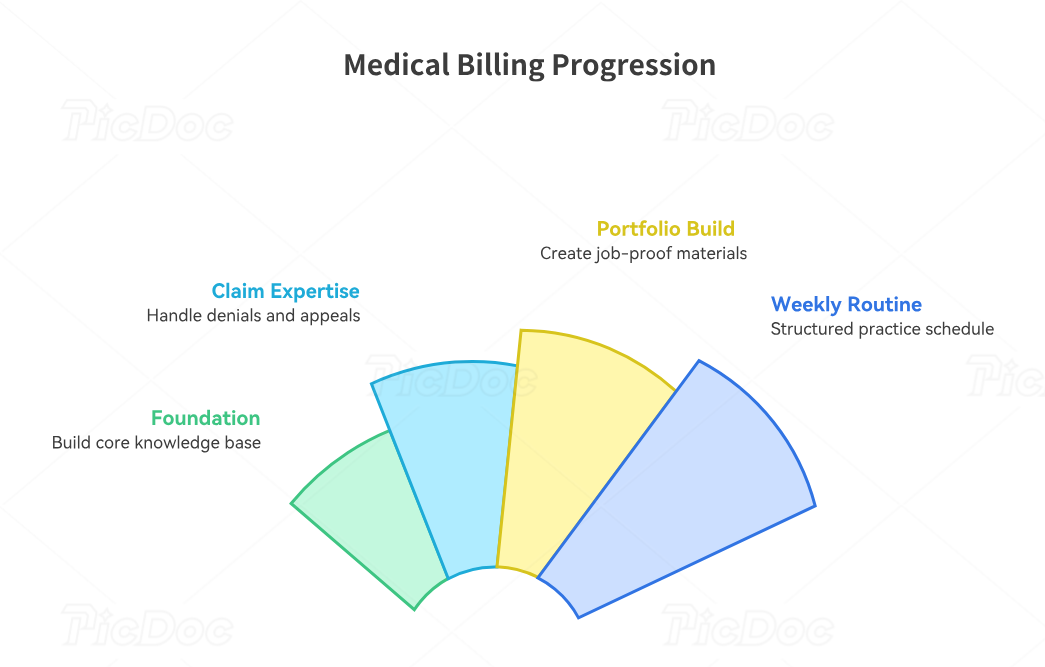
A practical Pakistan roadmap should run in five stages. Stage one is medical terminology and anatomy. Stage two is billing workflow and claim forms. Stage three is coding basics with documentation review. Stage four is payer response interpretation, denials, AR, and appeals. Stage five is specialty depth, audit practice, reporting, and client communication. This sequence helps beginners survive real jobs where one account may involve insurance verification, CPT review, claim rejection, missing authorization, underpayment, appeal letters, aging reports, and provider credentialing in the same week. Study medical terminology for certification, medical abbreviations, encounter forms and superbills, practice management system terms, and RCM software terms.
International certifications can help Pakistan-based candidates because many outsourced accounts follow U.S. coding and billing systems. CPC-style study builds CPT and ICD discipline; CBCS-style study supports billing and claims workflow; CPB-style preparation supports payer and reimbursement thinking; CCS-style study can strengthen coding depth. The winning move is to combine credential preparation with job simulations. Create sample claims, denial notes, appeal templates, AR action logs, payment posting examples, and audit rationales. That proof makes interviews stronger than generic course completion. Use CCS certification programs, CBCS certification course directory, coding competency assessment, medical coding apprenticeship terms, and professional development terms.
3. Skills Pakistani Employers and Outsourcing Clients Actually Reward
Employers reward people who reduce rework. In medical billing, rework happens when demographics are wrong, eligibility is unchecked, authorization is missing, modifiers are unsupported, diagnosis pointers are weak, claims reject at the clearinghouse, payers deny for policy reasons, payments are posted incorrectly, or AR notes lack the next action. A beginner who understands those pain points becomes useful faster. That is why Pakistan-based learners should train around claims management terms, clearinghouse terminology, claim adjustment reason codes, remittance advice codes, and advanced claims reconciliation.
Medical coding skill still matters in billing-heavy roles because many denials are code-related or documentation-related. A claim can look fine at first glance and still fail because the procedure requires a more specific diagnosis, a modifier conflicts with payer rules, the units are wrong, bundled services were billed separately, or the documentation lacks medical necessity. This is where certified candidates stand out: they can explain the error in language that managers, coders, billers, and clients understand. Build that ability with medical necessity criteria, coding edits and modifiers, CPT cardiology procedures, gastroenterology CPT codes, and orthopedic surgery CPT coding.
Documentation review is another major separator. Many new billers only read claim fields, while strong candidates read the provider note, superbill, referral, authorization, operative note, EOB, and payer policy together. That habit prevents blind resubmissions. A denied claim should never be touched without asking: Is the service documented? Is the diagnosis specific enough? Is the payer asking for records? Is the provider enrolled? Is the patient responsible? Is there coordination of benefits? Train this thinking through SOAP notes and coding, clinical documentation improvement terms, coding query process terms, problem lists in documentation, and medical record retention.
Communication also matters because Pakistan-based RCM professionals often work with overseas clients, onshore managers, providers, payers, or internal QA teams. The best AR notes are short, specific, and actionable: payer contacted, reference number, denial reason, documents required, next follow-up date, responsible party, and expected resolution. Weak notes destroy trust because the next person cannot continue the account. Build written precision through EOB guide, patient responsibility terms, coordination of benefits, commercial insurance billing terms, and payment posting terms.
Quick Poll: What is your biggest Pakistan RCM career pain right now?
4. A 90-Day Study Plan for Pakistan-Based Billing and Coding Beginners
The first 30 days should build language and workflow. Study medical terminology, anatomy basics, abbreviations, provider documentation, claim forms, insurance types, patient demographics, eligibility, authorization, CPT, ICD-10-CM, HCPCS, modifiers, and diagnosis pointers. The goal is to stop seeing billing as random software fields and start seeing it as a chain of evidence. Each day, take one mock patient visit and trace it from appointment to claim submission. Use medical terminology, medical abbreviations, CMS-1500 form terms, encounter forms and superbills, and health information management terms.
Days 31 to 60 should focus on claim behavior. Practice clearinghouse rejections, payer denials, EOB reading, ERA interpretation, payment posting, patient balances, appeals, and AR notes. The best exercise is to take ten denied claims and classify each denial as front-end, coding, documentation, authorization, credentialing, eligibility, timely filing, coordination of benefits, or payer policy. Then write the correction path. This is the kind of practical thinking supervisors want. Strengthen it with CARC definitions, RARC dictionary, payment posting, claims reconciliation, and medical billing reconciliation.
Days 61 to 90 should build job proof. Create a portfolio with a billing workflow map, five clean-claim checks, five denial analyses, five AR follow-up notes, three appeal summaries, three payment posting examples, and three coding rationale samples. Add specialty exposure in emergency medicine, radiology, labs, behavioral health, telemedicine, and surgery because Pakistan-based RCM teams often work different specialties across accounts. Your portfolio should prove that you can think, document, and communicate. Build specialty range with emergency medicine coding, radiology coding terms, lab and pathology coding, telemedicine coding terms, and surgical coding compliance.
A weekly schedule can be simple: three days for coding and documentation, two days for billing workflow, one day for denial and AR practice, and one day for review. Do timed drills because billing jobs reward accuracy under volume pressure. Track your accuracy, common mistakes, unclear topics, and payer-rule questions. This habit turns study into measurable improvement. Learners who document their progress can speak more confidently in interviews because they know their weak points and correction strategy. Use coding competency assessment, medical coding audit terms, coding ethics and standards, continuing education units, and certification renewal terms.
5. Jobs, Salary Growth, Remote Work, and Career Positioning in Pakistan
Pakistan-based medical billing and coding careers usually begin in roles such as medical biller, AR specialist, charge entry executive, payment posting associate, eligibility verification specialist, denial management associate, credentialing assistant, claims analyst, RCM executive, coding trainee, or QA analyst. Growth comes when you stop being only a task worker and become someone who understands root causes. A person who can reduce denials, clean aging buckets, improve first-pass rate, and communicate with clients can move toward senior AR, team lead, QA, trainer, account manager, RCM manager, coding auditor, or revenue integrity support. Study RCM KPIs, revenue leakage prevention, charge capture terms, billing solutions for small practices, and electronic claims submission platforms.
Salary positioning depends on skills, shift timing, city, account complexity, English communication, payer knowledge, certification, and measurable performance. A beginner who only knows basic data entry competes at the lowest level. A trained candidate who knows CPT, ICD, HCPCS, claim forms, clearinghouse edits, EOBs, denials, appeals, AR reports, and payer portals can compete for stronger roles. A candidate who can analyze trends, train juniors, speak with clients, and produce clean reports moves higher. Build that direction through data analytics and reporting terms, medical billing practice management systems, RCM software terms, healthcare claims management, and professional development terms.
Remote work is attractive, but remote medical billing is trust-based. Employers need people who can protect patient data, follow SOPs, document account activity, meet productivity targets, escalate uncertainty, and avoid shortcuts. Pakistan-based professionals handling U.S. accounts must take privacy and security seriously because one careless file share, screenshot, email, or login practice can damage a client relationship. Do not treat compliance as theory. Make secure habits part of your professional identity through healthcare data security terms, electronic health record coding terms, EHR integration terms, medical record retention, and coding regulatory compliance.
Interview positioning should be specific. Instead of saying “I know medical billing,” say, “I can verify eligibility, check claim fields, read EOBs, classify denials, write AR notes, prepare appeal support, and identify preventable rejection patterns.” Instead of saying “I studied coding,” say, “I connect CPT, ICD, HCPCS, modifiers, documentation, and medical necessity before claim submission.” That language shows the employer you understand production pain. Support your interview preparation with coding career development, coding apprenticeship and internship terms, credentialing organization terms, coding education and training terms, and medical coding system updates.
6. FAQs About Medical Billing and Coding Certification in Pakistan
-
The best certification depends on your target role. For U.S. medical billing and RCM jobs, choose training that covers claim forms, insurance verification, CPT, ICD-10-CM, HCPCS, modifiers, EOBs, payment posting, denials, appeals, AR follow-up, and compliance. For coding-heavy roles, prioritize stronger anatomy, documentation review, CPT guidelines, diagnosis specificity, and medical necessity. For health information roles, add EMR and documentation quality. Compare options using medical coding certification terms, CBCS exam terms, online CPC certification programs, CCS certification directory, and coding credentialing organizations.
-
Yes, many people enter billing roles through training, internships, or junior AR positions, but certification can make your learning faster and your interview stronger. Without certification, you must still prove that you understand insurance terms, claim forms, payer responses, denial reasons, EOBs, AR notes, and account follow-up. A portfolio can help: show sample claim checks, denial categories, appeal summaries, payment posting examples, and workflow maps. Build proof through claims management terms, EOB guide, payment posting, denial management services, and AR reconciliation terms.
-
A large share of Pakistan’s outsourced billing and RCM work is connected to U.S. healthcare accounts, which is why CPT, ICD-10-CM, HCPCS, modifiers, CMS-1500, EOBs, payer portals, HIPAA-style privacy practices, denial management, and AR follow-up matter so much. Local healthcare data and coding knowledge can also help, especially in hospital or health information settings, but many private-sector job ads focus on U.S. billing operations. Prepare with CMS-1500 terms, CPT modifiers, medical necessity, clearinghouse terminology, and healthcare data security.
-
Start with medical terminology, anatomy basics, insurance vocabulary, claim forms, CPT, ICD-10-CM, HCPCS, modifiers, eligibility verification, EOB reading, payment posting, denial categories, and AR notes. Do not start with memorization alone; start with workflow. You should know what happens before the claim, during submission, after payer response, and after denial or payment. The best first resources include medical terminology, medical abbreviations, healthcare billing acronyms, medical billing workflow, and revenue cycle management.
-
Build experience through structured practice. Create mock eligibility checks, clean claim audits, denial worksheets, AR follow-up notes, payment posting examples, appeal packets, and coding rationales. Practice reading EOBs and identifying whether a denial came from eligibility, authorization, coding, modifier use, medical necessity, credentialing, timely filing, coordination of benefits, or payer policy. This gives you interview stories and proves that you can think. Use medical coding apprenticeship terms, coding competency assessment, medical coding audit terms, coding query process, and coding career development.
-
The biggest mistake is treating medical billing as simple data entry. Real RCM work is investigative. You must understand why a claim rejected, why a payer denied, why payment was lower than expected, why patient responsibility changed, why a modifier is needed, why documentation fails medical necessity, or why an old claim still sits in AR. People who only follow instructions stay stuck; people who find causes grow. Build that mindset through revenue leakage prevention, CARC terms, RARC terms, medical billing reconciliation, and coding compliance.
