
Medical Billing and Coding Certification in Philippines: Complete Guide for 2026-2027
Medical billing and coding in the Philippines has become one of the strongest healthcare-BPO career paths because it sits at the meeting point of clinical knowledge, US insurance rules, documentation accuracy, and revenue cycle pressure. For 2026-2027, beginners need more than a certificate name. They need a clean route.
This guide explains the Philippines certification path, the skills employers actually test, the difference between local and international credentials, and how to build job readiness without wasting months on scattered courses, weak practice, or vague “medical coding” study plans.

1. Understanding Medical Billing and Coding Certification in the Philippines
The Philippines market is different from many countries because medical billing and coding jobs are often connected to offshore revenue cycle management, US healthcare accounts, insurance claims, risk adjustment, hospital coding, physician coding, and healthcare BPO operations. A learner who searches for “medical billing and coding certification in Philippines” may find TESDA-related training, CPC preparation, CCS preparation, CRC risk adjustment training, CPB billing courses, and company-sponsored academy programs. The right choice depends on the job target, so beginners should first understand medical coding certification terms, coding credentialing organizations, CBCS exam terms, and coding career development terms before paying for any program.
Most Philippines-based coding roles serving international clients require comfort with ICD-10-CM, CPT, HCPCS Level II, modifiers, payer rules, physician documentation, medical necessity, denials, and compliance. That means the strongest learners do not study codes as isolated labels. They learn how a chart supports a diagnosis, how a procedure code affects reimbursement, why modifiers change payment logic, and how weak documentation creates denials. This is where CPT modifiers, medical necessity criteria, coding edits and modifiers, and medical coding audit terms become practical career tools.
The biggest beginner pain point is route confusion. Nursing graduates, allied health graduates, BPO agents, medical transcriptionists, pharmacy graduates, and career shifters often enter the field from different starting points. A nurse may understand clinical language but still struggle with CPT and payer edits. A BPO worker may understand client communication but need anatomy and medical terminology. A fresh graduate may know theory but lack claim workflow awareness. The safest foundation combines medical abbreviations for coders, healthcare billing acronyms, medical coding workflow terms, and revenue cycle management terms.
Philippines Medical Billing and Coding Certification Map: 2026-2027 Planning Table
| Certification / Skill Area | Best For | What It Proves | Best 2026-2027 Action |
|---|---|---|---|
| Medical Coding and Billing NC II | Learners seeking local structured training | Basic medical coding and billing competencies | Use it as a foundation, then add international coding practice if targeting BPO or US accounts |
| CPC Certification | Outpatient and physician coding candidates | CPT, ICD-10-CM, HCPCS, modifiers, and coding guidelines | Choose CPC if job ads mention physician coding, outpatient coding, or professional fee coding |
| CPB Certification | Medical billing and claims candidates | Claim submission, payer rules, collections, denials, and revenue cycle basics | Pair CPB with denial management practice and payment posting examples |
| CCS Certification | Hospital and inpatient coding candidates | Medical record coding accuracy and data quality | Prepare after strong anatomy, ICD, procedure coding, and inpatient documentation practice |
| CRC Certification | Risk adjustment coding roles | HCC, chronic condition capture, provider documentation, and risk score logic | Pick this route if job descriptions mention HCC, Medicare Advantage, RAF, or risk adjustment |
| CIC Certification | Inpatient facility coding | Hospital record coding and inpatient procedure logic | Build strong ICD-10-CM and inpatient coding foundations before attempting it |
| COC Certification | Hospital outpatient coding | Outpatient facility coding and payment-linked coding rules | Target this when job ads mention outpatient hospital, facility coding, or ambulatory accounts |
| ICD-10-CM Skill | All US-account coders | Diagnosis selection, specificity, sequencing, and documentation support | Practice by body system and learn why unspecified codes trigger payer attention |
| CPT Coding Skill | Professional fee coders | Procedure selection, code range logic, and service-level accuracy | Study E/M, surgery, radiology, pathology, medicine, and specialty rules in sequence |
| HCPCS Level II Skill | Billing and outpatient coding roles | Supplies, drugs, devices, ambulance, DME, and payer-linked services | Learn HCPCS alongside payer policy instead of treating it as a small add-on |
| Modifier Accuracy | Coders handling claims and denials | Correct payment adjustment, bundling, laterality, and distinct service logic | Create a modifier error log because many denials begin with modifier misuse |
| Medical Terminology | Beginners from non-clinical backgrounds | Ability to understand provider documentation | Study terminology by specialty, diagnosis group, and procedure type |
| Anatomy and Physiology | All coding candidates | Clinical context for diagnosis and procedure decisions | Do weekly body-system drills before advanced coding cases |
| E/M Coding | Outpatient, clinic, and professional fee roles | Visit-level selection and medical decision-making logic | Practice with real-style office visit notes and compare time versus MDM logic |
| Risk Adjustment / HCC | Philippines coders targeting high-demand BPO roles | Chronic condition capture and documentation validation | Train on diabetes, CHF, COPD, CKD, vascular disease, cancer history, and MEAT evidence |
| Medical Billing Workflow | Claims and RCM candidates | Registration, eligibility, charge entry, claim submission, posting, and follow-up | Map one claim from patient appointment to final balance closure |
| Denial Management | Billing specialists and RCM agents | Root-cause analysis of payer rejections and underpayments | Separate eligibility, authorization, coding, medical necessity, timely filing, and duplicate denials |
| Payment Posting | Billing operations candidates | Correct allocation of payer payments, adjustments, and patient balances | Practice EOB and ERA reading until contractual adjustments make sense |
| Claims Reconciliation | RCM and senior billing roles | Ability to match charges, payments, denials, refunds, and outstanding balances | Build a small spreadsheet tracker by payer, denial reason, amount, and follow-up date |
| EHR / EMR Navigation | Coders working with digital records | Ability to locate evidence across notes, labs, orders, reports, and problem lists | Practice finding diagnosis support across different parts of the chart |
| Clinical Documentation Review | Coders, auditors, and CDI learners | Ability to separate documented support from unsupported assumptions | Use checklists for condition status, provider assessment, treatment, and plan evidence |
| Coding Compliance | Anyone working on US healthcare accounts | Safe coding behavior, ethical billing, privacy awareness, and audit defense | Study compliance early because speed without compliance creates account risk |
| HIPAA and Data Security Awareness | BPO and remote healthcare workers | Protection of patient information and secure workflow habits | Treat privacy rules as a daily work behavior, not an onboarding quiz |
| Specialty Coding Practice | Coders seeking higher-paying accounts | Confidence in cardiology, radiology, surgery, oncology, emergency, and primary care | Build specialty binders with common codes, documentation clues, and denial traps |
| Audit Readiness | Coders aiming for QA, senior, or auditor roles | Defensible code selection with traceable documentation evidence | Write a short rationale for difficult cases instead of only recording final answers |
| Job Portfolio | Beginners without coding experience | Proof of discipline, case practice, workflow understanding, and interview readiness | Create anonymized practice cases, denial trackers, modifier notes, and chart-review reflections |
2. Which Certification Route Should Filipino Learners Choose?
The most practical route for many Philippines-based learners is CPC when they want physician coding, outpatient coding, professional fee coding, or US healthcare BPO roles. CPC preparation gives structure to ICD-10-CM, CPT, HCPCS, modifiers, guidelines, and chart-based code selection. It is especially useful when job ads mention certified professional coder, outpatient coder, medical coder, coding associate, coding analyst, or professional services coder. Learners should support CPC preparation with CPT coding for emergency medicine, CPT coding for radiology, CPT coding for gastroenterology, and CPT coding for cardiology.
CCS fits learners aiming for hospital coding, inpatient coding, data quality, facility records, and deeper medical record classification work. It can be a stronger match for candidates who already understand anatomy, inpatient documentation, diagnosis sequencing, procedures, and hospital chart review. It is usually harder for beginners who have never coded from full medical records. CCS-oriented learners should strengthen ICD-11 coding standards, ICD-11 neurological coding, ICD-11 oncology references, and clinical documentation improvement terms because hospital coding depends heavily on evidence quality.
CRC is a smart option when the target is risk adjustment. The Philippines has many offshore healthcare roles tied to HCC coding, Medicare Advantage review, chronic condition validation, RAF logic, and provider documentation support. Risk adjustment is attractive because it rewards pattern recognition: diabetes with complications, vascular disease, chronic kidney disease, heart failure, COPD, cancer status, amputation status, and morbid obesity documentation all require careful evidence review. A learner aiming for this lane should study risk adjustment coding, hierarchical condition categories, value-based care coding terms, and MIPS payment system terms.
CPB and billing-focused training are better for people who want claims, accounts receivable, insurance follow-up, denial management, payment posting, eligibility, prior authorization, and patient balance roles. These jobs can be a strong entry point for BPO workers because they use communication discipline, queue handling, detail tracking, and client-account productivity. The common failure is learning billing vocabulary without understanding the flow of money. Start with claims management terms, payment posting in medical billing, claim adjustment reason codes, and remittance advice remark codes so denial messages stop looking like random payer language.
3. Skills Employers in the Philippines Actually Test
Employers rarely hire coders because they can define codes in a classroom. They hire coders who can read a chart, locate evidence, choose the correct diagnosis or procedure code, apply guidelines, recognize missing documentation, and protect client quality scores. During assessments, candidates may face anatomy questions, ICD-10-CM scenarios, CPT procedure questions, modifier usage, E/M cases, HCC evidence checks, or sample denial situations. That means your preparation must include medical coding audit terms, coding competency assessment terms, medical record retention terms, and coding ethics and standards.
Medical terminology is the first real filter. Candidates who cannot understand abbreviations, disease names, anatomy terms, lab clues, medication names, and procedure descriptions get stuck before coding begins. A chart may mention CHF, CKD, CAD, COPD, TIA, ESRD, morbid obesity, neuropathy, retinopathy, or postoperative complications without spelling everything out. A coder must understand the clinical picture before choosing codes. Build this layer through medical abbreviations and acronyms, ICD-11 cardiovascular coding, respiratory disease coding, and infectious disease coding.
Documentation review is the second filter. Employers want coders who can separate confirmed diagnoses from rule-out language, historical conditions from active conditions, complications from expected outcomes, and provider assessment from copied problem-list noise. This is especially painful for beginners because practice questions often look cleaner than real charts. Real records contain vague phrases, copied notes, old diagnoses, medication clues, missing specificity, and conflicting details. Study SOAP notes and coding, problem list documentation, EMR documentation terms, and EHR integration terms to learn where evidence hides.
Billing candidates face a different pressure. They may be tested on claim status, payer denial reasons, patient responsibility, coordination of benefits, EOB reading, ERA interpretation, timely filing, authorization, eligibility, and corrected claims. The pain point is that billing errors often look small until they multiply across hundreds of accounts. One wrong eligibility check, one missing authorization, one unposted payment, or one unresolved denial can sit in aging until the account becomes harder to collect. Study EOB guidance, coordination of benefits, patient responsibility and copay terms, and advanced claims reconciliation.
Quick Poll: What is your biggest Philippines coding career pain right now?
4. A 2026-2027 Study Plan for Filipino Beginners
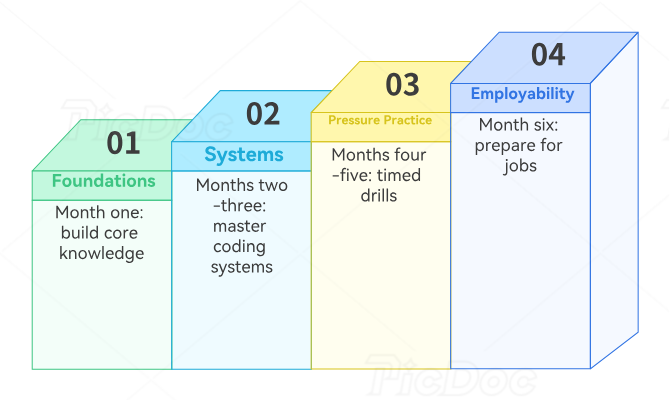
A strong six-month plan starts with foundations, then moves into systems, then adds exam practice and job proof. In month one, focus on medical terminology, anatomy, physiology, ICD-10-CM structure, and basic healthcare revenue cycle vocabulary. The goal is comprehension, because you cannot code what you cannot understand. Use dictionary terms for coding education, medical coding education accreditation terms, online coding exam prep resources, and continuing education units to structure the learning habit early.
In months two and three, move into coding systems. CPC candidates should drill ICD-10-CM, CPT, HCPCS, guidelines, modifiers, E/M, surgery, radiology, pathology, and medicine sections. CCS candidates should spend more time on full-record review, inpatient logic, diagnosis sequencing, and procedure coding. CRC candidates should master chronic disease evidence, MEAT documentation, HCC categories, and risk-adjustment audit logic. Billing candidates should map the entire claim lifecycle and practice denial scenarios. Support this stage with complete CPT emergency medicine coding, orthopedic surgery CPT coding, lab and pathology coding, and radiology billing and coding.
In months four and five, study under pressure. Timed practice matters because certification exams and employer assessments punish slow lookup habits. Build a correction journal with four columns: missed concept, why you missed it, correct rule, and prevention note. This simple document turns every wrong answer into a future point. For billing learners, create a denial tracker with payer reason, root cause, action taken, documentation needed, and expected prevention. Use medical billing reconciliation, denial management services, clearinghouse terminology, and electronic claims submission platforms to make practice workflow-based.
In month six, turn learning into employability. Build a one-page CV summary that states your target lane clearly: outpatient coding, risk adjustment, inpatient coding, billing, denial management, or revenue cycle support. Add training, exam preparation, practice-case volume, documentation-review exercises, software exposure, privacy awareness, and measurable learning outputs. Create a portfolio with anonymized examples: coding rationale notes, modifier practice sheets, HCC evidence checks, EOB breakdowns, and denial root-cause logs. Employers respond better when your preparation looks operational. Strengthen that portfolio with charge capture terms, revenue leakage prevention, RCM metrics and KPIs, and RCM software terms.
5. Jobs, Career Paths, and Mistakes to Avoid in the Philippines Market
The Philippines offers several practical healthcare revenue cycle paths: medical coder, risk adjustment coder, inpatient coder, outpatient coder, coding quality analyst, medical billing specialist, accounts receivable specialist, denial management analyst, payment posting associate, prior authorization specialist, eligibility specialist, clinical documentation support associate, and RCM team lead. The first job may be coding-adjacent, especially for career shifters. A billing or AR role can still become a strong launchpad if you use it to learn payer behavior, claim errors, documentation support, and revenue cycle discipline. Read billing solutions for small practices, practice management systems, healthcare claims management, and accurate billing and reimbursement to understand the business side.
The most damaging mistake is choosing a credential because someone online said it is “the best.” CPC may be best for one learner, CRC for another, CCS for another, and CPB for someone aiming at billing operations. Your decision should come from job ads, your background, your budget, your study time, and your target account type. A nurse targeting risk adjustment may move faster with CRC preparation. A BPO agent aiming for AR and billing may start with billing workflow and CPB-style training. A graduate aiming for physician coding may choose CPC. A hospital-record learner may work toward CCS later. Compare CPC certification programs, CCS certification programs, CBCS certification courses, and certification renewal terms before committing.
Another mistake is practicing only multiple-choice questions. Multiple-choice practice helps exam technique, but job readiness requires chart reading, evidence review, audit thinking, and workflow judgment. A coder must know why the final code is supported. A biller must know why a payer denied the claim. A risk adjustment coder must know why the condition is active, assessed, treated, or monitored. A QA analyst must explain errors without guessing. That is why complete reference for encoder software, coding automation terms, data analytics and reporting terms, and clinical decision support terms matter as the field becomes more tool-assisted.
The strongest applicants speak in workflow language. Instead of saying, “I studied medical coding,” say, “I practiced ICD-10-CM diagnosis selection, CPT procedure lookup, modifier usage, HCC documentation validation, denial root-cause tracking, and EOB interpretation.” That tells employers you understand the work beyond the exam. It also makes interviews easier because you can connect your training to account quality, claim accuracy, audit defense, and payment outcomes. Keep sharpening that language through commercial insurance billing terms, CMS-1500 form terms, UB-04 billing form terms, and cost reporting terms.
6. FAQs: Medical Billing and Coding Certification in Philippines
-
The best certification depends on the job target. CPC is usually a strong route for outpatient and physician coding roles. CCS fits hospital and inpatient coding goals. CRC is valuable for risk adjustment and HCC-focused accounts. CPB is better for billing, claims, denials, and revenue cycle operations. TESDA-style local training can help beginners build structure, especially when paired with international coding practice. Compare medical coding certification terms, CPC program options, CCS certification routes, and coding credentialing organizations.
-
Yes. Many coders come from nursing, pharmacy, allied health, biology, medical transcription, healthcare BPO, and general BPO backgrounds. Non-clinical learners need stronger medical terminology, anatomy, chart-reading, and coding guideline practice. The key is proving that you can understand provider documentation and apply codes accurately. Start with medical abbreviations for coders, medical coding workflow terms, coding competency assessment terms, and coding apprenticeship terms.
-
CPC can be worth it if your target jobs involve US outpatient coding, professional fee coding, physician services, CPT, HCPCS, modifiers, and ICD-10-CM. Many Philippines-based healthcare BPO roles value international coding credentials because clients need coders who understand US healthcare documentation and claims standards. CPC preparation should be paired with practical chart review, modifier practice, and denial awareness. Strengthen your preparation with CPT modifiers, CPT emergency medicine coding, CPT radiology coding, and coding edits guidance.
-
A focused learner can build a foundation in three to six months, but job readiness depends on practice quality. Someone with a nursing or healthcare background may move faster on terminology and anatomy. Someone from general BPO may move faster on productivity, client communication, and workflow discipline. The best plan includes daily terminology, weekly coding cases, denial examples, chart review, and timed practice. Use online exam prep resources, coding education terms, CEU guidance, and professional development terms.
-
Medical coding converts diagnoses, procedures, services, supplies, and clinical evidence into standardized codes. Medical billing uses those codes and claim details to submit charges, follow payer rules, post payments, correct denials, and close balances. Coding protects accuracy. Billing protects payment flow. In many Philippines-based RCM roles, the two functions connect closely. Learn both sides through revenue cycle management terms, claims management terms, payment posting terms, and reconciliation terms.
-
A beginner CV should clearly show target role, training route, coding systems studied, exam preparation, chart-review practice, billing workflow knowledge, privacy awareness, and portfolio evidence. Add practice volume where possible, such as “completed 150 ICD-10-CM practice cases” or “built denial tracker for CARC/RARC examples.” Avoid vague claims. Use concrete skill language from medical coding audit terms, healthcare data security terms, medical record retention terms, and coding ethics terms.
