
Medical Billing and Coding Certification in India: Complete Guide for 2026-2027
Medical billing and coding certification in India has become a serious career pathway for students, graduates, nurses, life-science professionals, pharmacy graduates, and healthcare back-office workers who want global healthcare skills without waiting years for a clinical role. The opportunity is strongest for people who can connect medical coding certification terms, CPT procedure coding, ICD coding standards, and medical billing reimbursement into one practical workflow. For 2026-2027, the winning candidates will be those who train for accuracy, documentation judgment, payer logic, and audit-ready decision-making.
1. Why Medical Billing and Coding Certification Matters in India for 2026-2027
India’s medical billing and coding market is shaped by two forces: domestic healthcare digitization and international revenue-cycle outsourcing. A certified candidate in India can support hospitals, physician groups, billing companies, insurance processes, KPO teams, RCM vendors, clinical documentation teams, and healthcare technology workflows. The skill set is valuable because coders do more than assign numbers; they translate medical records into structured data that affects claims management, medical necessity criteria, payment posting, and revenue cycle management.
The pain point for many Indian candidates is confusion. They hear about CPC, CCS, CBCS, ICD, CPT, HCPCS, EOBs, denials, modifiers, and payer edits, but no one explains how these pieces fit into an employable skill. A certificate alone will not save a weak candidate who cannot read a provider note, identify the service, assign the diagnosis, check the modifier, and defend the claim. That is why preparation should combine coding workflow terms, clinical documentation improvement, coding audit terminology, and coding ethics standards.
For 2026-2027, candidates in India should treat certification as a professional proof system. Employers want people who can work inside production targets without destroying accuracy. That means you need speed, but speed without documentation discipline creates denials, rework, and compliance risk. Strong candidates learn how CPT coding references, ICD-11 disease coding, modifier usage, and coding edits work together before they chase job applications.
Medical Billing and Coding Certification in India: 2026-2027 Career Readiness Map
2. Choose the Right Certification Path for Your Career Goal
The right certification depends on the role you want. A student targeting outpatient medical coding may need stronger CPT and modifier preparation. A candidate targeting hospital coding needs deeper diagnosis, documentation, and inpatient/outpatient awareness. Someone entering billing operations should understand claims, denials, payment posting, EOBs, and payer communication. Before paying for a course, compare your goal with CPC certification programs, CCS certification programs, CBCS certification courses, and coding credentialing organizations.
For Indian freshers, the strongest path is usually a layered one. Start with terminology, anatomy, healthcare billing vocabulary, ICD basics, CPT basics, documentation rules, and claim flow. Then choose a credential based on your job target. A CPC-style path helps outpatient coding and physician-service coding. A CCS-style path supports broader coding depth and documentation judgment. A CBCS-style path helps billing, claims, reimbursement, insurance, and administrative revenue-cycle roles. Your decision should reflect medical coding education accreditation, coding education terms, coding competency assessment, and coding career development.
Be careful with course promises. Any institute can advertise “job-ready training,” but a serious program should teach code-book navigation, documentation review, payer-facing billing logic, specialty practice, compliance, error analysis, and mock exams. Ask whether the course includes practical work with CMS-1500 form terms, UB-04 billing form concepts, EOB interpretation, and healthcare billing acronyms. A weak course gives definitions; a useful course teaches decisions.
3. Build the Core Skill Stack Before You Chase a Job
Medical billing and coding jobs in India often test practical readiness quickly. Candidates may be asked about ICD codes, CPT sections, modifiers, denials, AR follow-up, patient responsibility, eligibility, or claim status. The fastest way to become credible is to build a core stack: terminology, anatomy, diagnosis coding, procedure coding, modifiers, billing forms, payer edits, documentation rules, and denial logic. This stack connects ICD-11 cardiovascular coding, CPT emergency medicine coding, radiology billing terms, and lab and pathology coding.
The biggest weakness among beginners is studying coding and billing separately. In real work, they constantly touch. A diagnosis supports medical necessity. A modifier can protect payment. A missing documentation element can trigger a denial. A claim adjustment code can reveal a coding or eligibility problem. A payment posting issue can expose incorrect charge capture. That is why candidates should study CARC denial codes, RARC remark codes, coordination of benefits, and patient responsibility terms alongside coding rules.
India-based candidates should also prepare for remote and offshore workflows. Many roles require comfort with EHRs, practice management systems, spreadsheets, claim portals, quality checks, productivity targets, and written communication. A candidate who can explain a coding rationale clearly has an advantage over someone who only memorizes code examples. Build working familiarity with electronic medical record documentation, EHR coding terms, practice management systems, and encoder software terms.
Quick Poll: What is your biggest challenge in starting a medical billing and coding career in India?
4. Create a 2026-2027 Study Plan That Builds Job-Ready Accuracy
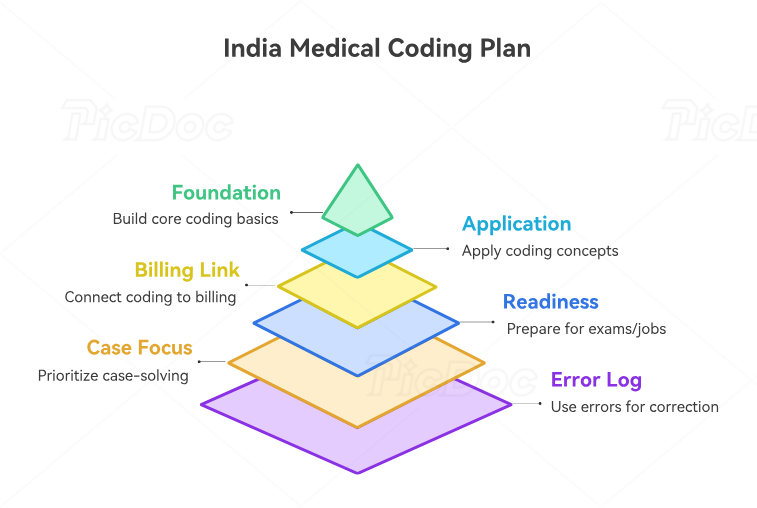
A strong India-focused study plan should run in phases. Phase one is foundation: medical terminology, anatomy, healthcare systems, insurance vocabulary, diagnosis coding, and procedure coding basics. Phase two is application: CPT sections, modifiers, ICD specificity, documentation reading, E/M concepts, and specialty examples. Phase three is billing connection: claim forms, denials, EOBs, payer edits, payment posting, and reconciliation. Phase four is exam and job readiness: timed practice, interview preparation, audit-style explanations, and portfolio proof. This plan should pull from professional development terms, continuing education units, certification renewal, and coding apprenticeship terms.
Do not measure progress only by how many chapters you finish. Measure whether you can solve cases. Can you identify the main diagnosis? Can you choose the right procedure family? Can you explain the modifier? Can you spot bundled work? Can you connect the claim denial to the coding issue? Can you defend your answer without guessing? These questions are more valuable than passive reading because employers need performance, not familiarity. Practice with cardiology CPT coding, gastroenterology CPT coding, orthopedic surgery coding, and dermatology CPT coding.
Your error log should become the center of your preparation. Every wrong answer should be labeled by cause: terminology, anatomy, missed guideline, wrong code family, unsupported diagnosis, modifier confusion, bundled service, weak medical necessity, billing-form mistake, or time pressure. This method turns frustration into exact correction. It also mirrors professional quality review, where coders must identify why errors happened and prevent them from recurring through claims reconciliation, medical billing reconciliation, charge capture terms, and revenue leakage prevention.
5. Prepare for Jobs, Interviews, and Career Growth in India
For job readiness, build a resume around skills rather than only course names. Mention coding systems studied, specialties practiced, billing workflows understood, claim tools encountered, denial categories reviewed, and mock practice completed. A fresher can still look serious by showing structured learning: ICD practice, CPT section work, modifier drills, EOB review, denial scenarios, and audit-style explanations. This is stronger than a generic line saying “completed medical coding course.” Connect your profile with healthcare claims management, RCM software terms, billing solutions for small practices, and electronic claims submission platforms.
Interview preparation should be practical. Be ready to explain the difference between ICD and CPT, why modifiers matter, how medical necessity affects payment, what an EOB shows, why claims deny, how documentation supports codes, and how you would handle uncertainty in a chart. Strong answers should sound calm, specific, and process-driven. Use examples from preventive medicine coding, behavioral health billing, telemedicine coding, and emergency transport coding to show range.
Career growth comes from specialization. After certification, choose a direction: outpatient coding, hospital coding, emergency coding, radiology, surgery, AR follow-up, denial management, payment posting, audit support, CDI, or RCM operations. India-based professionals who combine certification with specialty depth and communication skill can move beyond entry-level production into quality review, team lead, audit, training, and process-improvement roles. Keep learning through risk adjustment coding, HCC coding definitions, value-based care coding, and HEDIS terminology.
6. FAQs About Medical Billing and Coding Certification in India
-
Yes, it can be a strong career path for candidates who build practical coding, billing, documentation, and RCM skills. India has a large healthcare back-office and outsourcing ecosystem, but employers still look for accuracy, speed, process discipline, and communication. A useful preparation path should combine medical coding certification terms, coding workflow, billing reimbursement, and RCM terminology.
-
The best certification depends on your target job. CPC-style training is useful for outpatient and physician-service coding, CCS-style preparation supports stronger coding depth, and CBCS-style training fits billing, claims, and administrative revenue-cycle work. Compare online CPC programs, CCS certification programs, CBCS course options, and credentialing organization terms before choosing.
-
Freshers can enter the field, but they need more than a completion certificate. Employers want evidence that you understand medical terminology, anatomy, ICD, CPT, modifiers, claims, denials, and documentation basics. Build proof through practice tests, specialty drills, error logs, and short coding rationales. Study medical abbreviations, encounter forms, SOAP note coding, and problem list documentation.
-
The timeline depends on your background and target credential. A life-science or healthcare graduate may move faster through anatomy and terminology, while a complete beginner may need more time to build foundations. Measure readiness by your ability to solve cases, explain codes, handle modifiers, read EOBs, and identify denial causes. Build your plan around coding education terms, coding competency, practice management systems, and encoder software.
-
Learn terminology, anatomy, ICD, CPT, modifiers, documentation review, medical necessity, billing forms, EOBs, CARCs, RARCs, denials, and payer workflows. Also practice written explanations because coders often need to justify decisions. Skill depth should include ICD-11 respiratory coding, ICD-11 oncology coding, CPT radiology coding, and CPT modifier usage.
-
Billing and coding require different strengths. Coding demands stronger documentation interpretation, anatomy, terminology, diagnosis selection, procedure rules, and modifier logic. Billing demands claim flow, eligibility, insurance terms, denials, payment posting, appeals, and reconciliation. Many India-based roles blend both, so candidates benefit from understanding commercial insurance billing, clearinghouse terminology, payment posting, and collections and bad debt.
