
ICD-11 Oncology Codes: Detailed Dictionary & Case Studies
Cancer coding is where documentation precision, reimbursement logic, and compliance exposure collide. In oncology, a vague diagnosis line, missing morphology detail, or unsupported treatment intent can trigger denials, undercoding, audit risk, and distorted outcomes reporting. This guide is built for coders, billers, CDI teams, and revenue cycle leaders who need more than definitions—they need a practical oncology coding framework.
You’ll get a high-value ICD-11 oncology terminology dictionary, coding-focused explanations, and case studies that show how documentation quality directly changes code assignment, claim performance, and downstream revenue integrity.

1: Why ICD-11 Oncology Coding Is Operationally Different From General Diagnosis Coding
ICD-11 oncology coding demands a deeper synthesis of pathology, staging language, treatment intent, and episode timing than many non-oncology specialties. In real workflows, coders are not just assigning a diagnosis label—they are translating clinical oncology narratives into standardized data that supports claims, risk logic, registries, quality reporting, and longitudinal care planning. That is why teams that already understand medical billing dictionary common terms and definitions, medical coding compliance dictionary essential terms, medical necessity criteria essential coding guide, and guide to medical coding regulatory compliance still struggle when oncology charts become dense.
The pressure point is documentation granularity. Oncology coding often requires exact primary site, histology/morphology behavior, laterality (where relevant), recurrence status, metastatic spread, and treatment context. If documentation is fragmented across pathology reports, infusion notes, operative reports, and oncology consults, coding accuracy drops fast. That is why strong teams rely on clinical documentation improvement CDI terms dictionary, complete reference for coding query process terms, guide to electronic medical records EMR documentation terms, and complete guide to electronic health record EHR integration terms to build reliable query and abstraction workflows.
Another common pain point is the handoff between diagnosis coding and therapy billing. Oncology claims are frequently tied to infusion/injection administration, supportive medications, procedures, and ongoing surveillance. If the diagnosis coding is non-specific, the whole billing chain becomes fragile—especially for prior auth matching, medical necessity validation, and payer edits. This is where coders benefit from cross-training in infusion and injection therapy billing terms explained, comprehensive guide to charge capture terms, understanding coding edits modifiers complete guide, and guide to claim adjustment reason codes CARCs.
Finally, oncology coding errors are not only claim errors—they become data quality failures. Poorly coded cancer cases can skew internal analytics, treatment utilization trends, and reimbursement forecasting. Teams trying to improve this should align coding education with revenue cycle metrics and KPIs terms and definitions, guide to medical coding revenue leakage prevention, understanding cost reporting in medical billing, and value-based care coding terms explained so the coding team is not treated as a back-end cleanup function.
| Term | What It Means | Why It Hits Oncology Billing/Coding | Best Practice Action |
|---|---|---|---|
| Primary Site | Original organ/tissue where malignancy began | Drives diagnosis specificity, treatment pathway, and payer logic | Confirm pathology + oncologist assessment align before coding |
| Secondary Malignancy | Metastatic spread to another site | Changes sequencing and medical necessity support for therapy | Capture all documented metastatic sites, not just “mets present” |
| Histology | Microscopic tumor type | Affects specificity, regimen appropriateness, and reporting quality | Use final pathology wording; avoid coding from preliminary impressions |
| Morphology | Tumor cell type and behavior descriptor | Critical for exact oncology classification and analytics | Create coder checklist for morphology capture from pathology |
| Behavior | Benign/in situ/malignant/uncertain profile | Directly impacts diagnosis accuracy and claim validity | Do not assume malignant if provider language is ambiguous |
| Laterality | Side of body (left/right/bilateral) | Missing laterality can cause denials and weak audit defensibility | Query when pathology, imaging, and assessment conflict |
| Recurrence | Cancer returning after prior response/remission | Impacts episode characterization and treatment justification | Capture physician-documented recurrence status explicitly |
| Remission | Reduced/absent signs of disease after treatment | Avoids overcoding active malignancy when status changed | Code active disease only when supported in current encounter |
| History of Malignancy | Past cancer no longer under active treatment (unless exceptions) | Wrong use can trigger mismatched oncology claim edits | Validate current treatment plan before using history status |
| Staging | Extent/severity classification of cancer | Supports treatment intensity and utilization review rationale | Abstract staging from finalized oncologist-documented source |
| TNM | Tumor-node-metastasis staging framework | Commonly referenced but inconsistently documented in claims notes | Don’t infer missing TNM elements from scattered reports |
| Grade | Degree of cellular differentiation/aggressiveness | Can support treatment rationale and registry quality | Record only documented grade; avoid assumption from regimen |
| Biomarker Status | Molecular/protein marker result impacting therapy selection | Essential for payer review of targeted therapies | Link result date and ordering provider in abstraction workflow |
| Neoplasm of Uncertain Behavior | Pathology has not established benign vs malignant behavior | High denial risk if malignant therapy billed without support | Escalate for CDI/physician clarification before final coding |
| In Situ Neoplasm | Non-invasive malignant cells confined to epithelium | Coding as invasive malignancy creates compliance exposure | Use pathology-confirmed invasion status |
| Occult Primary | Metastatic disease with unknown original primary site | Sequencing and documentation become highly scrutinized | Code documented unknown primary status; track diagnostic workup |
| Progression | Disease worsening despite/after therapy | Supports regimen changes and utilization review defense | Capture radiology/oncology note alignment for progression statement |
| Treatment Intent | Curative, adjuvant, neoadjuvant, palliative, maintenance, etc. | Explains service necessity and sequencing logic | Build coder abstraction field for intent from oncologist plan |
| Adjuvant Therapy | Treatment after primary therapy to reduce recurrence risk | Context prevents coding confusion during post-op episodes | Tie diagnosis to active malignancy and documented treatment phase |
| Neoadjuvant Therapy | Treatment before surgery/radiation | Prevents claim denials when definitive surgery not yet done | Document planned definitive treatment in chart review notes |
| Maintenance Therapy | Ongoing treatment to sustain response/control disease | Payers often request stronger diagnosis/treatment rationale | Retain response/progression history for appeal support |
| Palliative Treatment | Therapy aimed at symptom relief/quality of life | Requires precise documentation to avoid intent confusion | Capture symptom burden and oncologist goals explicitly |
| Cycle/Regimen | Structured chemotherapy/targeted therapy plan schedule | Supports charge capture and administration coding consistency | Reconcile regimen orders with administration documentation daily |
| Toxicity/Adverse Effect | Treatment-related harmful event | Can affect diagnosis sequencing and medical necessity for interventions | Code treatment complications only when provider attributes causality |
| Encounter for Follow-up/Surveillance | Post-treatment monitoring without confirmed active disease | Prevents inappropriate active cancer coding on routine surveillance | Differentiate surveillance from recurrence workup in notes |
| Residual Disease | Cancer remains after treatment | Supports continued treatment and claim defense | Capture post-op/pathology statements precisely |
| Complete Response / Partial Response | Documented treatment response categories | Important for appeals, maintenance therapy support, and analytics | Track response terms in longitudinal oncology coding notes |
| Pathology Addendum | Updated pathology information after final report | Late changes can invalidate earlier coding decisions | Establish re-coding trigger rules for pathology addenda |
| Query Escalation Threshold | Standard for when coder must query provider/CDI | Reduces silent assumptions that cause audits and denials | Define mandatory query triggers for site, behavior, recurrence, mets |
2: Detailed ICD-11 Oncology Dictionary — What Coders Must Clarify Before They Finalize a Cancer Code
A high-performing oncology coder does not start with “what code fits this note?” They start with “what clinical facts are still unconfirmed?” That mindset prevents the most expensive oncology coding errors: coding presumed primaries as confirmed, coding history status when active treatment is underway, and coding metastatic disease without site specificity. To strengthen this discipline, teams should combine oncology workflow standards with medical coding audit terms comprehensive dictionary, medicare documentation requirements for coders, guide to fraud waste and abuse FWA terms for coders, and guide to financial audits in medical billing.
1) Primary vs Secondary Malignancy
This is the first hard stop. If the oncologist note says “metastatic disease to liver” but does not document primary site, coders cannot safely fill in gaps from suspicion language alone. Use pathology, imaging impressions, and final oncologist assessment carefully, but assign only what is documented as established. This is exactly where guide to medical claims submission complete terminology guide, clearinghouse terminology guide for medical coders, remittance advice remark codes RARCs comprehensive dictionary, and understanding coordination of benefits COB clear definitions become relevant in denial prevention.
2) Active Disease vs History vs Surveillance
One of the most damaging oncology coding habits is carrying forward active cancer diagnoses indefinitely. If the encounter is surveillance and the provider documents no current evidence of disease, that status should drive code selection—not historical carryover from a problem list. Teams should audit this using comprehensive guide to problem lists in medical documentation, comprehensive guide to SOAP notes and coding, medical record retention and storage terms, and guide to clinical documentation integrity terms.
3) Histology, Morphology, and Behavior
Oncology coding specificity rises or falls with pathology interpretation. Coders need a repeatable abstraction habit: site → histology → behavior → spread → status → treatment context. Skipping morphology/behavior precision often causes downstream mismatches when regimens, utilization review, or appeals require exact disease characterization. To systematize this, pair coder training with complete reference for encoder software terms, guide to coding software terminology, medical billing practice management systems terms defined, and guide to revenue cycle management software terms.
4) Treatment Context Is Not Optional
If a patient is receiving chemotherapy, immunotherapy, or targeted treatment, the coder must understand whether therapy is adjuvant, neoadjuvant, maintenance, palliative, or for progression. The diagnosis assignment may not change solely because the regimen changed, but payer review logic absolutely will. That is why oncology teams should also learn from reference understanding Medicare reimbursement fully, guide to physician fee schedule terms, future of Medicare and Medicaid billing regulations what coders must know, and predicting changes in healthcare reimbursement models by 2027.
5) Query Discipline in Oncology
Oncology coders can become “chart detectives” and accidentally cross the line into assumption. The fix is a mandatory query matrix for missing primary site, uncertain behavior, recurrence status, metastatic site specificity, and treatment intent. Strong query culture lowers both denial rates and compliance exposure. This aligns with best practices in guide to medical coding regulatory compliance, coding compliance trends staying ahead in a rapidly changing environment, how new healthcare regulations will impact coding careers, and upcoming regulatory changes affecting medical billing 2025-2030.
3: Case Study Framework — How to Code Oncology Encounters Without Guessing
The fastest way to improve oncology coding accuracy is to use a consistent case-review sequence. Below is a practical framework that coders, leads, and auditors can apply before finalizing ICD-11 oncology code assignment. It also helps when training staff preparing for career growth through how to become an oncology coding specialist, comprehensive CCS certified coding specialist exam guide, guide to CPC certified professional coder exam terms, and CBCS certified billing and coding specialist exam terms explained.
The 8-step oncology coding review sequence
Identify encounter purpose (new diagnosis workup, active treatment, surveillance, toxicity management, follow-up).
Confirm diagnosis authority source (final pathology, oncologist assessment, tumor board note, operative report).
Lock primary site and site specificity before looking at treatment charges.
Capture secondary/metastatic sites only when documented as established.
Confirm disease status (active, remission, recurrent, progressive, residual, history).
Extract treatment context (adjuvant/neoadjuvant/palliative/maintenance/etc.).
Reconcile problem list carryovers against current oncologist note.
Trigger query when a required oncology fact is missing or contradictory.
This sequence reduces “charge-first coding,” where coders anchor on infusion claims and backfill diagnoses afterward. That habit causes revenue leakage and audit exposure, especially when teams skip comprehensive guide to charge capture terms, guide to medical coding revenue leakage prevention, understanding computer assisted coding CAC terms, and understanding medical coding automation terms AMBCI.
4: Case Studies — Real-World Oncology Coding Decisions That Affect Claims, Denials, and Compliance
Case Study 1: “Breast cancer follow-up” that should not be coded as active malignancy
Scenario: A patient returns for surveillance after completed treatment. Problem list still shows prior breast malignancy. Current oncologist note states no evidence of active disease and ongoing surveillance imaging plan.
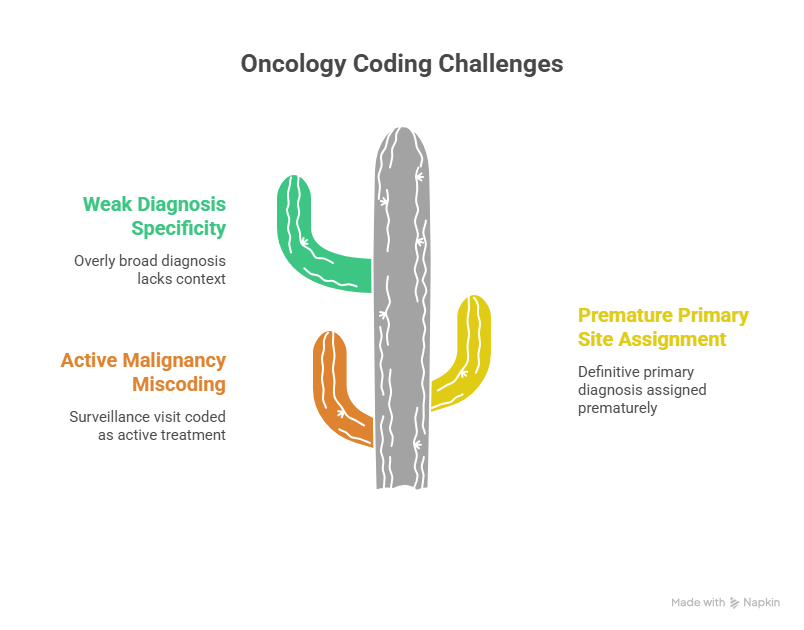
Risk: Coders copy forward active malignancy language, which can distort utilization analytics and trigger payer questions when the visit content supports surveillance rather than active treatment.
Coding lesson: The current encounter documentation controls. A problem list is helpful, but not authoritative when contradicted by the treating oncologist’s updated status. This is the same operational issue seen in comprehensive guide to problem lists in medical documentation, guide to electronic medical records EMR documentation terms, medical record retention and storage terms, and medical coding audit terms comprehensive dictionary.
Best practice action: Build a rule: if encounter purpose is surveillance and active disease is not documented, coder must validate status before finalizing oncology diagnosis assignment.
Case Study 2: Metastatic disease documented, primary site still under workup
Scenario: Patient admitted with liver lesions and biopsy confirming metastatic adenocarcinoma. Oncology note documents “suspected GI primary,” but workup is ongoing.
Risk: Coder prematurely assigns a definitive primary GI malignancy diagnosis based on suspicion, creating unsupported claim data and compliance exposure.
Coding lesson: Code what is confirmed, not what is suspected. Capture metastatic site(s) and documented unknown/suspected primary status per documentation standards until a definitive primary is established. Teams handling these charts should know medical necessity criteria essential coding guide, guide to fraud waste and abuse FWA terms for coders, guide to financial audits in medical billing, and medical claims submission complete terminology guide.
Best practice action: Use a mandatory oncology query/escalation protocol whenever documentation includes “suspected primary,” “probable source,” or “favored origin” without final confirmation.
Case Study 3: Infusion therapy denial caused by weak diagnosis specificity
Scenario: A chemotherapy infusion claim is billed, but diagnosis documentation on the claim is overly broad and does not reflect documented progression/recurrence context. Payer denies or requests records.
Risk: Revenue cycle delays, avoidable rework, and appeal burden—often caused by coding and charge capture teams working in silos.
Coding lesson: Oncology diagnosis coding cannot be separated from treatment context. The claim needs diagnosis specificity and chart support that matches why this regimen is medically necessary now (newly diagnosed, recurrent, progressive, maintenance, etc.). This connects directly with infusion and injection therapy billing terms explained, comprehensive guide to charge capture terms, guide to claim adjustment reason codes CARCs, and remittance advice remark codes RARCs comprehensive dictionary.
Best practice action: Require a pre-bill oncology diagnosis reconciliation step for high-cost infusion encounters when denials exceed threshold.
5: Building an Oncology Coding Quality System — Audits, Queries, Training, and Revenue Protection
If your oncology coding quality depends on individual “expert coders” catching everything manually, the system is fragile. You need a repeatable oncology coding quality framework that survives turnover, scale, and payer pressure. Start with a focused audit design that measures the real oncology failure points: primary/secondary distinction, disease status accuracy, treatment-context capture, pathology addendum follow-through, and unsupported assumptions. Use audit terminology and scoring rules from medical coding audit terms comprehensive dictionary, guide to financial audits in medical billing, guide to medical coding regulatory compliance, and medicare documentation requirements for coders.
Next, build an oncology-specific query governance policy. Many organizations have generic CDI query rules but no oncology triggers. That is a mistake. Oncology requires mandatory queries for missing primary site confirmation, unclear recurrence/progression language, unspecified metastatic sites, and ambiguous treatment intent. Strengthen this process with complete reference for coding query process terms, clinical documentation improvement CDI terms dictionary, guide to clinical documentation integrity terms, and comprehensive guide to SOAP notes and coding.
Then connect coding quality to revenue outcomes. If leaders only track coder productivity, they miss the real story: denials, rework, appeal volume, lag days, and net collections tied to diagnosis specificity quality. Oncology teams should monitor this using revenue cycle metrics and KPIs terms and definitions, guide to medical coding revenue leakage prevention, understanding cost reporting in medical billing, and value-based care coding terms explained.
Finally, make training continuous. Oncology coding is not a one-time education event because regulations, payer edits, documentation habits, and software workflows keep changing. Coders who want to future-proof their careers should study ICD-11 coding standards and best practices, guide to ICD-11 official coding guidelines explained, medical coding education accreditation terms, and understanding continuing education units CEUs for coders. Teams exploring automation should also evaluate understanding computer-assisted coding CAC terms, understanding medical coding automation terms AMBCI, AI in revenue cycle management upcoming trends for medical coders, and future skills medical coders need in the age of AI without outsourcing clinical judgment to software.
6: FAQs — ICD-11 Oncology Coding
-
The most common high-impact mistake is insufficient diagnosis specificity tied to active treatment, especially when claims are submitted with broad cancer labels while the chart documents recurrence, progression, metastatic spread, or maintenance context. The denial is often framed as medical necessity mismatch, but the root cause is usually diagnosis abstraction failure plus weak charge-capture coordination. Review infusion and injection therapy billing terms explained, guide to claim adjustment reason codes CARCs, RARCs dictionary, and charge capture terms.
-
Pathology is crucial, but coders should not rely on pathology in isolation if the encounter requires current disease status, recurrence/progression context, or treatment intent that is documented by the oncologist. Best practice is to reconcile pathology + oncologist assessment + encounter purpose before finalizing. This is where CDI terms, coding query process terms, EMR documentation terms, and problem list documentation guidance become operationally important.
-
They should not assume history status if active treatment is ongoing or the oncologist documents active disease, recurrence, progression, or residual disease. History coding in active treatment contexts is a classic audit trigger. Validate status in the current note and query when unclear. Strengthen this workflow with medical coding audit terms, medical coding compliance dictionary, medical necessity criteria guide, and regulatory compliance guide.
-
At minimum: unclear primary site, unspecified metastatic site(s), uncertain behavior when malignancy is not confirmed, conflicting active-vs-history status, recurrence/progression not clearly documented, and missing treatment intent for high-cost therapy encounters. A strong trigger list reduces silent assumptions and appeal volume. Build it using coding query process terms, CDI dictionary, guide to clinical documentation integrity terms, and financial audit terms in medical billing.
-
Track denial rate by oncology service line, diagnosis-related denial root causes, query rate, query response time, rework rate, first-pass resolution, appeal overturn success, and net collection lag tied to coding defects. Productivity alone hides quality failures. Build a dashboard using revenue cycle metrics and KPIs terms, revenue leakage prevention guide, RCM software terminology, and predictive analytics in medical billing trends and opportunities.
-
Yes—because oncology coding depends heavily on documentation interpretation, pathology-context synthesis, query judgment, and compliance discipline. Automation can assist with abstraction prompts, but it cannot safely replace human clinical reasoning in ambiguous oncology cases. Coders who combine oncology expertise with tech literacy will be more valuable, not less. For career planning, study how to become an oncology coding specialist (plus oncology-specific practice tracks), future of medical coding with AI, how automation will transform medical billing roles, and future skills coders need in the age of AI.
