
Medical Billing and Coding Certification in Canada: Complete Guide for 2026-2027
Medical billing and coding careers in Canada sit at the intersection of clinical documentation, health data, reimbursement, privacy, and provincial insurance administration. The strongest candidates understand the difference between Canadian hospital coding, physician billing, private insurance claims, and health information management before selecting a program. This guide explains the recognized pathways, employer expectations, practical skills, costs, timelines, and job strategy while connecting each step to essential areas such as coding accreditation, credentialing organizations, coding competency, and career development.

1. Understand How Medical Billing and Coding Careers Work in Canada
Canada does not use one universal “medical billing and coding certification” for every workplace. The pathway depends on the work you intend to perform. Hospital coding commonly falls within health information management and uses ICD-10-CA, the Canadian Classification of Health Interventions, Canadian Coding Standards, abstracting rules, and institutional data-submission requirements. Physician billing focuses more heavily on provincial fee schedules, insured-service rules, claim submission, remittance reconciliation, rejected-claim correction, and practice-management systems.
Job Bank classifies health information management occupations under NOC 12111. It states that workers commonly need a recognized two-year college diploma in health record technology or health information management and may need to pass the national certification examination requested by employers. The occupation is currently identified as non-regulated across Canada, which means there is no single government licence that every worker must hold. Employers can still make education, certification, experience, language ability, and software competence mandatory hiring conditions.
For hospital-oriented coding, the most visible Canadian credential is Certified in Health Information Management, or CHIM, administered through the Canadian College of Health Information Management. CHIM professionals work across coding, records administration, data quality, privacy, analytics, public health, clinical decision support, and information governance.
Students frequently lose time because they purchase a general online course before deciding which Canadian role they are targeting. A course based mainly on American ICD-10-CM, HCPCS, Medicare, Medicaid, or US payer rules will not provide complete preparation for Canadian institutional coding. It can develop transferable knowledge in medical necessity, coding compliance, clinical documentation improvement, and medical coding workflow, yet Canadian classifications and provincial payment rules require dedicated study.
A useful starting decision is to choose among four broad destinations. Hospital coders need deep classification, abstracting, data-quality, and documentation-analysis ability. Physician billing specialists need provincial claim rules, fee codes, referrals, service-location requirements, and rejection management. Clinic administrators often combine scheduling, patient registration, electronic records, billing, collections, and insurer communication. Revenue cycle or claims specialists may work with private insurers, rehabilitation providers, dental offices, third-party administrators, or outsourced billing companies using skills described in revenue cycle management, healthcare claims management, payment posting, and claims reconciliation.
CIHI confirms that ICD-10-CA classifies diseases, injuries, causes of death, and relevant health circumstances, while CCI classifies diagnostic, therapeutic, and other healthcare interventions. Its Canadian Classifications Browser brings ICD-10-CA, CCI, Canadian Coding Standards, directives, and related resources into a searchable web environment.
2. Choose the Right Canadian Certification and Education Pathway
The most dependable route into Canadian hospital coding is a CCHIM-accredited health information management diploma or degree that provides eligibility for the CHIM National Certification Examination. Accreditation should be confirmed directly before enrolment because a school’s general recognition as a public or private institution does not automatically mean its health information program satisfies professional certification requirements. Graduates of accredited programs gain a direct route to the certification examination, which is why academic accreditation, certification terminology, credential renewal, and professional development should be reviewed as one connected decision.
A prospective student should verify six items in writing: the exact credential awarded, the program’s current accreditation status, NCE eligibility, practicum arrangements, coding-system access, and the graduation-to-certification sequence. Marketing phrases such as “medical billing specialist,” “medical office assistant,” and “medical coding certificate” can describe very different curricula. One program may devote substantial time to ICD-10-CA, CCI, Canadian Coding Standards, abstracting, privacy, and health analytics. Another may focus on reception, transcription, appointment scheduling, keyboarding, and basic claim entry.
The second route serves experienced health information professionals who already possess a complementary degree and recent industry experience. CCHIM introduced an experiential CHIM pathway that may allow eligible professionals with a complementary degree and three years of recent health information experience to seek approval to write the CHIM NCE without completing a full new academic program. The published process includes self-assessment, College review, and an NCE application. The January 2026 announcement listed an exam application price of CAD $498 plus tax, although applicants should verify the current amount before budgeting.
This pathway is highly relevant for professionals arriving from nursing informatics, healthcare analytics, privacy, digital health, clinical documentation, records management, epidemiology, or related disciplines. Eligibility depends on the College’s assessment rather than job title alone. Candidates should map their experience against health information management terms, EHR documentation concepts, clinical decision support, and coding ethics before submitting evidence.
The third route targets physician-office or clinic billing. Many employers accept a medical office administration, medical billing, or healthcare administration certificate combined with direct provincial billing knowledge. This route can lead to work in family practices, specialist clinics, diagnostic facilities, rehabilitation practices, community health settings, and outsourced billing operations. A strong curriculum should include registration accuracy, provincial health-number validation, claim creation, fee-code selection, referrals, diagnostic information, service dates, batch transmission, rejection correction, remittance review, payment allocation, patient balances, and revenue leakage prevention.
The fourth route involves international or US-oriented credentials. A CPC, CCS, CBCS, or comparable certificate can demonstrate discipline, terminology knowledge, and exposure to structured coding. Canadian employers will assess whether the candidate can transfer that knowledge into ICD-10-CA, CCI, Canadian abstracting requirements, provincial schedules, local privacy rules, and Canadian claims systems. Candidates holding an international credential should add a Canadian bridge plan covering coding system updates, documentation improvement, coding audits, charge capture, and claims management.
CCHIM also launched an Entry-to-Practice Medical Coding micro-credential in 2026 for eligible graduates of accredited programs who have earned CHIM certification. The assessment uses practical coding and abstracting scenarios involving ICD-10-CA, CCI, and Canadian Coding Standards. This gives new graduates a more focused way to demonstrate entry-level coding readiness beyond the broader CHIM designation.
3. Build the Skills Canadian Employers Test Before Hiring
A certificate may secure an interview, while demonstrated accuracy determines whether the candidate advances. Coding departments and billing offices need employees who can reach defensible decisions, explain them, correct errors, and work within productivity expectations. Memorizing common codes provides limited value when the record contains uncertain diagnoses, multiple interventions, conflicting dates, copied-forward text, missing specificity, or an incomplete discharge summary.
For hospital coding, study must combine anatomy, physiology, pathophysiology, pharmacology, medical terminology, documentation analysis, ICD-10-CA, CCI, Canadian Coding Standards, chart abstraction, data quality, and privacy. Students should use full cases rather than isolated one-line diagnoses. A complete case forces the learner to distinguish active conditions from historical information, assess significance, connect interventions to documentation, apply sequencing rules, and validate the abstract. Supporting resources on SOAP-note documentation, problem lists, medical record retention, coding queries, and coding ethics help develop that reasoning.
For physician billing, the core challenge is rule interaction. A fee code can appear correct while the claim still fails because of provider speciality, referral status, patient eligibility, service location, time requirements, maximum frequency, diagnostic information, claim cutoff, conflicting services, or missing supporting documentation. Training should therefore connect encounter forms and superbills, billing acronyms, patient responsibility, payment posting, and collections controls.
Create a competency portfolio before applying. Protect patient privacy by using fictionalized or officially supplied educational cases. Include a coded inpatient case, an ambulatory case, a physician-billing claim, a rejected-claim correction, a remittance reconciliation, a documentation query, a data-quality audit, and a monthly KPI summary. Each item should show the source information, decision path, rule applied, result, and quality check. This mirrors the logic employers expect from people working with coding automation, encoder software, RCM software, and EHR integration.
Your productivity practice should measure both speed and accuracy. Record case type, completion time, first-pass accuracy, error category, reference consulted, and correction. A learner who completes 20 cases rapidly while repeating the same sequencing mistake has created false confidence. A learner who tracks error patterns can target the rule producing the largest quality loss. Use revenue cycle metrics, data analytics terminology, coding competency measures, and audit terminology to structure the scorecard.
4. Learn Provincial Billing Rules and Canadian Workplace Systems
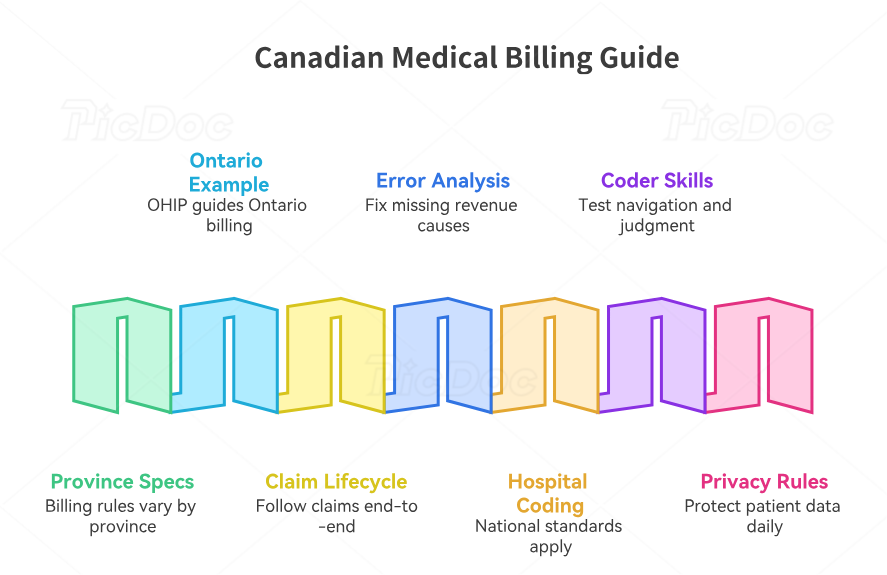
Canadian physician billing is province-specific. Every candidate should identify the province or territory where they intend to work and train on its current insured-service schedule, claim-submission method, provider bulletins, eligibility rules, adjudication responses, deadlines, and correction procedures. A generic billing course becomes far more valuable when supplemented with the actual fee schedule and test cases from the target jurisdiction.
Ontario provides a useful example of the operational detail involved. The province publishes its OHIP Schedule of Benefits, fee updates, INFOBulletins, and Medical Claims Electronic Data Transfer requirements. Ontario states that eligible claims must be submitted through MCEDT, and it publishes recurring monthly submission cutoffs. Fee schedules and master files also receive updates, requiring billers to verify effective dates rather than relying on saved personal lists.
A competent biller should be able to follow a claim across its entire lifecycle. The process begins with correct patient demographics, health coverage, provider information, encounter date, service location, referral details, diagnosis, and service code. It continues through claim validation, electronic submission, acknowledgement monitoring, adjudication, remittance posting, exception review, correction, resubmission, reconciliation, and account closure. The strongest study references connect charge capture, electronic claims submission, claim reconciliation, payment posting, and revenue leakage.
A recurring employer pain point is the biller who can enter claims but cannot diagnose why money is missing. Your training should teach root-cause analysis. Separate errors into registration, eligibility, provider setup, coding, documentation, transmission, payer adjudication, payment posting, and follow-up categories. Then measure the financial and operational effect of each category. Useful controls include clean-claim rate, first-pass acceptance, rejection rate, correction turnaround, unbilled encounters, unmatched payments, aging balances, resubmission risk, and recovered revenue. These concepts align with RCM metrics and KPIs, medical billing reconciliation, collections management, and accurate reimbursement.
Canadian hospital coding adds another layer. Coders frequently work inside integrated clinical and abstracting systems, review information from multiple record locations, and apply national and organizational data-quality rules. CIHI states that Canadian Coding Standards apply to data submitted to the Discharge Abstract Database and the National Ambulatory Care Reporting System.
Employers therefore test navigation and judgment alongside code knowledge. A candidate should know where to locate discharge summaries, operative reports, pathology, imaging, consultation notes, medication records, emergency documentation, progress notes, and final diagnoses. They should recognize when the documentation supports a code, when it requires further review, and when a compliant query is appropriate. Study EHR coding terminology, clinical documentation improvement, problem-list documentation, SOAP-note coding, and medical record storage.
Privacy competence must be visible in daily behaviour. Avoid downloading patient information to personal devices, using real records in job portfolios, discussing cases in public spaces, sharing passwords, or accessing charts without a work-related purpose. Employers need people who understand access control, audit trails, secure transmission, record retention, breach escalation, and the minimum information required for the task. Build this foundation through healthcare data security, coding ethics and standards, health information management, and electronic record documentation.
5. Plan Your Costs, Timeline, Job Search, and Salary Strategy
The total cost of certification extends beyond tuition. Build a budget that includes application fees, textbooks, classification resources, technology, software access, examination charges, professional membership, practicum travel, transcript evaluation, background checks, equipment, and lost working hours. Online delivery may reduce travel expenses while still requiring scheduled classes, examinations, group work, and a workplace practicum.
Program length depends on the target role. An accredited HIM diploma commonly requires about two academic years, while degree pathways take longer. Short medical office or billing certificates may be completed faster, although they generally prepare candidates for a narrower set of administrative and physician-billing functions. An experienced professional approved for the CHIM experiential pathway may reach the examination stage sooner because the pathway recognizes relevant prior education and recent experience. Accreditation announcements from 2026 show Canadian HIM diploma programs continuing to use two-year structures, while some associate-level online programs can be completed over a shorter or more flexible period.
The correct timeline includes four phases. The education phase develops theory and supervised practice. The certification phase covers exam preparation, application, testing, and designation requirements. The transition phase builds Canadian experience through practicum, records work, registration, release of information, clinic administration, data quality, or claims support. The advancement phase adds specialization in coding, privacy, analytics, auditing, clinical documentation, or management using professional development planning, continuing education, certification renewal, and career-development terminology.
Search beyond the title “medical coder.” Canadian vacancies may appear as health information management coder, coding specialist, health records technician, health information practitioner, abstractor, data-quality analyst, release-of-information specialist, medical billing clerk, physician billing specialist, medical office administrator, claims examiner, reimbursement specialist, or records analyst. Read responsibilities before judging relevance because organizations use different titles for overlapping work.
Job Bank’s wage data, updated in November 2026, places health information management coder wages across Canada at approximately CAD $22.00 per hour on the low end, CAD $30.51 at the median, and CAD $46.19 on the high end. Provincial and regional figures vary. Alberta’s reported median was higher at CAD $36.73 per hour, while British Columbia’s reported median was CAD $30.60. These are occupational estimates rather than guaranteed starting wages. Education, certification, collective agreements, seniority, shift premiums, language ability, location, employment sector, and role complexity influence actual pay.
Ontario’s 2026-2027 outlook for health information management occupations is rated moderate. Job Bank reports that approximately 69% of workers in the occupation are employed by hospitals and about 90% work full time.
A resume should translate coursework into employer outcomes. Replace “studied medical coding” with evidence such as “applied ICD-10-CA, CCI, and Canadian Coding Standards to inpatient and ambulatory cases,” “audited simulated abstracts for completeness and sequencing,” or “reconciled submitted claims against remittance results and documented unresolved variances.” Support those statements with knowledge of coding workflows, audit procedures, reconciliation controls, and data reporting.
For interviews, prepare stories showing how you found an error, selected an authoritative reference, protected privacy, managed conflicting priorities, requested clarification, and prevented recurrence. Hiring managers need evidence of professional judgment. A strong response explains the situation, the risk, the reference consulted, the correction, the communication, and the control added afterward.
Candidates without Canadian experience should pursue adjacent roles strategically. Patient registration, health records, clinic administration, scanning and indexing, release of information, appointment coordination, billing support, data entry, and claims follow-up can establish familiarity with Canadian systems. Combine that experience with an apprenticeship or internship strategy, a competency assessment, a professional learning plan, and a secure portfolio of fictional cases.
6. Frequently Asked Questions About Medical Billing and Coding Certification in Canada
-
Job Bank currently identifies health information management occupations as non-regulated in Canada. Employers may still require a recognized HIM diploma, CHIM certification, relevant experience, specific software knowledge, or provincial billing competence. A candidate should therefore treat employer requirements as the practical entry standard even where government licensing does not apply. Review certification terminology, credentialing organizations, education accreditation, and competency assessment before selecting a pathway.
-
CHIM is one of Canada’s central professional designations for health information management. Hospital coding is part of a broader HIM practice that can include data quality, privacy, records administration, analytics, abstracting, information governance, and clinical decision support. The Entry-to-Practice Medical Coding micro-credential can provide additional evidence of practical ICD-10-CA, CCI, and Canadian Coding Standards competence for eligible CHIM-certified graduates.
-
Canadian institutional coding primarily uses ICD-10-CA and CCI. ICD-10-CM and CPT belong primarily to the United States coding and reimbursement environment. Some Canadian professionals may encounter international claims or cross-border workflows, but students targeting Canadian hospitals should prioritize the Canadian classifications and standards. The CPT coding dictionary, CPT cardiology guide, and ICD-11 standards guide can broaden international knowledge after Canadian foundations are secure.
-
Physician-office and clinic billing jobs may accept shorter certificates in medical billing, medical office administration, or healthcare administration. Hospital coding positions commonly expect more extensive HIM education, classification training, abstracting experience, and professional certification. Compare the curriculum against the intended job’s actual duties, including practice-management systems, revenue cycle software, claims management, and payment posting.
-
International experience can be highly valuable when supported by a Canadian transition plan. Document your education, professional credentials, years of experience, specialties, audit results, productivity, software exposure, and privacy training. Then close the gaps in ICD-10-CA, CCI, Canadian Coding Standards, local health information practice, and province-specific billing. Experienced professionals holding a complementary degree and recent health information experience should review the CHIM experiential pathway.
-
Acceptance depends on the institution, accreditation, curriculum, credential, practicum, and employer. Online delivery can be fully credible when the underlying program meets Canadian professional standards and provides the required practical experience. Before enrolling, obtain written confirmation of NCE eligibility, accreditation status, practicum support, classification access, and graduate outcomes. Use education and training terminology, accreditation concepts, exam-prep resources, and credentialing guidance as your evaluation framework.
