
Complete CPT Code Listing for Emergency Medicine
Emergency medicine coding moves fast because the chart is built under pressure, the patient condition can change in minutes, and one missed documentation detail can weaken reimbursement, medical necessity, compliance, or denial defense. A strong emergency medicine CPT directory should help coders connect CPT coding essentials, medical necessity criteria, coding edits and modifiers, and revenue cycle management before the claim leaves the system. Use this as an emergency coding map, then verify final code selection against the current CPT manual, payer policy, and facility rules. Emergency department E/M codes fall in 99281–99285, and critical care services commonly involve 99291 and 99292; CPT guidance and CMS education emphasize documentation, medical decision making, and code-specific requirements.

1. Why Emergency Medicine CPT Coding Needs Its Own Directory
Emergency medicine coding carries a different kind of risk than routine office coding because the chart often includes incomplete history, urgent decision-making, multiple differential diagnoses, diagnostic testing, medication administration, procedures, reassessments, transfers, observation decisions, and sometimes critical care. Coders need to know whether the visit supports an ED E/M level, whether a procedure can be reported separately, whether a modifier is required, and whether the documentation proves medical necessity. That is why emergency coding should be studied alongside emergency medicine CPT codes, claim adjustment reason codes, remittance advice remark codes, and medical billing reimbursement accuracy.
The first pressure point is E/M level selection. Emergency department E/M services use codes 99281–99285, and ED visit levels are commonly driven by medical decision making rather than total time for those ED E/M levels. That makes documentation quality critical. A vague note saying “patient stable, labs reviewed, discharge home” may describe workflow, but it may not show the data reviewed, risk considered, differential diagnoses evaluated, or treatment decisions made. Coders should connect ED E/M work to clinical documentation improvement, SOAP note coding, EHR documentation terms, and medical coding audit terms, because the payer only sees what the record supports.
The second pressure point is separate procedure reporting. Emergency medicine commonly involves laceration repair, splinting, incision and drainage, airway support, injections, infusions, fracture care, burn care, foreign body removal, diagnostic testing, and monitoring. Many denials happen when a service is bundled, underdocumented, missing laterality, missing anatomical specificity, missing start and stop time, missing medical necessity, or missing a modifier. A clean ED coding workflow should connect CPT modifier usage, charge capture terminology, claims management terms, and coding revenue leakage prevention so the coder can spot the missing evidence before it becomes unpaid work.
Emergency Medicine CPT Code Directory Map: What Each Code Family Controls (25+ Rows)
| Code Family / Range | Emergency Medicine Use | Documentation Must Prove | Common Billing Risk | Best Practice Action |
|---|---|---|---|---|
| 99281–99285 | Emergency department E/M visit levels | MDM, presenting problem, data reviewed, risk, disposition | Level chosen from habit instead of chart evidence | Audit against ED CPT coding guidance |
| 99291–99292 | Critical care services | Critical illness or injury, time, interventions, physician attention | Time missing or care does not meet critical care threshold | Validate with Medicare documentation requirements |
| 99221–99223 | Initial hospital or observation care when admission/observation follows ED care | Admission decision, MDM, status, and provider role | ED and admission services collide without clear separation | Cross-check UB-04 billing terms |
| 99231–99233 | Subsequent inpatient or observation care after initial placement | Interval status, reassessment, treatment changes, risk | Duplicate billing or unsupported follow-up intensity | Trace care through coding workflow terms |
| 99238–99239 | Hospital discharge management when applicable | Discharge work, instructions, coordination, time when required | Discharge billed without complete discharge documentation | Review claims management terms |
| 12001–12057 | Simple, intermediate, and complex wound repair families | Wound length, site, depth, complexity, closure type | Length or repair complexity omitted | Use a wound documentation checklist tied to coding audit terms |
| 10060–10061 | Incision and drainage of abscess | Site, complexity, drainage performed, packing, follow-up plan | Procedure note too thin to support separate reporting | Check bundling and coding edits |
| 10120–10121 | Foreign body removal from subcutaneous tissue | Foreign body, site, incision, complexity, closure if any | Removal confused with simple wound care | Match evidence to modifier guidance |
| 11042–11047 | Debridement families sometimes seen in ED wound care | Tissue level, wound size, technique, medical necessity | Debridement level not documented | Verify with medical necessity criteria |
| 16000–16036 | Burn treatment and dressing families | Burn depth, body area, treatment performed, dressing details | Burn size and depth missing | Support diagnosis with ICD coding standards |
| 20600–20611 | Joint aspiration or injection families | Joint size, medication, guidance if used, laterality | Drug supply and procedure documentation mismatch | Connect to injection billing terms |
| 29105–29131 | Upper extremity splint application families | Body site, splint type, provider application, neurovascular status | Supply charge present without procedure support | Review charge capture terms |
| 29505–29515 | Lower extremity splint application families | Splint type, location, reason, post-application assessment | Splint bundled or missing separate documentation | Check payer edits using clearinghouse terminology |
| 26720–26785 | Finger fracture care families | Fracture site, treatment, manipulation, follow-up responsibility | Global fracture care reported without assuming management | Confirm with orthopedic CPT coding |
| 27750–27848 | Lower leg, ankle, and fracture treatment families | Fracture type, reduction, immobilization, follow-up plan | Manipulation and follow-up responsibility unclear | Reconcile with surgical coding compliance |
| 23600–23675 | Shoulder and humerus fracture/dislocation treatment families | Diagnosis, reduction, sedation if any, post-reduction status | Reduction procedure lacks separate procedure note | Link procedure evidence to CDI terms |
| 28630–28675 | Foot and toe fracture or dislocation treatment families | Specific bone/joint, treatment, manipulation, immobilization | Laterality or specific site missing | Use coding query process terms when needed |
| 30300–30320 | Nasal foreign body removal families | Location, method, instrumentation, patient tolerance | Service mistaken for E/M-only care | Confirm separate reporting with edit logic |
| 31500 | Emergency endotracheal intubation | Indication, airway approach, confirmation, complications | Critical care and intubation documentation overlap poorly | Audit against documentation standards |
| 36556–36569 | Central venous access families | Site, technique, guidance, catheter type, confirmation | Ultrasound guidance or catheter details missing | Validate supplies through practice management systems |
| 92950 | Cardiopulmonary resuscitation | CPR performed, clinical event, duration or resuscitation record | Resuscitation care buried in narrative | Pull evidence from EMR documentation terms |
| 93005–93010 | Electrocardiogram tracing and interpretation families | Order, tracing, interpretation, provider signature where required | Technical and professional components confused | Coordinate with cardiology CPT coding |
| 94002–94005 | Ventilation management families | Ventilator management, patient status, provider involvement | Bundled or duplicated with critical care incorrectly | Check payer logic with commercial billing terms |
| 96360–96361 | Hydration infusion families | Start/stop time, substance, route, medical necessity | Start and stop time absent | Use infusion billing terms |
| 96365–96368 | Therapeutic infusion families | Drug, route, start/stop time, sequence, diagnosis support | Hierarchy errors or unsupported medical necessity | Review lab and pathology coding when tied to results |
| 96372–96376 | Therapeutic injection families | Medication, route, site, medical necessity, repeat service support | Repeat injection coding lacks timing detail | Reconcile through claims reconciliation |
| 36415 | Venipuncture collection | Collection performed and payer/facility reporting rules | Bundled or denied under payer-specific policy | Confirm with claims submission tools |
| 81000–81003 | Urinalysis families commonly tied to ED evaluation | Order, test performed, result, medical necessity | Lab billed without diagnosis support | Connect to medical necessity criteria |
| 82947–82962 | Glucose testing families | Clinical reason, result, device/method where required | Screening or repeat tests unsupported | Monitor with RCM KPIs |
| 87804, 87635, related lab families | Rapid infectious testing commonly used in ED workflows | Order, specimen, test type, result, diagnosis support | Wrong test family or payer-specific denial | Compare with infectious disease coding |
| Radiology code families | X-ray, CT, ultrasound, and other diagnostic imaging tied to ED workups | Order, body area, interpretation, modifier/component rules | Technical/professional component and modifier mistakes | Use radiology CPT reference |
2. ED E/M Codes: 99281–99285 and the Documentation Behind the Level
The ED E/M family is the backbone of emergency medicine CPT coding. Codes 99281–99285 represent emergency department visit levels, but the safe coding question is never “how busy was the ED?” The safe question is what the provider documented about the presenting problem, data reviewed, differential diagnoses, risk, management decisions, treatment, reassessment, and disposition. For ED E/M levels, time is not the leveling driver, and the documentation must support the level through medical decision making. That makes ED CPT coding, medical coding workflow, clinical documentation improvement, and coding audit language essential for every emergency coder.
Low-level ED services usually fail audit review when the record is too vague to show why the patient needed emergency department resources. Higher-level ED services usually fail when the level is chosen from diagnosis severity alone while the note fails to show the actual complexity of data, decision-making, treatment risk, or reassessment. A coder should never assume that chest pain, abdominal pain, syncope, trauma, overdose, sepsis concern, stroke symptoms, or altered mental status automatically supports a level without the record proving the work. This is why ED coding should be tied to medical necessity criteria, problem list documentation, EHR coding terms, and coding query terms.
The most defensible ED E/M notes show the story of risk. They explain what the provider considered, what tests were reviewed, what independent interpretation occurred when applicable, what treatment was provided, what response was observed, why the patient was discharged or admitted, and what follow-up or return precautions were given. Coders should look for evidence of complexity rather than copy-forward volume. Payers may scrutinize high-level ED services, and some payer policies compare utilization or acuity patterns. The safest workflow links commercial insurance billing, claim adjustment codes, RARC denial signals, and denial management best practices before claims repeat the same preventable error.
3. Procedure, Infusion, Injection, and Critical Care CPT Families in the ED
Emergency medicine procedure coding depends on separate, specific, procedure-level documentation. The E/M note alone rarely carries enough detail to support a separate procedure code. For laceration repair, coders need wound length, site, repair type, depth, closure method, and whether layered closure or complex repair is supported. For incision and drainage, coders need site, complexity, drainage, packing, and aftercare. For splints, coders need body area, splint type, provider application, and post-application assessment. These details protect charge capture, CPT modifier use, orthopedic procedure coding, and surgical coding compliance.
Infusion and injection coding is another high-risk ED area. Hydration, therapeutic infusions, injections, sequential administrations, and repeat administrations can be denied when start and stop times are missing, when hierarchy is misunderstood, when the medication record conflicts with the claim, or when the diagnosis does not support medical necessity. Emergency departments often capture these services quickly, but billing requires disciplined evidence. Coders should pair medication administration review with infusion and injection therapy billing, practice management system terms, claims reconciliation terms, and revenue leakage prevention.
Critical care deserves special caution because it is time-sensitive, intensity-driven, and often confused with high-level ED E/M. Critical care codes 99291 and 99292 require the record to support a critically ill or critically injured patient and the provider’s qualifying critical care time and services. CMS education notes that critical care has bundled activities and documentation rules that should be followed carefully. Coders should check whether separately reportable procedures are allowed, whether time excludes noncritical activities, and whether the physician’s attention is documented clearly. Strong review connects Medicare documentation requirements, medical coding audit terms, medical necessity review, and revenue cycle KPIs.
Quick Poll: What is your biggest emergency CPT coding pain right now?
4. How to Prevent Denials When Emergency CPT Codes Meet Payer Edits
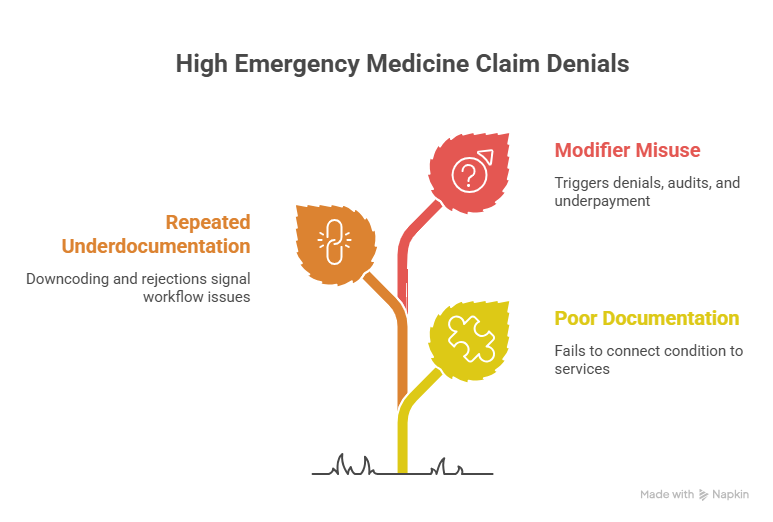
Emergency medicine denials often begin before the claim is submitted. They begin when documentation fails to connect the patient’s condition to the services charged. A CT, infusion, repair, splint, ECG, rapid test, or critical care service may be clinically reasonable, but the claim needs a coding trail that proves medical necessity and separates bundled work from separately reportable work. Coders should review ED claims with clearinghouse terminology, electronic claims submission platforms, claims management terms, and payment posting guidance.
The most dangerous denial pattern is repeated underdocumentation. If ED visits are downcoded, critical care is rejected, infusions are denied, radiology components are adjusted, or procedures are bundled unexpectedly, the team should treat the denial as a documentation and workflow signal. It may point to missing provider education, weak charge capture, system mapping problems, modifier misuse, or EHR templates that fail to capture required details. Coders should build a feedback loop using medical billing reconciliation, denial management services, coding productivity benchmarks, and coding accuracy impact.
Modifier review is especially important in emergency medicine because ED encounters often combine E/M services, procedures, imaging, medication administration, and supplies. Modifier misuse can trigger denials, audits, duplicate billing concerns, or underpayment. A separate E/M with a procedure needs documentation that distinguishes the evaluation from the procedure itself. Laterality, professional/technical components, distinct procedural services, repeat services, and assistant/provider distinctions must be handled carefully. A strong ED coding process uses CPT modifier dictionary guidance, coding edits and modifiers, radiology billing terms, and healthcare billing acronyms before final submission.
5. Building an Emergency Medicine CPT Workflow That Actually Holds Up
A durable emergency CPT workflow starts with chart completeness. Before code selection, the coder should know the chief complaint, clinical context, tests ordered, tests reviewed, treatments provided, reassessments performed, procedures documented, disposition chosen, and final diagnosis support. When those pieces are missing, the workflow should flag the issue before billing. This is where coding teams benefit from linking EMR documentation terms, EHR integration terms, encoder software terms, and medical coding automation terms into the ED coding process.
The second step is code-family matching. A coder should classify the encounter into E/M, critical care, procedure, diagnostic test, injection, infusion, supply-linked, observation/admission-linked, or transfer-linked work before trying to finalize codes. This prevents missed charges and reduces unsupported add-ons. For example, a trauma case may involve ED E/M, imaging, splinting, medication administration, and transfer documentation. A respiratory distress case may involve ED E/M, critical care review, ECG, imaging, medication administration, and possible ventilation support. The workflow should connect respiratory coding essentials, cardiology CPT coding, lab and pathology coding, and ambulance and emergency transport coding when the clinical path requires it.
The third step is denial-proof review. Before the claim goes out, the coder or billing team should ask whether each code has documentation, medical necessity, correct sequencing, correct modifier use, payer-specific compatibility, and clean charge capture. This should happen before payment posting reveals a preventable failure. ED coding teams should measure repeat denials, high-level E/M review outcomes, critical care rejections, infusion timing errors, modifier denials, and charge lag. That performance view connects revenue cycle metrics, revenue leakage analysis, medical coding error rates, and compliance audit trends.
6. FAQs About CPT Code Listing for Emergency Medicine
-
The core emergency department E/M code family is 99281–99285. These codes represent different ED visit levels, and code selection should be supported by the documented medical decision making and visit complexity rather than the diagnosis name alone. The safest approach is to connect the E/M level to emergency medicine CPT coding, medical necessity criteria, clinical documentation improvement, and coding audit review. ED E/M levels should be supported by chart evidence, payer rules, and current CPT guidance.
-
Critical care may be reported when the documentation supports critical illness or injury, qualifying provider attention, and the required time and service conditions. The coder must separate critical care from routine ED E/M work and check whether separately reportable procedures are allowed. Strong documentation should support why the patient was critically ill, what interventions were provided, and how time was counted. Coders should review Medicare documentation requirements, ED CPT coding examples, coding edits and modifiers, and claims reconciliation terms. CMS education identifies 99291 and 99292 as critical care codes and warns that certain activities are bundled into those services.
-
Emergency procedure coding needs a distinct procedure note or clearly separated documentation that proves the procedure performed, anatomical site, laterality when relevant, technique, complexity, supplies, results, and patient response. Laceration repair needs wound length and repair type. Splints need body area and application details. Incision and drainage needs site and complexity. Infusions need start and stop time. This should be reviewed with charge capture terms, CPT modifier usage, infusion billing terms, and surgical coding compliance.
-
Emergency CPT claims are often denied because the documentation does not support the level billed, the procedure is bundled, the modifier is missing or unsupported, medical necessity is weak, timing is absent, or the diagnosis does not justify the service. Denials also happen when the charge capture system and clinical documentation do not match. The best prevention strategy connects claim adjustment reason codes, remittance advice remark codes, denial management best practices, and medical billing reconciliation.
-
Encoder software can help organize options, but it cannot replace chart judgment. Emergency medicine coding often requires interpretation of MDM, separate procedures, medical necessity, payer edits, modifier rules, and documentation gaps. Coders should validate every software suggestion against the record and current coding guidance. Encoder-assisted workflows should include encoder software terms, medical coding automation terms, coding workflow terms, and coding competency assessment. Human validation is especially important when the chart contains incomplete or conflicting documentation.
-
The strongest improvement plan combines provider education, coding audits, denial trend review, EHR template fixes, modifier checks, and charge capture reconciliation. Start by identifying the highest-risk categories: ED E/M level selection, critical care, infusions, procedures, radiology components, and repeat denials. Then build focused documentation prompts and coder checklists around those areas. A mature improvement plan should use revenue cycle KPIs, coding accuracy revenue impact, compliance audit trends, and revenue leakage prevention. Emergency coding gets stronger when teams treat every denial as a workflow signal rather than a one-time billing event.
