
ICD-11 Reference Directory for Oncology
Oncology coding becomes difficult when the record says “cancer” but the claim needs a precise, defensible diagnosis story: site, behavior, laterality, histology, primary versus secondary disease, treatment status, recurrence, complications, and documentation support. ICD-11 gives coders a more structured way to represent disease detail, while the WHO ICD-11 Browser and Coding Tool remain the official places to verify current ICD-11 content. This directory helps billing and coding teams turn oncology documentation into cleaner, safer, revenue-aware coding decisions.

1. Why ICD-11 Oncology Coding Needs a Directory Mindset
ICD-11 oncology coding should start with a directory mindset because cancer documentation rarely arrives as one clean diagnosis line. A single oncology encounter may include the primary tumor, metastatic site, prior treatment, active chemotherapy, radiation effects, immunotherapy complications, genetic markers, surveillance status, recurrence language, and symptom management. When coders reduce that whole clinical picture to one broad cancer label, they weaken reimbursement support, registry usefulness, audit defense, and longitudinal care reporting. That is why oncology coders should connect ICD-11 oncology codes, ICD-11 coding standards, medical necessity criteria, clinical documentation improvement terms, and medical coding audit terms before assigning or validating any oncology diagnosis.
The practical pain point is simple: oncology records carry high clinical complexity, and billing teams get punished when that complexity is translated loosely. A payer may question why an expensive infusion, imaging study, genetic test, radiation plan, or specialist visit was billed if the diagnosis does not reflect the treated condition accurately. A weak cancer code can make a medically necessary service look unsupported, especially when the documentation separates active malignancy, history of malignancy, metastatic disease, remission, surveillance, and treatment-related complications. ICD-11’s postcoordination system can add detail to selected entities, including histopathology detail for many neoplasm categories, which makes documentation precision even more important. Coders should pair this directory with infusion and injection therapy billing, radiology billing and coding, lab and pathology coding, revenue leakage prevention, and accurate billing and reimbursement.
ICD-11 Oncology Reference Map: What Each Detail Means for Coding (25+ Rows)
| Oncology Detail | What It Means | Why It Hits Coding | Best Practice Action |
|---|---|---|---|
| Primary site | Original anatomic location of the cancer | Drives the main diagnosis selection | Confirm site from pathology, assessment, or oncology plan |
| Secondary site | Location where cancer has spread | Metastatic disease changes coding priority and medical necessity | Code metastatic site only when documented clearly |
| Unknown primary | Metastatic cancer without identified original site | Incorrect assumptions can distort the diagnosis story | Use provider-stated diagnosis, not coder inference |
| Laterality | Right, left, bilateral, or unspecified side | Breast, kidney, lung, ovary, and paired organs need side clarity | Query when laterality affects specificity and is missing |
| Histology | Cell type or tumor morphology | Different tumor types can carry different clinical meaning | Validate against pathology before using detailed descriptors |
| Behavior | Benign, in situ, malignant, uncertain, or borderline behavior | Behavior changes diagnosis category and reimbursement logic | Avoid treating “mass” language as confirmed malignancy |
| Grade | How abnormal or aggressive tumor cells appear | May support severity, planning, and oncology documentation depth | Capture grade only when documented in reliable source text |
| Stage | Extent of disease within body | Supports treatment intensity and risk context | Do not substitute stage for site, behavior, or metastasis coding |
| TNM language | Tumor, node, and metastasis descriptors | Adds clinical precision but must be translated carefully | Use TNM as supporting detail, not a shortcut |
| Active treatment | Cancer is being treated or managed as active | Supports active malignancy coding and treatment services | Check oncology plan, treatment orders, and assessment |
| History of cancer | Past malignancy with no current active disease | Different from active cancer and recurrence | Confirm disease status before choosing history coding |
| Recurrence | Cancer has returned after treatment or remission | Requires clear provider documentation | Avoid coding recurrence from suspicious findings alone |
| Remission | Disease activity has decreased or resolved clinically | Status affects whether cancer is active, historical, or monitored | Follow provider wording and current treatment context |
| Surveillance visit | Follow-up to monitor for recurrence | Diagnosis selection differs from active treatment encounter | Separate surveillance purpose from active disease management |
| Chemotherapy | Drug treatment intended to destroy or control cancer | Often needs treatment encounter and complication context | Match diagnosis support to drug, intent, and active condition |
| Immunotherapy | Treatment that uses immune response mechanisms | Can create unique adverse effects and monitoring needs | Document therapy type and reaction details carefully |
| Radiation therapy | Targeted treatment using radiation | Diagnosis must support site, intent, and treatment plan | Link radiation encounter to treated malignancy |
| Surgical oncology | Tumor removal, biopsy, resection, reconstruction, staging procedure | Procedure coding and diagnosis support must align | Review operative report and pathology together |
| Biopsy result | Tissue diagnosis from pathology | Often confirms malignancy, histology, grade, or uncertainty | Never code confirmed cancer from pending pathology alone |
| Genetic marker | Molecular or biomarker finding tied to tumor behavior or treatment | Can support targeted therapy and testing logic | Capture only when relevant to coded record requirements |
| Tumor marker | Lab marker used for monitoring or diagnostic support | May support follow-up, progression, or treatment response | Do not let marker elevation replace provider diagnosis |
| Complication | Problem caused by cancer or treatment | Complication coding affects medical necessity and severity | Link anemia, pain, infection, or toxicity to cause when documented |
| Cancer pain | Pain caused by malignancy or treatment burden | May be the reason for encounter | Code pain context only when provider links it clearly |
| Anemia in cancer | Blood disorder related to malignancy or therapy | Cause affects diagnosis sequencing and payment support | Distinguish malignancy-related from treatment-related anemia |
| Neutropenia | Low neutrophils, often treatment-related in oncology | Can justify monitoring, infection precautions, or treatment delay | Capture drug or therapy relationship when documented |
| Palliative care | Symptom-focused care that may occur with active cancer treatment | Clarifies care intent and service context | Do not confuse palliative care with hospice unless stated |
| Hospice status | End-of-life care election or hospice-managed service context | Affects payer rules and billing pathway | Verify hospice responsibility before billing related services |
| Screening finding | Abnormal result from screening before confirmed diagnosis | Screening, abnormal finding, and confirmed malignancy differ | Code confirmed cancer only after provider confirmation |
2. ICD-11 Oncology Reference Categories Coders Should Build Around
The first directory category is anatomic site. Oncology coding starts by finding the most defensible site description in the record, then checking whether the tumor is primary, secondary, recurrent, historical, or uncertain. Site detail matters because lung cancer with brain metastasis, breast cancer with bone metastasis, colon cancer after resection, and a suspicious pancreatic mass create very different coding decisions. A coder should never let a problem list override a current oncology assessment without verification. Strong site-based review should connect ICD-11 cardiovascular coding, ICD-11 infectious disease coding, ICD-11 respiratory coding, ICD-11 neurological disorders, and ICD-11 mental health coding when oncology care overlaps with other body systems.
The second category is tumor behavior. Oncology records often include terms such as malignant, benign, in situ, uncertain behavior, dysplasia, neoplasm, lesion, mass, carcinoma, sarcoma, lymphoma, leukemia, and metastatic disease. Those terms are not interchangeable. A coder who treats “mass” as cancer or “history of cancer” as active disease can create medical necessity errors and audit exposure. The directory should train teams to separate confirmed malignancy from suspected disease, surveillance from treatment, recurrence from history, and metastatic spread from local extension. That judgment is supported by medical coding workflow terms, coding query process terms, problem list documentation, EHR documentation terms, and SOAP notes and coding.
The third category is extent of disease. Staging language can explain why treatment is aggressive, why imaging is repeated, why genetic testing is ordered, or why palliative services appear in the record. The TNM system describes tumor size or extent, lymph node involvement, and distant metastasis, and it is widely used for cancer reporting in many settings. Coding teams should still avoid using stage as a substitute for the codeable diagnosis detail. Stage IV breast cancer, for example, should push the coder to confirm the current primary site, metastatic site or sites, treatment status, and documentation source. This work should connect HCC coding definitions, risk adjustment coding, HEDIS data terms, value-based care coding terms, and MIPS guidance.
3. Oncology Documentation Sources That Should Drive ICD-11 Code Selection
Pathology is often the strongest source for histology, behavior, grade, margins, lymph node findings, and biomarker details, but coders should not pull a cancer diagnosis from a pathology report in isolation when the encounter’s provider assessment says the result is pending, uncertain, ruled out, or under review. The safe workflow is to compare pathology with the oncologist’s assessment, operative report, imaging interpretation, treatment plan, and current problem list. This matters because overcoding confirmed malignancy from ambiguous documentation can create compliance risk, while undercoding confirmed active disease can weaken the medical necessity behind expensive oncology services. Oncology code review should use lab and pathology coding essentials, medical record retention terms, Medicare documentation requirements, complete guide to coding ethics, and coding compliance guidance.
Imaging reports are powerful, but they need careful handling. CT, MRI, PET, ultrasound, mammography, and nuclear medicine reports may describe suspicious lesions, likely metastasis, treatment response, progression, stable disease, or no evidence of disease. Those phrases can support review, but final code selection should follow the documented diagnosis and coding rules for the encounter. A scan impression that says “concerning for metastasis” should trigger documentation review or query support rather than automatic metastatic coding. Imaging-heavy oncology workflows should connect radiology CPT reference, radiology billing terms, claim adjustment reason codes, RARC explanations, and EOB interpretation.
Treatment records add the reimbursement story. Chemotherapy, radiation, immunotherapy, hormone therapy, surgery, targeted therapy, transfusions, port care, pain management, nutrition support, and palliative care all depend on diagnosis alignment. If the oncology diagnosis does not support the service, the claim becomes vulnerable even when the care was appropriate. The coder should check whether the encounter is for active cancer treatment, follow-up after treatment, complication management, symptom control, recurrence evaluation, or surveillance. This is where ICD-11 coding touches charge capture terms, infusion billing terms, surgical coding compliance, hospice and palliative care coding, and preventive medicine CPT coding.
Quick Poll: What is your biggest oncology ICD-11 coding pain point?
4. ICD-11 Oncology Coding Workflow for Cleaner Claims
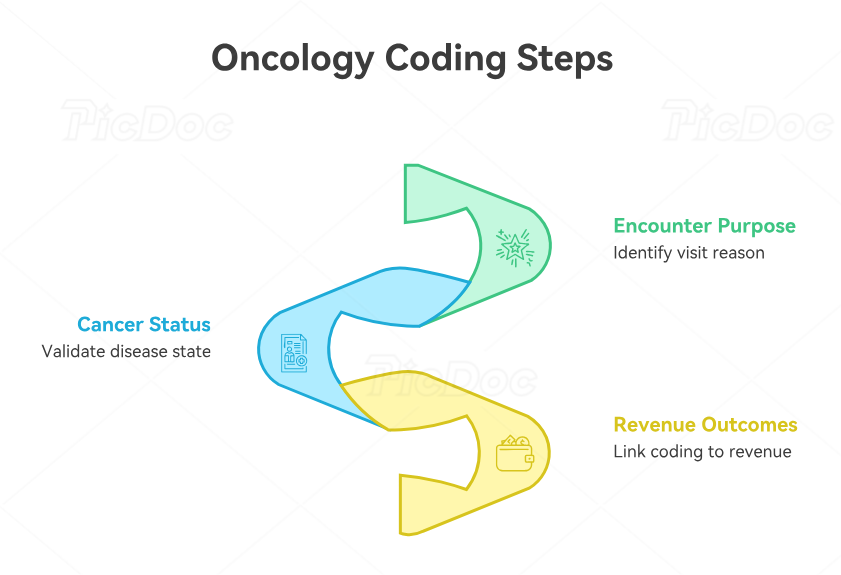
The first step is to identify the encounter purpose. Oncology visits can be for diagnosis, active treatment, pre-treatment evaluation, medication monitoring, post-treatment follow-up, surveillance, recurrence evaluation, symptom control, treatment complication, palliative care, or end-of-life coordination. The diagnosis selected should explain why the patient was seen on that date, not simply what appears somewhere in the historical chart. This prevents a common billing failure: using an old cancer diagnosis to support a service that was actually for screening, surveillance, adverse effect management, or unrelated symptoms. A cleaner workflow should rely on medical billing workflow terms, encounter forms and superbills, clinical decision support terms, EHR integration terms, and encoder software terms.
The second step is to validate the cancer status. Active disease, no evidence of disease, remission, history, recurrence, progression, and metastatic spread must be handled with discipline. Coders should check the oncology assessment first, then support it with pathology, imaging, treatment plan, and medication records. When documentation is conflicting, the answer is not creative coding; the answer is a compliant query. Oncology documentation gaps are especially dangerous because they can affect high-cost services such as radiation planning, biologics, chemotherapy administration, advanced imaging, genetic testing, or inpatient oncology stays. This step should connect CDI terminology, query process terms, medical coding automation, coding edits and modifiers, and CPT modifiers.
The third step is to connect diagnosis detail to revenue cycle outcomes. Oncology coding affects eligibility checks, prior authorization, claim submission, denial prevention, payment posting, appeals, and reporting. When codes fail to support services, teams waste time chasing preventable denials. When codes exaggerate or misrepresent disease, teams create audit exposure. Strong oncology coding is the middle ground: specific enough to support medical necessity, conservative enough to stay documentation-based, and organized enough to withstand review. Revenue-focused oncology coders should use electronic claims submission platforms, clearinghouse terminology, EDI billing terms, payment posting guidance, and claims reconciliation terms.
5. High-Risk Oncology Coding Mistakes and How to Prevent Them
One major mistake is coding active malignancy from old problem list language. Oncology problem lists often carry diagnoses long after treatment has ended, and copying those diagnoses without checking the current assessment can make a surveillance visit look like active cancer management. The reverse problem is also harmful: coding history of malignancy when the patient is still receiving treatment, has documented recurrence, or has active metastatic disease. The solution is to require current disease status from the treating provider’s documentation, then verify it against treatment orders and recent diagnostic evidence. This prevention strategy should sit beside medical coding error rates, top coding errors, coding accuracy revenue impact, revenue leakage data, and coding denials management.
Another mistake is assuming metastasis from uncertain imaging language. Radiology reports often use phrases such as “suspicious for,” “concerning for,” “possible,” or “cannot exclude.” Those phrases may guide clinical action, but coding confirmed metastatic disease from uncertain evidence can create an unsupported diagnosis. Oncology coders should flag these cases for provider clarification when the diagnosis drives treatment or reimbursement. The same discipline applies to recurrence, progression, treatment failure, and complications. If the provider has not linked the finding, the coder should not build the link alone. This is where healthcare claims management, medical billing reconciliation, denial management services, commercial insurance billing, and Medicare reimbursement become part of the coding conversation.
A third mistake is ignoring treatment-related complications. Oncology patients may present with anemia, neutropenia, nausea, dehydration, infection, pain, fatigue, neuropathy, mucositis, malnutrition, or adverse drug effects. These conditions can be central to the encounter and may explain labs, infusions, hospital admission, medication changes, or urgent evaluation. When the record documents a causal relationship between cancer, therapy, and complication, the coding should tell that story accurately. A vague code may understate the encounter; an unsupported causal link may overstate it. Safer coding requires structured review through utilization review terms, healthcare billing acronyms, CMS-1500 form terms, UB-04 billing form guidance, and revenue cycle KPIs.
6. FAQs About ICD-11 Oncology Coding
-
The first thing to confirm is whether the cancer is active, historical, recurrent, metastatic, uncertain, or being monitored after treatment. That status controls the entire coding story. Coders should review the current oncology assessment, not only the problem list, then compare it with pathology, imaging, treatment plans, and medication orders. This workflow should be supported by ICD-11 oncology coding, ICD-11 coding standards, EHR documentation terms, and coding query process terms.
-
Pathology reports are extremely important, but coders should use them within the full encounter context. A pathology report can support histology, behavior, grade, margins, and tumor type, but the treating provider’s assessment and plan should confirm how the diagnosis is being managed. If pathology says one thing and the progress note is unclear, query support may be safer than assumption. Coders should connect lab and pathology coding, clinical documentation improvement, medical record retention, and coding ethics.
-
Metastatic cancer requires clear documentation of the primary site, secondary site, and current disease status when available. Coders should avoid assuming metastasis from uncertain imaging language or patient history. If a provider documents lung cancer metastatic to bone, the coding story should represent both the primary and secondary disease according to applicable coding rules and encounter purpose. When the record is unclear, coders should use query process guidance, medical necessity criteria, radiology coding terms, and claim denial prevention.
-
Staging does not replace diagnosis coding. Staging explains disease extent and clinical severity, while diagnosis coding still needs site, behavior, current status, and encounter relevance. The TNM system describes tumor, node, and metastasis categories, but coders still need documented diagnoses that support services and claims. A coder should use staging as supporting clinical context alongside risk adjustment coding, HCC definitions, value-based care coding, and oncology ICD-11 case studies.
-
A query may be needed when the record conflicts on active versus historical cancer, primary versus metastatic site, recurrence versus surveillance, uncertain imaging versus confirmed diagnosis, or complication cause. A query is also appropriate when treatment intensity suggests active disease but the assessment only lists history of cancer. Coders should not fill those gaps through guesswork. Query discipline protects audit readiness, coding compliance, documentation accuracy, and reimbursement accuracy.
-
ICD-11 oncology coding affects reimbursement by shaping medical necessity, prior authorization support, claim acceptance, denial risk, payment accuracy, reporting quality, and appeal strength. A weak diagnosis story can make appropriate care look unsupported; an exaggerated diagnosis can create compliance exposure. The safest coding tells the exact documented story: disease site, behavior, active status, metastasis, treatment purpose, and complications. Revenue cycle teams should align oncology coding with claims submission, clearinghouse terms, CARC guidance, and payment posting.
