
Medical Billing and Coding Certification in Brazil: Complete Guide for 2026–2027
Medical billing and coding in Brazil sits at the intersection of clinical documentation, hospital finance, public reimbursement, supplementary health plans, data exchange, and regulatory compliance. Professionals entering the field during 2026–2027 need more than a general certificate. They need a deliberate pathway covering Brazilian systems such as TISS, TUSS, SIGTAP, and CID, alongside the medical coding workflow, revenue cycle management, claims management, and coding compliance skills demanded by modern healthcare employers.

1. What Medical Billing and Coding Certification Means in Brazil
Brazil’s healthcare reimbursement environment contains two major operating worlds. The Sistema Único de Saúde, commonly called SUS, uses government-managed systems, procedure tables, establishment identifiers, authorization processes, and production-reporting rules. The private and supplementary health sector relies heavily on health-plan contracts, authorization controls, TISS transactions, TUSS terminology, medical-account auditing, and denial management. A serious training plan must prepare learners to identify which world a claim belongs to before applying any billing and reimbursement, medical necessity, charge-capture, or claims-reconciliation rule.
Brazil’s labor market generally handles medical-account, billing, coding, and audit qualifications through employer-defined requirements. Job titles may include faturista hospitalar, analista de contas médicas, auditor de contas, assistente de faturamento, analista de glosas, codificador de dados clínicos, or analista de receita hospitalar. Requirements vary by institution, payer, specialty, seniority, and whether the work serves Brazilian or international accounts. One 2026 public-sector procurement specification, for example, classified hospital billing personnel at the secondary-education level while requiring relevant technical education, a hospital-billing course, and prior experience. This illustrates why candidates should read the actual vacancy rather than relying on a broad job title.
A certificate therefore functions as structured evidence of competency. Its value rises when the curriculum includes actual account analysis, procedure validation, diagnosis-to-documentation review, authorization matching, denial investigation, and payment-posting exercises. Employers need people who can trace a financial problem through the complete revenue cycle, interpret an explanation of benefits, investigate adjustment reason codes, and document a defensible corrective action.
The supplementary-health sector requires specific attention. The Brazilian National Supplementary Health Agency, ANS, organizes the TISS standard into five components: organizational rules, content and structure, representation of health concepts through TUSS, security and privacy, and electronic communication. The communication component uses XML, which means billing professionals increasingly need enough technical fluency to distinguish a coding error from a file-structure, mapping, transmission, or versioning error.
Version control is a genuine operational risk. The March 2026 TISS organizational release recorded thousands of terminology additions involving materials, OPME, medicines, procedures, and submission formats. A learner who memorizes a static spreadsheet without understanding effective dates, implementation windows, mapping, and system updates can create large batches of denials within days. Strong professionals develop habits around coding-system updates, encoder software, EHR integration, and medical coding automation.
For SUS-facing work, candidates must understand SIGTAP, the official management system for the unified table of SUS procedures, medicines, orthoses, prostheses, and special materials. The practical challenge extends beyond locating a code. Billers must validate compatibility, financing rules, service setting, professional eligibility, quantity restrictions, authorization requirements, patient identifiers, and the reporting system receiving the production record.
The following map can be inserted directly into the article. It gives candidates a 30-point competency framework for comparing certification programs and building a Brazil-ready learning plan.
Brazil Certification Competency Map: What to Learn and How to Prove It
| Competency | What You Must Understand | Operational Risk It Controls | Evidence to Build |
|---|---|---|---|
| Brazilian healthcare structure | Differences among SUS, supplementary health, private payment, hospitals, clinics, and outsourced billing operations | Applying the wrong payer workflow or reimbursement rule | Create a one-page payer and workflow comparison |
| SIGTAP | Procedure, medicine, OPM, compatibility, financing, service-setting, and effective-date data | Rejected or unpaid SUS production | Complete ten documented SIGTAP lookup cases |
| SIA/SUS | Ambulatory production, BPA, APAC, validation, and submission logic | Missing outpatient revenue and production inconsistencies | Map one outpatient encounter from documentation to submission |
| SIH/SUS | Hospital admission billing, AIH logic, principal procedures, secondary items, and discharge data | Incorrect inpatient reporting and underbilling | Audit a simulated inpatient account |
| TISS | Organizational, structural, terminology, privacy, and communication components | Health-plan submission failures | Draw the complete electronic claims workflow |
| TUSS | Unified terminology, code validity, implementation periods, materials, medicines, and procedures | Invalid, expired, or mismatched procedure reporting | Maintain a version-controlled code-change log |
| CID diagnosis coding | Diagnosis selection, specificity, sequencing, documentation support, and code updates | Unsupported diagnoses and inaccurate health data | Code 25 de-identified diagnostic scenarios |
| ICD-11 readiness | Foundation structure, post-coordination, transition planning, and organizational impact | Weak preparation for future classification changes | Complete an ICD-11 comparison exercise |
| Medical terminology | Anatomy, disease processes, abbreviations, procedures, medications, and clinical language | Misreading documentation and selecting the wrong service | Build a specialty-based terminology notebook |
| Clinical documentation | Provider intent, completeness, authentication, chronology, contradictions, and amendments | Billing unsupported by the medical record | Review 20 records using a CDI checklist |
| Coding queries | Clear, neutral, compliant clarification requests based on documentation gaps | Leading providers or assigning unsupported codes | Write ten compliant coding queries |
| Authorization control | Requested, authorized, delivered, documented, and billed service reconciliation | Denials for missing or exceeded authorization | Create an authorization variance tracker |
| Eligibility and registration | Patient, beneficiary, payer, plan, provider, establishment, and identifier validation | Front-end denials and attribution failures | Design a pre-billing registration checklist |
| Charge capture | How procedures, supplies, medicines, equipment, rooms, and professional services enter the account | Revenue leakage and duplicate charging | Perform a charge-capture reconciliation |
| Contract interpretation | Negotiated tables, packages, exclusions, ceilings, discounts, payment terms, and documentation clauses | Billing above or below contractual entitlement | Annotate a simulated payer contract |
| Materials and OPME | Authorization, traceability, quantity, manufacturer data, pricing, and supporting documents | High-value denials and audit exposure | Audit five implant and material cases |
| Medication billing | Dose, route, unit, waste, administration, package data, and authorization | Unit conversion errors and unsupported quantities | Complete an infusion billing worksheet |
| Account auditing | Documentation-to-charge matching, duplicate detection, rule validation, and exception reporting | Preventable denials, overbilling, and underbilling | Build a 30-line audit workpaper |
| Glosa management | Denial classification, root cause, ownership, correction, appeal, deadline, and recovery value | Permanent loss of recoverable revenue | Create a denial root-cause dashboard |
| Appeal writing | Contractual, clinical, technical, and documentary support for disputed charges | Weak appeals and repeated denials | Write five evidence-based appeal letters |
| Payment posting | Paid, denied, deducted, withheld, transferred, and patient-responsibility amounts | False balances and hidden underpayments | Reconcile a simulated payment batch |
| Accounts receivable | Aging, follow-up priority, timely filing, dispute status, expected value, and collectability | Cash delays and missed deadlines | Segment an aging report by action priority |
| Revenue integrity | Patterns of missed charges, invalid edits, mapping failures, underpayments, and recurring denials | Systematic revenue leakage | Complete a revenue-leakage investigation |
| LGPD | Purpose limitation, necessity, access control, sensitive health data, retention, and incident handling | Privacy breaches and unlawful data processing | Draft a role-based health-data access matrix |
| Medical-record retention | Organizational policy, legal retention, secure storage, disposal, and retrieval controls | Missing evidence during audits and disputes | Create a retention workflow |
| System integration | EHR, billing system, clearinghouse, payer portal, interface, and code-table mapping | Claims altered or lost between systems | Map an EHR-to-payer data flow |
| Spreadsheet analysis | Lookups, conditional logic, duplicate detection, aging, pivots, and exception lists | Slow investigations and undetected billing patterns | Build an interactive denial workbook |
| Revenue-cycle metrics | Denial rate, clean-claim rate, days in receivables, recovery rate, rework, and underpayments | Teams chasing activity instead of financial outcomes | Build a monthly KPI dashboard |
| Professional ethics | Accuracy, confidentiality, escalation, conflict management, and refusal to manipulate records | Fraud, reputational damage, and compliance failures | Resolve ten coding ethics scenarios |
| Continuing education | Release monitoring, targeted learning, competency reassessment, and documented development | Skills becoming obsolete after certification | Create a 12-month continuing-education plan |
2. Which Certification Path Should You Choose?
The right certification depends on the claims you intend to touch. A candidate seeking work in a Brazilian hospital’s SUS billing department needs a different technical stack from someone serving private health plans, auditing surgical accounts, or coding for a United States-based outsourcing company. Begin with the target job description, then work backward through its required coding systems, forms, payer rules, technology, language, and compliance duties.
Brazil-focused hospital billing
This path should emphasize SIGTAP, SIA/SUS, SIH/SUS, BPA, APAC, AIH, CNES, CNS, CBO, CID, TISS, TUSS, authorization, medical-account auditing, and glosa management. Learners also need the healthcare billing acronyms, EHR coding terminology, patient responsibility concepts, and practice-management system skills used in day-to-day account resolution.
Look for a program that teaches claim creation and claim correction. A course that stops after code lookup leaves a major skills gap. Brazilian employers frequently need professionals who can find why an account failed, identify who owns the correction, prepare supporting documents, meet the appeal deadline, update the system, and verify that the recovered amount was eventually posted.
Private and supplementary-health billing
Candidates targeting health-plan work need deep TISS and TUSS exposure. They should understand consultation guides, SP/SADT billing, hospitalization summaries, individual professional fees, attachments, authorization numbers, XML messages, protocol returns, glosa codes, and appeal workflows. ANS treats TISS as an interoperability standard, while TUSS supplies the concepts used to represent health events and items.
The strongest learning sequence combines EDI billing terminology, clearinghouse concepts, claims reconciliation, and denial-management services. This combination helps candidates recognize whether a failed claim came from patient registration, eligibility, authorization, documentation, coding, contract configuration, transmission, adjudication, or payment posting.
International and U.S.-facing coding
Brazilian professionals pursuing international remote work should select a curriculum aligned with the country being billed. U.S.-facing roles may require ICD-10-CM, CPT, HCPCS Level II, modifiers, CMS-1500, UB-04, Medicare rules, commercial insurance, EOBs, electronic remittance, NCCI edits, and HIPAA-oriented workflows. Useful preparation includes a CPT modifier reference, CMS-1500 guide, UB-04 guide, and Medicare documentation requirements.
Credentials such as CPC, CCS, CBCS, or a comprehensive AMBCI educational pathway can strengthen an international profile when they match the employer’s requested system. Candidates should compare the coding credentialing organizations, review CBCS exam terminology, evaluate coding education accreditation, and understand certification renewal before paying.
A recognized name carries limited value when the curriculum targets the wrong reimbursement environment. A learner planning to work only with Brazilian supplementary-health claims gains more immediate value from TISS, TUSS, contracts, glosas, LGPD, and auditing than from memorizing U.S. Medicare rules. A learner targeting U.S. outpatient coding needs the opposite emphasis. Career direction should control credential selection.
3. What a Brazil-Ready Certification Curriculum Must Teach
A strong curriculum starts with clinical literacy. Coders and billers need enough anatomy, physiology, pathology, pharmacology, and procedural knowledge to interpret the record accurately. Specialty exposure matters because documentation, bundling, units, supporting evidence, and authorization rules differ across cardiology procedures, radiology services, laboratory and pathology, and surgical coding.
Clinical documentation must be treated as the source of billing evidence. The learner should know how to detect missing dates, unsigned records, conflicting diagnoses, absent procedure details, unclear laterality, incomplete discharge information, missing implant data, unsupported quantities, and vague medication administration. Training should connect SOAP documentation, problem-list management, EMR documentation, and clinical documentation improvement to reimbursement outcomes.
Students also need diagnosis-classification discipline. Brazil continues to operate with established CID workflows while national stakeholders prepare for ICD-11 implementation. ANS listed ICD-11 implementation among its 2026 standardization priorities, which gives current learners a strong reason to understand the new classification without assuming that every Brazilian production environment has already converted.
A future-ready program should therefore cover existing diagnosis-coding accuracy alongside ICD-11 standards, ICD-11 mental-health coding, ICD-11 neurological conditions, and ICD-11 cardiovascular coding. The goal is controlled transition readiness: version identification, mapping awareness, documentation impact analysis, training plans, system testing, and dual-classification risk management.
Revenue-cycle training must go deeper than claim submission. The learner should follow an account from scheduling and registration through eligibility, authorization, documentation, charge capture, coding, claim generation, transmission, payer adjudication, payment posting, denial correction, appeal, collections, and final reconciliation. The RCM terminology guide, healthcare claims guide, collections and bad-debt guide, and payment-posting reference provide a useful conceptual sequence.
Denial analysis deserves a dedicated module. Students should classify denials by root cause, value, recurrence, payer, service line, responsible department, deadline, documentation requirement, correction type, and preventability. A denial queue becomes useful only when it produces action. Candidates should practise with CARCs, RARCs, coordination-of-benefits rules, and coding edits, especially when preparing for international roles.
Technology competency now affects employability. A candidate should be comfortable with spreadsheets, payer portals, hospital information systems, EHRs, billing platforms, document repositories, code tables, interface reports, and exception queues. Basic XML awareness helps TISS-focused professionals communicate with IT teams. Familiarity with RCM software terminology, electronic claims platforms, data analytics, and clinical decision support strengthens that foundation.
Privacy training is mandatory for credible practice. Brazil’s LGPD classifies health information as sensitive personal data and imposes duties involving purpose, necessity, security, access, governance, and incident response. Certification exercises should use de-identified records, restricted storage, controlled sharing, and documented access rules.
Candidates should connect LGPD principles with healthcare data security, record-retention controls, coding ethics, and regulatory compliance. Remote work increases this responsibility because patient data may move across devices, networks, vendors, and national borders.
Quick Poll: What is blocking your medical billing and coding career in Brazil?
4. Step-by-Step Certification Roadmap for 2026–2027
Start by selecting a target role rather than a course. Download ten to fifteen vacancies from hospitals, clinics, laboratories, health-plan administrators, medical-account auditing companies, RCM vendors, and international outsourcing firms. Create a requirement matrix covering education, experience, coding systems, software, language, specialty, schedule, location, and certification. This prevents candidates from spending months on a curriculum that fails to match their intended employment market.
Next, assess your baseline. Test yourself on medical terminology, anatomy, documentation review, spreadsheets, diagnosis coding, account auditing, authorization, denials, and data privacy. The coding competency guide, medical abbreviations dictionary, coding certification terms, and coding education terminology can help organize the assessment.
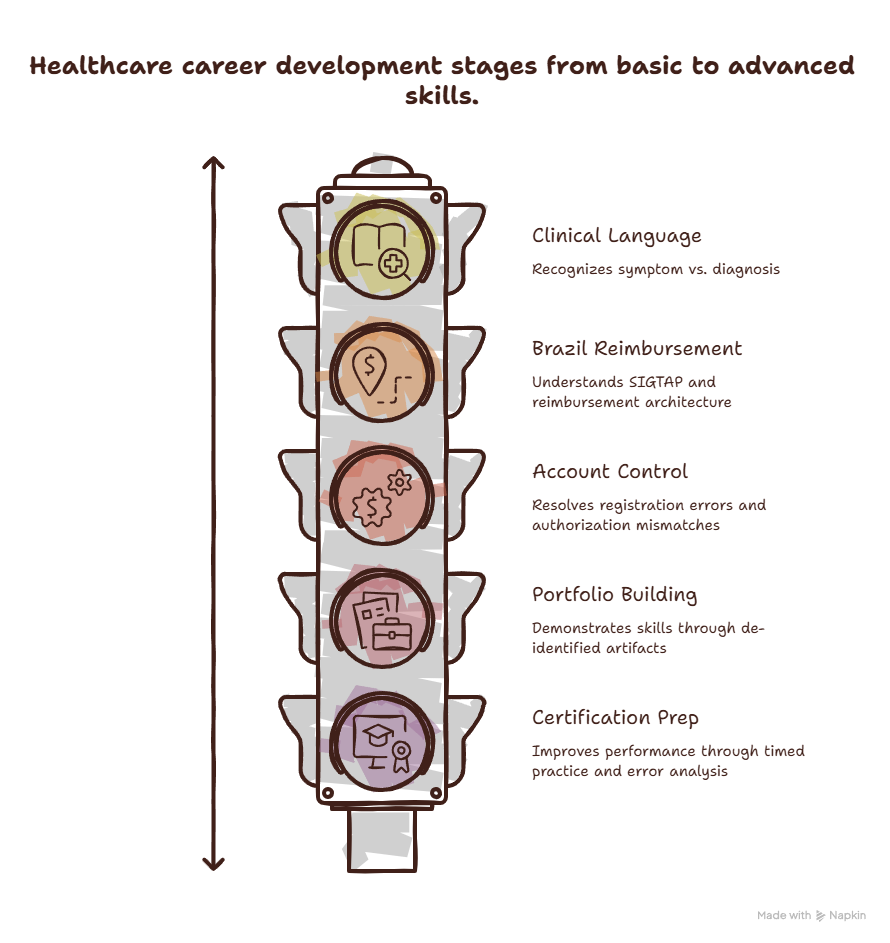
Build your foundational phase around clinical language and documentation. Spend enough time reading records to recognize the difference between a symptom, confirmed diagnosis, historical condition, suspected condition, comorbidity, complication, procedure indication, and incidental finding. Add behavioral-health billing, preventive-medicine coding, emergency-medicine coding, and dermatology coding examples gradually, based on your target employer.
The second phase should cover Brazil-specific reimbursement architecture. Study SIGTAP directly through the official system, practise TISS and TUSS version identification, learn the purpose of BPA, APAC, AIH, CNES, CNS, and CBO data, and connect each field with its operational consequence. The Ministry of Health identifies SIGTAP as the central system for the SUS procedure, medicine, and OPM table, while ANS maintains the current TISS components and terminology releases.
The third phase should focus on account control. Work through registration errors, authorization mismatches, undocumented services, duplicate charges, missing materials, invalid quantities, expired terminology, contract exclusions, transmission failures, glosas, appeal deadlines, partial payments, and underpayments. Use the medical-necessity guide, utilization-management terminology, claims-reconciliation guide, and revenue-leakage framework to structure case reviews.
A useful portfolio should contain at least six de-identified artifacts: a clinical-documentation audit, a code-validation worksheet, an authorization-versus-service reconciliation, a denial root-cause report, a written appeal, and a payment-reconciliation dashboard. Add a seventh artifact showing how you would monitor TISS, TUSS, SIGTAP, payer, and classification updates. This portfolio gives interviewers evidence of reasoning, precision, communication, and financial awareness.
Certification preparation should include timed practice and error analysis. Record every incorrect answer by category: knowledge gap, documentation misread, sequencing mistake, overlooked instruction, outdated reference, calculation error, or time pressure. A raw score reveals performance; an error log reveals how to improve it. Support this stage with exam-preparation communities, certification course directories, career-development terminology, and professional-development planning.
Budget planning should include tuition, registration, examination, books, reference access, retakes, renewal, continuing education, foreign transaction fees, translation needs, software access, and practice materials. A lower advertised course price can produce a higher final cost when exam fees, codebooks, renewals, and retakes sit outside the package. Request a written cost breakdown and refund policy before enrolling.
A realistic part-time roadmap may run for four to eight months, depending on prior healthcare experience, language ability, and target complexity. Candidates changing careers often need a longer clinical-literacy phase. Nurses, pharmacy technicians, health administrators, and experienced hospital staff may progress faster in familiar areas while still needing formal training in coding logic, account auditing, and reimbursement.
5. Turning Certification Into Employment in Brazil
Employers hire people who can reduce errors, protect revenue, improve compliance, and communicate clearly across departments. Your résumé should therefore translate coursework into operational outcomes. Replace “studied medical billing” with evidence such as “audited simulated inpatient accounts for documentation-to-charge discrepancies,” “classified denial causes and assigned corrective actions,” or “built a dashboard tracking aging, denial rate, recovery value, and recurring root causes.”
Use Brazilian job terminology in your search. Relevant phrases include faturamento hospitalar, contas médicas, auditoria de contas, analista de glosas, recurso de glosa, faturamento SUS, faturamento TISS, analista TUSS, receita hospitalar, autorização médica, auditoria concorrente, and auditoria retrospectiva. Pair these with your city, state, remote preference, and experience level.
Entry-level candidates should target roles offering transaction volume and feedback. Registration, authorization, billing assistance, account review, payment posting, denial follow-up, and document control can create useful foundations. The strongest early role exposes you to the entire account lifecycle rather than one repetitive keystroke. The medical coding apprenticeship guide, billing workflow reference, RCM software guide, and claims-management terminology can help evaluate these opportunities.
For hospital interviews, prepare to explain how you would investigate a rejected account. A strong answer begins with the payer response, then checks patient and provider identifiers, eligibility, authorization, dates, documentation, diagnosis, procedure, quantity, contract, code-table validity, transmission protocol, and prior corrections. It ends with a documented corrective action, ownership assignment, deadline, resubmission, and payment verification.
For audit roles, demonstrate financial prioritization. An auditor should distinguish a high-value systemic issue from a low-value isolated error. Show how you would calculate exposure, sample affected accounts, identify the originating process, preserve evidence, recommend correction, and measure whether the problem recurs. Strengthen this preparation with the medical coding audit dictionary, coding ethics guide, revenue-cycle KPI reference, and billing reconciliation guide.
International candidates should present language proficiency alongside coding proficiency. Written English affects query drafting, payer communication, appeal writing, policy interpretation, and audit documentation. Employers may also test internet reliability, secure workspace, time-zone availability, productivity, and familiarity with remote systems. Knowledge of commercial insurance billing, Medicare reimbursement, physician fee schedules, and coding modifiers can make that profile more credible.
Professional growth after the first role should be intentional. A biller may progress into denial analysis, account auditing, revenue integrity, clinical documentation improvement, contract management, coding quality, training, systems analysis, or RCM supervision. Choose the next competency according to the problems you repeatedly encounter. Frequent documentation failures point toward CDI. Recurring payer deductions point toward contract and denial analysis. Interface errors point toward systems and data quality. Complex procedure disputes point toward specialty coding and auditing.
6. Frequently Asked Questions About Certification in Brazil
-
Brazilian employers establish role-specific education, training, and experience requirements for many billing and medical-account positions. Requirements vary across hospitals, government contractors, health-plan operations, auditing companies, and international employers. A certificate strengthens evidence of preparation, while the vacancy’s stated requirements remain decisive. Public procurement specifications may request technical education, a hospital-billing course, and prior work experience for a hospital biller position.
Before enrolling, compare the course with current job descriptions and the coding credentialing guide, education accreditation terms, competency assessment reference, and certification renewal guide.
-
For Brazil-facing work, begin with the systems used by your target employer. Common priorities include CID, SIGTAP, TISS, TUSS, and the identifiers and production systems connected with SUS or supplementary health. Candidates serving U.S. accounts may also need ICD-10-CM, CPT, HCPCS, CMS-1500, UB-04, and payer-specific edits.
A sensible sequence moves from medical terminology into clinical documentation, then diagnosis and procedure systems, followed by claim creation, denial resolution, and payment reconciliation.
-
Yes. ICD-11 readiness has growing strategic value because Brazilian stakeholders are actively discussing implementation. Current learners should retain competency in the classification environment used by their employer while developing familiarity with ICD-11 structure, terminology, post-coordination, implementation planning, and system impact. ANS identified ICD-11 implementation as a 2026 priority topic.
Useful preparation includes ICD-11 best practices, oncology case studies, infectious-disease coding, and respiratory-disease coding.
-
Remote opportunities may be available through outsourcing firms, RCM vendors, hospitals, payers, and consulting organizations. Eligibility depends on the employer’s location rules, contracting model, language requirements, security standards, work schedule, and coding system.
Candidates should align their training with the destination market, build evidence using CMS-1500 claims, UB-04 institutional billing, EOB interpretation, and medical billing reconciliation. Secure data handling and professional written communication deserve equal attention.
-
A focused learner may complete a foundational pathway in approximately four to eight months of part-time study. Prior clinical experience, coding exposure, English proficiency, study hours, and the complexity of the chosen credential affect the timeline. Candidates preparing simultaneously for Brazilian and U.S. systems should allow additional time because the terminology, reimbursement rules, forms, modifiers, and compliance expectations differ.
Build the schedule around measurable competencies rather than video hours. Include weekly coding cases, documentation audits, coding-query exercises, denial investigations, payment-posting cases, and revenue-cycle metrics.
-
Yes. Career changers need a structured clinical foundation and enough practical exercises to compensate for limited workplace exposure. Begin with anatomy, terminology, documentation, privacy, and the complete billing workflow. Then add one reimbursement environment at a time.
A strong beginner portfolio can demonstrate charge-capture analysis, medical-necessity review, coding audit workpapers, and claims reconciliation. Entry-level hospital-administration, authorization, document-control, and billing-support positions can provide valuable operational exposure.
