
Medical Billing and Coding Certification in Ireland: Complete Guide for 2026-2027
Medical billing and coding certification in Ireland is valuable because Irish healthcare coding sits at the intersection of clinical documentation, hospital data quality, reimbursement logic, and patient-record accuracy. Anyone entering this field needs more than code lookup ability; they need working knowledge of medical coding workflow terms, clinical documentation improvement, medical billing reimbursement, and health information management.
For 2026-2027, the strongest learners should prepare for coding roles that demand accuracy, audit discipline, software confidence, and documentation judgment. A certificate can open the door, but the career value comes from understanding ICD coding standards, coding compliance, medical coding audit terms, and revenue cycle management well enough to prevent errors before they become reporting, payment, or quality problems.

1. Why Medical Billing and Coding Certification Matters in Ireland in 2026-2027
Ireland’s coding environment rewards people who can read clinical records carefully, choose defensible codes, and understand how coded data affects hospital reporting, planning, funding analysis, and healthcare quality measurement. A beginner who only memorises diagnoses will struggle when notes are incomplete, terminology is vague, or procedures must be translated into structured code sets. A certified learner who understands medical necessity criteria, problem list documentation, electronic health record coding, and coding query process terms becomes far more useful inside real healthcare teams.
The biggest pressure point is documentation quality. Clinical coders are often expected to convert messy records into clean data without guessing, overcoding, or ignoring missing support. That means the coder must know when the note supports the code, when clarification is needed, when a procedure detail changes the code choice, and when a secondary diagnosis has enough clinical significance to capture. This is where SOAP note coding, medical record retention, EMR documentation terms, and clinical decision support terms become practical career tools.
Certification also helps learners speak the language of healthcare operations. A coder may work with hospital records, billing departments, private practice teams, claims teams, revenue-cycle vendors, or remote employers. Each setting has different pressure, but the shared requirement is accuracy that can survive review. The best preparation connects charge capture terms, claims management terms, payment posting terms, and medical billing reconciliation so learners understand what happens after a code leaves the record.
A good certification path should therefore build three forms of confidence: technical coding confidence, documentation-review confidence, and workplace confidence. Technical confidence helps you select accurate codes. Documentation-review confidence helps you challenge weak records without being careless. Workplace confidence helps you communicate with clinicians, administrators, auditors, and billing teams. Those strengths grow faster when you study coding ethics, healthcare data security, coding competency assessment, and professional development terms.
Ireland Coding Readiness Map: 25+ Skills You Must Build
| Skill Area | What It Means | Why It Matters in Ireland | Best Practice Action |
|---|---|---|---|
| Clinical coding foundations | Understanding how diagnoses and procedures become coded data | Irish hospitals depend on accurate clinical coding for reliable reporting | Study code structure before memorising examples |
| ICD-10-AM awareness | Knowing the diagnosis classification used in Irish clinical coding | Incorrect diagnosis selection weakens coded data quality | Code from documented clinical evidence |
| ACHI procedure logic | Understanding procedure coding within the Australian classification family | Procedure detail affects hospital activity data | Match procedure codes to operative and clinical notes |
| Irish Coding Standards | Applying Ireland-specific coding guidance | Local standards prevent inconsistent coding decisions | Check Irish guidance before final code selection |
| Documentation review | Reading notes, discharge summaries, results, and operative reports | Codes are only as strong as the record behind them | Review the full episode, not one note fragment |
| Principal diagnosis selection | Identifying the condition chiefly responsible for the episode | Wrong principal diagnosis can distort hospital data | Confirm the episode focus before coding |
| Secondary diagnosis capture | Capturing relevant comorbidities and complications | Missed secondary diagnoses understate case complexity | Capture only clinically significant supported conditions |
| Procedure sequencing | Ordering procedures according to coding rules | Sequencing affects data interpretation | Use standards, operative reports, and episode context |
| Discharge-summary accuracy | Using the final clinical summary carefully | Incomplete summaries create coding uncertainty | Cross-check with labs, imaging, and progress notes |
| Clinical terminology | Understanding medical language across specialties | Poor terminology knowledge leads to wrong interpretation | Build specialty vocabulary every week |
| Anatomy and physiology | Knowing body systems and disease processes | Accurate coding requires clinical context | Pair code practice with anatomy review |
| Audit trail thinking | Keeping the reasoning behind code choices clear | Coding decisions may need review later | Document code rationale when records are complex |
| Coding query process | Asking clinicians for clarification when records are unclear | Guessing creates data and compliance risk | Query politely, specifically, and evidence-first |
| HIPE awareness | Understanding Ireland’s hospital discharge data environment | Coders contribute to national hospital data quality | Learn how coding affects reporting outputs |
| Data quality checks | Finding inconsistencies before coded data is final | Small coding errors multiply across datasets | Use a final review checklist |
| EHR navigation | Finding diagnoses, procedures, results, and discharge details | Hidden documentation can change code choices | Learn where each record type lives |
| Privacy and confidentiality | Protecting patient information during coding work | Coders access sensitive clinical records | Use secure systems and minimum necessary access |
| Specialty coding | Applying coding rules across departments | Medicine, surgery, oncology, maternity, and emergency care differ | Practise one specialty at a time |
| Oncology coding | Capturing cancer site, treatment, and disease status correctly | Oncology records can be highly detailed | Review pathology, treatment notes, and staging language |
| Emergency coding | Handling fast-moving presentations and incomplete information | Emergency records often need careful interpretation | Verify final diagnosis and investigations |
| Surgical coding | Translating operative detail into procedure codes | Procedure coding depends on exact surgical work | Read the operative report before selecting codes |
| Comorbidity review | Identifying conditions that affected care | Missed complexity can weaken data quality | Look for treatment, monitoring, or management evidence |
| Claims awareness | Understanding how codes can influence billing workflows | Private and vendor roles often connect coding with claims | Learn claim flow, denials, and payer feedback |
| Revenue-cycle vocabulary | Understanding billing, payment, and denial terms | Remote employers often expect RCM fluency | Study EOBs, CARCs, RARCs, and reconciliation |
| Software confidence | Using coding, EHR, and billing systems accurately | System mistakes can become coding mistakes | Practise fields, queues, reports, and edits |
| Continuing education | Keeping up with standards and coding changes | Coding guidance evolves over time | Schedule quarterly updates and refresher practice |
2. What a Good Certification Program Should Teach Irish Learners
A strong medical billing and coding certification program should train you to code from records, understand classification rules, review documentation quality, and communicate uncertainty professionally. The ideal course should cover anatomy, terminology, diagnosis coding, procedure coding, audit principles, privacy, claim basics, and denial vocabulary. The weakest programs only teach definitions. The strongest ones connect medical coding certification terms, medical abbreviations, coding education terms, and coding credentialing organizations into practical work.
Irish learners should pay special attention to clinical coding standards and record-based decision-making. In hospital environments, the coder’s work is tied to coded activity data, episode-level documentation, and national reporting quality. In private billing or remote revenue-cycle work, coding may sit closer to claims, payer rules, modifiers, and payment follow-up. A career-ready learner should therefore understand ICD coding best practices, clinical documentation terms, coding edits and modifiers, and claims reconciliation.
A good program should include actual case practice. You should read discharge summaries, operative notes, pathology reports, imaging results, medication notes, and progress notes. Then you should select codes, defend your logic, identify missing documentation, and decide whether a query is needed. This is where SOAP note coding, coding query process terms, medical necessity criteria, and medical coding audit terms become the difference between theoretical learning and job readiness.
The course should also teach how to avoid dangerous shortcuts. Never code a condition simply because it appears in the past history. Never capture a diagnosis without evidence that it affected the current episode. Never use a procedure code before reading the procedure detail. Never assume a complication just because the patient had a poor outcome. These habits connect directly to coding ethics standards, medical record storage terms, healthcare data security, and regulatory compliance.
3. Best Certification Path for Beginners, Healthcare Administrators, and Career Switchers
Beginners should start with the language of healthcare before jumping into complex coding rules. Spend the first stage learning medical terminology, anatomy, common abbreviations, disease processes, procedure descriptions, and chart structure. Without that base, coding practice becomes guesswork dressed up as study. The cleanest foundation includes health information management terms, medical abbreviations for coders, EHR coding terms, and EMR documentation terms.
Healthcare administrators already working in clinics, hospitals, or private practices should use certification to move beyond clerical workflow into coding and claims intelligence. If you understand appointments, authorisations, invoices, or patient accounts, certification can help you explain why claims fail, why documentation gaps matter, and why small coding mistakes create downstream work. Study encounter forms and superbills, patient responsibility terms, payment posting, and healthcare claims management.
Career switchers should build evidence of competence while studying. A certificate listed on a CV is stronger when paired with a small portfolio: sample coded cases, a documentation-query example, a denial-tracking worksheet, an audit checklist, and a short explanation of how you review records. This helps employers see judgment, not just ambition. Useful portfolio topics include charge capture, denial management, claim adjustment reason codes, and remittance advice remark codes.
Nurses, healthcare assistants, and clinical staff can transition well because they already understand patient care, but clinical knowledge alone does not make someone a coder. Coding requires proof inside the record, rule-based selection, and consistent standards. A clinician moving into coding should practise translating clinical meaning into coded evidence without adding assumptions. The best study areas are utilization review terms, clinical decision support, problem list documentation, and medical documentation requirements.
Quick Poll: What is your biggest coding career pain point in Ireland?
4. Ireland Job Skills Employers Actually Care About
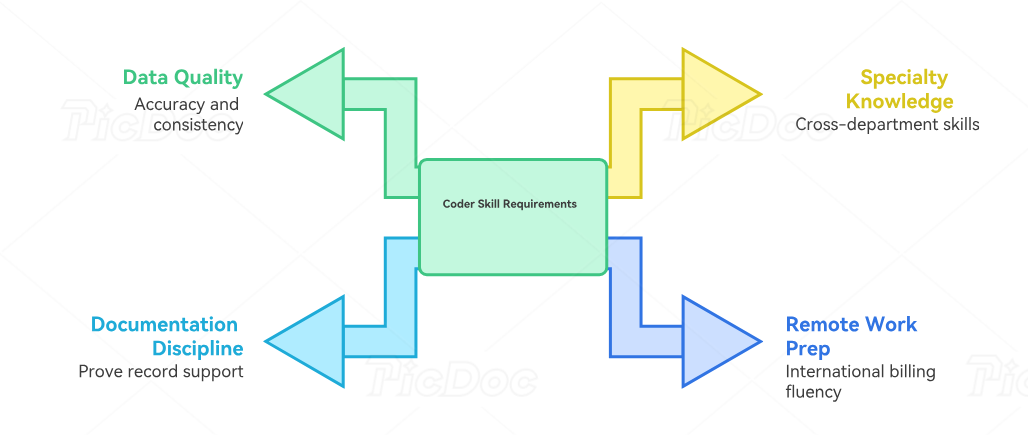
Employers care about coders who can protect data quality. That means you must be accurate, consistent, organised, and able to explain your reasoning. In hospital coding, the pressure is often classification accuracy and complete episode capture. In billing-heavy roles, the pressure may include claim cleanliness, rejection prevention, payment follow-up, and payer communication. A strong candidate understands revenue cycle KPIs, clearinghouse terminology, practice management systems, and RCM software terms.
The most valuable skill is documentation discipline. Anyone can look up a code; fewer people can prove the record supports it. Coders who catch missing discharge details, incomplete operative descriptions, unsupported diagnoses, and unclear comorbidity evidence protect both the organisation and the data. Make this your career positioning by studying clinical documentation improvement, coding query process, medical necessity criteria, and coding audit terms.
Specialty knowledge also helps. A coder who understands cardiology, emergency care, radiology, gastroenterology, oncology, pathology, dermatology, mental health, and surgery can move across more roles. Specialty exposure teaches you how documentation patterns change by department. Build that range through cardiology CPT coding, emergency medicine CPT terms, radiology coding terms, and gastroenterology CPT codes.
Remote-work seekers should add international billing fluency. Irish learners who want to work with US, UK, or global revenue-cycle teams should understand claim forms, CPT-style procedure coding, modifiers, remittance language, denial codes, and payment posting. These roles often reward speed and accuracy, but they punish careless assumptions. Useful preparation includes CMS-1500 terms, UB-04 billing form terms, CPT modifiers, and EOB interpretation.
5. How to Study for Medical Billing and Coding Certification Without Wasting Months
Use a 12-week plan that builds from language to records to claims. Weeks 1-2 should cover terminology, anatomy, abbreviations, record structure, and the basic coding workflow. Weeks 3-5 should focus on diagnosis coding, procedure coding, standards, sequencing, and documentation support. Weeks 6-8 should add billing, claim forms, denials, EOBs, payment posting, and compliance. Weeks 9-12 should focus on timed practice, weak-area repair, and portfolio building using online coding exam prep resources, coding competency terms, CEU requirements, and certification renewal terms.
Study every code through five questions: What condition or procedure is documented? Where is the evidence? Does the coding standard allow it? Does the episode context support it? What would an auditor ask? This method forces you to build judgment instead of memorising isolated terms. It works especially well with medical coding automation terms, encoder software terms, coding edits, and medical coding regulatory compliance.
Every week, complete one full practical scenario. Read a short patient episode, identify the principal diagnosis, capture relevant secondary diagnoses, code procedures, list missing documentation, and write a short rationale. Then turn the same case into a billing scenario by predicting claim risks, denial reasons, or reconciliation steps. This exercise connects healthcare claims management, CARC denial codes, RARC remark codes, and revenue leakage prevention.
Your CV should show practical readiness. Include certification, coding systems studied, software exposure, specialties practised, documentation-review skills, and any claim or denial knowledge. Add a portfolio link or short attachment if possible. Even a simple one-page portfolio can include a coding checklist, sample query, denial tracker, and audit note. That turns your preparation into visible proof across coding career development, medical coding apprenticeship terms, professional development, and CBSC exam terms.
6. FAQs About Medical Billing and Coding Certification in Ireland
-
Certification is worth it when it teaches practical record review, coding standards, diagnosis and procedure coding, documentation queries, and audit-ready decision-making. The certificate helps most when it proves you can work with real notes, not just definitions. Learners should pair certification with medical coding workflow terms, clinical documentation improvement, health information management, and medical coding audit terms.
-
Irish learners should understand ICD-10-AM diagnosis coding, ACHI procedure coding, Australian Coding Standards, and Irish Coding Standards for hospital clinical coding contexts. Learners who want billing, private practice, or remote international roles should also understand CPT-style procedure coding, modifiers, claim forms, denials, and remittance language. A balanced study plan includes ICD coding standards, CPT coding references, CPT modifier usage, and EOB guidance.
-
It is possible, but you need to prove practical ability. Beginners should build a portfolio showing coded cases, documentation queries, audit checklists, specialty examples, and denial-resolution thinking. Employers are more likely to trust you when you can explain why a code is supported and what risk appears when documentation is weak. Start with medical abbreviations, coding education terms, coding competency assessment, and coding apprenticeship terms.
-
A focused learner can build a strong foundation in 8-12 weeks, but beginners may need longer if anatomy, terminology, and records are new. The goal is not speed; the goal is dependable accuracy. You should be able to read a record, choose codes, explain your logic, identify weak documentation, and understand downstream billing impact. Study with SOAP note coding, problem list documentation, medical necessity criteria, and claims reconciliation.
-
Beginners should avoid coding from memory, coding unsupported diagnoses, skipping procedure detail, ignoring coding standards, and treating unclear notes as if they are complete. Another major mistake is studying only diagnosis codes while ignoring documentation, audit risk, and claim flow. Protect yourself with coding ethics, medical documentation requirements, coding edits and modifiers, and regulatory compliance.
-
Stand out by proving you can code carefully, communicate clearly, and solve real workflow problems. Build a small portfolio with a coded case, documentation query, denial example, audit checklist, and specialty coding sample. In interviews, speak about accuracy, standards, data quality, and documentation support instead of only saying you completed a course. Support that positioning with charge capture terms, revenue cycle KPIs, claims management, and coding career development.
