
Medical Billing and Coding Certification in New Zealand: Complete Guide for 2026-2027
Medical billing and coding certification in New Zealand needs a sharper plan than most beginners expect. The local market mixes clinical documentation improvement, health information management, medical coding workflow, revenue cycle management, and accurate reimbursement skills into one career conversation.
The strongest 2026-2027 path is simple: understand New Zealand’s coding reality, build globally portable billing knowledge, then prove you can read documentation, assign codes, catch leakage, and explain denials. A certificate helps when it sits on top of medical necessity, regulatory compliance, EHR documentation, coding ethics, and practical claim review ability.

1. What Medical Billing and Coding Certification Means in New Zealand for 2026-2027
New Zealand learners need to separate three career lanes early: hospital clinical coding, private-practice billing support, and international remote billing/coding work. Hospital-focused roles lean heavily on medical coding workflow, discharge documentation, morbidity data, and classification rules. Private clinics add patient responsibility, payment posting, claims reconciliation, and practice management systems. Remote work for US-facing employers brings in CPT modifiers, CARCs, RARCs, and EOB interpretation.
For New Zealand hospital coding, the official foundation is ICD-10-AM/ACHI/ACS and AR-DRG. Health New Zealand lists ICD-10-AM/ACHI/ACS and Australian Refined Diagnosis Related Groups as the classification systems used in New Zealand hospitals, which means a learner should treat local inpatient coding as a documentation-and-classification discipline rather than a generic “code lookup” job. That makes clinical documentation improvement, SOAP note coding, problem list accuracy, medical record retention, and coding query process essential from the start.
A 2026-2027 certification plan should also account for edition control. Health New Zealand’s New Zealand Coding Authority page states that Australia moved to ICD-10-AM/ACHI/ACS Thirteenth Edition on 1 July 2025 while New Zealand continues to use Twelfth Edition. That single detail can save a learner from buying the wrong books, practicing on the wrong examples, or giving interview answers that sound polished yet mismatched. Pair local classification awareness with ICD-11 standards, ICD-11 respiratory coding, ICD-11 oncology coding, neurological disorder coding, and cardiovascular code directory only as broader coding literacy.
New Zealand Certification Roadmap: 30 Billing and Coding Decisions That Matter
| Certification Area | What It Means in New Zealand | Why It Hits Career Readiness | Best Practice Action |
|---|---|---|---|
| Clinical coding | Hospital records coded through ICD-10-AM, ACHI, ACS, and AR-DRG logic | Weak documentation reading creates wrong morbidity data | Study medical coding workflow before memorizing codes |
| Billing fundamentals | Useful for private clinics, remote work, and payer-facing admin | Claims fail when coding and billing teams speak different languages | Master RCM terms and claim flow |
| Documentation review | Coder must pull evidence from notes, discharge summaries, reports, and orders | Thin evidence causes audit exposure and lost revenue | Use documentation requirements as a checklist habit |
| CDI | Clarifies diagnoses, specificity, severity, complications, and procedure detail | Incomplete notes make correct coding impossible | Build a CDI vocabulary |
| Coding queries | Formal clarification route when provider notes lack coding-level detail | Guessing creates compliance risk | Practice the coding query process |
| EHR literacy | Records live across notes, medication lists, orders, lab reports, and discharge documents | Missing one tab can change the final code | Review EHR coding terms |
| Problem lists | Useful clues, although final coding still needs encounter evidence | Old problems can contaminate current coding | Audit problem list accuracy |
| Medical necessity | Links condition, service, intervention, and payer logic | A technically correct code can still fail payment review | Map every service to medical necessity criteria |
| Audit defense | Evidence trail must support every coding decision | Unsupported codes create repayment and credibility risk | Use audit terms to structure reviews |
| Revenue leakage | Missed charges, weak documentation, wrong modifiers, and undercoding drain income | Employers value coders who protect clean revenue | Track revenue leakage patterns |
| CPT literacy | More relevant for US-facing remote billing than New Zealand hospital coding | Remote employers test procedure coding confidence | Start with CPT modifiers |
| Specialty coding | Cardiology, radiology, emergency, gastroenterology, and dermatology need separate practice | General certification fails when specialty detail gets complex | Use cardiology CPT coding as a model |
| Denial language | Remote billing roles require claim adjustment fluency | A coder who cannot read denials cannot fix revenue | Study CARCs and RARCs |
| EOB interpretation | Explains how claims were paid, reduced, denied, or shifted to patient balance | Payment posting errors hide under confusing remittance language | Practice with an EOB guide |
| Compliance | Covers documentation integrity, privacy, standards, and defensible coding | Compliance failures damage both employers and coders | Review coding regulatory compliance |
| Ethics | Protects against upcoding, cherry-picking, and unsupported assumptions | Ethical judgment is tested when productivity pressure rises | Learn coding ethics standards |
| Data analytics | Coding quality affects reporting, planning, funding, benchmarking, and audits | Employers increasingly want coders who explain trends | Add data analytics terms |
| Charge capture | Ensures billable services appear correctly in the revenue system | Missing charges create invisible losses | Use a charge capture checklist |
| Clearinghouse knowledge | Needed for electronic claim submission roles | Rejected claims require technical triage | Learn clearinghouse terminology |
| EDI | Explains the electronic movement of claims, remits, eligibility, and acknowledgments | Remote billing teams expect EDI vocabulary | Review EDI billing terms |
| Forms literacy | CMS-1500 and UB-04 knowledge helps with US-facing claims | Field-level mistakes delay reimbursement | Study CMS-1500 terms and UB-04 terms |
| Credential planning | Different credentials support different markets | The wrong certificate wastes money and months | Compare credentialing organizations |
| CEUs | Ongoing education keeps certification credible | Static knowledge ages quickly as rules update | Plan CEUs for coders |
| Competency assessment | Employers want proof beyond course completion | Portfolio cases beat vague “certified” claims | Use competency assessment terms |
| Apprenticeship thinking | Entry-level learners need supervised practice and feedback loops | Independent study without correction creates bad habits | Build from apprenticeship terms |
| Specialty portfolio | Choose two to three specialties for deeper practice | Focused samples look stronger than scattered notes | Try radiology coding, emergency CPT, and gastroenterology CPT |
| Remote work readiness | US, Gulf, and international clients may expect broader billing fluency | Remote roles test speed, independence, and denial recovery | Add claims management terms |
| RCM software | Billing work runs through platforms, queues, edits, and reports | Software confusion slows production immediately | Review RCM software terms |
| Automation awareness | Coders increasingly work beside encoders, edits, and AI-assisted tools | Automation helps only when humans catch context errors | Study coding automation terms |
| Career development | Long-term growth can move into audit, CDI, data, compliance, or RCM leadership | A narrow first certificate needs a second-step plan | Map growth with coding career development |
2. Which Certification Path Fits New Zealand Learners
The best certification path depends on the job target. A learner aiming for New Zealand hospital clinical coding should prioritize ICD-10-AM/ACHI/ACS, documentation abstraction, coding standards, and supervised practice. A learner aiming for remote US billing support should prioritize CPT coding, HCPCS-style billing vocabulary, claims management, denial management, and payment posting. A learner aiming for practice administration should add commercial insurance billing, patient responsibility, collections, and COB concepts.
For local hospital credibility, look at formal New Zealand-linked pathways as well as employer training. NZQA lists a micro-credential called “Apply clinical coding principles and processes in a health context,” and the overview says successful completion can lead to intermediate and advanced clinical coding courses offered by Health New Zealand. That creates a sensible foundation for candidates who want public-sector coding exposure, while AMBCI-style study can strengthen medical billing certification terms, coding education terms, professional development, certification renewal, and coding competency.
For international mobility, AMBCI candidates should treat certification as a skill stack. Start with medical coding certification terms, then layer CPT coding for emergency medicine, radiology billing terms, lab and pathology coding, and preventive medicine CPT coding. This matters because remote job descriptions often blend “coder,” “billing specialist,” “AR follow-up,” “denial analyst,” and “revenue cycle associate” into one role.
A smart New Zealand learner also studies the countries where remote roles originate. AMBCI’s guides for medical billing and coding certification in Australia, medical billing and coding certification in the UK, medical billing and coding certification in India, medical billing and coding certification in the Philippines, and medical billing and coding certification in the UAE help compare market expectations. The goal is to avoid sounding local-only when applying globally and avoid sounding US-only when applying locally.
3. Skills New Zealand Employers and Remote Clients Actually Test
The first tested skill is evidence extraction. Can you read a discharge summary, operative note, pathology report, radiology report, medication list, and clinician clarification without inventing detail? That skill ties directly to SOAP note coding, EMR documentation terms, medical record storage, encoder software, and clinical decision support. Beginners often lose marks because they know code families but miss the documented reason the service occurred.
The second tested skill is classification discipline. Good coders follow the alphabetic index, tabular verification, excludes notes, sequencing rules, intervention rules, and standard instructions. A candidate who jumps straight from a diagnosis word to a final answer will struggle in any real audit. Build discipline with ICD-11 mental health definitions, infectious disease coding, orthopedic CPT coding, dermatology CPT essentials, and surgical coding compliance. Use global examples for practice, then apply New Zealand classification rules when targeting local clinical coding.
The third tested skill is revenue explanation. Remote billing clients rarely want someone who can only submit a clean claim. They want someone who can explain why a claim denied, whether the denial links to eligibility, authorization, coding, modifier logic, patient responsibility, bundling, or documentation. That means you need claim adjustment reason codes, remittance advice remark codes, coordination of benefits, coding edits and modifiers, and payment posting. This is where certified beginners often separate themselves from certificate collectors.
The fourth tested skill is privacy, licensing, and controlled data use. Health New Zealand notes that ICD-10-AM/ACHI/ACS and AR-DRG-related clinical code tables are licensed products and available through appropriate channels rather than freely posted as full tables online. A serious candidate respects licensing, uses approved references, and avoids copying restricted code sets into public portfolios. Study healthcare data security, medical abbreviations, coding system updates, data analytics, and HIM terms so your workflow looks employer-safe.
Quick Poll: What is your biggest New Zealand billing and coding certification pain right now?
4. How to Build a 90-Day Certification Plan Without Wasting Money
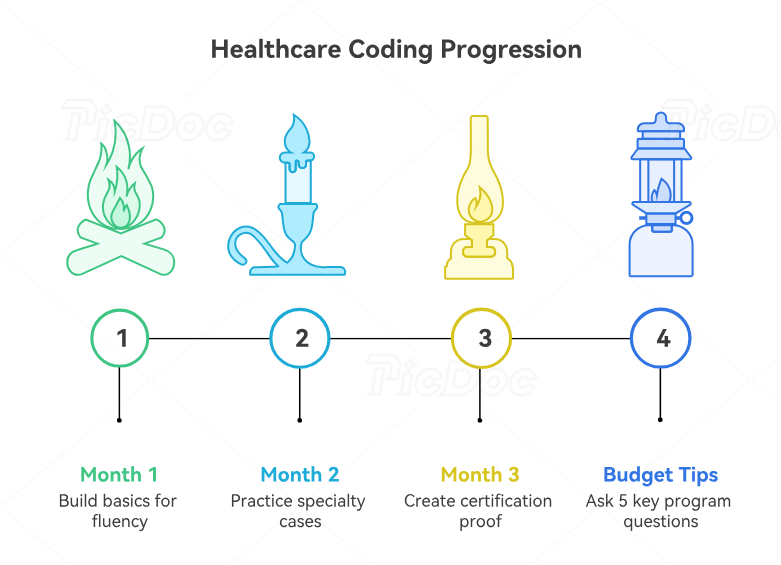
Days 1-30 should build vocabulary and workflow. Learn how a patient encounter becomes documentation, how documentation becomes codes, how codes move into data or claims, and how errors surface. Use healthcare billing acronyms, RCM KPI terms, charge capture, encounter forms and superbills, and medical billing reconciliation. Your goal in the first month is fluency, because coding exams and interviews punish people who memorize isolated terms.
Days 31-60 should move into case practice. Work through common settings: emergency, radiology, pathology, dermatology, pediatrics, cardiology, and behavioral health. This helps you see how documentation changes by specialty. Pair emergency medicine CPT, radiology procedure coding, lab and pathology coding, pediatric CPT coding, and behavioral health billing. For each case, write a short rationale: source document, key evidence, selected code family, sequencing logic, and possible query.
Days 61-90 should produce proof. Build a small certification portfolio with sample coding rationales, denial explanations, modifier examples, audit corrections, and a career target. Include coding audit terms, modifiers usage examples, claims reconciliation terms, revenue leakage prevention, and coding competency assessment. A portfolio should show how you think, not simply that you finished a course.
Budget control matters. Before paying for any program, ask five questions: which coding system is taught, which edition is used, whether real-style records are included, whether feedback is provided, and which job market the certificate supports. A New Zealand-focused candidate should understand local pathways; a remote-work candidate should compare CPC certification directories, CBCS certification terms, CCS certification programs, coding credentialing organizations, and coding education accreditation. The cheapest certificate becomes expensive when it points to the wrong market.
5. How to Turn Certification Into Work: Hospitals, ACC, Private Clinics, and Remote Billing
For New Zealand hospital roles, aim your resume at health data quality. Use language around discharge documentation, ICD-10-AM/ACHI/ACS awareness, coding standards, clinical evidence, query process, and confidentiality. Add proof through HIM terms, data analytics reporting, clinical documentation improvement, medical coding ethics, and coding system updates. Interviewers respond to candidates who understand that coding supports funding, planning, audit trails, and clinical reporting.
For ACC-adjacent or injury-claim environments, focus on documentation clarity, injury context, treatment evidence, provider communication, and claim status tracking. ACC’s official site frames New Zealand injury support around prevention, care, and recovery, with resources for injured people, New Zealanders injured overseas, and visitors injured in New Zealand. A billing-aware candidate can strengthen this lane with medical necessity criteria, utilization review terms, claims management, reconciliation terms, and denial management resources.
For private clinics, certification becomes useful when paired with front-end and back-end billing control. Front-end errors include wrong patient details, missing referral information, unclear coverage, and weak documentation. Back-end errors include wrong fee capture, payment posting mistakes, aging balances, and unresolved rejections. Study practice management systems, RCM software terms, electronic claims submission platforms, payment posting, and collections and bad debt. This is the lane where a certified learner can become useful fast by fixing small leaks.
For remote US-facing work, speak the language of claim outcomes. Employers want clean claims, denial recovery, modifier accuracy, specialty coding, follow-up discipline, and turnaround reliability. Build examples around CMS-1500 terms, UB-04 billing forms, EOBs, clearinghouse terminology, and EDI billing. Then add specialty proof from cardiology CPT, anesthesia coding, infusion billing, ambulance coding, and sleep medicine billing.
The strongest 2026-2027 career move is positioning. “Certified medical coder” is too broad on its own. “Entry-level clinical coding candidate with ICD-10-AM/ACHI/ACS awareness, documentation abstraction practice, CDI vocabulary, and audit-safe rationale writing” sounds stronger for New Zealand hospitals. “Certified billing and coding candidate with CPT, modifier, EOB, CARC/RARC, payment posting, and denial follow-up practice” sounds stronger for remote billing teams. Support either positioning with professional development terms, career development terms, apprenticeship terms, online exam prep communities, and CEU planning.
6. FAQs About Medical Billing and Coding Certification in New Zealand
-
Yes, certification is useful when it matches the job lane. For New Zealand hospital clinical coding, prioritize ICD-10-AM/ACHI/ACS, documentation abstraction, and Health New Zealand-aligned training pathways. For private clinics and remote work, add revenue cycle management, claims management, EOBs, CPT modifiers, and payment posting. The mistake is buying a certificate before deciding whether you want local clinical coding, private billing, or international remote work.
-
Start with the coding system tied to your target role. New Zealand hospital coding requires ICD-10-AM/ACHI/ACS and AR-DRG awareness, while remote US billing roles often ask for CPT, modifiers, claims, denials, and payment posting. Build base knowledge with medical coding workflow, medical necessity, coding edits, CARCs, and RARCs.
-
Remote work is possible when your skills match the employer’s payer environment. US-facing roles usually care about claim submission, CPT, modifiers, denial follow-up, EOB review, AR queues, and productivity. Build a remote-ready profile with CMS-1500 form terms, UB-04 form terms, clearinghouse terminology, EDI billing terms, and denial management services. Certification opens the door; case practice keeps it open.
-
A focused beginner can build foundational readiness in about 90 days, although local clinical coding competence takes longer because real records require judgment. Month one should cover billing acronyms, coding workflow, and documentation terms. Month two should cover cases using radiology coding, pathology coding, and emergency CPT. Month three should produce portfolio samples and audit rationales.
-
The biggest mistake is studying codes without studying evidence. Real coding starts with the record: what was assessed, treated, ordered, performed, clarified, and supported. A beginner should spend as much time on SOAP notes, problem lists, CDI terms, coding query process, and audit terms as on code selection.
-
ICD-11 is useful for global awareness, terminology growth, and future-facing literacy. For current New Zealand hospital coding, prioritize the classification system used locally and verify the edition before buying resources. Use AMBCI ICD-11 resources such as ICD-11 coding standards, ICD-11 infectious diseases, ICD-11 oncology, ICD-11 mental health, and ICD-11 cardiovascular directory as supplementary learning.
