
Medical Billing and Coding Certification in Kenya: Complete Guide for 2026-2027
Kenya has one of the strongest healthcare talent pipelines in East Africa, and medical billing and coding certification can help learners move toward remote revenue cycle work, healthcare documentation roles, claims support, medical coding assistance, and international healthcare operations. The challenge is knowing what to study, how certification fits the job market, and which skills actually matter beyond the certificate. A strong path combines medical coding workflow terms, accurate medical billing and reimbursement, healthcare billing acronyms, and medical coding certification terms into one practical career plan.

1. What Medical Billing and Coding Certification Means in Kenya in 2026-2027
Medical billing and coding certification in Kenya is valuable because it gives learners a structured way to understand how clinical documentation becomes coded data, how coded data becomes a claim, and how claims become payment, denial, adjustment, or patient responsibility. Kenyan learners who want remote healthcare work cannot rely on basic terminology alone. They need to understand documentation evidence, payer rules, compliance pressure, coding accuracy, and revenue cycle behavior. That is why certification should be paired with practical study of health information management terms, medical abbreviations for coders, medical coding regulatory compliance, and coding ethics and standards.
The biggest pain point for beginners in Kenya is the gap between studying coding definitions and doing real coding work. A candidate may understand that ICD codes describe diagnoses and CPT codes describe procedures, but still struggle when a provider note is vague, a procedure needs a modifier, a diagnosis fails medical necessity, or a denial arrives with a payer adjustment code. Real employability begins when you can connect ICD-11 coding standards, CPT modifier usage, medical necessity criteria, and claim adjustment reason codes inside one decision.
Certification also helps Kenyan candidates speak the language international employers expect. Many remote healthcare teams need people who can review documentation, check claim errors, read EOBs, track denials, post payments, and support clean claim submission. A certificate becomes stronger when the learner can explain remittance advice remark codes, explanation of benefits, clearinghouse terminology, and revenue cycle management terms without sounding like they memorized isolated definitions.
For 2026-2027, Kenyan learners should treat medical billing and coding as a practical skill path, not a shortcut. A good certification plan should build clinical language, coding rules, payer logic, documentation judgment, billing operations, denial recovery, and compliance discipline. The target is to become someone who can protect claim quality. That means noticing missing laterality, unsupported diagnoses, mismatched modifiers, incomplete provider notes, weak authorization checks, and unresolved balances before they become revenue leakage. Learners who understand charge capture terms, revenue leakage prevention, medical billing reconciliation, and advanced claims reconciliation will have a stronger foundation than learners who only chase exam completion.
Kenya Medical Billing and Coding Certification Map: 25+ Terms You Must Know
| Term | What It Means | Why It Hits Billing | Best Practice Action |
|---|---|---|---|
| Medical Coding | Translating diagnoses, services, procedures, and supplies into standardized codes | Drives claim accuracy, reporting, payment, denial prevention, and audit quality | Practice coding from provider documentation, not from memorized term lists alone |
| Medical Billing | Submitting, tracking, correcting, and reconciling healthcare claims | Shows whether coded services turn into payment or rework | Learn claims, EOBs, denials, payment posting, and patient balances together |
| ICD-11 | Diagnosis classification system used to organize diseases, injuries, and health conditions | Builds diagnosis literacy for documentation review and coding accuracy | Study conditions by specialty and documentation specificity |
| CPT | Procedure coding system widely used in U.S.-style physician billing | Procedure selection affects reimbursement, edits, modifiers, and medical necessity | Study CPT by service family and documentation requirement |
| HCPCS | Codes for supplies, equipment, drugs, ambulance, and certain services | Important for billing items that CPT alone may not capture | Verify units, modifiers, payer rules, and supporting documentation |
| Medical Necessity | Proof that a service was clinically reasonable for the patient’s condition | Weak necessity support causes denials even when codes are technically valid | Match diagnosis, procedure, frequency, and clinical evidence |
| Modifier | Code add-on that explains special circumstances around a service | Controls payment, bundling exceptions, service separation, and compliance risk | Use modifiers only when documentation proves the reason |
| Clean Claim | A claim accepted without avoidable correction or missing information | Improves cash flow and reduces billing team rework | Check patient data, payer rules, codes, modifiers, units, and attachments before submission |
| Claim Scrubbing | Pre-submission review to catch errors before payer processing | Stops preventable denials from reaching the payer | Build specialty-specific edit checks and denial-prevention rules |
| Denial Management | Correcting, appealing, and preventing rejected or unpaid claims | Turns billing pain into recoverable revenue and process improvement | Classify denial causes before correcting claims |
| EOB | Explanation of Benefits showing how a payer processed a claim | Reveals allowed amounts, adjustments, denials, and patient responsibility | Read every line item, not just the final payment amount |
| ERA | Electronic remittance advice used for payment and denial posting | Supports faster reconciliation and payment posting accuracy | Compare ERA totals with charges, payments, adjustments, and balances |
| CARC | Claim Adjustment Reason Code explaining why payment changed | Shows whether the problem is contractual, coding, coverage, or patient responsibility | Pair CARCs with RARCs and payer notes before action |
| RARC | Remark code adding detail to a claim adjustment or denial | Often reveals missing records, policy limits, or correction requirements | Use RARC patterns to prevent repeat denials |
| Charge Capture | Making sure every supported billable service is captured | Missed charges create silent revenue leakage | Reconcile notes, orders, procedure logs, and charges daily |
| Revenue Leakage | Lost revenue from missed charges, undercoding, denials, or unpaid balances | Shows the financial cost of weak coding and billing controls | Track underpayments, denied lines, unbilled services, and missed modifiers |
| CDI | Clinical documentation improvement that strengthens record clarity | Supports specificity, medical necessity, quality reporting, and coding accuracy | Identify gaps without leading the provider |
| Coding Query | Compliant request for provider clarification | Prevents assumption-based coding and unsupported claims | Ask neutral questions tied to facts already in the record |
| NCCI Edits | Rules that flag bundled or incompatible code combinations | Protects against improper separate billing | Check edits before adding a modifier |
| Bundling | Grouping related services into one payable service | Incorrect separation causes denials and compliance concern | Understand service packages within each specialty |
| Unbundling | Separating codes improperly to increase payment | Creates serious audit and overpayment risk | Use complete service codes and document any valid exception |
| Prior Authorization | Payer approval needed before selected services | Missing authorization can block payment even with correct coding | Confirm service, date range, diagnosis, provider, and payer authorization rules |
| Eligibility Verification | Checking active coverage and benefit rules | Prevents avoidable registration and coverage denials | Verify member ID, coverage dates, payer, deductible, copay, and benefit limits |
| Patient Responsibility | Amount the patient owes after payer processing | Affects billing transparency, collections, and account accuracy | Separate deductible, copay, coinsurance, non-covered services, and write-offs |
| Payment Posting | Recording payer payments, adjustments, denials, and patient balances | Keeps account balances accurate and appeal work visible | Post line by line and flag underpayments quickly |
| Claims Reconciliation | Comparing submitted claims, payer responses, payments, and outstanding balances | Finds missing payments, unpaid lines, and unresolved denials | Track every claim from submission to final resolution |
| Compliance | Following coding, billing, documentation, privacy, and payer rules | Protects against overpayment, audit findings, and billing risk | Code only what the documentation supports |
| Credential Renewal | Ongoing education needed to keep a credential current | Shows employers that your knowledge has not gone stale | Track CEUs, coding updates, payer changes, and specialty refreshers |
2. Best Certification Path for Kenyan Learners
The best certification path for Kenyan learners begins with medical language, then moves into diagnosis coding, procedure coding, billing operations, claim correction, and compliance. A beginner who jumps straight into an exam may pass some theory questions but still freeze when a claim denies for medical necessity, a modifier is unsupported, or an EOB shows an adjustment that changes patient responsibility. A stronger path uses coding education and training terms, coding competency assessment terms, coding credentialing organizations, and continuing education units to understand both the learning process and long-term career maintenance.
The first phase is clinical vocabulary. You need enough anatomy and medical terminology to understand what the provider actually documented. This protects you from choosing codes based on keywords instead of clinical meaning. For example, pain, injury, chronic disease, infection, follow-up care, complications, and screening visits all need different coding judgment. Build diagnosis confidence through ICD-11 mental health coding, ICD-11 neurological disorder coding, ICD-11 respiratory disease coding, and ICD-11 cardiovascular disease coding.
The second phase is procedure coding. Procedure codes carry payment impact, bundling rules, units, modifiers, and payer edits. Kenyan learners aiming for remote U.S.-style support should treat CPT as a system of service logic, not a number catalog. Learn how the service was performed, what documentation proves it, whether the diagnosis supports it, and whether another code already includes it. Good practice areas include cardiology CPT coding, emergency medicine CPT codes, radiology CPT procedures, and gastroenterology CPT codes.
The third phase is billing workflow. This is where learners become more employable because they understand how coding decisions travel through the claim lifecycle. A claim can fail because the patient’s coverage was inactive, the payer required authorization, the place of service was wrong, the modifier was missing, the code pair was bundled, or the filing limit expired. Study CMS-1500 form terms, UB-04 billing form terms, electronic data interchange billing terms, and electronic claims submission platforms to understand the operating environment around codes.
The fourth phase is job-readiness. Kenyan candidates should practice writing short coding rationales, explaining denied claims, summarizing provider documentation gaps, and showing how they would correct a claim. This matters because remote teams need clear written communication. A hiring manager wants to know whether you can work independently, document your thinking, protect compliance, and reduce rework. Build that readiness with clinical documentation improvement terms, coding query process terms, electronic health record coding terms, and encoder software terms.
3. Skills Kenyan Candidates Must Build Before Applying for Jobs
Kenyan candidates should build practical skill in documentation review before anything else. Every code must come from the record. If the note is incomplete, vague, contradictory, or missing specificity, the coder must recognize the gap instead of guessing. Documentation skill means knowing how to read a chief complaint, history, exam findings, assessment, plan, orders, procedure details, medication records, and test results. Start with SOAP notes and coding, EMR documentation terms, problem lists in documentation, and Medicare documentation requirements.
The next skill is coding accuracy by specialty. A coder who understands one or two specialties well can become more employable than a learner who vaguely studied everything. Choose a specialty lane after building the basics. Radiology teaches orders, medical necessity, imaging types, and modifiers. Emergency medicine teaches acuity, E/M logic, procedures, and diagnosis support. Dermatology teaches lesion documentation, excisions, repairs, and pathology relationships. Pediatrics teaches preventive care, vaccines, sick visits, and age-specific billing. Use orthopedic surgery CPT coding, pediatric CPT coding, dermatology CPT coding, and lab and pathology coding for focused practice.
Billing judgment is another major skill. Many beginners think a claim is correct once the diagnosis and procedure codes are selected. In real billing work, claim success also depends on eligibility, authorization, provider identifiers, place of service, payer edits, filing rules, coordination of benefits, and correct patient responsibility. This is why learners should study commercial insurance billing terms, coordination of benefits, patient responsibility and copay terms, and collections and bad debt in medical billing.
Denial analysis is where job-ready candidates stand out. A denial should never be treated as random. It tells you something about the claim, payer rule, documentation, code pair, coverage, or submission process. Kenyan learners should practice identifying root causes and corrective actions from sample denial scenarios. That means reading payer messages, checking claim history, reviewing codes, comparing documentation, and deciding whether the next step is correction, appeal, write-off, or patient billing. Build this skill using insurance denial management services, healthcare claims management terms, payment posting guidance, and claims reconciliation terms.
Compliance discipline is the skill that protects your career. A coder must know when documentation supports a code and when it does not. A coder must avoid upcoding, unbundling, unsupported modifiers, copying prior codes, and coding from assumptions. This matters even more in remote work because your written explanation may be the only proof of your judgment. Strengthen compliance through surgical coding compliance terms, Stark Law and Anti-Kickback terms, utilization review and management terms, and clinical decision support terms.
Quick Poll: What is your biggest medical coding career barrier in Kenya?
4. How to Prepare for Certification Without Wasting Time
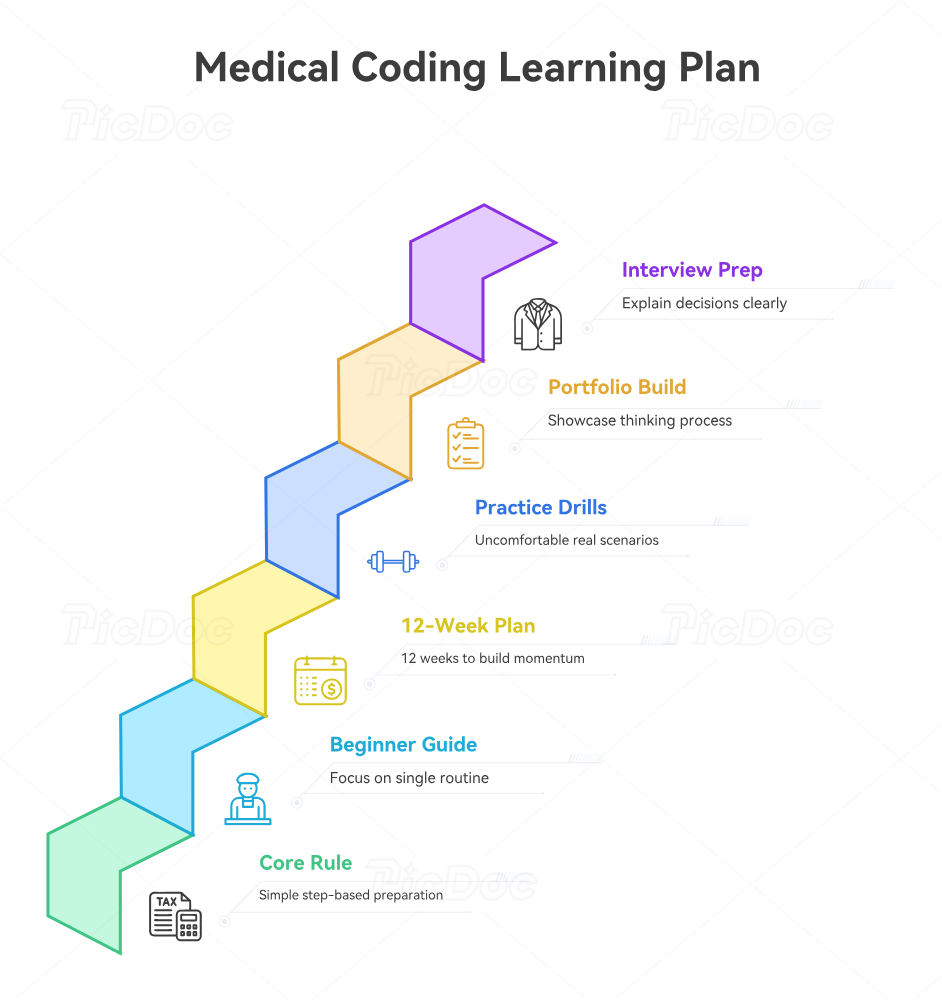
The best preparation plan is simple: learn the rule, apply it to a case, explain your decision, then correct your errors. Many learners lose months because they keep collecting resources instead of building skill. A Kenyan beginner should use one core study path, one terminology system, one weekly case-practice routine, and one error log. The error log should track missed diagnosis specificity, modifier misuse, wrong primary diagnosis, unsupported medical necessity, bundled services, missing authorization, and payment posting confusion. Support that routine with medical coding education accreditation terms, coding career development terms, online coding exam prep resources, and certification renewal terms.
A strong 12-week beginner plan can be enough to build momentum. Weeks 1 and 2 should focus on terminology, anatomy, abbreviations, and documentation structure. Weeks 3 through 5 should focus on diagnosis coding and specialty-specific examples. Weeks 6 through 8 should focus on CPT, HCPCS, modifiers, bundling, and medical necessity. Weeks 9 and 10 should focus on claim forms, EOBs, payment posting, denials, and reconciliation. Weeks 11 and 12 should focus on exam-style practice, timed review, and portfolio samples. Useful resources include charge capture terms, medical billing practice management systems, RCM software terms, and medical coding automation terms.
Practice should feel uncomfortable. If every question feels easy, the material is too shallow. Real coding work requires messy documentation, incomplete notes, ambiguous diagnoses, competing codes, payer edits, and unclear denial language. Build study drills around those pain points. Take a sample provider note and ask: What is the chief reason for the visit? What diagnoses are supported? Which procedures are documented? Is the payer likely to require prior authorization? Does the procedure need a modifier? What evidence supports medical necessity? Then review coding edits and modifiers, medical necessity guidance, EOB interpretation, and payment posting terms.
A mini-portfolio can help Kenyan learners prove seriousness before they have formal experience. The portfolio can include self-created sample cases, de-identified practice scenarios, coding rationales, denial correction notes, EOB explanations, and specialty summaries. Each sample should show how you think. For example, explain why a modifier is supported, why a diagnosis does or does not prove medical necessity, why a claim denied, or how a documentation query should be written. Portfolio topics can draw from preventive medicine CPT coding, behavioral health billing, telemedicine coding, and radiology billing and coding terms.
The final step is interview preparation. Be ready to explain coding decisions in plain English. A strong answer sounds like this: “The documentation supports the diagnosis because the provider assessed and treated it during the encounter. The procedure is separately reportable because the note supports a distinct service, and the modifier is justified by the documented circumstances.” Employers trust candidates who can explain decisions clearly. Keep building fluency through CBCS exam terms, medical coding apprenticeship terms, professional development terms, and data analytics and reporting terms.
5. Career Opportunities for Certified Medical Billing and Coding Professionals in Kenya
Certified learners in Kenya can pursue several career lanes. The first is remote medical coding support. This may involve diagnosis coding, procedure coding, charge review, documentation review, coding edits, or specialty coding assistance. Remote teams may prefer candidates who can work accurately, document decisions, and handle productivity expectations. Specialty exposure helps because employers often hire for defined service areas. Build specialty readiness with anesthesia coding and billing terms, allergy and immunology coding, dialysis coding terms, and infusion and injection therapy billing.
The second lane is revenue cycle management support. These jobs may involve eligibility checks, claim submission, denial follow-up, payment posting, patient balance review, appeals support, and account reconciliation. This can be a smart entry point because it teaches the financial side of healthcare while building coding confidence. A candidate who understands the full claim lifecycle can move into stronger coding and audit roles later. Study ambulance billing reimbursement, directory of billing solutions for small practices, Medicare billing tools and resources, and Medicaid billing software terms.
The third lane is denial management and appeals support. This is valuable because denials are painful for healthcare organizations. A denied claim can mean delayed revenue, extra staff time, provider frustration, patient confusion, and missed appeal deadlines. If you can read denial codes, find root causes, correct claims, and prevent repeat errors, you become useful quickly. Build this skill with claim adjustment reason code guidance, RARC guidance, insurance denial management resources, and healthcare claims management terms.
The fourth lane is documentation quality and CDI support. Strong documentation drives accurate coding, risk adjustment, quality reporting, reimbursement, and compliance. Kenyan candidates who learn CDI thinking can help identify missing specificity, conflicting diagnoses, unsupported chronic conditions, unclear procedures, and incomplete clinical indicators. This lane is especially useful for learners with clinical exposure or strong reading skills. Build toward it with home health coding terms, hospice and palliative care coding, HCC coding definitions, and risk adjustment coding.
The fifth lane is value-based care, reporting, and analytics. This path is more advanced, but it can become powerful for learners who enjoy data, quality measures, payer performance, and documentation integrity. Healthcare organizations need people who can connect coding to quality outcomes, risk scores, utilization trends, and reimbursement models. If this interests you, study value-based care coding terms, MACRA terms, MIPS guidance, and ACO billing terms.
Kenyan candidates should apply with a targeted resume, a small portfolio, and a clear specialty direction. Avoid saying you can do everything. Say you are building toward radiology coding, emergency medicine billing, HCC validation, denial management, or RCM support. That sounds more credible and easier to hire. Strengthen your chosen track through sleep medicine billing terms, speech-language pathology coding, ambulance and emergency transport coding, and oncology ICD-11 coding.
6. FAQs About Medical Billing and Coding Certification in Kenya
-
Yes. Certification can help Kenyan learners prepare for remote billing, coding support, RCM, claims, documentation, and denial-management roles. Its value depends on how well you can apply the knowledge to real documentation and claim problems. A strong learner should understand medical coding workflow, RCM terms, claim management, and medical billing reimbursement.
-
Remote work is possible when you combine certification with practical ability, English communication, documentation accuracy, denial analysis, and billing-system awareness. Employers want candidates who can handle real claims, not only theory. Build proof through EOB reading, CARC interpretation, RARC interpretation, and claims reconciliation.
-
Start with medical terminology, anatomy, documentation structure, diagnosis coding, procedure coding, modifiers, medical necessity, claim forms, EOBs, and denials. This gives you the full picture of how coding affects payment. Build your base with medical abbreviations, ICD-11 coding standards, CPT modifiers, and medical necessity criteria.
-
Many focused learners can build a solid foundation in 12 to 16 weeks, but the timeline depends on healthcare background, English confidence, study time, and practice quality. The goal is competency, not speed. Use case practice around SOAP note coding, EMR documentation, coding queries, and audit terminology.
-
The strongest skills are documentation review, diagnosis-procedure matching, modifier judgment, denial analysis, EOB interpretation, payment posting awareness, and written coding rationale. Employers value candidates who can reduce claim errors and explain corrections clearly. Build those skills through charge capture, revenue leakage prevention, payment posting, and billing reconciliation.
-
Specialization is a smart move after the basics. It helps you apply for clearer roles and show sharper value. Good options include radiology, emergency medicine, cardiology, behavioral health, HCC risk adjustment, denial management, and RCM support. Explore radiology coding, emergency medicine coding, cardiology CPT coding, and behavioral health billing.
