
Medical Billing and Coding Certification in Japan: Complete Guide for 2026-2027
Japan offers a distinctive career environment for professionals interested in medical coding, claims review, reimbursement, clinical documentation, and healthcare data management. Success requires fluency in Japan’s national fee schedule, DPC/PDPS hospital payment model, Japanese terminology, and digital claims infrastructure alongside internationally transferable medical coding certification concepts, revenue cycle management skills, clinical documentation improvement, and coding compliance knowledge. This 2026-2027 guide explains the qualifications, technical skills, study strategy, and career positioning needed to compete.
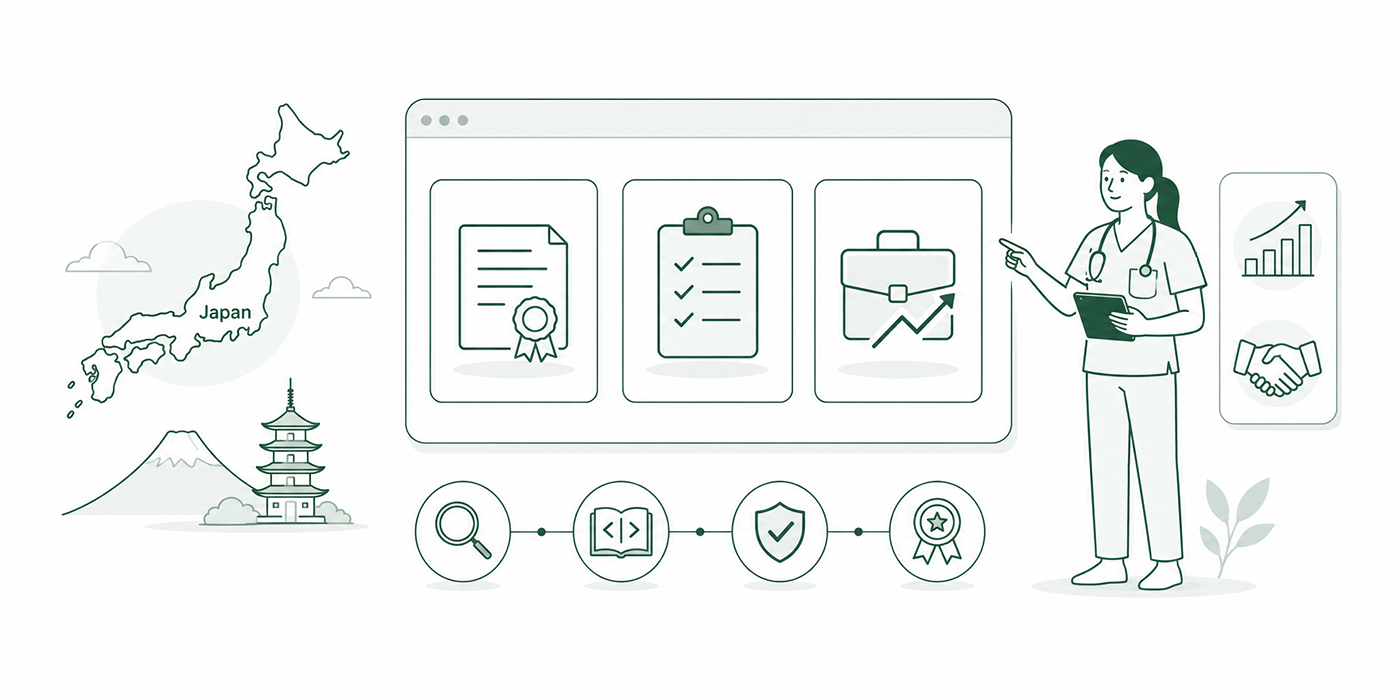
1. What Medical Billing and Coding Certification Means in Japan
Medical billing and coding in Japan operates through a nationally regulated reimbursement environment. Medical institutions and pharmacies submit claims for insured services according to the national medical service fee schedule, which assigns points to covered services, drugs, materials, tests, and procedures. One point generally equals ¥10, while the Ministry of Health, Labour and Welfare determines covered fees following deliberation by the Central Social Insurance Medical Council. Professionals entering this environment need accurate billing and reimbursement knowledge, charge-capture expertise, claims-management vocabulary, and billing reconciliation skills.
The Japanese term iryo jimu commonly refers to medical administration work involving reception, patient accounts, insurance verification, claim preparation, and reimbursement documentation. Shinryo hoshu seikyu, often associated with medical fee claims, requires detailed knowledge of the applicable fee schedule and claim rules. Hospital information roles may also involve diagnosis classification, DPC data, record audits, disease registries, and operational analysis. These responsibilities connect directly with health information management, medical coding workflow, electronic health record terminology, and medical records management.
Certification should therefore match the candidate’s intended market. An international medical billing and coding credential can support remote US-facing claims, coding, payment-posting, denial-management, or audit work. Japanese hospital careers may place greater value on domestic medical administration training, Japanese-language ability, DPC familiarity, and the Shinryo Joho Kanrishi, or Health Information Manager, pathway. The Japan Hospital Association describes this professional as someone who collects, manages, extracts, analyzes, and supplies health information using international statistical classifications. Its current program states that more than 49,802 professionals had received the qualification by 2026.
That domestic qualification has a broader information-management emphasis than a basic billing course. Its work can involve medical-record audits, DPC support, hospital statistics, electronic systems, disease registries, quality indicators, and management data. Candidates considering this route should study medical coding audit terminology, problem-list documentation, data analytics for coders, and EHR integration terminology. The current Japan Hospital Association correspondence route lists one year of foundational study followed by one year of specialist study, subject to its published admission conditions and examination pathway.
Japan’s acute inpatient payment environment adds another layer. DPC/PDPS stands for Diagnosis Procedure Combination/Per-Diem Payment System. Japan introduced this system for acute inpatient care in 2003, and an MHLW regional guidance document reported 1,786 participating hospitals as of June 1, 2024. The classification begins with 18 Major Diagnostic Categories and then incorporates diagnoses, procedures, comorbidities, severity, and other case characteristics. Learners therefore need diagnosis-coding discipline, surgical coding compliance, risk-adjustment knowledge, and cost-reporting literacy.
| Competency | Japan-Specific Application | Cost of Weakness | Best Preparation Step |
|---|---|---|---|
| Healthcare-system literacy | Understand universal insurance, insurers, providers, review organizations, patient copayments, and reimbursement flow | Foreign billing assumptions can produce inaccurate advice and poor job targeting | Study healthcare billing terminology |
| Japanese medical vocabulary | Read diagnoses, procedures, claim comments, fee rules, abbreviations, and administrative instructions | Minor translation mistakes can change clinical meaning or claim eligibility | Build bilingual notes using medical abbreviations |
| National fee schedule | Interpret reimbursable services, calculation conditions, additions, exclusions, and documentation requirements | Incorrect fee selection creates rejected or reduced claims | Pair fee rules with fee-schedule concepts |
| Claims preparation | Translate documented care into a compliant monthly reimbursement claim | Missing details delay review, correction, and payment | Master claims management |
| Eligibility verification | Confirm insurance status, patient details, payer responsibility, and valid coverage information | Incorrect eligibility can shift balances and trigger rework | Review coverage coordination |
| Patient cost sharing | Understand age-, income-, program-, and benefit-dependent patient payment rules | Bad calculations create patient complaints and account corrections | Study patient responsibility terms |
| ICD diagnosis classification | Translate documented conditions into standardized morbidity and reporting categories | Poor classification damages statistics, DPC accuracy, and record quality | Use ICD coding standards |
| DPC/PDPS logic | Connect principal diagnosis, procedures, resource intensity, severity, and length of stay | Wrong case classification can distort reimbursement and hospital analytics | Study DPC alongside cost reporting |
| Principal diagnosis selection | Identify the condition chiefly responsible for the admission after study | Incorrect selection can change the entire DPC pathway | Practice through coding competency cases |
| Comorbidity capture | Identify supported secondary conditions that affected evaluation, treatment, monitoring, or care | Missed conditions weaken severity and utilization data | Review risk-adjustment principles |
| Procedure documentation | Capture operative, diagnostic, therapeutic, and interventional details accurately | Missing specificity can block the correct fee or DPC branch | Use surgical coding compliance |
| Medical necessity | Connect the service to a documented clinical purpose, indication, and patient condition | Unclear justification weakens review defensibility | Apply medical necessity criteria |
| Clinical documentation improvement | Identify ambiguity, contradictions, missing specificity, and incomplete causal relationships | Documentation gaps flow into coding, claims, quality, and research data | Master CDI terminology |
| Provider queries | Request clarification without leading the clinician toward a preferred code | Poor queries introduce compliance and data-integrity risk | Use the coding query guide |
| Record auditing | Check completeness, signatures, consistency, classification, and support for reported services | Unresolved defects can survive into reimbursement and official statistics | Learn coding audit terminology |
| Claim review response | Investigate reductions, returned claims, missing documentation, and disputed services | Unstructured follow-up allows recurring errors to continue | Build skills with claims reconciliation |
| Revenue leakage detection | Find missed services, incomplete claims, documentation failures, and underpayments | Revenue disappears before a denial report exposes it | Apply revenue leakage controls |
| Electronic claims | Understand structured submissions, validation, correction, routing, and status tracking | Formatting and data errors create preventable returns | Review electronic claims workflows |
| EHR interpretation | Navigate notes, orders, results, problem lists, operative records, and discharge summaries | Template noise and copied text can misdirect coding decisions | Study EMR documentation terms |
| Problem-list validation | Separate active diagnoses from resolved, historical, duplicated, or unverified entries | Stale problems can cause unsupported classification | Use problem-list controls |
| Discharge-summary analysis | Reconcile diagnoses, procedures, complications, treatment outcomes, and follow-up plans | An incomplete summary weakens the final coded dataset | Practice with structured note analysis |
| Privacy protection | Secure patient data during access, storage, exchange, correction, and reporting | Administrative convenience never removes confidentiality obligations | Study healthcare data security |
| Coding compliance | Follow official definitions, calculation rules, evidence requirements, and organizational policy | Assumption-driven coding can become repayment or audit exposure | Use regulatory compliance guidance |
| Healthcare analytics | Turn coded data into case-mix, utilization, quality, operational, and financial reports | Uninterpreted data cannot guide management decisions | Build coding analytics literacy |
| Performance metrics | Track return rates, correction rates, missing documentation, coding accuracy, and turnaround time | Teams repeat costly mistakes when quality stays unmeasured | Use RCM metrics and KPIs |
| Specialty knowledge | Understand the documentation and reimbursement logic of high-volume specialties | General knowledge may fail during specialty-level review | Start with cardiology coding |
| ICD-11 readiness | Understand digital coding, post-coordination, extension codes, mappings, and terminology services | Legacy-only knowledge limits participation in classification modernization | Study coding-system updates |
| Healthcare DX awareness | Follow electronic prescriptions, standardized records, insurance-card integration, and national data exchange | Manual-only skills age quickly inside standardized digital workflows | Review coding automation terms |
| Software proficiency | Use billing platforms, EHRs, encoders, spreadsheets, validation tools, and reporting systems | Theoretical knowledge alone produces slow workplace performance | Learn encoder software terminology |
| Professional communication | Explain corrections, missing evidence, patient balances, and data issues clearly | Poor communication turns technical issues into operational conflict | Develop through professional development |
| Career portfolio | Show coded cases, audit reports, corrected claims, analytical summaries, and bilingual terminology work | A certificate without visible competence may attract limited employer confidence | Follow a coding career roadmap |
2. Choosing the Right Certification Path in Japan
The first path serves people seeking Japanese medical administration work. Training should cover the national insurance structure, medical-fee calculations, claim forms, receipt review, patient registration, outpatient and inpatient billing, medication fees, tests, imaging, procedures, and hospital terminology. Japanese-language competence carries enormous weight because claim notices, clinical records, fee rules, and employer communication commonly use Japanese. Candidates should combine local instruction with medical billing practice-management knowledge, billing acronyms, claims reconciliation, and medical-record terminology.
The second path serves candidates interested in health information management, hospital data, DPC support, quality reporting, registries, or record audits. Japan’s Health Information Manager route provides a locally aligned framework for these responsibilities. The Japan Hospital Association says its curriculum develops professionals through standardized education offered by its correspondence program and approved schools and universities. Candidates following this direction should prioritize coding audit methods, clinical documentation improvement, health information management, and coding data analytics.
The third path serves Japan-based professionals pursuing remote international work. US-facing employers may require ICD-10-CM, CPT, HCPCS, CMS-1500, UB-04, commercial insurance, Medicare, denial management, or payment-posting knowledge. These systems differ materially from Japan’s domestic reimbursement environment, so candidates must keep both rule sets separated in their notes, examples, and interviews. Build this route through CMS-1500 terminology, UB-04 claim knowledge, CPT modifier rules, and commercial insurance billing.
A fourth path combines Japanese healthcare expertise with international data and classification knowledge. This route suits bilingual candidates targeting multinational insurers, health-technology firms, clinical data vendors, consulting companies, international patient departments, or cross-border reimbursement teams. Build a portfolio around bilingual terminology mapping, diagnosis classification, documentation audits, claim explanations, and healthcare data analysis. Helpful foundations include ICD-11 coding standards, EHR integration concepts, coding automation terminology, and healthcare data-security terms.
Course selection should begin with curriculum evidence. Look for medical terminology, anatomy, reimbursement rules, claim preparation, diagnosis classification, documentation, practical exercises, error correction, and examination support. Review the issuing body, candidate eligibility, language, testing method, renewal requirements, and employer relevance. Use the coding credentialing organizations guide, medical coding accreditation terms, coding education dictionary, and certification renewal guide before committing money.
3. Technical Skills Required for Japanese Billing and Coding Work
The first high-value skill is accurate record interpretation. Coders must distinguish confirmed diagnoses, suspected conditions, historical problems, symptoms, complications, comorbidities, and treatment consequences. A diagnosis written somewhere in the chart may carry limited relevance to the coded encounter. The coder must trace assessment, treatment, monitoring, resource use, and discharge conclusions. Training should include SOAP-note interpretation, problem-list analysis, coding query procedures, and medical necessity evaluation.
The second skill is fee-schedule interpretation. Billing professionals need to identify calculation conditions, frequency limits, combinations, bundled elements, documentation requirements, and exceptions. A service may be clinically appropriate while its reimbursement still depends on specific administrative conditions. Japan’s fee system is reviewed on a two-year cycle through the Central Social Insurance Medical Council, making update discipline part of the job. Candidates should build change logs using fee-schedule terminology, coding edits and modifiers, charge-capture controls, and coding-system update guidance.
The 2026 fee revision makes current study especially important. Japan’s medical fee schedule operates as a central policy instrument that influences provider reimbursement, staffing incentives, digital-health adoption, documentation requirements, and service delivery. Candidates should confirm 2026 calculation rules directly from current MHLW materials and their training provider because older notes may contain expired points or conditions. Good revision habits include version-controlled reference sheets, dated screenshots, official-source bookmarks, and scenario-based comparison exercises. Support this work with regulatory compliance, medical coding ethics, coding audit terminology, and revenue leakage prevention.
The third skill is DPC reasoning. Candidates must understand how principal diagnoses, procedures, comorbidities, severity, discharge status, and length of stay interact. Memorizing isolated codes leaves the candidate vulnerable when the clinical record contains competing diagnoses or incomplete documentation. Strong practice cases should require a full explanation: why one diagnosis controls the case, which secondary conditions affected care, where the procedure evidence appears, and how documentation changes the grouping. Useful study areas include risk-adjustment coding, surgical coding compliance, medical coding audits, and clinical documentation terms.
The fourth skill is digital workflow competence. Japan’s Healthcare DX roadmap for FY2026 onward includes expansion of My Number Card and health-insurance integration, standardization of electronic medical-chart information, electronic prescriptions, shared information infrastructure, and connections among governments and healthcare organizations. These initiatives increase the importance of structured data, identity accuracy, interoperability, and digital audit trails. Candidates should strengthen EHR coding terminology, EHR integration knowledge, coding automation concepts, and healthcare data-security skills.
4. Career Opportunities After Certification in Japan
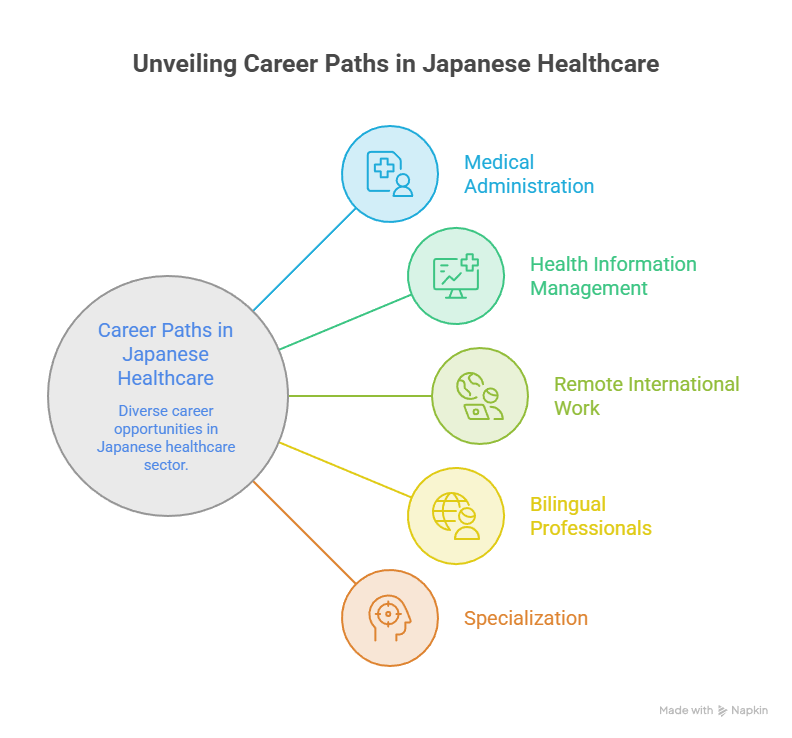
Medical administration offers the clearest entry point. Responsibilities can include patient registration, insurance verification, appointment support, outpatient billing, inpatient accounts, claim preparation, corrections, and communication with clinical departments. Employers may advertise positions using Japanese titles rather than the English phrase “medical biller.” Candidates should search for roles connected to iryo jimu, claims, reimbursement, hospital administration, medical records, and patient accounts. Strengthen applications with billing workflow terminology, practice-management system knowledge, claims-management skills, and payment-posting principles.
Hospitals also hire professionals for health information, records, DPC data, statistics, disease registries, quality programs, and management analysis. These roles reward candidates who can audit source records, classify diagnoses, detect documentation gaps, analyze datasets, and explain findings to clinical or administrative teams. Japan’s Health Information Manager qualification aligns closely with this area and is associated with record management, DPC support, data analysis, electronic systems, quality evaluation, and hospital management. Build relevant depth through health information management, data analytics for coders, record-retention terminology, and clinical decision-support concepts.
Remote international work can expand the market for Japan-based professionals who have English-language coding and claims expertise. Potential roles include coding reviewer, charge-entry specialist, claims analyst, denial-management associate, payment-posting specialist, accounts-receivable representative, eligibility specialist, and audit assistant. Employers in these markets expect familiarity with their own code sets and payer rules. Prepare through EOB interpretation, CARC analysis, RARC interpretation, and electronic data interchange.
Bilingual professionals can target international patient departments, insurance support companies, healthcare technology vendors, research organizations, consulting firms, and multinational healthcare operations. Their value comes from connecting Japanese documentation and reimbursement language with international stakeholders. A strong portfolio could include a bilingual terminology sheet, de-identified claim analysis, diagnosis mapping exercise, record-quality audit, and reimbursement explanation. Supporting expertise includes medical abbreviations, ICD coding standards, coding query terminology, and professional development strategy.
Specialization can increase credibility. Cardiology, radiology, emergency care, oncology, gastroenterology, pediatrics, dermatology, laboratory medicine, rehabilitation, dialysis, and behavioral health each have distinctive documentation and reimbursement patterns. Choose one specialty and build 15 to 20 realistic cases around its common services, documentation gaps, and classification risks. Useful references include cardiology procedure coding, radiology coding, gastroenterology coding, and oncology classification.
5. A Job-Ready Study Plan for 2026-2027
A complete beginner should plan approximately five to eight months of disciplined preparation. The first month should cover anatomy, medical terminology, healthcare-system structure, and basic documentation. The second month should focus on Japan’s insurance environment, patient cost sharing, fee-schedule structure, and claim flow. The third month should cover ICD classification, principal diagnoses, comorbidities, and documentation analysis. Support these stages with medical coding education terms, medical abbreviations, ICD coding practices, and SOAP-note coding.
Months four and five should move into DPC reasoning, procedure documentation, claim calculation, audit exercises, and reimbursement corrections. Every study week should include practical cases. Read the source record, identify reportable conditions, select the main diagnosis, justify secondary conditions, identify billable services, flag incomplete evidence, and write a concise correction note. Build these skills using coding audit terminology, medical necessity criteria, charge-capture concepts, and revenue leakage prevention.
Months six onward should concentrate on mock examinations, speed, accuracy, software, specialty practice, and portfolio preparation. Track every error under one of five categories: clinical misunderstanding, classification error, fee-rule error, documentation oversight, or rushed reading. This creates a targeted repair plan. Use coding competency assessments, online exam-preparation resources, encoder software terminology, and certification exam vocabulary.
Candidates pursuing Japanese roles should dedicate daily time to Japanese medical language. Build a three-column glossary containing the Japanese term, English equivalent, and a short reimbursement or coding explanation. Include body systems, diseases, procedures, fee terminology, hospital departments, claim outcomes, and documentation phrases. Reading current MHLW and insurer materials will also help candidates recognize formal administrative Japanese. Pair this work with medical terminology references, healthcare billing acronyms, clinical documentation terms, and medical record terminology.
ICD-11 awareness should form part of the 2026-2027 plan even where current operational work still relies on ICD-10-based systems. WHO states that ICD-11 came into effect internationally on January 1, 2022, while countries can continue using ICD-10 during their transition. ICD-11 brings a digital structure, richer clinical detail, extension codes, and interoperability capabilities. Prepare through ICD-11 mental health coding, ICD-11 neurological coding, ICD-11 cardiovascular coding, and ICD-11 infectious disease coding.
Finish with a compact portfolio. Include two diagnosis-classification cases, one DPC reasoning exercise, one outpatient claim review, one documentation query, one audit summary, one claim-correction case, and one data-analysis page. Remove patient identifiers and label simulated work clearly. Each example should show the source facts, decision, supporting rule, detected risk, and recommended action. Strengthen the language through claims reconciliation terms, coding career development, professional coding ethics, and medical coding apprenticeship guidance.
6. FAQs About Medical Billing and Coding Certification in Japan
-
Medical billing and coding work covers several occupational routes rather than one universal license. Medical administration certificates, employer training, and the Health Information Manager qualification serve different functions. The correct choice depends on whether the candidate wants front-office billing, claims preparation, hospital records, DPC analysis, data management, or international RCM work. Compare programs using credentialing organization terminology, coding education accreditation, HIM terminology, and career development concepts.
-
The answer depends on the department. Medical administration training may suit patient accounts and insurance claims. The Japanese Health Information Manager pathway can align more closely with medical records, DPC support, registries, audits, statistics, and data analysis. International credentials can add value in multinational or remote environments. Candidates should compare job advertisements and speak with training providers before enrollment. Useful preparation includes record-audit terminology, DPC-relevant risk coding, healthcare analytics, and clinical documentation improvement.
-
Most domestic patient-facing, claims, records, and hospital administration roles require strong Japanese reading and communication because clinical notes, fee rules, claim comments, and workplace instructions commonly appear in Japanese. Bilingual ability can become a major advantage in international patient services and cross-border healthcare work. Build vocabulary through medical abbreviations, medical coding terminology, EHR documentation concepts, and healthcare billing acronyms.
-
Remote opportunities may be available when the employer accepts workers or contractors located in Japan and the candidate meets data-security, working-hour, tax, contractual, and payer-knowledge requirements. US-facing positions commonly expect ICD-10-CM, CPT, HCPCS, claim forms, denials, remittance, and payer-policy knowledge. Build competence through CMS-1500 claim terminology, CPT modifier usage, CARC interpretation, and RARC interpretation.
-
A candidate with healthcare experience may reach exam readiness in three to five months for a focused credential. A complete beginner may need five to eight months for foundational billing or coding competence. Japan’s formal Health Information Manager correspondence route currently describes a two-year program consisting of foundational and specialist stages, subject to its official eligibility and examination requirements. Candidates can organize preparation through coding competency assessments, coding education terminology, exam-preparation resources, and continuing education planning.
-
DPC/PDPS is Japan’s Diagnosis Procedure Combination/Per-Diem Payment System for acute inpatient care. It links case classification and daily bundled payment logic to diagnoses, procedures, patient characteristics, and hospitalization details. Learners interested in hospital records, reimbursement, coding, or analytics need to understand how documentation affects classification. Build the required reasoning through risk-adjustment coding, medical necessity, clinical documentation improvement, and cost-reporting terminology.
