
Medical Billing and Coding Certification in Mexico: Complete Guide for 2026–2027
Medical billing and coding certification in Mexico can lead toward three distinct markets: Mexican healthcare administration, international health-information work, and U.S.-focused revenue cycle management. Each route uses different code sets, documentation rules, claim workflows, and employer expectations. A strong program must therefore teach more than code lookup. It should connect medical coding workflow, clinical documentation, accurate reimbursement, regulatory compliance, and data protection to the exact healthcare market you intend to serve.
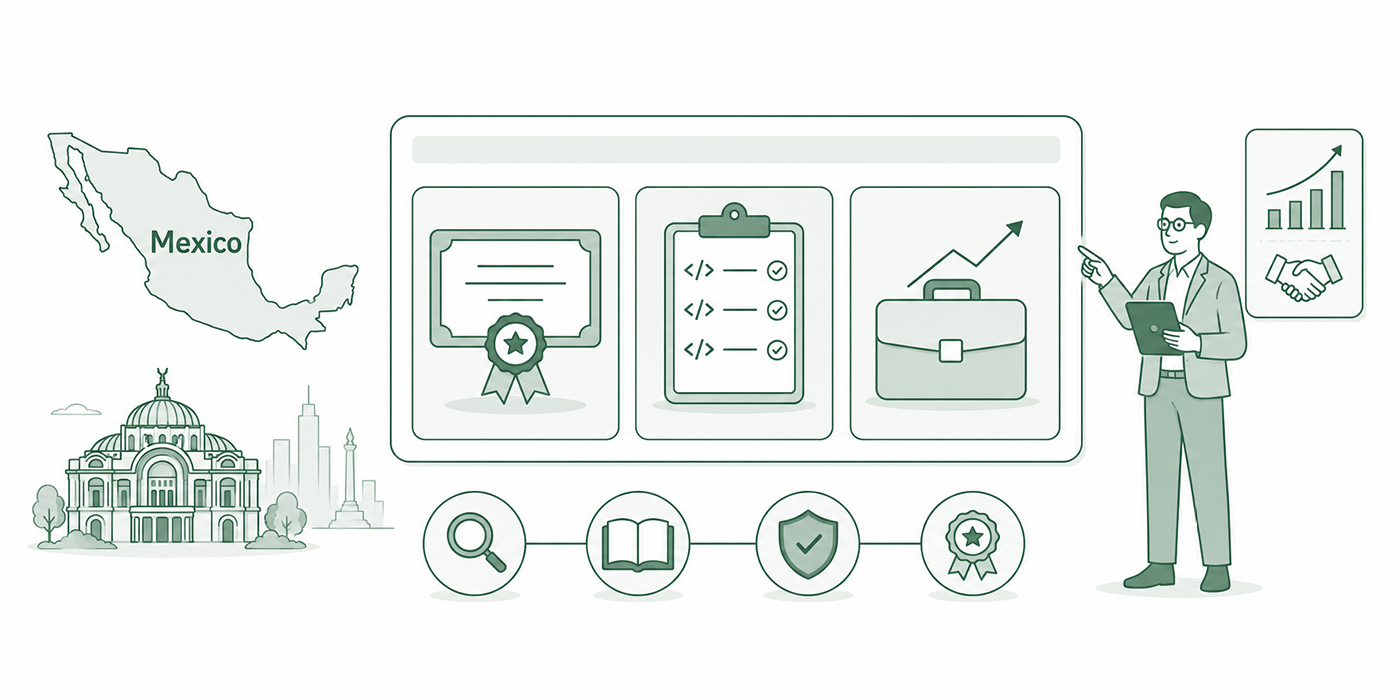
1. What Medical Billing and Coding Certification Means in Mexico in 2026–2027
Medical billing and coding in Mexico covers several overlapping functions. A professional may classify diagnoses for health statistics, organize information from the expediente clínico, validate charge documentation, prepare insurer submissions, reconcile payments, investigate rejected claims, or support a U.S. healthcare organization from Mexico. These functions share a dependence on accurate records, yet they operate under different technical frameworks.
For Mexican healthcare organizations, coders and health-information staff must understand the nationally adopted disease classification, local documentation requirements, electronic record standards, insurer procedures, and the organization’s own billing rules. Mexico’s current Dirección General de Información en Salud catalogue identifies CIE-10 as the official classification currently used for diagnosis information, while NOM-035-SSA3-2012 establishes national requirements for health-information classification and statistics.
For U.S.-focused work, the required knowledge changes substantially. Coders may need ICD-10-CM for diagnoses, CPT for physician and outpatient procedures, HCPCS Level II for products and services outside CPT, and ICD-10-PCS for hospital inpatient procedures. CMS describes HCPCS Level II as the standardized system used primarily for supplies, products, ambulance services, durable medical equipment, prosthetics, orthotics, and other services outside CPT.
This distinction prevents one of the most expensive training mistakes: learning CIE-10 terminology for Mexican health reporting and assuming it is interchangeable with U.S. ICD-10-CM claim coding. The systems share an ICD foundation, but their granularity, guidelines, sequencing rules, reimbursement use, and yearly maintenance differ. A candidate targeting U.S. work should study healthcare billing acronyms, CMS-1500 terminology, UB-04 billing, EDI claim transmission, and clearinghouse terminology as separate operational competencies.
Mexico’s official framework regulates clinical records, health-information systems, confidentiality, and statistical classifications. Based on the scope of those rules, employers generally evaluate coding candidates through education, demonstrated competency, experience, specialty knowledge, and relevant private credentials rather than one universal federal medical-coder license. NOM-004-SSA3-2012 governs the creation, handling, preservation, ownership, and confidentiality of clinical records across public, social, and private healthcare settings.
The practical question is therefore broader than “Which certificate should I buy?” You need to identify the records you will code, the payer receiving the claim, the country whose rules control the workflow, the software environment, and the level of responsibility expected. A certificate gains value when it confirms skills that match those conditions.
Mexico Medical Billing and Coding Certification Decision Map: 30 Skills to Verify
| Skill or Decision | Why It Matters in Mexico | Requirement for U.S.-Focused Work | Best Practice Action |
|---|---|---|---|
| Target market | Mexican hospitals, insurers, clinics, and public-health reporting may use locally adopted classifications and internal billing processes. | U.S. providers and RCM companies expect payer-specific claim knowledge. | Choose the market before selecting a credentialing organization. |
| CIE-10 | Supports diagnosis classification and health-information reporting within Mexico. | It cannot replace ICD-10-CM training for U.S. diagnosis coding. | Learn classification logic and verify the officially adopted version. |
| ICD-10-CM | Useful mainly for candidates supporting U.S. healthcare accounts. | Required for detailed diagnosis assignment and sequencing. | Study official conventions and annual code-set updates. |
| ICD-10-PCS | Generally relevant when serving U.S. inpatient hospital workflows. | Used to code inpatient procedures under the U.S. system. | Master root operations, body systems, approaches, devices, and qualifiers. |
| ICD-11 readiness | Supports future-facing health-information and digital classification skills. | It does not currently replace ICD-10-CM on U.S. claims. | Build awareness through the ICD-11 coding standards guide. |
| CPT | Relevant to U.S.-focused physician and outpatient coding roles. | Used for professional and many outpatient services. | Practice guidelines, parenthetical instructions, add-on codes, and modifiers. |
| HCPCS Level II | Needed for U.S. supplies, drugs, ambulance, and equipment billing. | Frequently paired with CPT and ICD-10-CM. | Study service-specific rules through an ambulance coding reference and payer manuals. |
| Medical terminology | Supports accurate interpretation of Spanish-language clinical records. | English terminology is essential for U.S. charts and payer communication. | Create a bilingual medical abbreviations dictionary. |
| Anatomy and physiology | Prevents code selection based on similar-sounding conditions or body sites. | Required for surgical, specialty, and inpatient coding accuracy. | Study anatomy by specialty rather than memorizing disconnected terms. |
| Clinical documentation | NOM-004 places significant importance on complete and properly managed clinical records. | Claim codes must be supported by the medical record. | Learn coding query procedures and documentation escalation. |
| Electronic records | Mexican health-information systems are subject to electronic record and interoperability requirements. | Remote teams must navigate EHR work queues securely. | Study EHR integration terminology. |
| Patient privacy | Health information is sensitive personal data requiring controlled handling. | U.S. accounts may also impose HIPAA-based safeguards and contractual controls. | Use role-based access and follow healthcare data-security practices. |
| Medical necessity | Insurers may require clear clinical support for covered services. | U.S. payer policies connect diagnoses, services, coverage, and documentation. | Train with a medical necessity criteria guide. |
| Charge capture | Missing services create revenue leakage even when codes are correct. | Coders may reconcile documentation against charges and orders. | Map each service using charge-capture controls. |
| Modifiers | Relevant where procedure billing requires clarification of circumstances. | Incorrect modifiers can trigger denials, underpayment, or compliance exposure. | Build examples with the CPT modifiers dictionary. |
| Claim forms | Formats depend on employer, insurer, and local billing arrangements. | Professional and institutional claims use different data structures. | Practice both CMS-1500 and UB-04 field validation. |
| EDI transactions | Electronic submissions require accurate identifiers and structured data. | 837, 835, 270, 271, 276, and 277 transactions appear throughout U.S. RCM. | Trace claims through the complete claims-management lifecycle. |
| NPI and provider data | Primarily relevant to U.S. accounts supported from Mexico. | Incorrect provider identifiers can stop clean claims. | Validate rendering, billing, referring, and facility data before submission. |
| Eligibility verification | Coverage details determine financial responsibility and submission strategy. | Benefits, exclusions, deductibles, copays, and authorization affect claims. | Review patient responsibility terminology. |
| Prior authorization | Insurer rules may require approval before services are delivered. | Authorization numbers, dates, units, and service codes must match. | Create an authorization-to-claim reconciliation step. |
| Denial management | Rejected or denied claims require root-cause investigation. | Staff must understand payer messages, appeal rights, and filing limits. | Learn CARCs and RARCs. |
| Payment posting | Accurate posting reveals balances, adjustments, and unresolved variances. | 835 remittances must reconcile with claims and payer contracts. | Use a formal payment-posting workflow. |
| Claims reconciliation | Unmatched claims and payments conceal lost revenue. | Teams must identify missing, duplicated, rejected, or underpaid claims. | Apply claims reconciliation controls. |
| Revenue-cycle metrics | Employers expect staff to understand operational outcomes. | Clean-claim rate, denial rate, aging, and days in A/R guide performance. | Study RCM metrics and KPIs. |
| Audit readiness | Employers need traceable code selection and documentation. | U.S. clients may audit accuracy, compliance, and productivity. | Use the medical coding audit dictionary. |
| Ethical coding | Financial pressure must never override record-supported coding. | Upcoding, unbundling, and unsupported diagnosis assignment create serious exposure. | Follow documented coding ethics and standards. |
| Specialty selection | A focused specialty can improve employability and accuracy. | Rules differ across surgery, radiology, cardiology, emergency care, and other settings. | Start with one specialty such as cardiology coding. |
| Credential level | Entry-level candidates need foundations before advanced auditing or inpatient work. | Employers distinguish billing, outpatient coding, and facility coding credentials. | Compare programs using a certification terms dictionary. |
| Continuing education | Classification systems, rules, and software continue changing. | Many professional credentials require renewal and CEUs. | Plan for continuing education units before enrolling. |
| Job-readiness evidence | A certificate alone may provide limited proof of production ability. | Employers may test coding accuracy, English, research ability, and claim judgment. | Build a de-identified portfolio using competency assessments. |
2. Which Coding Systems and Regulations Should You Learn?
The correct curriculum depends on whether you want to work inside Mexico’s healthcare system or support a foreign payer environment. Programs that combine every acronym into one shallow module often leave graduates unable to code either system safely.
Mexican healthcare and health-information work
For domestic roles, begin with CIE-10, medical terminology in Spanish, clinical record structure, statistical reporting, insurer requirements, and the organization’s charge and authorization processes. Mexico’s CIE-10 catalogue remains available through official health-data resources as of 2026. NOM-035 defines the internationally recognized disease classification adopted by Mexico as mandatory for standardized morbidity and mortality statistics.
You should also understand NOM-004-SSA3-2012 because coding quality begins with the clinical record. If diagnoses, procedures, signatures, dates, findings, or treatment details are incomplete, the coder cannot safely manufacture certainty. Training in SOAP notes, problem-list documentation, EMR documentation terms, record retention, and CDI terminology improves your ability to identify unsupported assumptions.
NOM-024-SSA3-2012 applies to electronic health-record information systems used across Mexico’s public, private, and social healthcare sectors. It connects electronic systems with clinical-record and health-information standards, making system navigation, access control, data quality, and interoperability meaningful parts of modern coding work.
U.S. medical coding and billing work performed from Mexico
A U.S.-focused curriculum should teach ICD-10-CM, CPT, HCPCS Level II, modifiers, payer policies, medical necessity, claim forms, EDI, denials, remittances, compliance, and reimbursement methodologies. Inpatient facility coders also require ICD-10-PCS, present-on-admission logic, discharge-based code selection, and MS-DRG concepts.
CMS released FY 2027 ICD-10-CM and ICD-10-PCS files for use beginning October 1, 2026. Candidates testing or working during 2026–2027 must verify which code-book year applies to the examination date and service date.
This yearly change cycle creates a predictable pain point. A student may understand coding principles and still fail an assessment because the program uses outdated code books, deleted codes, revised guidelines, or old modifier instructions. Before paying tuition, ask which code-year editions are included, when the curriculum was updated, and whether access continues after annual releases. Use the coding edits and modifiers guide, physician fee schedule terminology, Medicare reimbursement reference, commercial insurance billing guide, and EOB reference to connect codes with payment outcomes.
Privacy and secure remote work
Mexican health information can qualify as sensitive personal data, requiring strong safeguards, limited access, and responsible treatment. When supporting a U.S. healthcare organization, individually identifiable health information may also be protected under the HIPAA framework when handled for a covered entity or business associate. HHS explains that protected health information includes identifiable health information held or transmitted in electronic, paper, or oral form by covered entities and business associates.
For remote work, practical security matters more than memorizing privacy definitions. Never save patient charts on a personal desktop, photograph a screen, send identifiers through personal messaging apps, copy live patient data into public AI tools, or discuss cases in shared spaces. Employers may require managed devices, multifactor authentication, encrypted connections, restricted printing, clean-desk controls, and monitored access. Review healthcare data-security terms, EHR coding terminology, practice-management systems, and RCM software terminology before handling production records.
3. How to Choose the Right Certification Path in Mexico
A useful certification path should match the work setting rather than the broad label “medical coding.” Four common routes are available to candidates in Mexico.
A foundational medical billing and coding program suits career changers who need structured instruction in terminology, anatomy, diagnosis coding, procedure coding, claims, reimbursement, denials, and compliance. Evaluate the syllabus against the CBCS exam terms guide, coding education terminology, medical coding accreditation terms, and online exam-preparation resources. A completion certificate and an independent professional credential serve different purposes, so read the award language carefully.
AAPC’s CPC pathway is oriented toward professional and outpatient physician coding, while its CPB pathway focuses more heavily on billing and reimbursement. AAPC describes the CPC credential as validating coding knowledge across outpatient and physician services. Candidates targeting clinic coding, professional claims, evaluation and management services, surgery, radiology, or specialty practices may find this alignment useful.
AHIMA’s CCA is an entry-level credential requiring a high-school diploma, with coding education or experience recommended. AHIMA states that the examination is offered globally through Pearson VUE and that exams delivered on or after May 1, 2026 require the specified 2026 code books. This route can suit candidates seeking broad health-information and coding foundations across multiple settings.
AHIMA’s CCS is designed for more advanced coding proficiency. Its published pathways include combinations of formal coursework and coding experience, two years of direct coding experience, or qualifying credentials plus experience. Beginners should therefore avoid selecting an advanced credential solely because it appears stronger on a résumé. The real question is whether your current experience lets you interpret complex inpatient and outpatient records under time pressure.
Before enrolling, verify eight points: the credential awarded, the organization issuing it, exam format, testing availability in Mexico, code-book year, retake policy, renewal obligations, and employer relevance. AHIMA applications use a 120-day eligibility window after approval, while testing arrangements and credential policies can change. Review the latest official candidate guide before paying any examination fee.
Avoid programs that advertise guaranteed remote employment, promise high salaries without discussing experience, teach code memorization without guidelines, omit compliance, or use screenshots instead of licensed current resources. A defensible program should include timed cases, documentation review, code sequencing, claim correction, denial interpretation, and feedback explaining why each answer is right or wrong.
Quick Poll: What is your biggest barrier to starting medical billing and coding in Mexico?
4. Step-by-Step Certification Plan for 2026–2027
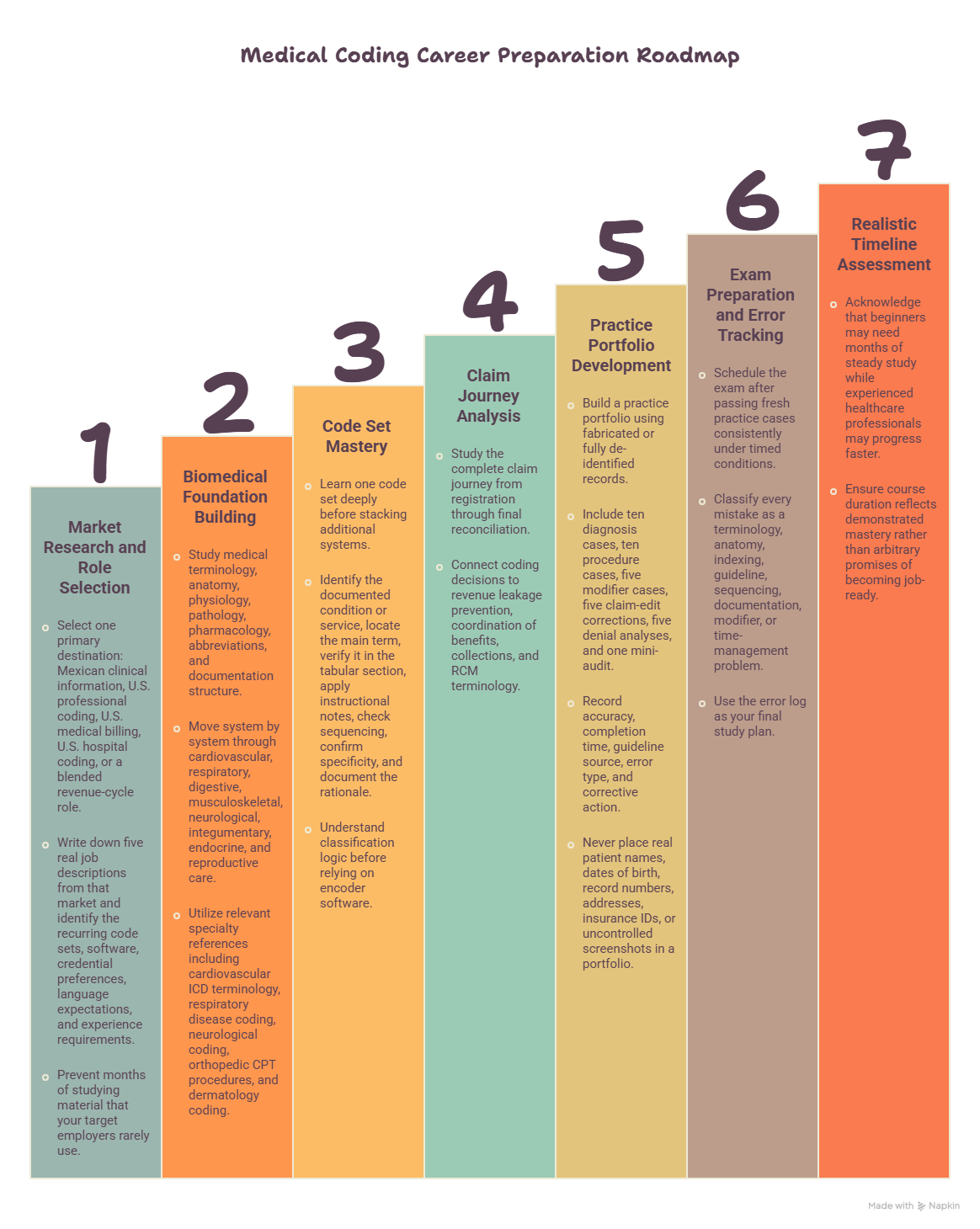
Begin by selecting one primary destination: Mexican clinical information, U.S. professional coding, U.S. medical billing, U.S. hospital coding, or a blended revenue-cycle role. Write down five real job descriptions from that market and identify the recurring code sets, software, credential preferences, language expectations, and experience requirements. This exercise prevents months of studying material that your target employers rarely use.
Next, build the biomedical foundation. Study medical terminology, anatomy, physiology, pathology, pharmacology, abbreviations, and documentation structure. Move system by system through cardiovascular, respiratory, digestive, musculoskeletal, neurological, integumentary, endocrine, and reproductive care. Relevant specialty references include cardiovascular ICD terminology, respiratory disease coding, neurological coding, orthopedic CPT procedures, and dermatology coding.
Then learn one code set deeply before stacking additional systems. For each case, identify the documented condition or service, locate the main term, verify it in the tabular section, apply instructional notes, check sequencing, confirm specificity, and document the rationale. Blindly searching an encoder teaches answer retrieval without developing coding judgment. Encoder software becomes useful after you understand the classification logic covered in the encoder software guide and medical coding automation reference.
After code assignment, study the complete claim journey. Follow a patient account from registration and eligibility through authorization, charge capture, coding, claim creation, clearinghouse edits, payer adjudication, payment posting, patient balance, denial follow-up, appeal, refund, and final reconciliation. This connects coding decisions to revenue leakage prevention, coordination of benefits, collections and bad debt, billing reconciliation, and RCM terminology.
Build a practice portfolio using fabricated or fully de-identified records. Include ten diagnosis cases, ten procedure cases, five modifier cases, five claim-edit corrections, five denial analyses, and one mini-audit. Record your accuracy, completion time, guideline source, error type, and corrective action. Never place real patient names, dates of birth, record numbers, addresses, insurance IDs, or uncontrolled screenshots in a portfolio.
Schedule the exam after you can pass fresh practice cases consistently under timed conditions. Repeating memorized questions can create a false readiness signal. Your review should classify every mistake as a terminology gap, anatomy gap, indexing error, guideline error, sequencing error, documentation assumption, modifier error, or time-management problem. That error log becomes your final study plan.
A realistic beginner may need several months of steady study, while a nurse, physician, health administrator, biller, or experienced medical assistant may progress faster in clinical content and still require concentrated training in U.S. code rules. Course duration should reflect demonstrated mastery rather than an arbitrary promise to become “job-ready” in a few days.
5. Career Opportunities and How to Become Employable from Mexico
Potential employers include hospitals, private clinics, diagnostic centers, insurers, healthcare administrators, billing companies, RCM outsourcing firms, health-information departments, consulting groups, and organizations supporting U.S. healthcare accounts. Roles may include coding assistant, medical biller, payment poster, denial analyst, authorization specialist, claims processor, charge-entry specialist, coding auditor, clinical documentation assistant, or revenue-cycle analyst.
Your first role may sit beside coding rather than inside a pure coder title. Payment posting teaches remittance logic. Eligibility work develops payer fluency. Charge entry builds service-code familiarity. Denial follow-up teaches how documentation, coding, authorization, and payer policy collide. These roles can create the production experience needed for more advanced coding career development, professional development, apprenticeship opportunities, claims management, and audit responsibilities.
Bilingual ability becomes commercially useful when it includes clinical and operational precision. Employers need professionals who can understand an English-language operative note, research an unfamiliar payer edit, write a concise account note, explain a denial, and communicate an unresolved documentation issue without changing the provider’s meaning. Conversational English alone does not prove this capability.
Create a résumé that names the exact systems you can use: CIE-10, ICD-10-CM, CPT, HCPCS Level II, ICD-10-PCS, CMS-1500, UB-04, 837P, 837I, 835, CARCs, RARCs, modifiers, eligibility, authorization, payment posting, and denial management. Include accuracy results from structured assessments, specialty exposure, code-book year, software experience, and privacy training. Avoid broad claims such as “expert coder” unless your work history supports them.
Interview preparation should focus on judgment. Be ready to explain what you do when documentation conflicts, a diagnosis lacks specificity, a procedure appears bundled, an authorization does not match the claim, a payer denies for medical necessity, or a supervisor pressures you to code beyond the record. OIG compliance guidance emphasizes that coding and billing should be based on medical-record documentation and that organizations should monitor billing and coding work.
Your long-term progression can move from transaction processing to coding, specialty coding, auditing, clinical documentation integrity, risk adjustment, reimbursement analysis, team leadership, or compliance. Advanced directions include risk adjustment coding, HCC terminology, value-based care coding, MIPS reporting, and utilization management.
The strongest candidates combine a current credential, measurable accuracy, secure work habits, bilingual healthcare communication, and a clear specialty direction. That combination gives employers evidence that you can protect patient information, research rules independently, and produce defensible work.
6. Frequently Asked Questions About Medical Billing and Coding Certification in Mexico
-
Mexico has mandatory standards governing clinical records, health-information classification, electronic record systems, and confidentiality. The official sources reviewed for this guide do not present one universal federal medical-coder license comparable to licensure for regulated clinical professions. Employers commonly assess candidates through education, private credentials, experience, competency testing, and knowledge of the organization’s coding environment. NOM-004 and NOM-035 remain central references for clinical records and standardized health information.
-
Study CIE-10 for roles centered on Mexican health-information reporting and local healthcare records. Study ICD-10-CM for U.S. diagnosis coding. Candidates pursuing international RCM work may eventually need both, but they should keep the guidelines and use cases separate. The Mexican DGIS currently identifies CIE-10 as the officially adopted diagnosis catalogue, while CMS maintains ICD-10-CM for U.S. coding.
Use the ICD-11 standards guide, mental-health coding dictionary, infectious disease reference, and oncology case studies as forward-looking supplements rather than substitutes for the system required by your employer.
-
WHO states that ICD-11 came into effect globally on January 1, 2022 and released its 2026 edition in February 2026. Country implementation remains a managed transition rather than an automatic replacement on every local claim, system, and form. Mexico’s official DGIS diagnosis catalogue still identifies CIE-10 as the current adopted version. Candidates should verify the system used by the specific employer instead of assuming a nationwide operational switch.
-
International candidates can pursue credentials that allow global registration and testing, subject to the certifying organization’s current eligibility, identification, location, and scheduling policies. AHIMA states that global candidates follow the same exam naming and registration approach and can select an available Pearson VUE location. Confirm current Mexican test-center availability before purchasing a course or exam voucher.
-
A beginner should choose a pathway that teaches anatomy, physiology, terminology, documentation, diagnosis coding, procedure coding, claims, reimbursement, compliance, and privacy before demanding advanced production judgment. AHIMA’s CCA is positioned as an early-career credential, while the CPC aligns more directly with physician and outpatient coding. Compare each option with the certification terms dictionary, credentialing guide, and certification renewal reference.
-
A medical degree is generally unnecessary for entry-level billing and coding credentials, though healthcare education can shorten the learning curve in anatomy, pathology, pharmacology, and documentation. AHIMA’s CCA eligibility requires a high-school diploma, with coding experience or structured education recommended. Every candidate still needs formal training in the code systems, official guidelines, reimbursement rules, and compliance expectations used by the target employer.
