
Medical Billing and Coding Certification in Turkey: Complete Guide for 2026–2027
Medical billing and coding certification in Turkey can support careers in Turkish hospital administration, private-insurance billing, health-information management, and international revenue cycle services. Each route demands a different combination of ICD knowledge, SGK reimbursement rules, MEDULA workflows, documentation controls, and data-security discipline. Before choosing a course, candidates should understand how medical coding workflows, clinical documentation, accurate medical reimbursement, and regulatory compliance change across Turkish and international healthcare settings.

1. What Medical Billing and Coding Certification Means in Turkey
Medical billing and coding in Turkey sits at the intersection of clinical documentation, disease classification, hospital information systems, Social Security Institution reimbursement, private-insurance administration, and health-data protection. A professional may review diagnoses, match services to reimbursement codes, verify patient eligibility, enter services into an information system, prepare documentation for billing, investigate rejected items, reconcile payments, or produce coded health statistics.
Turkey uses ICD-10 for disease classification and health statistics. The Ministry of Health describes ICD-10 as the international standard for coding and classifying diseases and health problems, while Turkish health institutions use nationally distributed diagnosis and code lists. Candidates must understand the ICD classification structure, medical abbreviations, electronic health-record terminology, and problem-list documentation needed to translate a clinical record into defensible coded data.
Turkish reimbursement work also requires familiarity with the Sosyal Güvenlik Kurumu, commonly called SGK, and the Sağlık Uygulama Tebliği, or SUT. SUT rules define coverage, payment conditions, service requirements, reimbursement lists, documentation expectations, and numerous service-specific restrictions. SGK continued issuing SUT amendments during 2026, which means a coder who relies on an old course workbook can make technically polished decisions that fail current reimbursement rules. Professionals should connect SUT research with medical necessity criteria, charge-capture controls, claims-management terminology, and revenue leakage prevention.
MEDULA is another core concept. SGK defines MEDULA Hastane as an integrated system that electronically gathers invoice information between General Health Insurance and healthcare providers so covered services can be processed for payment. This makes coding only one component of the workflow. Staff must also understand patient tracking records, provision status, service entries, facility information, submission timing, system edits, supporting documents, and payment reconciliation. The most useful preparation therefore includes practice-management systems, RCM software terminology, payment-posting procedures, and billing reconciliation.
Turkey does not present one single national private “medical coder certification” that automatically qualifies every holder for every coding and billing job. The domestic academic route commonly includes a two-year Tıbbi Dokümantasyon ve Sekreterlik associate-degree program offered through Turkish universities, including campus, open-education, and distance-learning formats. YÖK Atlas lists these programs within health-services vocational schools and identifies TYT-based admission pathways.
Shorter certificates can provide targeted training, yet their employment value depends on the curriculum, awarding body, practical assessments, and the employer’s requirements. A certificate with no supervised cases, no current SUT content, and no information-system practice may carry little operational value. Candidates should use a coding education dictionary, accreditation terminology guide, credentialing organization reference, and competency assessment guide before comparing programs.
Turkey Medical Billing and Coding Skills Map: 30 Areas to Verify Before Certification
| Skill or System | What It Controls | Common Candidate Pain Point | Best Practice Action |
|---|---|---|---|
| Target job market | Determines whether training should focus on Turkish healthcare, private insurance, health tourism, or international RCM. | Students buy a general course before reading actual job descriptions. | Compare ten vacancies and map their requirements using a coding career framework. |
| ICD-10 | Supports diagnosis classification and Turkish health-information reporting. | Candidates memorize codes without learning conventions and record interpretation. | Practice indexing, verification, specificity, sequencing, and documentation support. |
| ICD-10-CM | Applies to U.S. diagnosis coding rather than ordinary Turkish SGK billing. | Students assume all ICD-10 variants operate identically. | Study annual U.S. guidelines through a coding updates reference. |
| ICD-10-PCS | Supports U.S. inpatient procedure coding. | Beginners attempt PCS before mastering anatomy and inpatient documentation. | Learn root operations, approaches, devices, body parts, and qualifiers systematically. |
| ICD-11 awareness | Prepares professionals for future classification modernization. | Some courses describe ICD-11 as an immediate replacement in every workflow. | Use an ICD-11 standards guide while following the employer’s current system. |
| SUT | Defines many SGK coverage, payment, documentation, and service conditions. | Old teaching materials omit later amendments. | Verify the rule version effective on the service date. |
| MEDULA Hastane | Supports electronic service and invoice information exchange with SGK. | Graduates understand codes but cannot navigate the operational submission process. | Seek supervised simulations covering provision, tracking, entry, correction, and finalization. |
| Provision control | Confirms eligibility and the conditions under which services are processed. | Eligibility errors surface only after treatment or claim submission. | Build a pre-service validation checklist tied to coverage coordination. |
| Procedure coding | Represents services, operations, tests, treatments, and interventions. | Similar procedures are selected without checking technique, site, or scope. | Link the operative record to a detailed surgical compliance review. |
| Medical terminology | Enables accurate interpretation of diagnoses, symptoms, treatments, and anatomy. | Coders mistake similar Turkish, Latin, and English clinical terms. | Build a bilingual healthcare acronym dictionary. |
| Anatomy and physiology | Supports site, laterality, body-system, and procedure selection. | Weak anatomy creates repeated errors across several specialties. | Study one body system at a time with clinical cases. |
| Clinical documentation | Provides the evidence supporting diagnosis, service, and reimbursement decisions. | Revenue pressure encourages assumptions beyond the record. | Apply a formal coding query process. |
| Electronic health records | Store encounters, orders, results, notes, diagnoses, and treatment information. | Relevant evidence remains hidden in separate modules. | Learn EHR integration terminology. |
| Patient registration | Captures identity, coverage, demographics, and encounter details. | Upstream data mistakes later appear as billing failures. | Validate identity, payer, facility, physician, and service-date fields. |
| Charge capture | Ensures documented services enter the billing workflow. | Valid services disappear because the charge never reaches the account. | Use charge-capture reconciliation. |
| Medical necessity | Connects a service with documented clinical need and coverage conditions. | Correct codes still fail when the record does not support the service. | Review medical necessity criteria before submission. |
| Authorization | Confirms that required approval exists for the service, date, unit, and setting. | Authorization details differ from the delivered treatment. | Reconcile approval against the final claim or MEDULA entry. |
| Private-insurance billing | Applies contract, benefit, network, and insurer-specific requirements. | Teams apply SGK logic to commercial policies without checking contract rules. | Study commercial insurance billing terms. |
| Health-tourism accounts | May involve foreign patients, package pricing, translations, deposits, and international insurers. | Clinical charges and quoted packages are poorly reconciled. | Separate clinical coding, contract pricing, patient communication, and collection controls. |
| Rejected submissions | Identify technical, eligibility, coding, timing, or documentation failures. | Staff repeatedly resubmit without correcting the root cause. | Use a structured denial-management workflow. |
| Payment posting | Records payments, reductions, patient balances, and unresolved differences. | Incorrect posting hides underpayments and creates false balances. | Follow a controlled payment-posting process. |
| Claims reconciliation | Matches submitted services with decisions and payments. | Unmatched records remain unnoticed until aging becomes severe. | Use claims-reconciliation controls. |
| Revenue-cycle metrics | Measures clean submissions, aging, rejections, denials, and collection performance. | Teams track volume without identifying preventable leakage. | Monitor RCM metrics and KPIs. |
| KVKK compliance | Protects health information treated as sensitive personal data. | Staff copy patient information into uncontrolled files or communication channels. | Apply healthcare data-security controls. |
| Access management | Limits records to authorized users and appropriate purposes. | Shared accounts destroy traceability and expose excessive information. | Use individual access, minimum privileges, and audit logs. |
| Coding audits | Test accuracy, documentation support, compliance, and process consistency. | Audits occur only after payment loss or external review. | Use a coding audit framework routinely. |
| Professional ethics | Prevents unsupported coding, alteration, manipulation, and concealment. | Productivity targets pressure staff to bypass unresolved documentation. | Follow documented coding ethics and standards. |
| Specialty expertise | Builds accuracy in a defined clinical service line. | Graduates claim expertise across every specialty after shallow exposure. | Begin with one area such as radiology billing and coding. |
| Credential maintenance | Keeps professional knowledge current after certification. | Candidates budget for the exam while ignoring renewal and education costs. | Review recertification requirements early. |
| Job-readiness portfolio | Demonstrates research, coding, billing, audit, and problem-solving ability. | A certificate provides little evidence of production performance. | Create de-identified cases using competency assessments. |
2. Which Education and Certification Route Should You Choose?
The strongest route depends on where you intend to work. Candidates targeting Turkish public or private hospitals should prioritize Turkish clinical terminology, ICD-10, hospital information systems, SUT interpretation, MEDULA workflows, health-record administration, and KVKK obligations. The formal associate-degree route in Tıbbi Dokümantasyon ve Sekreterlik can provide broader preparation for medical records, hospital communication, terminology, documentation, and administrative functions. YÖK Atlas confirms that Turkish universities offer this program through conventional, open, and distance formats.
A short certificate may suit someone who already works in a hospital, insurer, clinic, laboratory, or healthcare call center and needs a defined additional skill. A billing employee might require MEDULA and SUT training, while a records employee may need stronger HIM terminology, record-retention procedures, EMR documentation knowledge, and data-analytics terminology. The course must solve a verified skills gap rather than add another vague certificate to a résumé.
Candidates targeting U.S. healthcare work from Turkey need a different curriculum. They should study ICD-10-CM, CPT, HCPCS Level II, CMS-1500, UB-04, EDI transactions, payer policies, modifiers, medical necessity, denials, remittance advice, and U.S. compliance. Inpatient facility work also requires ICD-10-PCS. These professionals benefit from the CMS-1500 terminology guide, UB-04 billing-form reference, EDI billing dictionary, and clearinghouse terminology guide.
AAPC’s CPC credential focuses on professional coding skills and can support candidates pursuing physician-office, clinic, and outpatient coding. Its CPB pathway concentrates more heavily on billing and revenue-cycle functions. AAPC provides a testing-center locator, so candidates in Turkey should verify available delivery options, identity requirements, exam format, code-book rules, and dates before buying preparation materials.
AHIMA offers the Certified Coding Associate as an entry-level coding credential and the Certified Coding Specialist as a more advanced coding qualification. AHIMA’s international certification information identifies the CCA as an entry-level option delivered through Pearson VUE. Its current examination pages state that CCA and CCS exams delivered on or after May 1, 2026 require the approved 2026 code books. Bringing an unapproved or outdated edition can prevent testing and cause forfeiture of the exam fee.
That code-book rule exposes a major pain point for international candidates. Exchange rates, shipping, customs, membership fees, examination costs, and rescheduling expenses can make an incorrect purchase expensive. Before paying, confirm the current candidate guide, allowed books, local testing availability, identification format, eligibility window, retake rules, and renewal requirements. AHIMA states that candidates generally receive a 120-day eligibility period to schedule and take an approved exam, while retake applications require another fee and a waiting period.
Use the CBCS exam terminology guide, online coding program directory, CCS program directory, and coding credential guide to compare scope. The job should determine the credential. Brand recognition alone cannot compensate for a mismatch between the exam and the work.
3. What a High-Quality Turkey-Focused Program Must Teach
A valuable Turkish program should begin with medical terminology, anatomy, physiology, disease processes, pharmacology, and record structure. Coding errors frequently begin before code selection because the learner misunderstands the diagnosis, confuses an anatomical site, overlooks laterality, misreads an abbreviation, or fails to distinguish a symptom from a confirmed condition. Specialty resources covering cardiovascular coding, neurological disorders, respiratory diseases, and infectious diseases can strengthen the foundation when used alongside the applicable coding system.
The coding component must teach how to interpret the record, identify the reportable diagnosis, use the index, confirm the code in the tabular structure, follow inclusion and exclusion instructions, apply specificity, and avoid unsupported assumptions. Students should explain their reasoning for every answer. A course that trains learners to type a phrase into an encoder can create false confidence because encoder software, coding automation, clinical decision support, and EHR integration still depend on clean source documentation and human validation.
Turkey-focused billing instruction should connect SUT conditions with the actual patient account. Learners need to identify the service date, facility level, physician or provider, branch, diagnosis, treatment type, procedure, material, medication, authorization, supporting report, and applicable restrictions. They should then trace the service through MEDULA or a realistic simulation. SGK describes MEDULA as the system used to collect electronic invoice data and facilitate payment between GSS and providers, making system fluency a practical requirement rather than an optional technology module.
The curriculum should also teach students how to research current rules. SUT is amended repeatedly, and SGK’s searchable notices include updated consolidated versions and later changes. The candidate must know where to find the rule, how to identify its effective date, which appendix controls the service, and whether a later notice changed the requirement. This research discipline should be reinforced through cost-reporting terms, reimbursement principles, revenue-cycle terminology, and billing workflow controls.
Data protection must be taught through practical scenarios. Turkey’s Personal Data Protection Law classifies health data as a special category of personal data. The Ministry of Health also states that manual and electronic health information should be managed according to confidentiality, integrity, and accessibility principles. The Personal Health Data Regulation was amended in December 2025, making current privacy training especially important for 2026–2027 candidates.
Students should learn to avoid downloading patient lists to personal devices, sharing screenshots through informal messaging applications, reusing passwords, accessing unrelated records, leaving printouts unattended, using public AI systems with identifiable information, or discussing cases in shared spaces. A credible program should include role-based access, minimum-necessary use, password and authentication controls, incident escalation, record disposal, remote-work security, and audit trails. These controls connect directly with healthcare data security, medical-record storage, coding ethics, and regulatory compliance.
Quick Poll: What is blocking your medical billing and coding career in Turkey?
4. Step-by-Step Certification Plan for Turkey in 2026–2027
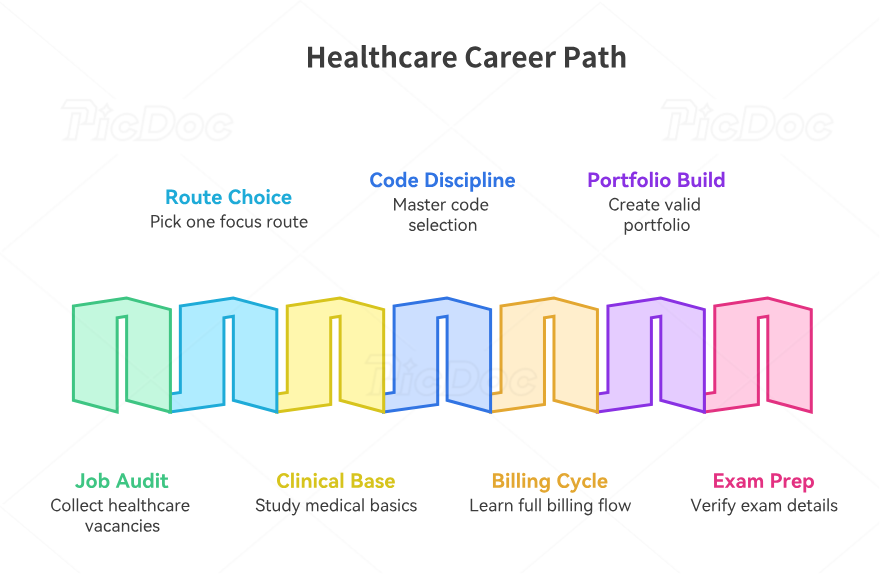
Begin with a job-market audit. Collect vacancies from Turkish hospitals, private clinics, insurers, health-tourism businesses, healthcare software providers, and international RCM employers. Record the required education, language, code system, software, experience, working hours, and credential. Separate local medical-secretary roles from billing, coding, records, insurance, and international revenue-cycle roles. Use career-development terminology, professional-development planning, apprenticeship terminology, and coding competency standards to turn those vacancies into a skills map.
Choose one primary route. A Turkish hospital-administration route should emphasize Turkish medical terminology, ICD-10, health records, SUT, MEDULA, documentation, patient registration, billing control, and KVKK. A U.S.-focused route should emphasize ICD-10-CM, CPT, HCPCS Level II, claim forms, EDI, payer rules, denials, remittances, and compliance. A blended plan can eventually cover both, yet beginners progress faster when they master one operational environment before mixing code systems.
Build the clinical foundation next. Study terminology, anatomy, physiology, pathology, pharmacology, diagnostic tests, operative language, and common abbreviations. Work through cardiology procedures, emergency medicine coding, gastroenterology procedures, laboratory and pathology coding, and radiology procedures to see how documentation changes across specialties.
Then develop code-selection discipline. For every case, identify the setting, determine what the clinician documented, locate the correct classification entry, verify instructions, assess specificity, check secondary conditions, and document the rationale. Maintain an error log that separates terminology mistakes, anatomy mistakes, indexing errors, guideline errors, sequencing failures, unsupported assumptions, and missed documentation. This transforms mistakes into a targeted study plan.
Learn the complete billing lifecycle rather than stopping after code assignment. Follow one account through registration, eligibility, authorization, service delivery, charge capture, coding, invoice creation, system edits, submission, rejection, adjudication, payment posting, patient responsibility, follow-up, and reconciliation. Supporting references include claims reconciliation, patient responsibility, collections and bad debt, and revenue-cycle KPIs.
Create a portfolio using fabricated or fully de-identified information. Include diagnosis-coding cases, procedure reviews, missing-documentation findings, SUT research exercises, MEDULA workflow maps, rejection analyses, payment-reconciliation examples, and a small coding audit. Record your accuracy, completion time, source consulted, error category, and corrective action. Live patient data, identifiable screenshots, policy numbers, Turkish identity numbers, contact information, or treatment records should never appear in a personal portfolio.
Schedule an international exam only after confirming the current delivery method and required books. AHIMA’s CCA and CCS pages specify approved 2026 books for examinations delivered from May 1, 2026, while AAPC provides a location tool for exam planning. Requirements can change during 2026–2027, so candidates should verify the official policy immediately before purchasing materials or booking travel.
5. Career Opportunities and How to Become Employable
Possible Turkish roles include medical secretary, medical-records employee, patient-services specialist, hospital billing employee, SGK operations specialist, insurance claims processor, provision specialist, documentation controller, health-information technician, payment-reconciliation employee, and healthcare software support specialist. Internationally oriented candidates may pursue medical biller, coding associate, charge-entry specialist, eligibility representative, payment poster, denial analyst, accounts-receivable representative, coding auditor, or revenue-cycle analyst positions.
The title alone rarely reveals the true work. A “medical secretary” role may involve appointments and correspondence, while another position with the same title may include diagnosis entry, document completion, patient registration, reporting, and billing support. Read the responsibilities carefully and connect them with encounter-form terminology, charge capture, medical billing systems, and claims-management operations.
Employers need evidence that a beginner can work carefully under operational pressure. Your résumé should name the exact systems and competencies you have practiced. For a Turkey-focused role, these may include ICD-10, SUT research, MEDULA concepts, patient registration, health records, provision control, documentation review, billing reconciliation, Excel, and KVKK-aware data handling. For international work, list ICD-10-CM, CPT, HCPCS Level II, CMS-1500, UB-04, EDI, CARCs, RARCs, modifiers, denial follow-up, payment posting, and payer research only when you can demonstrate them.
Communication skills are especially important. Turkish hospital work requires precise Turkish documentation and professional communication with patients, clinicians, insurers, and administrative departments. International roles may require medical English, payer terminology, account notes, escalation emails, and spoken communication during foreign working hours. Study EOB terminology, CARC definitions, RARC terminology, and medical billing acronyms to strengthen operational language.
Interviewers may ask what you would do when a diagnosis lacks specificity, a procedure conflicts with the note, SUT conditions appear unmet, MEDULA returns an error, supporting documentation is missing, or a supervisor requests unsupported coding. A strong answer explains how you would stop, verify the record, research the applicable rule, query the responsible party, document the decision, and protect the audit trail.
Career growth can lead toward specialty billing, coding audits, health-information management, clinical documentation improvement, reimbursement analysis, data quality, denial management, revenue-cycle supervision, and compliance. Long-term development can include risk-adjustment coding, HCC terminology, utilization review, coding audits, and clinical documentation improvement
6. Frequently Asked Questions About Certification in Turkey
-
Turkey has education and training pathways connected with medical documentation, secretarial services, health information, hospital administration, and billing. Employer requirements vary by role and institution. YÖK Atlas lists formal Tıbbi Dokümantasyon ve Sekreterlik associate-degree programs, while private and continuing-education providers may offer shorter certificates. A candidate should compare the qualification with the exact job description rather than assuming one certificate has universal authority.
-
The associate degree covers a broader professional area that can include medical documentation, terminology, records, communication, hospital procedures, and administrative work. A specialized international coding credential usually tests defined coding systems and guidelines. Candidates should compare the curriculum with HIM terminology, coding education terms, credentialing organizations, and career-development expectations.
-
MEDULA Hastane is SGK’s integrated system for electronically collecting invoice information from healthcare providers and processing payment-related information. Practical roles may require understanding provision, patient tracking, service entry, corrections, system responses, invoicing, and documentation.
-
Sağlık Uygulama Tebliği contains SGK healthcare implementation and reimbursement rules, including conditions and appendices affecting services, medicines, materials, documentation, and payment. SGK continued publishing SUT changes during 2026, so professionals must research the version applicable to the service date.
-
Learn ICD-10 for Turkish diagnosis classification and health-information workflows. Learn ICD-10-CM when pursuing U.S. diagnosis-coding work. The systems share a classification lineage, yet their conventions, specificity, annual maintenance, and reimbursement applications differ. Use the ICD coding standards guide, system-updates reference, coding workflow guide, and medical terminology dictionary to keep their applications separate.
-
The Ministry of Health’s public digital-hospital resource continues to describe ICD-10 as the disease-classification standard used in the health sector, while WHO maintains ICD-11 as the current global revision available for national implementation. Candidates should verify the system used by the specific Turkish institution and avoid assuming that global availability means immediate replacement in every local operational workflow.
