
Medical Billing and Coding Certification in France: Complete Guide for 2026-2027
Medical billing and coding certification in France requires a different mindset from US-style billing because the French system blends clinical documentation improvement, hospital PMSI reporting, health information management, procedure nomenclatures, and electronic claim transmission. A strong candidate understands medical coding workflow, medical billing reimbursement, EHR documentation, and revenue cycle management.
For 2026-2027, the winning path is practical: learn French coding language, understand PMSI and SESAM-Vitale, build documentation judgment, then add internationally useful AMBCI-style billing skills for remote or cross-border roles. France rewards coders who can connect medical necessity, coding audit terms, coding ethics, and claims reconciliation into clean, defensible work.

1. What Medical Billing and Coding Certification Means in France for 2026-2027
France uses role-specific competency routes rather than one universal “medical billing and coding license.” Hospital coding usually points toward PMSI, DIM/TIM work, RUM production, diagnosis coding, procedure coding, and medico-economic data. Private practice billing points toward SESAM-Vitale, FSE, DRE, CCAM, NGAP, Carte Vitale workflow, and payer transmission. Remote international billing adds CPT modifiers, CARCs, RARCs, EOB interpretation, and payment posting.
In French hospital settings, PMSI is central because the ATIH 2026 MCO guide covers production of information related to medical activity and billing in medicine, surgery, obstetrics, and odontologie, applicable from January 1, 2026. This makes clinical documentation improvement, SOAP note coding, problem list accuracy, coding query process, and medical record retention career-critical instead of optional.
The coding vocabulary also differs from many global programs. France uses CIM-10 FR à usage PMSI for PMSI reporting, with ATIH noting that the CIM-10 FR publication is intended for PMSI collection across MCO, SMR, HAD, and psychiatry fields. Procedure and act language also matters: Ameli explains that the list of reimbursed acts includes CCAM for technical medical acts and NGAP for clinical medical acts plus acts by dental surgeons, midwives, and auxiliary medical professionals. A France-ready learner should therefore combine ICD-11 coding standards, medical coding regulatory compliance, healthcare data security, medical abbreviations, and French nomenclature awareness.
France Certification Roadmap: 30 Billing and Coding Terms You Must Control
| Term | What It Means in France | Why It Hits Billing/Coding | Best Practice Action |
|---|---|---|---|
| PMSI | French hospital medical information program tied to activity reporting and billing | Weak PMSI logic damages hospital data and funding accuracy | Pair it with medical coding workflow |
| DIM | Medical information department that supervises coded hospital data | This is where coding quality, audits, and physician clarification meet | Study HIM terms |
| TIM | Technicien de l'information médicale, often linked to PMSI coding tasks | This role needs documentation precision and system discipline | Build coding competency |
| RUM | Résumé d’unité médicale used in hospital stay information | Bad source data creates bad downstream grouping | Practice CDI terms |
| RSS | Résumé de sortie standardisé built from stay-level information | Completeness affects grouping and reporting credibility | Review record retention terms |
| GHM | Groupe homogène de malades, France’s hospital stay grouping concept | Coding errors can change medico-economic classification | Learn cost reporting terms |
| GHS | Tariff-related hospital stay output connected to grouping | Incorrect coding can distort reimbursement logic | Connect it to reimbursement concepts |
| CIM-10 FR | French PMSI-use ICD-10 diagnosis reference | Diagnosis detail drives reporting and grouping | Supplement with ICD coding standards |
| CCAM | Classification Commune des Actes Médicaux for technical medical acts | Procedure selection shapes billing and PMSI quality | Compare with CPT modifier logic |
| NGAP | Nomenclature générale des actes professionnels for listed clinical and professional acts | Wrong act category creates payment friction | Use accurate reimbursement guidance |
| SESAM-Vitale | Electronic billing ecosystem using Carte Vitale and professional systems | Teletransmission mistakes delay payment | Study EDI billing terms |
| FSE | Feuille de soins électronique sent to Assurance Maladie | Clean FSE creation controls reimbursement flow | Practice payment posting |
| DRE | Electronic reimbursement request for complementary insurers | AMO and AMC coordination affects patient balance | Review coordination of benefits |
| AMO | Assurance maladie obligatoire | Primary coverage logic must be verified early | Link to insurance billing terms |
| AMC | Assurance maladie complémentaire | Complementary reimbursement errors create patient complaints | Use patient responsibility terms |
| Tiers payant | Third-party payment arrangement reducing patient upfront payment | Incorrect eligibility creates collection headaches | Track collections risk |
| Carte Vitale | Patient insurance card used for identification and teletransmission | Bad identity or rights data blocks clean billing | Strengthen data security terms |
| CPS card | Professional health card used in secure workflows | Security and authorization affect claim validity | Add regulatory compliance |
| ARL | Logical acknowledgment after electronic transmission | Negative or missing ARL needs fast follow-up | Use claims reconciliation |
| NOÉMIE | Return information stream tied to third-party payment settlement | Payment matching depends on reading returns correctly | Review EOB interpretation |
| DPI | Dossier patient informatisé | Record quality controls coding accuracy | Learn EMR documentation terms |
| Identitovigilance | Patient identity safety discipline | Identity errors contaminate claims and records | Add medical acronym control |
| Acte technique | Technical procedure often captured through CCAM logic | Specificity affects reimbursement and reporting | Practice with radiology procedure coding |
| Acte clinique | Clinical professional act often linked to NGAP rules | Wrong categorization breaks fee logic | Connect to preventive medicine coding |
| Cotation | Act rating or pricing logic used in French billing language | Poor cotation creates direct revenue leakage | Track revenue leakage |
| Télétransmission | Electronic transmission of care sheets or billing data | Transmission failures stall reimbursement | Study clearinghouse terminology |
| T2A | Tarification à l’activité, activity-linked hospital financing language | Coding precision affects hospital financial interpretation | Review RCM metrics |
| Audit trail | Evidence chain behind each coding or billing decision | Unsupported coding decisions fail under review | Use audit terms |
| Documentation gap | Missing diagnosis, procedure, identity, or payer detail | Gaps trigger undercoding, rejected billing, or compliance exposure | Apply query process terms |
| Portfolio case | De-identified sample showing how you code and explain decisions | Employers trust proof more than course claims | Build with career development terms |
2. Which Certification Path Fits France: Hospital Coding, Medical Secretary, or International Billing
A France-based learner should choose a lane before choosing a certificate. Hospital-focused candidates need PMSI, RUM/RSS thinking, diagnosis abstraction, procedure linkage, and medical coding audit discipline. Medical secretary or clinic administration candidates need patient intake, scheduling, télétransmission, payment handling, dossier management, and practice management systems. International remote billing candidates need CPT coding, claims management, denial management, EOB interpretation, and payment posting.
For France-specific administrative roles, RNCP-linked medical secretary training can include billing and coding-adjacent skills. France Compétences describes tasks such as using télétransmission, managing accounting procedures, producing RUMs with adapted coding, and transmitting information under PMSI rules. This is important because many candidates search for “medical billing and coding certification” and miss the local job title language. Pair RNCP-style administrative readiness with coding education accreditation, coding credentialing organizations, certification renewal, continuing education units, and professional development.
For hospitals, the certification mindset should revolve around medical information production. ATIH states that 2026 PMSI data collection format documents are available for MCO, HAD, SMR, and psychiatry, with entry and output format files listed by field. A candidate who can read EHR integration terms, encoder software terms, data analytics reporting, clinical decision support, and coding automation terms will sound far more prepared than someone who only says, “I studied codes.”
For international or remote work, AMBCI-style billing knowledge fills the gap between French administrative competence and global revenue-cycle expectations. Remote employers may ask for CMS-1500 form knowledge, UB-04 billing form knowledge, commercial insurance billing, coordination of benefits, and coding edits and modifiers. A France-based learner with bilingual vocabulary and denial-response skills can compete beyond local clinic administration.
3. Skills French Employers and Remote Clients Actually Test
The first skill is documentation extraction. Can you identify the diagnosis that actually drove care, the procedure actually performed, the patient identity elements, the care setting, and the evidence needed for billing or PMSI transmission? France-facing learners need SOAP note coding, problem list accuracy, medical record storage, EMR documentation terms, and medical necessity criteria. Most beginner errors start at the record, long before the final code.
The second skill is nomenclature control. You need to know when a concept belongs to diagnosis coding, procedure coding, act billing, medical information production, or claim transmission. Ameli’s NGAP page explains that NGAP and CCAM sit inside the list of acts and services covered by Assurance Maladie, with later changes published through official channels. This means a France-ready candidate should practice cardiology CPT coding, radiology procedure coding, lab and pathology coding, emergency medicine coding, and surgical coding compliance as skill-building examples while keeping local French nomenclature separate.
The third skill is teletransmission discipline. Ameli explains that an FSE workflow includes reading the Carte Vitale, showing patient identification and AMO rights, entering the act code and fees, then transmitting grouped files to the relevant health insurance funds; it also notes ARL feedback and maximum timeframes between creation and transmission. That workflow creates immediate value for learners who understand EDI billing, clearinghouse terminology, payment posting, claims reconciliation, and patient responsibility.
The fourth skill is data security and identity accuracy. Service-Public explains that the digital Vitale card became available to all insured persons from November 18, 2025, and that it supports identification, reimbursement through teletransmission, automatic rights updating, and secure access. This raises the bar for candidates: you should understand healthcare data security, EHR coding terms, EHR integration, regulatory compliance, and coding ethics as everyday workflow tools.
Quick Poll: What is your biggest France billing and coding certification pain right now?
4. A 90-Day Certification Plan for France-Based Learners
Days 1-30 should build the language map. Learn the difference between PMSI, DIM, TIM, RUM, RSS, GHM, GHS, CIM-10 FR, CCAM, NGAP, FSE, DRE, AMO, AMC, and télétransmission. Then connect those terms to medical coding workflow, RCM terms, healthcare billing acronyms, medical coding certification terms, and coding education terms. The goal is speed with vocabulary, because interviews expose fuzzy terminology fast.
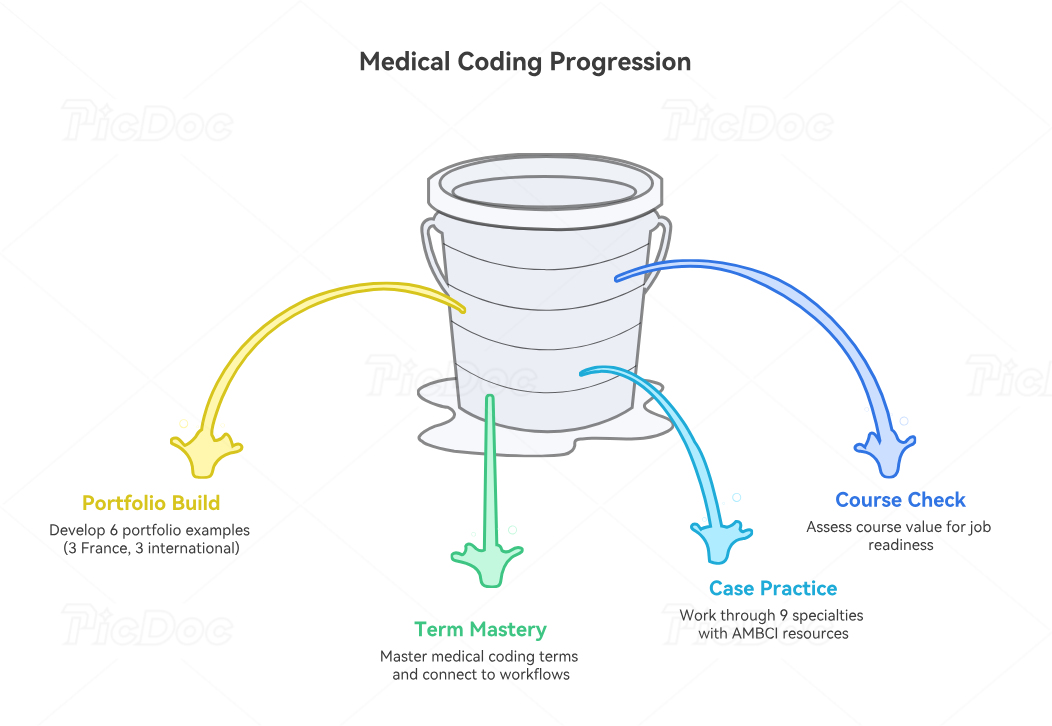
Days 31-60 should move into documentation and specialty cases. Work through cardiology, radiology, emergency medicine, lab/pathology, dermatology, gastroenterology, anesthesia, dialysis, and behavioral health. Use AMBCI resources like cardiology CPT coding, radiology billing terms, emergency CPT codes, pathology coding essentials, and behavioral health billing. For each case, write the source note, key evidence, selected coding pathway, missing documentation, and billing risk.
Days 61-90 should turn study into proof. Build a small portfolio with three France-focused mock examples and three international billing examples. France-focused examples can show PMSI vocabulary, RUM-style abstraction, CCAM/NGAP awareness, FSE workflow logic, and identity/security controls. International examples can show CMS-1500 fields, UB-04 terms, EOB review, CARC denial analysis, and RARC explanation.
Budget discipline protects beginners. Before paying for a course, check the target job title, language of instruction, coding systems covered, software exposure, assessment format, portfolio support, update policy, and whether the credential helps in France, international billing, or both. Compare medical coding education accreditation, credentialing organizations, CBCS exam terms, CCS certification directories, and CPC certification programs. A certificate should move you toward a role, a workflow, and a measurable skill.
5. How to Turn Certification Into Work in France and Beyond
For French hospital opportunities, shape your resume around PMSI accuracy, documentation abstraction, medical information quality, data formats, confidentiality, and audit-safe reasoning. Mention clinical documentation improvement, health information management, coding query process, data analytics reporting, and coding system updates. Recruiters need evidence that you understand hospital coding as a data quality function with financial consequences.
For clinic and medical secretary billing roles, position yourself around patient intake, rights verification, appointment coordination, FSE/DRE preparation, télétransmission, payment matching, document handling, and payer communication. SESAM-Vitale describes FSE as electronic transmission of care sheets to health insurance and DRE as electronic reimbursement requests sent to complementary health insurance bodies. Strengthen that lane with practice management systems, RCM software terms, payment posting, claims reconciliation, and patient responsibility.
For remote international work, translate your French strengths into global billing language. PMSI precision shows you can handle structured data. SESAM-Vitale exposure shows you understand electronic billing controls. France’s strict identity and data culture supports a compliance-first profile. Add commercial insurance billing, coordination of benefits, clearinghouse terms, denial management, and collections and bad debt. International clients value coders who can explain workflow risk, not merely enter codes.
Your strongest job-search line should be specific. “Certified billing and coding candidate” is broad. “France-based billing and coding candidate with PMSI vocabulary, CIM-10 FR/CCAM/NGAP awareness, SESAM-Vitale workflow understanding, documentation abstraction practice, and international RCM training” gives employers a clearer reason to keep reading. Support it with coding career development, professional development terms, apprenticeship terms, online coding exam prep, and CEU planning.
6. FAQs About Medical Billing and Coding Certification in France
-
Yes, certification is useful when it supports the correct role. Hospital candidates should prioritize PMSI, CIM-10 FR, CCAM awareness, documentation abstraction, and DIM/TIM language. Clinic candidates should prioritize SESAM-Vitale, FSE, DRE, AMO, AMC, NGAP, payment handling, and teletransmission. Remote candidates should add CPT modifiers, claims management, EOB review, CARCs, and payment posting.
-
Start with the systems tied to your target. France-facing hospital learners should understand CIM-10 FR à usage PMSI, CCAM, PMSI, GHM, and data collection rules. Clinic billing learners need CCAM, NGAP, SESAM-Vitale, FSE, DRE, AMO, and AMC. Remote learners should add ICD coding standards, CPT coding references, coding edits, medical necessity, and audit terms.
-
Remote work is possible when your skill set matches the payer environment. US-facing roles commonly require CPT, modifiers, denial management, EOB interpretation, AR follow-up, and productivity discipline. Build proof using CMS-1500 terms, UB-04 terms, commercial insurance billing, coordination of benefits, and claim adjustment codes. Bilingual French-English healthcare vocabulary can be a real advantage.
-
A focused beginner can build foundational readiness in about 90 days, then deepen through supervised work, cases, and local system practice. Month one should cover billing acronyms, coding workflow, RCM terms, documentation requirements, and coding certification terms. Month two should focus on cases. Month three should create portfolio proof.
-
The biggest mistake is mixing systems together. CIM-10 FR, CCAM, NGAP, PMSI, SESAM-Vitale, CPT, ICD-11, and US claim forms serve different purposes. Treat each one as a separate layer of the healthcare revenue and data chain. Use medical coding workflow, coding regulatory compliance, coding ethics, CDI terms, and coding query terms to keep the layers clean.
-
Study ICD-11 as global literacy, then prioritize the French references your target role uses. PMSI-facing learners should focus on CIM-10 FR à usage PMSI and current ATIH rules. ICD-11 study can still improve disease vocabulary through ICD-11 mental health coding, ICD-11 oncology coding, infectious disease coding, respiratory coding, and cardiovascular coding.
