
Medical Billing and Coding Certification in Spain: Complete Guide for 2026-2027
Spain is a strong place to build a healthcare documentation career because coders can serve local clinical coding needs, Spanish-language health data work, and international revenue cycle teams. A serious learner needs more than a certificate: they need medical coding certification terms, billing workflow control, RCM terminology, coding compliance judgment, and medical necessity discipline. This guide shows how to study, what to prioritize, and how to turn certification into employable proof for 2026-2027.

1. Medical Billing and Coding Certification in Spain: What It Means in 2026-2027
Medical billing and coding certification in Spain can point in two career directions. One path supports Spain-facing clinical coding, documentation quality, hospital data, and healthcare information work. The other supports international billing teams that need CPT coding knowledge, claims management terms, EOB interpretation, CARC denial analysis, and RARC remark code fluency.
Spain uses CIE-10-ES for clinical classification, and the Spanish Ministry of Health’s eCIEmaps portal lists CIE-10-ES 2026 diagnosis and procedure resources under the sixth electronic edition for January 2026. The official 2026 procedures volume also states that the sixth edition entered into force on January 1, 2026. For Spain-based learners, that means certification planning should include CIE-10-ES awareness along with global coding systems used by remote employers.
This distinction is important because beginners often mix three different things: local clinical classification, U.S.-style reimbursement coding, and general healthcare administration. A coder targeting Spanish hospital data needs CIE-10-ES diagnosis and procedure logic, Spanish clinical vocabulary, discharge-summary reading, and documentation standards. A coder targeting U.S.-style remote billing needs CMS-1500 form terms, UB-04 billing form knowledge, clearinghouse terminology, payment posting, and claims reconciliation.
A certificate becomes valuable when it proves practical judgment. Employers want to know whether you can read a record, select defensible codes, catch missing documentation, understand payer behavior, fix edits, and explain revenue impact. That is why a Spain-based learner should study coding audit terms, clinical documentation improvement terms, coding query process terms, charge capture terms, and revenue leakage prevention from the start.
Spain Certification Readiness Map: What to Learn, Why It Matters, and What to Do First (25+ Rows)
| Readiness Area | What It Means in Spain | Why It Hits Billing or Coding | Best Practice Action |
|---|---|---|---|
| Career direction | Choose local clinical coding, international RCM, denial work, audit support, or documentation quality. | A vague goal leads to scattered study and weak applications. | Start with coding certification terms and role matching. |
| CIE-10-ES awareness | Spain-facing work requires understanding of Spanish clinical classification and official code logic. | Wrong classification thinking creates weak documentation review and poor data quality. | Compare CIE-10-ES concepts with ICD coding standards. |
| Procedure coding | Spain-facing coding uses CIE-10-ES procedure logic, while U.S.-style work uses CPT and HCPCS. | Procedure errors affect reimbursement, audits, utilization data, and denial risk. | Practice with CPT modifiers and specialty examples. |
| Spanish-English terminology | Bilingual coders must connect Spanish clinical notes with English payer and RCM language. | Translation gaps create coding uncertainty and appeal errors. | Build a glossary from medical abbreviations and coding terms. |
| Documentation review | The chart must support every code, modifier, procedure, and claim decision. | Unsupported codes create audit exposure and delayed payment. | Study CDI terms and SOAP note coding. |
| Medical necessity | The diagnosis, service, payer rule, and clinical evidence must line up. | Weak necessity causes denials, downcoding, and rework. | Use a medical necessity guide during case drills. |
| Claim forms | Remote billing teams expect clean form logic even from entry-level candidates. | Correct codes fail when placed into incorrect claim fields. | Learn CMS-1500 terms and UB-04 terms. |
| Clearinghouse edits | Claims may reject before payer adjudication because of format, eligibility, or routing problems. | Front-end rejections age AR before a payer reviews the claim. | Train with clearinghouse terminology. |
| EOB reading | International billing roles require fast reading of payer payment explanations. | Misread EOBs create bad balances and missed appeals. | Practice line-by-line review with an EOB guide. |
| CARCs | CARCs explain payer adjustment reasons at claim or line level. | Weak CARC knowledge leads to repeat denials. | Keep a CARC reference beside denial drills. |
| RARCs | RARCs add payer remarks that explain missing data, attachments, or next steps. | Ignoring remarks wastes appeal windows and follow-up time. | Pair each denial with the RARC dictionary. |
| Payment posting | Posting connects remittance data, payer payments, contractual adjustments, and patient balances. | Posting mistakes distort AR, collections, and payer follow-up. | Study payment posting with remittance examples. |
| Patient responsibility | Balances depend on deductible, copay, coinsurance, coverage status, and payer adjudication. | Incorrect balances create patient disputes and collection delays. | Review patient responsibility terms. |
| COB logic | Coordination of benefits determines payer order when multiple policies exist. | Wrong payer order causes denials, refunds, and slow AR loops. | Build rules from COB definitions. |
| Modifier judgment | Modifiers explain special service circumstances, distinct procedures, components, repeats, and payer exceptions. | Modifier misuse triggers edits, denials, underpayment, and audit questions. | Use the modifier dictionary daily. |
| Coding edits | Edits check bundling, frequency, compatibility, payer rules, and claim logic. | Skipping edits creates avoidable denials. | Practice with coding edits and modifiers. |
| Charge capture | The documented service must become the correct charge before billing. | Missed charges create silent revenue leakage. | Audit front-end loss with charge capture terms. |
| Revenue leakage | Leakage comes from missed documentation, missed charges, wrong codes, weak follow-up, and expired appeals. | Small losses across many encounters become serious monthly damage. | Use revenue leakage prevention checklists. |
| Audit defense | Every code must be defensible from the chart, guideline, and payer rule. | Weak evidence creates recoupment risk and team distrust. | Build habits with coding audit terms. |
| Provider queries | Queries clarify missing, conflicting, incomplete, or vague documentation. | Poor query wording creates compliance and provider relationship problems. | Use query process terms for practice. |
| EHR navigation | Coders must find evidence across notes, orders, results, problem lists, and encounter forms. | Missing the right field leads to wrong coding decisions. | Review EHR coding terms and EMR documentation terms. |
| Risk adjustment | Risk coding connects documented chronic conditions to payment and population health models. | Missed conditions affect reimbursement, quality, and care planning. | Study risk adjustment coding and HCC terms. |
| Quality reporting | Some roles connect codes with outcomes, measures, utilization, and value-based care. | Quality knowledge helps coders move beyond basic production work. | Connect value-based care terms with HEDIS terms. |
| Specialty exposure | Specialties have different documentation, modifier, diagnosis, and procedure patterns. | General study alone leaves candidates weak in production queues. | Rotate through cardiology CPT, radiology coding, and lab coding. |
| Compliance | Coders must respect documentation rules, privacy, payer policies, and ethical boundaries. | Compliance failure damages trust faster than slow productivity. | Use coding ethics and data security terms. |
| Software fluency | Remote teams expect comfort with EHRs, encoders, RCM systems, spreadsheets, and work queues. | Slow system navigation reduces productivity even with strong coding knowledge. | Study encoder software terms and RCM software terms. |
| KPI literacy | Employers measure clean claim rate, denial rate, AR days, productivity, and accuracy. | Candidates who know metrics sound operationally ready. | Learn RCM metrics and KPIs. |
| Continuing education | Code sets, payer rules, software workflows, and documentation expectations keep changing. | Old knowledge creates fresh denials. | Plan renewal with CEU terms and recertification terms. |
| Career proof | A certificate opens attention; case examples prove employable judgment. | Employers trust applied examples more than generic course claims. | Build a portfolio using competency assessment terms and career development terms. |
2. Choosing the Right Certification Path From Spain
The best certification path from Spain starts with your target work queue. A learner chasing remote U.S.-style billing should focus on medical billing acronyms, commercial insurance billing terms, Medicare reimbursement basics, Medicare documentation requirements, and accurate billing and reimbursement. A learner pursuing Spain-facing coding should add CIE-10-ES, Spanish discharge-summary structure, clinical documentation vocabulary, and national health data logic.
A good program should connect four layers. First, code selection: diagnoses, procedures, modifiers, laterality, acuity, complications, and documentation support. Second, claim construction: forms, edits, eligibility, authorization, payer rules, and attachments. Third, adjudication: EOB interpretation, CARC adjustment codes, RARC remark codes, payment posting, and billing reconciliation. Fourth, audit defense: each code must have an evidence trail.
Spain-based learners should avoid collecting credentials without building production judgment. A weak candidate says they completed a course. A stronger candidate explains why a modifier was needed, which diagnosis supported medical necessity, why a claim rejected, how an EOB moved the balance, and what documentation would survive audit. That level requires coding audit vocabulary, coding ethics standards, HIM terms, utilization review terms, and claims management discipline.
Bilingual ability can become a career asset. Spanish helps with local healthcare documentation, Spanish-language clinical datasets, international teams serving Spanish-speaking patients, and documentation translation workflows. English helps with U.S. payer rules, global RCM platforms, medical policy reading, appeal writing, and remote team communication. Candidates who combine both with EHR integration terms, practice management system terms, encoder software terms, medical abbreviations, and data analytics reporting terms can position themselves as practical, flexible, and globally useful.
3. Skills Spain-Based Coders Must Prove Before Employers Trust Them
Employers trust coders who can work through the full encounter-to-payment chain. That means reading the note, finding the billable service, validating the diagnosis, applying the right procedure logic, identifying missing documentation, fixing an edit, and explaining the outcome. Build that ability through SOAP note coding, problem list documentation, medical record retention terms, clinical decision support terms, and EMR documentation terms.
Diagnosis accuracy is the first major proof point. Beginners often grab the obvious diagnosis and miss acuity, cause, laterality, status, complication, encounter type, or history detail. That mistake damages medical necessity and risk capture. Train your eye with ICD-11 mental health definitions, neurological disorder codes, respiratory disease coding, cardiovascular code references, and oncology coding references.
Procedure logic is the second proof point. A coder who understands basic diagnosis coding can still fail production work when procedure rules, documentation thresholds, modifiers, components, and bundling edits enter the picture. Build specialty reps through emergency medicine CPT codes, radiology CPT references, orthopedic surgery CPT coding, dermatology CPT coding, and infusion billing terms.
Denial thinking is the third proof point. An employable coder can explain why a claim failed, which evidence is missing, who owns the fix, and which correction should happen first. That skill grows from working with coordination of benefits definitions, claim adjustment reason code directories, RARC explanations, workers compensation billing resources, and collections and bad debt terms. Denials are a diagnostic tool for revenue cycle weakness.
Quick Poll: What is your biggest coding certification blocker in Spain right now?
4. A Practical 12-Week Study Plan for Certification Success in Spain
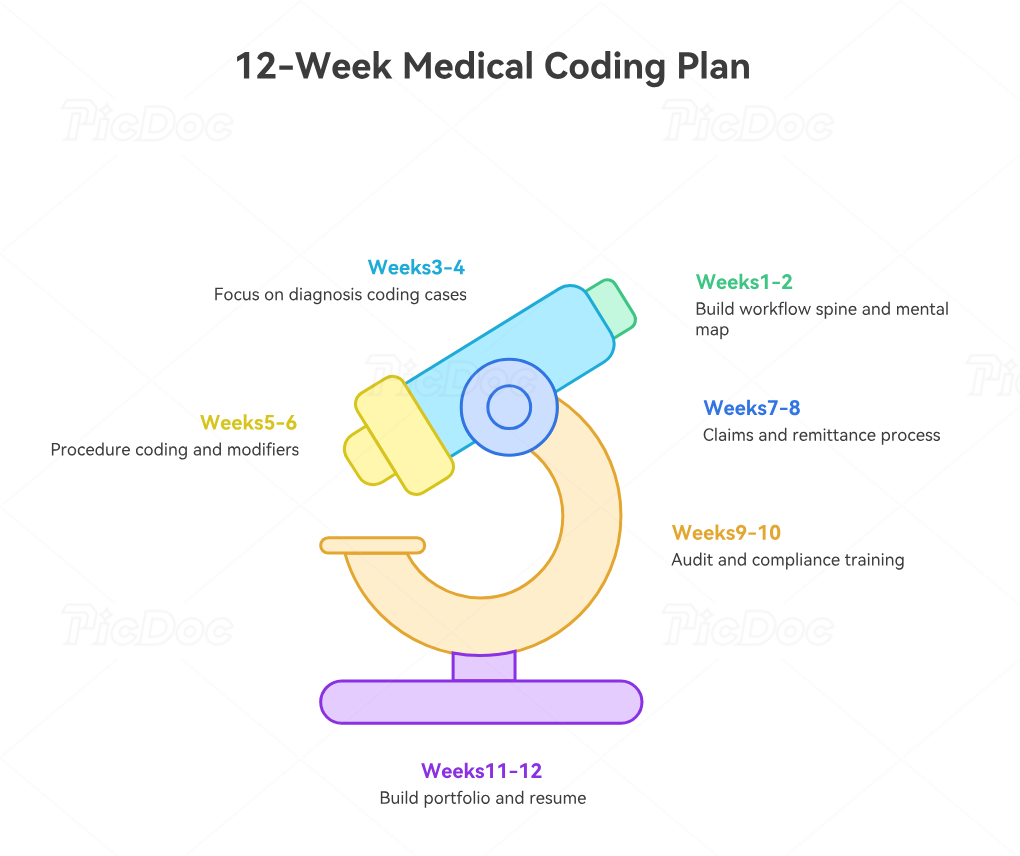
Weeks 1 and 2 should build the workflow spine. Learn how an encounter turns into documentation, how documentation turns into diagnosis and procedure codes, how codes move into charges, how charges become claims, and how claims become payment, denial, or patient responsibility. Read medical coding workflow terms, charge capture terms, RCM terminology, healthcare claims management, and billing reconciliation terms. This creates the mental map that keeps every later topic connected.
Weeks 3 and 4 should focus on diagnosis coding, clinical specificity, and documentation support. Create 30 short cases across primary care, cardiology, respiratory care, neurology, oncology, infectious disease, and behavioral health. For each case, write the diagnosis evidence, missing documentation, code rationale, and medical necessity connection. Use behavioral health billing terms, cardiovascular disease code references, infectious disease coding, oncology references, and medical necessity criteria.
Weeks 5 and 6 should focus on procedure coding, modifiers, specialty patterns, and documentation thresholds. Build a table with common services, required note elements, possible modifiers, bundling concerns, payer edit risks, and appeal evidence. Rotate through cardiology CPT procedures, gastroenterology CPT codes, pediatric CPT references, preventive medicine coding, and anesthesia billing terms.
Weeks 7 and 8 should move into claims and remittance. Take five claim examples and explain the journey from encounter to final balance. Include eligibility, claim form fields, clearinghouse checks, payer edits, denial reasons, payment posting, patient responsibility, and appeal options. Use clearinghouse terminology, EDI billing terms, EOB interpretation, payment posting guidance, and patient responsibility definitions.
Weeks 9 and 10 should sharpen audit, compliance, CDI, and query judgment. Select ten encounters and write a defense for each code. Then write a compliant query for unclear, conflicting, or incomplete documentation. The goal is to train your brain to ask: “What does the record prove?” Use coding ethics standards, CDI terminology, query process terms, surgical coding compliance, and Stark Law and Anti-Kickback terms.
Weeks 11 and 12 should turn knowledge into proof. Build a small portfolio with de-identified sample cases, denial explanations, modifier examples, query examples, and a one-page revenue cycle map. Add a resume section showing certification progress, CIE-10-ES awareness, claim workflow knowledge, specialty exposure, bilingual terminology strength, and audit readiness. Strengthen your wording with career development terms, coding education terms, credentialing organization terms, apprenticeship and internship terms, and professional development terms.
5. Career Opportunities After Medical Billing and Coding Certification in Spain
Certification can support several career lanes from Spain. International RCM companies may hire or contract coders, billing assistants, denial analysts, payment posters, charge entry staff, audit support workers, and specialty coding trainees. Strong applications connect training to operational value: fewer claim errors, cleaner documentation, faster denial correction, safer audits, and better revenue visibility. Use RCM KPI terms, claims reconciliation terms, denial management resources, billing software terms, and electronic claims submission platforms.
Spain-facing healthcare information roles can involve clinical coding support, documentation quality, hospital statistics, discharge data, audit preparation, health data reporting, or administrative billing workflows. CIE-10-ES awareness, Spanish clinical vocabulary, and health information discipline matter here. The Ministry’s official eCIEmaps platform provides access to electronic disease classification resources, including CIE-10-ES, which makes it an important reference point for Spain-focused study. Strengthen that path with HIM terms, data security terms, medical record storage terms, data analytics terms, and cost reporting terms.
Remote work can be attractive, yet it rewards proof over hope. Many beginners fail interviews because their resume says “certified” while their answers show weak claim logic, weak denial reasoning, weak modifier confidence, and weak audit evidence. Prepare three stories before applying: one code selection story, one denial correction story, and one documentation query story. Each story should mention the record, the coding decision, the payer issue, the correction, and the revenue result. Use coding competency assessment terms, medical coding automation terms, RCM software terms, practice management systems, and EHR integration terms.
Specialization is the fastest way to sound serious. Pick one area after you build the base, then study documentation patterns, CPT families, common modifiers, medical necessity rules, denial causes, and appeal evidence. Good specialty lanes include telemedicine coding, radiology coding, lab and pathology coding, sleep medicine billing, hospice and palliative care coding, and speech-language pathology coding. Depth creates sharper interviews, stronger accuracy, and better long-term growth.
6. FAQs About Medical Billing and Coding Certification in Spain
-
Yes. Certification is useful when it is connected to practical documentation, coding, claims, denial, and audit skills. Spain-based learners can use certification for international RCM roles, remote billing support, documentation quality work, health information pathways, and specialty coding preparation. Build your foundation with medical coding certification terms, RCM terms, accurate reimbursement guidance, coding compliance, and coding career terms.
-
Start with your target market. For Spain-facing work, learn CIE-10-ES and Spanish clinical coding language. For U.S.-style remote billing, learn ICD-10-CM concepts, CPT, HCPCS, modifiers, claim forms, EOBs, CARCs, and RARCs. A practical plan should include ICD coding standards, CPT modifier usage, claim adjustment codes, RARC definitions, and EOB reading.
-
Remote work is possible when your certification is backed by proof of applied skill. Employers want coders who understand documentation, code selection, claim forms, payer edits, denial correction, payment posting, and audit evidence. Build a portfolio using SOAP note coding, CMS-1500 terms, clearinghouse terminology, payment posting, and claims reconciliation.
-
A focused beginner can build a strong foundation in about 12 weeks, then continue with specialty practice, mock cases, and real-world claim scenarios. The timeline depends on healthcare background, English fluency, Spanish clinical vocabulary, and weekly study hours. A strong schedule covers medical billing workflow, medical necessity, coding edits, coding audits, and competency assessment.
-
The biggest mistake is studying code lists without studying the billing and documentation chain. Real work requires documentation review, diagnosis support, procedure logic, medical necessity, claim form accuracy, payer edits, remittance reading, denial correction, and audit defense. Beginners should study charge capture, revenue leakage prevention, denial management, patient responsibility, and coordination of benefits together.
-
Spanish helps with Spain-facing clinical documentation, local coding references, patient-facing terms, and health information work. English helps with U.S.-style billing, payer policies, global RCM platforms, medical policies, EOBs, and appeal writing. Candidates with both languages can stand out by combining medical abbreviations, EMR documentation terms, EHR coding terms, HIM terminology, and healthcare data security.
