
Medical Billing and Coding Certification in Australia: Complete Guide for 2026-2027
Australia’s medical billing and coding pathway rewards people who understand documentation, classification rules, payer logic, Medicare item discipline, and hospital funding pressure. A strong certification plan should connect clinical coding knowledge with practical billing judgment, because employers need staff who can protect revenue without weakening compliance. This guide breaks down the Australian pathway for 2026-2027, including skills, training choices, local terminology, job readiness, and the mistakes that make new coders look unprepared.

1. Why Medical Billing and Coding Certification in Australia Requires a Different Strategy
Medical billing and coding certification in Australia needs a country-specific plan because Australian healthcare uses its own coding, funding, Medicare, private health, and hospital reporting structures. A learner who only studies generic coding may understand diagnoses, yet still struggle when workplace expectations involve ICD-10-AM, ACHI, ACS, AR-DRG logic, Medicare Benefits Schedule awareness, or documentation standards. That is why a serious learner should combine medical coding certification terms, clinical documentation improvement terms, medical necessity criteria, coding regulatory compliance, and health information management terms before treating certification as a simple exam target.
The biggest trap is assuming “coding” means selecting codes from a list. In Australia, coding quality can affect hospital activity reporting, revenue integrity, reimbursement review, audit exposure, and data used for health planning. A weak coder may miss complications, misread operative reports, ignore sequencing rules, or fail to query unclear documentation. Those errors create pressure across claims management, claims reconciliation, revenue leakage prevention, revenue cycle KPIs, and accurate medical billing and reimbursement.
For 2026-2027, the strongest pathway is skills-first: learn anatomy and terminology, then documentation, then classification logic, then billing context, then audit readiness. That order helps learners avoid the common “memorized code, failed case” problem. A person entering the Australian market should understand how clinical notes become coded data, how coded data supports funding and reporting, how Medicare item rules shape outpatient and professional billing, and how evidence protects the claim. AMBCI learners can strengthen this foundation through medical abbreviations and acronyms, medical coding workflow terms, electronic health record coding terms, coding query process terms, and medical record retention terms.
Australia Certification Readiness Map: 25+ High-Value Terms
| Term | What It Means | Why It Matters in Australia | Best Practice Action |
|---|---|---|---|
| ICD-10-AM | Australian modification of ICD-10 used for diagnosis coding | Core classification system for admitted patient coding | Study Australian coding rules instead of relying on generic ICD knowledge |
| ACHI | Australian Classification of Health Interventions | Supports accurate procedure and intervention coding | Read operative notes fully before selecting intervention codes |
| ACS | Australian Coding Standards | Controls code selection, sequencing, and documentation interpretation | Treat standards as mandatory rules, not optional study notes |
| AR-DRG | Australian Refined Diagnosis Related Group | Groups hospital activity for funding and reporting | Understand how diagnosis and procedure choices can affect grouping |
| MBS | Medicare Benefits Schedule | Defines Medicare item numbers, benefits, restrictions, and billing rules | Check item descriptors, provider rules, timing limits, and updates |
| Medicare Item Number | Billing identifier attached to an eligible Medicare service | Wrong item selection can cause underpayment, rejection, or compliance risk | Match the service, provider, setting, documentation, and restrictions |
| Bulk Billing | Provider accepts Medicare benefit as full payment | Common Australian billing process in general practice and other services | Confirm patient assignment, item eligibility, and service evidence |
| Private Health Billing | Billing involving private health insurers and patient gaps | Adds payer-specific rules, fund checks, and out-of-pocket calculations | Verify fund rules before submitting high-value or complex services |
| Principal Diagnosis | Main condition chiefly responsible for the admission or episode | Drives coding accuracy, reporting meaning, and case grouping | Validate against admission reason, investigations, treatment, and discharge summary |
| Additional Diagnosis | Condition that meets criteria for coding in addition to the principal diagnosis | Captures real patient complexity when properly supported | Look for treatment, monitoring, evaluation, medication, or resource impact |
| Comorbidity | Coexisting condition that affects patient care | Can change case complexity and documentation review requirements | Code only when the record shows impact on care |
| Complication | Condition arising during care or affecting the care episode | Can affect quality reporting, coding review, and funding interpretation | Require clear provider documentation before coding it as a complication |
| Episode of Care | Defined healthcare encounter, admission, or treatment period | Determines which diagnoses and procedures belong in the coded record | Code only conditions and interventions linked to the relevant episode |
| Discharge Summary | Clinical summary prepared at the end of care | Often anchors diagnosis selection, treatment confirmation, and coding review | Compare it with progress notes, pathology, imaging, and operation reports |
| Clinical Query | Formal clarification request sent when documentation is incomplete or unclear | Prevents guessing, unsupported coding, and audit exposure | Write neutral, evidence-based queries that do not lead the provider |
| Activity Based Funding | Funding approach linked to services and hospital activity | Makes coding accuracy financially and operationally important | Protect revenue by coding only what documentation supports |
| Casemix | Profile of patient types, diagnoses, complexity, and services | Helps explain workload, funding needs, and hospital activity | Understand how code choices shape casemix reporting |
| Revenue Integrity | Alignment between services, documentation, coding, billing, and payment | Prevents leakage, overbilling, underbilling, and audit problems | Connect coding decisions to claim outcomes and compliance evidence |
| Denial Prevention | Process of reducing avoidable claim rejections and adjustments | Protects cash flow and reduces rework for billing teams | Check eligibility, item rules, documentation, and payer requirements early |
| Payment Posting | Recording insurer, Medicare, or patient payments against accounts | Shows whether claims paid correctly or need follow-up | Post by item, adjustment, patient balance, and denial reason |
| Remittance Advice | Payment response explaining paid, adjusted, or rejected amounts | Helps billing teams identify payment gaps and correction needs | Review adjustment patterns instead of only checking totals |
| Claim Adjustment | Change made to expected payment because of payer rules or claim issues | Can expose coding, billing, eligibility, or documentation errors | Track root cause before resubmitting or appealing |
| Coding Audit | Review of coded records against documentation and rules | Finds risk before external review, funding issues, or compliance escalation | Track error type, financial impact, and corrective action |
| Workpaper | Coder or auditor evidence trail showing rationale | Supports defensible decisions during internal or external review | Record source documents, code rationale, query outcomes, and rule references |
| Data Quality | Accuracy, completeness, and reliability of coded and billed information | Affects reporting, funding, patient accounts, compliance, and planning | Audit patterns, missing fields, recurring denials, and documentation gaps |
| EHR Audit Trail | System record showing documentation access, edits, and activity | Supports compliance review and protects against unsupported changes | Keep coding decisions traceable to original source documentation |
| Credential Portfolio | Proof of training, case practice, audit thinking, and job-ready skill | Helps beginners compete when job ads ask for experience | Build sample cases, billing scenarios, denial notes, and audit summaries |
2. The Best Certification Pathway for Australia in 2026-2027
A practical Australian certification pathway should start with medical language, then move into documentation review, classification systems, Medicare awareness, and audit practice. Beginners often rush into code assignment before they can read clinical notes with confidence. That creates shaky decisions when a record contains sepsis language, post-operative complications, chronic disease detail, imaging findings, medication clues, and unclear provider wording. Before choosing a course, build a base with medical terminology for certification success, medical abbreviations, problem lists in documentation, SOAP notes and coding, and electronic medical record documentation terms.
For hospital-focused coding in Australia, learners should understand ICD-10-AM, ACHI, ACS, and DRG-related concepts. For medical billing or physician-practice-style roles, learners should also understand Medicare Benefits Schedule item logic, private payer rules, patient responsibility, gap payments, remittance patterns, and payment posting. The strongest candidates can explain how a clinical record becomes a code set, how a code set supports billing or reporting, and how documentation weakness creates financial and compliance exposure. That is why AMBCI-style study should connect ICD-11 coding standards, CPT modifiers, EOB fundamentals, payment posting, and patient responsibility terms.
International learners targeting Australia should avoid copying a U.S.-only exam plan without adapting it. CPC-style thinking can sharpen procedure coding discipline, medical terminology, compliance awareness, and claim logic, yet Australian roles require local classification and payer knowledge. Use global certification skills as a foundation, then add Australian rules through local coding references, HIM pathways, hospital coding resources, and Medicare billing practice. A smart learner can combine online CPC certification programs, CCS certification program options, CBCS exam terms, coding education and training terms, and coding credentialing organizations into one stronger roadmap.
A serious 2026-2027 pathway should end with a portfolio, not just a certificate. Employers care about whether you can read a record, defend a code, spot missing evidence, escalate a query, follow payer logic, and avoid creating downstream cleanup work. Build a portfolio with sample case analyses, anonymized coding rationales, billing-rule checklists, audit worksheets, denial-prevention notes, and quality-improvement summaries. That kind of evidence supports interviews better than vague claims about being “detail-oriented.” Use coding competency assessment terms, medical coding apprenticeship terms, coding career development terms, continuing education units, and certification renewal terms to plan long-term growth.
3. Core Skills Australian Employers Expect From New Billing and Coding Candidates
Australian employers want accuracy, judgment, and evidence discipline. A new coder who can assign basic codes still creates risk if they cannot explain why the principal diagnosis was selected, why a complication qualifies, why a procedure code is supported, why a query is needed, or why a Medicare item rule applies. Hiring managers usually trust candidates who speak in workflow terms: documentation source, coding standard, payer rule, audit trail, correction path, and prevention measure. Strengthen that language through medical coding workflow terms, charge capture terms, encounter forms and superbills, CMS-1500 form terms, and UB-04 billing form terms.
Documentation review is the skill that separates employable coders from certificate collectors. In Australia, admitted-care coding depends heavily on whether the record supports the diagnosis, procedure, sequence, episode context, and resource use. In billing environments, clean documentation supports item selection, payer review, and patient communication. Pain begins when providers document vaguely, coders guess, billers submit, payments lag, and managers discover the issue only after reporting or cash flow suffers. Candidates should study Medicare documentation requirements, medical necessity criteria, utilization review terms, clinical decision support terms, and healthcare data security terms.
Billing candidates also need revenue-cycle awareness. A claim can fail because of eligibility, item mismatch, documentation weakness, modifier misuse, clearinghouse edits, payer-specific rules, coordination of benefits, or poor payment posting. Coders who understand those failure points are more valuable because they reduce rework before it starts. Study the movement from patient registration to charge capture, coding, claim submission, remittance, denial review, posting, reconciliation, collections, and reporting. AMBCI’s resources on revenue cycle management terms, clearinghouse terminology, EDI billing terms, CARCs, and RARCs help create that wider view.
Specialty knowledge increases job readiness because Australian healthcare employers often need coders who can handle real service lines instead of generic classroom examples. A learner can build depth by choosing two or three areas first: emergency care, radiology, pathology, surgery, cardiology, gastroenterology, mental health, oncology, pediatrics, or telehealth. Specialty practice improves pattern recognition and exposes documentation gaps faster. Use emergency medicine CPT codes, radiology billing and coding terms, lab and pathology coding, surgical coding compliance, and behavioral health billing terms to train beyond entry-level examples.
Quick Poll: What is your biggest Australia coding-career pain right now?
4. How to Build a 2026-2027 Study Plan That Produces Job-Ready Skill
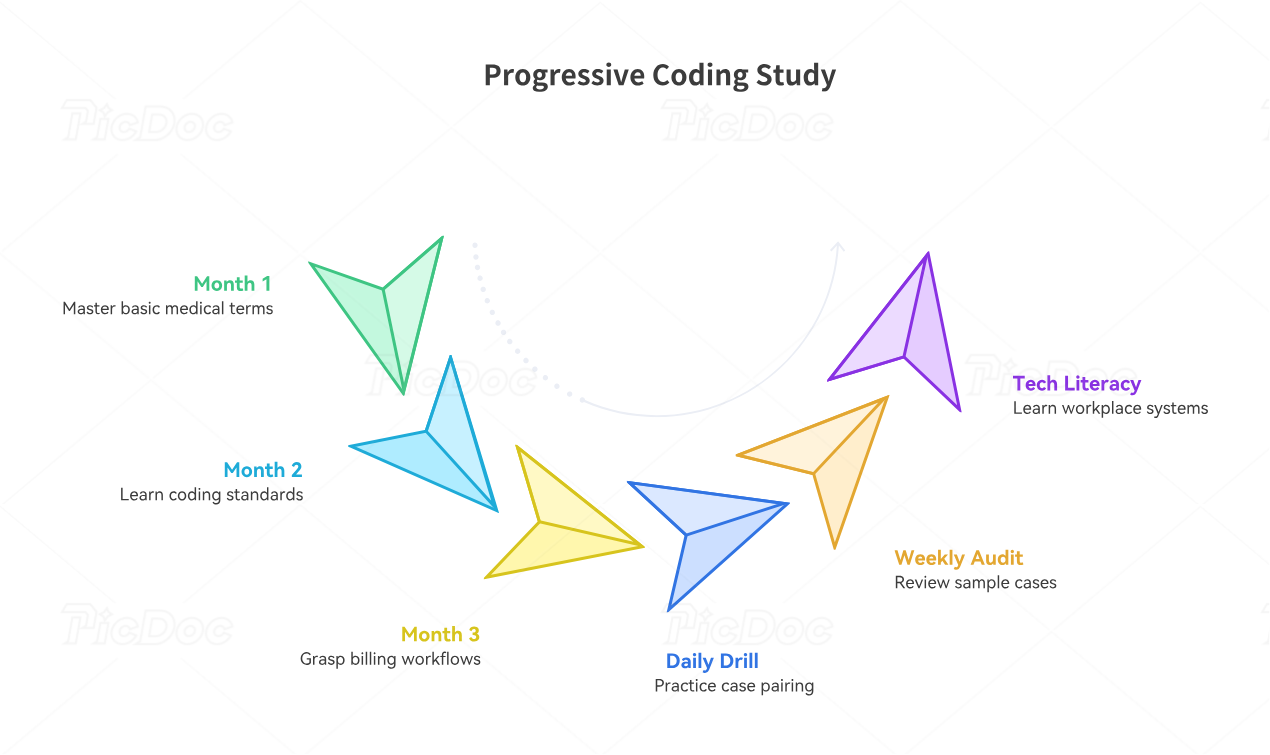
A strong study plan should run in layers. Month one should focus on anatomy, terminology, abbreviations, documentation structure, and the language of clinical decision-making. Month two should focus on diagnosis coding, intervention coding, coding standards, sequencing, and documentation queries. Month three should focus on billing workflows, Medicare item awareness, payment posting, denials, remittance, and audit workpapers. That structure prevents the common failure pattern where learners collect code facts without understanding the record-to-payment chain. Start with medical terminology, coding education terms, EHR integration terms, encoder software terms, and coding automation terms.
Daily practice should include record reading, not only code lookup. Take one disease process, one procedure type, and one billing scenario each day. For example, pair pneumonia documentation with respiratory coding, colonoscopy documentation with gastroenterology coding, or fracture management with orthopedic procedure logic. Then ask: What is documented? What is missing? Which standard applies? What evidence supports the code? What could trigger denial, audit, or rework? Use respiratory disease coding essentials, gastroenterology CPT codes, orthopedic surgery CPT coding, cardiology procedure coding, and dermatology procedure coding for targeted specialty drills.
Weekly practice should include an audit loop. Select five sample cases and review them as if you are the second-level auditor. Identify unsupported diagnoses, missing procedure details, sequencing problems, payer-rule risks, documentation conflicts, and unclear provider language. Then write corrective actions. This trains the exact thinking employers value: finding risk before it becomes a rejected claim, inaccurate report, funding issue, or compliance headache. Study medical coding audit terms, coding ethics and standards, claims reconciliation terms, insurance denial management services, and medical billing reconciliation.
Your study plan should also include technology literacy. Australian workplaces may use EHRs, practice management systems, revenue-cycle platforms, encoders, reporting dashboards, claim submission tools, and payer portals. A candidate who understands system handoffs can explain how errors travel: wrong demographic data affects eligibility, weak documentation affects coding, wrong item selection affects billing, poor posting affects reconciliation, and missing notes affect audit response. Build this through practice management system terms, revenue cycle management software terms, electronic claims submission platforms, data analytics and reporting terms, and healthcare billing acronyms.
5. Career Opportunities, Salary Positioning, and How to Compete in Australia
Medical billing and coding opportunities in Australia can sit across hospitals, private practices, specialist clinics, day surgeries, billing companies, insurers, health information teams, revenue-cycle teams, and auditing functions. The exact title may vary: clinical coder, medical coder, health information officer, billing officer, revenue officer, claims analyst, coding auditor, documentation improvement assistant, or practice billing coordinator. Your positioning should match the role. A hospital coding role needs stronger classification and documentation depth; a clinic billing role needs stronger MBS, patient billing, payment posting, and payer workflow knowledge. Build both sides using HIM terms, healthcare claims management, commercial insurance billing terms, patient responsibility terms, and collections and bad debt terms.
Entry-level candidates often lose interviews because they describe study topics instead of workplace outcomes. Replace “I studied coding” with “I can review documentation, apply coding rules, identify missing evidence, prepare a query, check claim risk, and document my rationale.” That language tells employers you understand the pressure they live with: backlogs, inaccurate data, payer adjustments, audit requests, provider pushback, and month-end reporting. A resume should include course work, classification exposure, billing workflow knowledge, specialty practice, audit exercises, software familiarity, and case-based examples. Support that with coding career development, professional development terms, coding competency assessment, CEUs for coders, and medical coding education accreditation.
For salary positioning, think in skill bands. A beginner with terminology and basic billing knowledge competes for support roles. A trained coder with documentation, classification, and audit practice competes for stronger coding roles. A coder who also understands revenue-cycle leakage, denial trends, payer rules, documentation improvement, and analytics can grow into senior, audit, CDI, or revenue integrity work. The path improves when you build measurable proof: accuracy scores, audit samples, denial reduction examples, productivity tracking, query logs, and specialty exposure. Study revenue leakage prevention, value-based care coding terms, risk adjustment coding, HCC coding definitions, and HEDIS terms.
Remote and hybrid opportunities require extra discipline because managers need trust without constant supervision. Remote coders must prove they can protect data, follow workflow, communicate queries professionally, meet productivity targets, escalate uncertainty, and maintain audit-ready notes. That means your training should include written rationales, secure documentation habits, and communication examples. Employers fear silent guessing more than slow learning, so show how you handle uncertainty. Use healthcare data security terms, EMR documentation terms, coding query process terms, medical record retention terms, and coding ethics to build that trust.
6. FAQs About Medical Billing and Coding Certification in Australia
-
Choose a pathway based on the role you want. Hospital clinical coding requires strong Australian classification knowledge, especially ICD-10-AM, ACHI, ACS, documentation review, and grouping awareness. Clinic or practice billing requires stronger Medicare item logic, private billing rules, payment posting, claims follow-up, and patient account workflows. A global certification can strengthen anatomy, terminology, coding discipline, and compliance language, while Australian employment readiness requires local payer and classification study. Build a roadmap with medical coding certification terms, coding credentialing organizations, CBCS exam terms, CCS certification programs, and online CPC programs.
-
You can use U.S. coding study as a foundation, especially for anatomy, medical terminology, compliance thinking, procedural logic, and revenue-cycle concepts. For Australian roles, you must add local knowledge. Australian employers may expect ICD-10-AM, ACHI, ACS, Medicare Benefits Schedule awareness, Australian documentation expectations, and payer-specific workflow understanding. A candidate who openly bridges both systems looks stronger than one who presents U.S. coding as complete preparation. Strengthen the bridge with ICD-11 standards, CPT modifiers, physician fee schedule terms, Medicare reimbursement basics, and billing reimbursement guidance.
-
Learn medical terminology, anatomy, documentation review, diagnosis coding, intervention coding, coding standards, query writing, billing workflow, payer-rule checking, audit workpapers, and basic reporting. Entry-level hiring improves when you can show case reasoning instead of only naming courses. Practice reading discharge summaries, operative reports, pathology reports, imaging notes, medication lists, and progress notes. Then write short rationales explaining what you coded, what evidence supported it, and what needed clarification. Use SOAP notes and coding, problem list documentation, clinical documentation improvement, medical coding workflow, and coding audit terms.
-
Medical billing and clinical coding create different pressure. Billing requires strong attention to eligibility, item rules, claim submission, payer responses, remittance, posting, patient balances, and follow-up. Clinical coding requires deeper medical record interpretation, classification rules, documentation evidence, sequencing, and audit defense. Billing can feel faster-moving because cash flow issues appear quickly. Coding can feel heavier because small documentation judgments can affect reporting, funding, and compliance. A strong career plan studies both through revenue cycle management, payment posting, claims reconciliation, medical necessity, and coding compliance.
-
Create proof through practice cases, audit worksheets, billing workflow maps, denial analysis exercises, and documentation query samples. Volunteer or internship-style exposure can help, but self-built evidence also matters when it shows structured thinking. Build a small portfolio with five diagnosis coding cases, five procedure cases, five billing scenarios, three denial-prevention examples, and three audit findings with corrective actions. Employers want to see how you think under uncertainty. Support your portfolio with coding apprenticeship terms, coding competency assessment, career development terms, professional development terms, and continuing education units.
-
The biggest mistake is studying codes without studying documentation, billing flow, payer rules, and audit defense. Real work begins when the record is incomplete, the provider wording is unclear, the payer rule is specific, the claim fails, or the audit asks for evidence. Beginners should train themselves to ask: What does the record prove? Which rule applies? What is missing? What could be denied? How would I defend this decision? Build that discipline with coding query process terms, denial management resources, CARC definitions, RARC definitions, and revenue leakage prevention.
