
Medical Billing and Coding Certification in Italy: Complete Guide for 2026-2027
Italy is a serious market for anyone who wants billing, coding, claims, reimbursement, documentation, or healthcare administration skills that travel beyond one country. The smartest path is to understand Italy’s SSN structure, learn global coding fundamentals, and build job-ready proof through medical coding certification terms, revenue cycle management, claim accuracy, and clinical documentation improvement. In 2026-2027, Italy also deserves extra attention because hospital coding is moving through a major modernization cycle.

1. What Medical Billing and Coding Certification Means in Italy in 2026-2027
A medical billing and coding certification in Italy should be viewed as a professional skills credential, not as a single government license that automatically unlocks every Italian healthcare role. Italy’s public healthcare model is built around the Servizio Sanitario Nazionale, while many billing-style workflows appear in private clinics, hospital administration, insurance coordination, international patient services, outsourced RCM, and data-quality roles. Italy’s SSN provides universal coverage and is regionally organized, with the central government setting essential care levels and regions managing service delivery.
That distinction matters because someone preparing from Milan, Rome, Naples, Turin, Florence, Bologna, Palermo, or remotely from Italy must know which lane they are entering. A person targeting global remote billing needs CPT coding basics, ICD coding standards, claims management terms, and payment posting workflows. A person targeting Italian hospital data work must understand SDO-style discharge data, diagnosis/procedure coding, DRG logic, documentation quality, and regional reimbursement pressures.
Italy is also entering a major coding transition. The Ministry of Health’s NSIS-CLASS project has been working on the move from ICD-9-CM toward ICD-10-IM for diagnoses and CIPI for procedures, with 2027 identified as the implementation point for hospital discharge and other health information flows. That makes 2026-2027 a powerful window for coders who can handle both legacy logic and transition mapping. Weak coders memorize codes; valuable coders understand documentation, reimbursement risk, audit exposure, and why a missing secondary diagnosis can distort case mix.
Italy Medical Billing and Coding Certification Roadmap: 28 Skill Rows
| Skill Area | What It Means in Italy | Why It Hits Billing or Coding | Best Practice Action |
|---|---|---|---|
| SSN literacy | Understanding Italy’s public healthcare structure | Prevents US-style billing assumptions from being forced onto Italian workflows | Study cost reporting and reimbursement context together |
| ICD transition awareness | Italy is moving from ICD-9-CM toward newer diagnosis/procedure systems | Legacy-to-new mapping errors can damage case mix and data quality | Build a transition notebook using ICD coding standards |
| Diagnosis coding | Turning documented conditions into valid codes | Wrong diagnosis sequencing weakens reporting, risk, and reimbursement logic | Practice with HCC concepts and medical necessity |
| Procedure coding | Capturing interventions, surgeries, diagnostics, and therapies | Procedure detail drives payment grouping, analytics, and utilization reports | Use specialty references like cardiology CPT coding |
| Medical terminology | Anatomy, procedures, disease names, abbreviations, and clinical language | A coder who guesses terms creates avoidable denials and audit risk | Pair terminology with medical abbreviations |
| CDI basics | Improving documentation clarity before final coding | Unclear notes create undercoding, miscoding, and weak audit defense | Master CDI terminology early |
| Medical necessity | Proof that a service was clinically justified | Claims fail when the record cannot defend the service | Review medical necessity criteria |
| Charge capture | Making sure provided services become billable/reported items | Missed charges quietly drain revenue before anyone sees a denial | Use a charge capture checklist |
| Claims workflow | Submission, payer review, rejection, correction, and follow-up | Global RCM employers hire people who can move claims to payment | Study claims management terms |
| Denial management | Finding why payment failed and fixing the root cause | Denials expose weak eligibility, modifiers, documentation, and payer logic | Train with denial management workflows |
| CARCs | Claim Adjustment Reason Codes explain payment reductions or denials | Posting teams need CARCs to understand what really happened | Use the CARC guide |
| RARCs | Remark codes add context to payment decisions | They reveal missing documents, bundling, eligibility, or appeal options | Map them with the RARC dictionary |
| EOB reading | Understanding payer explanations of benefits | EOB errors can hide underpayments, patient balance mistakes, and appeal windows | Practice with an EOB guide |
| EDI literacy | Electronic claim and remittance transaction understanding | Bad EDI knowledge causes preventable rejections and slow cash | Study EDI billing terms |
| Clearinghouse work | Routing claims between provider systems and payers | Front-end edits stop claims before payer review | Learn clearinghouse terminology |
| Payment posting | Recording payments, adjustments, transfers, and balances | Incorrect posting corrupts AR, patient billing, and reconciliation | Build skills with payment posting |
| AR follow-up | Tracking unpaid claims until resolution | Aging claims become write-offs when nobody owns follow-up | Tie AR to RCM KPIs |
| Modifiers | Extra code details explaining service circumstances | Modifier misuse triggers denials, bundling errors, and compliance exposure | Use the CPT modifier dictionary |
| Audit readiness | Keeping coding decisions defensible | Auditors do not care that the coder was rushed; they care about proof | Study coding audit terms |
| Compliance | Following rules, payer policies, documentation standards, and privacy expectations | Compliance failures can convert coding mistakes into organizational risk | Review coding regulatory compliance |
| EHR documentation | Reading structured and narrative clinical records correctly | Copy-forward notes and vague templates create coding traps | Use EHR coding terms |
| SOAP note review | Reading subjective, objective, assessment, and plan documentation | The assessment and plan often reveal the strongest coding support | Practice with SOAP notes and coding |
| Problem list control | Separating active problems from historical noise | Stale problem lists cause overcoding and audit findings | Review problem list documentation |
| Specialty coding | Cardiology, radiology, dermatology, gastroenterology, emergency medicine, and more | Specialty coders earn trust by knowing procedure-specific rules | Start with radiology coding |
| Revenue leakage | Lost money from missed charges, bad codes, weak follow-up, or underpayments | Leakage grows when teams only measure claim volume | Use revenue leakage prevention |
| Risk adjustment | Capturing patient complexity accurately | Poor chronic-condition documentation distorts risk and performance data | Study risk adjustment coding |
| Analytics reporting | Using coding and claims data for dashboards, quality, and operations | Data teams need coders who can explain why numbers shifted | Learn analytics terms for coders |
| Career positioning | Turning certification into a portfolio, role target, and interview story | Employers hire proof, not vague claims of “knowing codes” | Use a coding career roadmap |
2. The Best Certification Path for Students and Career Changers in Italy
The strongest certification path begins with the job market you want, then works backward. For remote US-facing RCM, prioritize ICD-10-CM, CPT coding, HCPCS-style billing logic, CMS-1500 claim concepts, and payer-denial workflows. For Italian hospital administration, prioritize diagnosis/procedure classification, SDO logic, DRG grouping, clinical documentation, and data quality because Italy’s 2027 coding transition puts mapping and documentation discipline at the center of the profession.
A beginner in Italy should avoid the common mistake of buying a course before understanding the target role. A person who wants outpatient clinic billing needs patient responsibility terms, commercial insurance billing, coordination of benefits, and accurate reimbursement workflows. A person who wants hospital coding or clinical data roles needs stronger anatomy, terminology, disease sequencing, inpatient documentation, and discharge abstraction skills. The same certification can help both paths, but the portfolio must look different.
A good 2026-2027 study sequence is simple: medical terminology first, anatomy and physiology second, diagnosis coding third, procedure coding fourth, claims and reimbursement fifth, compliance and audits sixth, and specialty practice last. Do not start with random code memorization. Start with record interpretation. Every real coding decision begins with the note, not the codebook. Use medical coding workflow terms, coding ethics standards, medical necessity guidance, and coding query process terms to train your judgment before exam day.
The best candidates also build proof outside the certificate. Create sample coding cases, denial-resolution worksheets, EOB explanations, mock audit notes, and specialty cheat sheets. An Italian learner who can explain why a claim denied, why documentation failed, why a modifier changed payment, and why a diagnosis was unsupported will stand above someone who only says they completed a course. Use medical billing reconciliation terms, advanced claims reconciliation, RCM software terms, and encoder software terms to turn theory into visible job evidence.
3. Skills Italian Learners Must Build Before Taking the Exam
The first skill is clinical reading. Coders lose money for organizations when they code from headings, problem lists, copied phrases, or habit. A strong coder verifies the provider’s assessment, links the condition to treatment, checks whether the condition affected care, and avoids coding inactive history as active disease. That is why SOAP note coding, problem list documentation, EHR documentation terms, and clinical decision support terms should be part of the study plan from week one.
The second skill is reimbursement thinking. In global RCM work, coders and billers must know how mistakes move through the money chain. A wrong code can become a rejected claim, a denied claim, a delayed appeal, a bad patient bill, a damaged AR report, or a compliance issue. Study EOB interpretation, CARC denial codes, RARC explanations, and collections and bad debt as one connected workflow.
The third skill is specialty confidence. Italy-based learners who want remote work often compete with candidates from countries where US billing operations are already mature. The way to stand out is to become useful in one specialty while remaining competent in general coding. Cardiology, radiology, emergency medicine, gastroenterology, dermatology, orthopedics, pediatrics, behavioral health, and preventive medicine all have different traps. Build specialty muscles through cardiology procedure coding, radiology billing terms, emergency medicine CPT codes, and gastroenterology CPT codes.
The fourth skill is audit discipline. Every code should survive the question: “Where exactly does the record support this?” If the answer is weak, the coder is gambling. Certification should train you to think like a reviewer, not a data-entry clerk. Use coding audit terms, Medicare documentation requirements, coding edits and modifiers, and surgical coding compliance until evidence-based coding becomes automatic.
Quick Poll: What is your biggest certification challenge in Italy right now?
4. Career Opportunities After Medical Billing and Coding Certification in Italy
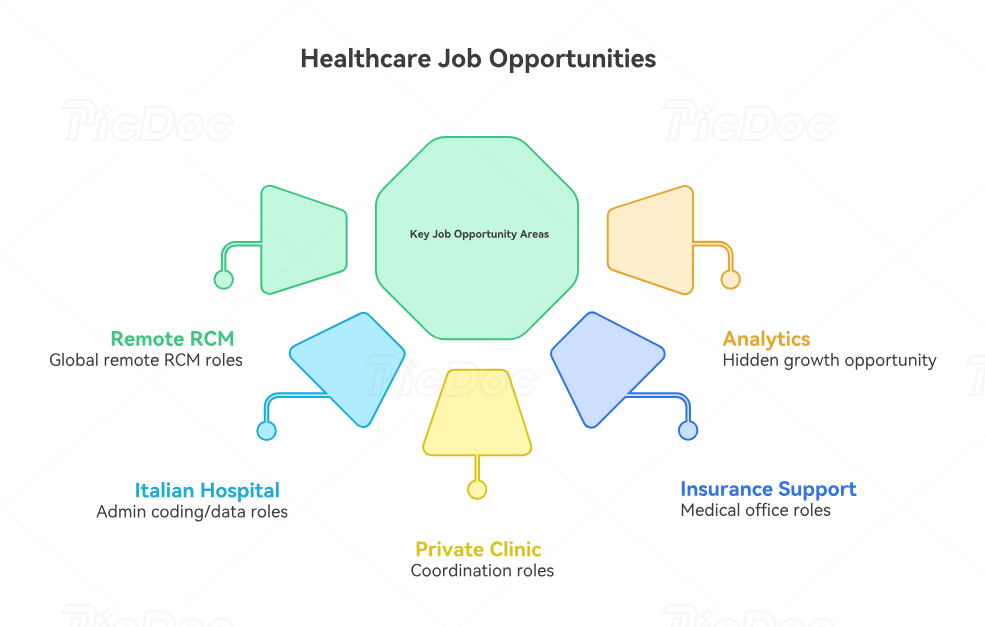
The most realistic opportunities fall into four buckets: remote global RCM work, Italian hospital administrative coding/data roles, private clinic coordination, and insurance or medical-office support. Remote RCM roles may include medical coder, billing specialist, charge entry specialist, denial analyst, payment posting associate, AR follow-up specialist, EOB reviewer, and coding audit assistant. Those roles reward practical command of claims submission platforms, medical billing software, RCM software, and billing solution workflows.
In Italy itself, job titles may look different from the US job market. You may see roles connected to healthcare administration, hospital discharge data, medical records, clinical data quality, private practice administration, insurance support, health information, and revenue or reimbursement analysis. This is where learners must avoid keyword tunnel vision. Search for work that uses the skill, even when the job title does not say “medical coder.” Italy’s SSN is regional, and the WHO-linked Observatory notes regional differences in capacity, access, and service quality, which makes documentation, data quality, and reporting skills important beyond traditional billing.
Private and international-care environments can also value billing and coding literacy. A clinic serving international patients, travel insurance cases, private payers, employer health programs, or cross-border documentation requests may need staff who understand clean documentation, claim packets, invoice support, medical necessity, and coding vocabulary. That is where commercial insurance billing, patient responsibility terms, coordination of benefits, and medical record retention become practical workplace tools.
The hidden opportunity is analytics. Modern healthcare organizations want cleaner data, fewer avoidable denials, better reporting, and stronger documentation habits. A certified professional who can connect coding to dashboards, KPIs, utilization, reimbursement, and audit risk has more room to grow than someone who only performs basic code lookup. Study data analytics for coders, revenue cycle metrics, value-based care coding, and MIPS concepts if you want long-term career leverage.
5. How to Prepare for Certification Without Wasting Time or Money
Start with a 12-week plan if you already have healthcare exposure, or a 20- to 24-week plan if you are new to anatomy, medical terminology, claims, and reimbursement. Week one should cover terminology and anatomy. Week two should cover documentation structure. Weeks three to five should cover diagnosis coding. Weeks six to eight should cover procedure coding and modifiers. Weeks nine and ten should cover claims, denials, EOBs, and payer logic. Weeks eleven and twelve should cover audits, compliance, mock exams, and weak-area repair. Use coding education terms, certification exam terms, CEU planning, and certification renewal terms to avoid last-minute confusion.
Your study materials should include a coding textbook or structured course, official code references for the exam you choose, practice cases, claim examples, EOB examples, modifier exercises, and denial-resolution drills. Do not judge a course by video hours alone. A weak course gives definitions; a strong course forces you to code messy notes, defend sequencing, read payer responses, correct claim errors, and explain why one code choice beats another. Support your study with online exam prep resources, coding competency assessment, professional development terms, and credentialing organization terms.
If you are preparing from Italy for remote US-facing work, you must become comfortable with US code-set logic. ICD-10-CM is the US clinical modification used for diagnosis coding, while CMS publishes ICD-10-CM/PCS update files for the US Medicare coding environment. Pair that knowledge with CPT orthopedic surgery coding, pediatric CPT coding, dermatology CPT coding, and preventive medicine CPT coding so your skills feel usable instead of purely academic.
Before applying for jobs, build a portfolio with five assets: a diagnosis-coding worksheet, a procedure-coding worksheet, a denial-resolution example, an audit rationale sample, and a one-page specialty reference. For each case, show the source documentation, selected code, rejected alternatives, reason, compliance concern, and billing effect. This turns certification into proof. Add charge capture analysis, medical billing reconciliation, coding automation terms, and EHR integration terms to make your portfolio sound like workplace output.
6. FAQs About Medical Billing and Coding Certification in Italy
-
Certification can support your career in Italy, especially for private healthcare administration, global RCM, medical records, insurance support, and coding-related data roles. The key is positioning it correctly. Italy’s public system operates differently from US insurance billing, so your certification should be paired with health information management terms, Italian-style documentation awareness, reimbursement fundamentals, and claims workflow knowledge. Treat certification as evidence of technical ability, then match it to the right role type.
-
Yes, remote opportunities can exist when employers accept international contractors or remote staff, especially for billing support, coding review, AR follow-up, denial analysis, payment posting, and data cleanup. Your strongest advantage will come from proving you understand EOBs, CARCs, RARCs, and EDI billing. Remote hiring teams need low-maintenance problem solvers who can protect cash, document actions, and avoid repeat errors.
-
Start with medical terminology, anatomy, documentation reading, diagnosis coding, procedure coding, claims flow, denials, compliance, and audit logic. For Italy-focused healthcare work, add SDO, hospital discharge data, DRG concepts, and the ICD-10-IM/CIPI transition. For US-facing remote work, add CPT modifiers, CMS-1500 form terms, UB-04 billing form terms, and medical coding workflow terms.
-
A focused learner with healthcare background may prepare in three months. A beginner should plan four to six months, especially if medical terminology, anatomy, payer rules, and documentation review are new. The target is not speed; the target is accuracy under exam and workplace pressure. Build weekly practice around medical necessity, coding edits, audit terms, and coding ethics, because these are the areas where beginners often lose confidence.
-
You can target medical billing assistant, medical coder, claims support specialist, AR follow-up associate, denial analyst, payment posting specialist, medical records assistant, private clinic administrator, clinical data assistant, coding audit trainee, and reimbursement support roles. Search broadly because Italian employers may use administrative or data-focused titles instead of US-style coding titles. Strengthen your applications with career development terms, apprenticeship and internship terms, RCM KPIs, and revenue leakage prevention.
-
The biggest mistake is studying codes in isolation. Real billing and coding work sits inside documentation, payer logic, reimbursement rules, denial patterns, audit defense, and software workflows. A beginner who only memorizes codes may pass simple quizzes but freeze when a claim denies or a chart lacks support. Build practical strength through claims reconciliation, payment posting, clearinghouse terminology, and healthcare data security. The coder who understands the whole revenue chain becomes useful faster.
