
Medical Billing and Coding Certification in Norway: Complete Guide for 2026-2027
Norway is a strong target for learners who want healthcare documentation, coding, billing, claims, reimbursement, and data-quality skills with international value. The right path blends Norway’s public healthcare structure with global coding competence, especially medical coding certification terms, revenue cycle management, medical necessity criteria, clinical documentation improvement, and coding regulatory compliance. Norway’s healthcare financing, DRG logic, ICD transition planning, and digital health environment make 2026-2027 a serious preparation window.

1. What Medical Billing and Coding Certification Means in Norway in 2026-2027
Medical billing and coding certification in Norway should be understood as a professional capability credential for healthcare administration, documentation quality, claims support, coding review, reimbursement analysis, and international revenue cycle work. Norway has universal health coverage, legal residents are automatically covered, municipalities handle primary care, and the national government is responsible for hospital and specialist care through regional health authorities. That structure creates a different career map from a purely insurance-driven market, so learners should combine health information management terms, medical coding workflow terms, reimbursement fundamentals, and claims management terms.
The biggest Norway-specific issue is classification readiness. The Norwegian Directorate of Health says Norway is preparing for ICD-11, with the Directorate leading translation, testing, and wider sector collaboration ahead of planned introduction in 2028-2029. That means 2026-2027 learners should become strong in current diagnosis coding while preparing for future digital classification, mapping, interoperability, and documentation-quality demands. A serious learner should study ICD coding standards, ICD-11 mental health coding, ICD-11 neurological codes, and ICD-11 respiratory coding.
Norway also uses activity-based financing through Innsatsstyrt finansiering, where part of regional health authority funding depends on how many patients receive treatment and which treatments they receive. The 2026 ISF rulebook explains that this funding model supports cost-effective patient treatment and links reimbursement to activity and treatment type. For coders, that means weak documentation, bad sequencing, vague clinical evidence, and poor classification habits can affect data, funding logic, and performance reporting. Study DRG-style reimbursement concepts, revenue cycle KPIs, charge capture terms, and revenue leakage prevention.
Norway Certification Roadmap: 30 Billing and Coding Skill Rows
| Skill Area | What It Means in Norway | Why It Hits Billing or Coding | Best Practice Action |
|---|---|---|---|
| Norway health system literacy | Understanding municipalities, regional health authorities, specialist care, patient pathways, and public financing | Prevents imported billing assumptions from damaging local healthcare interpretation | Pair system study with HIM terminology |
| ICD-10 strength | Current diagnosis-code competence before Norway’s ICD-11 shift | A weak ICD base makes transition mapping harder | Review ICD coding standards |
| ICD-11 readiness | Preparing for digital classification, new code structure, extension codes, and interoperability | Norway’s transition planning creates demand for coders who understand change management | Build an ICD-10-to-ICD-11 comparison log |
| DRG awareness | Understanding case grouping, resource use, and activity-based funding logic | Bad coding can distort case mix, reporting, and reimbursement signals | Study cost reporting with coding examples |
| Clinical documentation review | Reading provider notes for support, specificity, severity, and active treatment | Unsupported coding creates audit exposure and weak data | Master CDI terms |
| Medical terminology | Anatomy, diseases, procedures, abbreviations, and clinical phrasing | Terminology errors turn into wrong codes and weak claims | Use medical abbreviations drills |
| Procedure coding | Capturing interventions, diagnostics, surgeries, therapies, and specialty services | Procedure detail affects utilization analytics and payment logic | Practice with radiology coding |
| Medical necessity | Proving that the service was clinically justified | Weak necessity language creates denials and audit failures | Use medical necessity criteria |
| Charge capture | Making sure services performed are captured for reporting or billing | Missed services become invisible revenue leakage | Build a charge capture checklist |
| Claims workflow | Submission, edits, payer response, correction, appeal, posting, and reconciliation | Remote RCM roles depend on claim movement, not code lookup alone | Study claims management |
| Denial management | Finding why payment failed and fixing the root issue | Denials expose eligibility, documentation, coding, and modifier weakness | Create denial workpapers for every practice case |
| CARC interpretation | Reading adjustment reason codes tied to payer decisions | CARCs show whether the issue is contractual, clinical, administrative, or corrective | Use the CARC guide |
| RARC interpretation | Reading payer remark codes for deeper denial or payment context | RARCs reveal missing evidence, bundling, appeals, and documentation gaps | Practice with the RARC dictionary |
| EOB analysis | Explaining what was billed, allowed, adjusted, paid, or transferred to patient responsibility | EOB mistakes hide underpayments and bad balances | Read the EOB guide |
| EDI knowledge | Understanding electronic claim and remittance exchanges | EDI errors block claims before a human reviews them | Study EDI billing terms |
| Clearinghouse literacy | Knowing how claim files move through edits and payer routes | Front-end rejections delay cash and inflate rework | Use clearinghouse terminology |
| Payment posting | Recording payments, write-offs, adjustments, transfers, and balances | Bad posting corrupts AR, patient billing, and reporting | Train with payment posting |
| AR follow-up | Working unpaid claims by age, payer, denial reason, and dollar impact | Old claims become preventable write-offs when follow-up is weak | Tie AR to RCM KPIs |
| Modifier use | Adding service-context details that affect payment and bundling | Modifier misuse triggers denials and compliance risk | Use the CPT modifier dictionary |
| Coding edits | Understanding bundling, mutually exclusive services, payer edits, and claim logic | Edit ignorance creates repeated denials | Study coding edits |
| Audit defense | Keeping every coding choice supported by documentation | Audits punish unsupported assumptions, copied notes, and missing evidence | Review coding audit terms |
| EHR reading | Using structured fields, narrative notes, orders, results, and provider documentation | Template noise can mislead inexperienced coders | Use EHR coding terms |
| SOAP note review | Connecting subjective, objective, assessment, and plan sections | Assessment and plan often carry the strongest coding support | Practice SOAP note coding |
| Problem list control | Separating active conditions from historical or copied problems | Stale problem lists cause overcoding and audit exposure | Study problem list documentation |
| Specialty coding | Applying specialty-specific rules in cardiology, radiology, emergency medicine, gastroenterology, and more | Specialty knowledge makes a certified coder useful faster | Start with cardiology CPT coding |
| Risk adjustment | Capturing patient complexity through supported chronic and acute conditions | Poor risk capture distorts patient complexity and performance analytics | Review risk adjustment coding |
| Data analytics | Using coded data for dashboards, quality reports, utilization, and funding analysis | Modern coding careers increasingly require data explanation | Learn analytics terms for coders |
| Privacy and data security | Protecting patient information in digital healthcare workflows | Billing and coding staff handle sensitive data every day | Study healthcare data security |
| Software fluency | Using EHRs, encoders, billing systems, claim platforms, and reporting tools | Employers value coders who can work inside real systems | Review encoder software terms |
| Career portfolio | Sample cases, denial workpapers, audit notes, and specialty sheets | Proof beats vague claims during hiring | Use coding career terms |
2. The Best Certification Path for Norway-Based Learners
The best path starts with your target role. A learner aiming at Norwegian healthcare administration should prioritize clinical documentation, health information management, diagnosis classification, DRG logic, and data quality. A learner aiming at remote US-facing RCM should prioritize CPT modifiers, CMS-1500 form terms, UB-04 billing form terms, commercial insurance billing, and payment posting. Role clarity prevents wasted study months.
A strong beginner sequence is medical terminology, anatomy, documentation reading, diagnosis coding, procedure coding, claims logic, denial management, compliance, audits, and specialty practice. That order works because coding starts with the record. A coder who cannot read the note will misread the codebook. Build foundations with medical abbreviations for coders, SOAP notes and coding, clinical documentation improvement, and medical coding ethics.
Norway’s ICD-11 preparation makes transition literacy especially valuable. WHO says ICD-11 supports modern health systems through APIs, structured definitions, mappings, and data-quality validation tools. Norway’s Directorate says the national shift requires translation, testing, collaboration, and sector preparation. Learners who understand ICD-11 oncology codes, ICD-11 infectious disease coding, ICD-11 cardiovascular coding, and ICD system updates will be better prepared for workplace change.
For certification selection, choose a program that tests applied judgment. A course with lectures alone will leave you fragile in interviews. You need practical cases, claim examples, denial exercises, modifier questions, documentation audits, EOB interpretation, and specialty scenarios. Use coding competency assessment, coding education terms, credentialing organization terms, and online coding exam prep resources before paying for training.
3. Skills Norway Learners Must Build Before Exam Day
The first skill is documentation judgment. Beginners often code from problem lists, copied-forward text, discharge headings, or familiar disease names. Strong coders verify whether the condition was assessed, treated, monitored, evaluated, or clinically relevant to the encounter. That habit protects organizations from overcoding, undercoding, and unsupported reporting. Practice with problem list documentation, EHR documentation terms, medical record retention, and coding query process terms.
The second skill is reimbursement impact. In activity-funded environments and global RCM workflows, a code creates downstream consequences. It can influence grouping, dashboards, reimbursement, denial rates, audit findings, patient statements, and management decisions. A serious learner should connect coding to charge capture, claims reconciliation, billing reconciliation terms, revenue leakage prevention, and RCM KPIs.
The third skill is denial and remittance reading. Remote billing teams need people who can explain what happened after claim submission. Learn to read payer responses, separate front-end rejections from true denials, spot missing documentation, identify modifier issues, and route appeals properly. Build fluency through EOB explanations, CARC codes, RARC codes, coordination of benefits, and patient responsibility terms.
The fourth skill is specialty depth. A general certificate opens the door, while specialty confidence makes your work valuable. Choose one strong lane, such as radiology, cardiology, emergency medicine, dermatology, gastroenterology, pediatrics, behavioral health, dialysis, infusion, or ambulance billing. Train with cardiology CPT coding, emergency medicine CPT codes, gastroenterology CPT codes, dermatology CPT coding, and lab and pathology coding.
Quick Poll: What is your biggest Norway coding challenge right now?
4. Career Opportunities After Certification in Norway
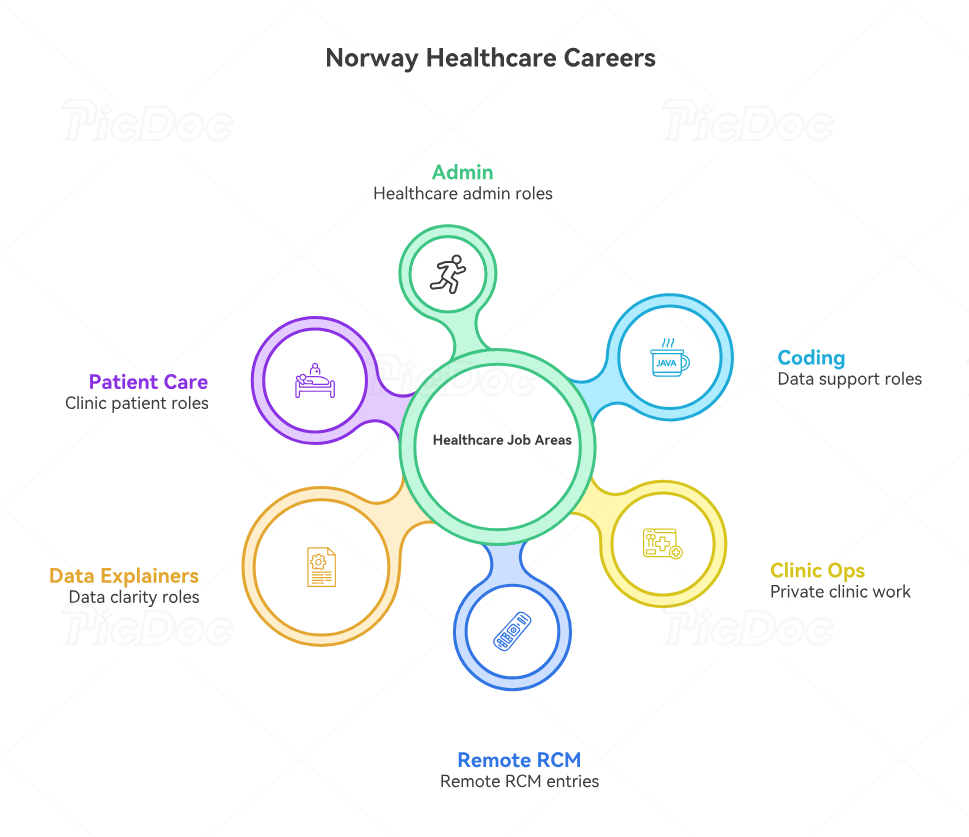
Career opportunities usually sit in four areas: Norwegian healthcare administration, hospital coding/data support, private clinic operations, and remote international RCM. Inside Norway, job titles may mention medical secretary, health administration, patient administration, medical records, clinical data, reimbursement, reporting, coding, registry work, or quality support. The skill stack matters more than the title. Pair certification with medical billing practice management terms, EHR integration terms, healthcare data security, and data analytics for coders.
For remote RCM, realistic entry points include billing assistant, medical coder trainee, charge entry specialist, payment posting associate, AR follow-up specialist, denial analyst, claims support representative, EOB reviewer, and coding audit assistant. Employers want proof that you can move work through the revenue chain with limited hand-holding. Build visible strength in electronic claims submission, clearinghouse terminology, payment posting, insurance denial management, and accurate billing and reimbursement.
Norway’s highly digital, publicly funded system also creates demand for people who can explain healthcare data cleanly. A coder who understands documentation, classifications, DRG logic, service activity, and quality reporting can support audits, dashboards, reimbursement analysis, and service-planning reports. The WHO-linked Observatory notes that Norway’s health spending is among the highest in Europe and mostly publicly financed, which makes data quality and funding visibility important across the system. Strengthen that angle through value-based care coding, HEDIS concepts, risk adjustment coding, and cost reporting.
A private clinic, dental-adjacent provider, rehabilitation office, specialist practice, or international patient service may value billing and coding skills for documentation packets, invoices, insurance communication, translated medical summaries, claim support, and patient balance explanations. That path rewards people who can speak clearly with patients and clinicians. Use patient responsibility terms, commercial insurance billing, coordination of benefits, medical record storage terms, and healthcare billing acronyms.
5. How to Prepare for Certification Without Wasting Time or Money
Use a 16-week plan if you have healthcare exposure and a 24-week plan if you are starting from zero. Weeks 1-2 should cover medical terminology, anatomy, abbreviations, and documentation structure. Weeks 3-6 should focus on diagnosis coding and ICD logic. Weeks 7-10 should focus on procedure coding, modifiers, coding edits, and specialty scenarios. Weeks 11-13 should focus on claims, EOBs, denials, appeals, AR, and payment posting. Weeks 14-16 should focus on compliance, audits, mock exams, and portfolio creation. Support the plan with certification exam terms, coding education accreditation, continuing education units, and certification renewal terms.
Your course should include case-based coding, documentation review, denial correction, audit rationales, claim forms, EOB review, and specialty practice. A course that only gives definitions creates a false sense of progress. Real employers care whether you can defend a code, correct a denial, interpret a payer response, identify missing documentation, and protect reporting accuracy. Strengthen practice with medical coding audit terms, Medicare documentation requirements, coding edits and modifiers, and surgical coding compliance.
Build a portfolio before applying. Include one diagnosis-coding case, one procedure-coding case, one denial-resolution worksheet, one audit note, one EOB interpretation, one specialty cheat sheet, and one short dashboard-style explanation of coding impact. Each sample should show source documentation, selected code, rejected alternatives, reason for selection, billing or data impact, and compliance concern. Pull supporting language from claims reconciliation terms, billing reconciliation, medical coding automation, encoder software, and RCM software.
For Norway-specific positioning, add Norwegian-language healthcare vocabulary where possible, learn the public system structure, follow ICD-11 transition updates, and understand activity-based funding. The Directorate’s ICD-11 work is active, and its English digitalisation page says the planned introduction is 2028-2029, so 2026-2027 is a smart window to become “transition ready.” Combine that with ICD system updates, data analytics for coders, professional development terms, and coding apprenticeship terms.
6. FAQs About Medical Billing and Coding Certification in Norway
-
Yes, certification can support healthcare administration, medical records, coding support, clinical data quality, private clinic operations, insurance documentation, and remote RCM work. Norway’s system is publicly financed and organized differently from US insurance billing, so certification works best when paired with Norway-aware health information management, clinical documentation improvement, DRG and cost reporting concepts, and coding compliance.
-
Yes, remote work can be realistic when employers accept international applicants or contractors. The strongest entry points are claims support, charge entry, denial management, AR follow-up, payment posting, EOB review, and coding audit assistance. Build practical proof around EOB interpretation, CARC codes, RARC codes, EDI billing, and payment posting.
-
Start with medical terminology, anatomy, documentation reading, diagnosis coding, procedure coding, DRG logic, claims workflow, denials, compliance, and audit defense. For Norway, add ICD-11 transition awareness and activity-based financing literacy. Use medical abbreviations, SOAP note coding, ICD coding standards, and medical necessity criteria as early foundations.
-
Norway is preparing for ICD-11, and the Norwegian Directorate of Health is leading work that includes translation, testing, and collaboration with the healthcare sector. Its English digitalisation page states that planned introduction is 2028-2029, so learners in 2026-2027 should treat ICD-11 literacy as a career advantage. Study ICD-11 mental health, ICD-11 oncology, ICD-11 infectious diseases, and coding system updates.
-
A learner with healthcare background can prepare in about three to four months. A beginner should plan four to six months because terminology, anatomy, documentation logic, claims flow, and audit thinking take time. The best plan mixes study, cases, claim examples, denial workpapers, and mock exams. Use coding competency assessment, coding education terms, online exam prep resources, and certification renewal terms.
-
The biggest mistake is learning codes without learning the revenue and documentation chain around them. Real coding work connects provider notes, medical necessity, code selection, claim edits, payer response, remittance, posting, audit defense, and reporting. A beginner who studies that full chain becomes useful faster. Build the chain through claims management, charge capture, coding audits, revenue leakage prevention, and RCM analytics.
