
Medical Billing and Coding Certification in Switzerland: Complete Guide for 2026-2027
Switzerland rewards billing and coding professionals who can connect clinical documentation, tariff logic, insurer rules, and clean claim evidence. For 2026-2027, the biggest opportunity sits at the intersection of medical coding workflow, revenue cycle management, healthcare claims management, regulatory compliance, and Swiss-specific tariff readiness. Certification helps when it produces practical competence: accurate documentation review, defensible code selection, payer-aware billing decisions, and audit-ready workpapers.

1. Who Medical Billing and Coding Certification in Switzerland Is Really For
A strong certification path in Switzerland serves four groups: local hospital coding applicants, outpatient billing staff, international coders targeting remote revenue cycle work, and healthcare administrators who need stronger command of charge capture, claims reconciliation, payment posting, coding audits, and medical billing reconciliation. The best candidates understand that Switzerland’s market is documentation-heavy, multilingual, insurer-sensitive, and increasingly tariff-driven.
Swiss billing work has become especially demanding because outpatient reimbursement changed from the old TARMED structure to TARDOC and outpatient flat rates from 1 January 2026. Federal guidance explains that outpatient physician services are billed either through TARDOC or outpatient flat rates, with mixed billing inside the same billing logic restricted by the new system. That shift raises the value of people who understand coding system updates, billing compliance, payer denial management, revenue leakage prevention, and data analytics reporting.
For inpatient work, Switzerland’s acute-care reimbursement environment uses SwissDRG logic, and the 2026/2026 SwissDRG 15.0 tariff version references CHOP 2026 and ICD-10-GM 2024. That means a Switzerland-ready certification plan should develop general coding judgment through medical coding certification terms, then add SwissDRG, CHOP, ICD-10-GM, documentation hierarchy, and local audit expectations. Candidates who only memorize code labels struggle when a discharge summary, procedure note, complication statement, and insurer query all point in different directions.
Switzerland Billing & Coding Skill Map: What to Learn Before Certification
| Skill Area | What It Means in Switzerland | Why It Hits Billing | Best Certification Prep Action |
|---|---|---|---|
| Basic insurance billing | Compulsory health insurance creates a regulated reimbursement environment. | Coverage rules, deductibles, payer rules, and patient responsibility affect payment behavior. | Study payer logic before claim creation, then connect billing decisions to documentation. |
| Patient responsibility | Deductibles, coinsurance, and patient balances require clean front-end and back-end handling. | Weak estimates create disputes, delayed collections, and patient service escalations. | Practice patient balance explanations using plain, payer-safe language. |
| Revenue cycle control | Swiss providers need disciplined handoffs from registration to coding to billing to posting. | Small handoff errors become underbilling, rebilling, write-offs, or insurer pushback. | Map each claim from appointment scheduling through final payment reconciliation. |
| TARDOC readiness | Outpatient physician services moved into the new 2026 tariff framework. | Old tariff habits create incorrect service selection, weak charge logic, and rejection risk. | Build a 2026 outpatient tariff change checklist and update it quarterly. |
| Outpatient flat rates | Certain outpatient encounters are billed through bundled payment logic. | Bundled payment requires stronger episode thinking and cleaner service grouping. | Practice classifying encounters by tariff pathway before choosing codes. |
| KVG/LAMal awareness | Swiss health insurance law shapes tariff approval and reimbursement structure. | Compliance gaps can affect claims, audits, patient disputes, and insurer negotiations. | Learn the billing rule behind the payment, then document the evidence behind the rule. |
| Risk profile accuracy | Patient complexity influences resource interpretation, quality reporting, and payer scrutiny. | Missing comorbidities can distort case complexity and weaken reimbursement support. | Train on secondary diagnosis rules, evidence thresholds, and chronic-condition clarity. |
| Risk adjustment thinking | Global coding teams increasingly need diagnosis specificity and complete clinical capture. | Incomplete specificity damages analytics, quality reporting, and future reimbursement models. | Create diagnosis validation notes that connect provider statements to coded conditions. |
| Medical necessity | Services need a defensible clinical reason in the record. | Insurers challenge weak documentation even when the service itself was performed. | Check diagnosis-to-service support before billing, especially for procedures and diagnostics. |
| CDI judgment | Coders need provider clarification when records lack specificity. | Missing laterality, acuity, cause, complication status, or procedure detail affects payment. | Write compliant query drafts that ask for clarity without leading the provider. |
| Query process | Ambiguous documentation requires a controlled clarification process. | Informal clarification creates audit risk and inconsistent coding outcomes. | Use standardized query templates and track provider responses. |
| SOAP note review | Outpatient documentation often depends on structured clinical notes. | Poor assessment-plan linkage causes weak diagnosis support and payer questions. | Audit subjective, objective, assessment, and plan alignment before charge release. |
| EHR documentation | Swiss providers increasingly rely on digital documentation and structured records. | Template cloning, missing signatures, and vague orders weaken claims. | Build an EHR audit checklist for signatures, timestamps, orders, and clinical specificity. |
| EHR integration | Billing data may move between scheduling, clinical, coding, and finance systems. | Interface mismatches create missing charges, wrong provider attribution, and duplicate work. | Learn how encounter data flows before assuming the claim is complete. |
| Charge capture | Performed services need complete capture before claims leave the provider. | Lost charges create silent revenue leakage that finance teams discover too late. | Compare orders, notes, procedure logs, medication records, and billed services. |
| Revenue leakage | Leaks arise from undercoding, missing modifiers, late documentation, and payer edits. | Swiss cost pressure makes every avoidable leakage point visible. | Track leakage by source: documentation, coding, eligibility, tariff, or posting. |
| Coding audit | Audits test whether coded data matches clinical evidence. | Weak workpapers make accurate coding look unsupported during review. | Keep evidence notes that identify the exact clinical source for every key code. |
| Procedure documentation | Surgical and procedural coding requires complete operative detail. | Missing approach, device, anatomy, laterality, or complication detail changes code assignment. | Use a procedure-documentation checklist before final coding. |
| Diagnostic services | Imaging and diagnostic work depends on orders, clinical indications, and reports. | Incomplete indication-to-result linkage can trigger denial or rebilling. | Match order, indication, report, provider, and billed service before submission. |
| Lab and pathology billing | Laboratory and pathology billing requires accurate test, specimen, and medical necessity support. | Bundled services, panel logic, and missing indications can cause payment friction. | Review specimen source, order, diagnosis, and billed service together. |
| Telemedicine coding | Remote care requires clear modality, provider, patient, and documentation evidence. | Virtual visits fail when documentation lacks time, consent, or service detail. | Create a telemedicine note checklist before billing remote encounters. |
| Coding edits | Automated checks flag conflicts before or after claim submission. | Edit queues become denial factories when staff override without root-cause review. | Document every edit resolution with rule, evidence, and prevention step. |
| Modifier judgment | International and remote roles often require modifier fluency for U.S.-linked billing work. | Wrong modifiers create underpayment, overpayment, audits, and payer corrections. | Study modifier intent, documentation support, and payer-specific edits together. |
| Claims transmission | Clean data submission depends on correct formatting and payer routing. | Formatting failures delay payment before clinical review even begins. | Learn front-end rejection categories and create fix codes for recurring failures. |
| Payment posting | Payment data must match expected reimbursement, patient balance, and payer adjustments. | Incorrect posting hides denial patterns and corrupts revenue reporting. | Post payments with adjustment reason, balance ownership, and follow-up status. |
| Adjustment reasoning | Adjustment patterns reveal payer behavior, documentation gaps, and billing defects. | Teams lose money when adjustments are treated as routine write-offs. | Group adjustments by preventable, contractual, documentation, and appealable categories. |
| Remittance review | Remittance data explains what the payer accepted, changed, rejected, or questioned. | Weak remittance reading causes repeat denials and missed appeals. | Turn every remittance pattern into a coding, billing, or documentation correction. |
| Data security | Coders handle sensitive health and billing information across systems. | Privacy mistakes damage trust, compliance posture, and employer confidence. | Follow minimum-access, secure-transfer, and documentation-control habits every day. |
2. What You Need to Learn Before Applying for Certification
Start with the foundation: anatomy, physiology, medical terminology, diagnosis coding, procedure coding, billing forms, payer logic, denial workflows, and audit evidence. AMBCI learners should move through medical abbreviations, healthcare billing acronyms, medical coding education terms, coding competency assessment, and professional development terms before chasing job titles. A certification has real market value when it proves that you can convert a clinical record into a billable, compliant, defensible claim.
For Switzerland specifically, add three local layers. First, inpatient coding requires SwissDRG awareness, CHOP procedure familiarity, and ICD-10-GM diagnosis discipline. Second, outpatient billing now requires TARDOC and outpatient flat-rate awareness for 2026-2027. Third, documentation review often requires multilingual comfort because clinical and administrative material may appear in German, French, Italian, or English depending on canton, employer, and patient flow. Build your baseline through ICD coding standards, ICD neurological coding, ICD respiratory coding, ICD oncology coding, and infectious disease coding, then translate that discipline into the classifications your employer uses.
The most serious pain point for new coders is evidence blindness. They see a diagnosis in the record and code it without asking whether the provider assessed it, treated it, monitored it, evaluated it, or linked it to the encounter. They see a procedure and bill it without checking indication, approach, laterality, device, time, place of service, and bundled service rules. To fix that, train with medical necessity criteria, encounter forms and superbills, problem list documentation, record retention, and coding ethics until your code choices can survive review.
3. Step-by-Step Certification Path for Switzerland in 2026-2027
Step one is choosing your target lane. A hospital coding candidate should prioritize SwissDRG, CHOP, ICD-10-GM, discharge summaries, operative reports, complications, comorbidities, and audit trails. An outpatient billing candidate should prioritize TARDOC, outpatient flat rates, insurer workflow, charge capture, payment posting, and claim correction. A remote international coder should prioritize CPT coding, cardiology CPT coding, emergency medicine CPT, radiology CPT, and gastroenterology CPT, especially if U.S.-linked claims are part of the role.
Step two is building a study stack that turns theory into decisions. Use certification modules for structured learning, then create a weekly routine: code five diagnosis-heavy cases, five procedure-heavy cases, five denial scenarios, and five documentation queries. Add specialty depth through anesthesia coding, dermatology CPT, pediatric CPT, preventive medicine CPT, and behavioral health billing. This mix trains accuracy, payer awareness, documentation judgment, and speed.
Step three is creating proof of competence before you apply for jobs. Build a portfolio with de-identified sample case analyses, coding rationale, denial root-cause reviews, appeal drafts, query examples, and dashboard-style metrics. Employers want people who can reduce rework, protect compliance, and explain problems clearly to clinicians, finance teams, and insurers. Use RCM software terms, practice management systems, encoder software terms, coding automation terms, and online exam prep resources to make your workflow modern.
Quick Poll: What is your biggest Switzerland coding readiness gap right now?
4. Career Roles, Employer Expectations, and Remote Work Options
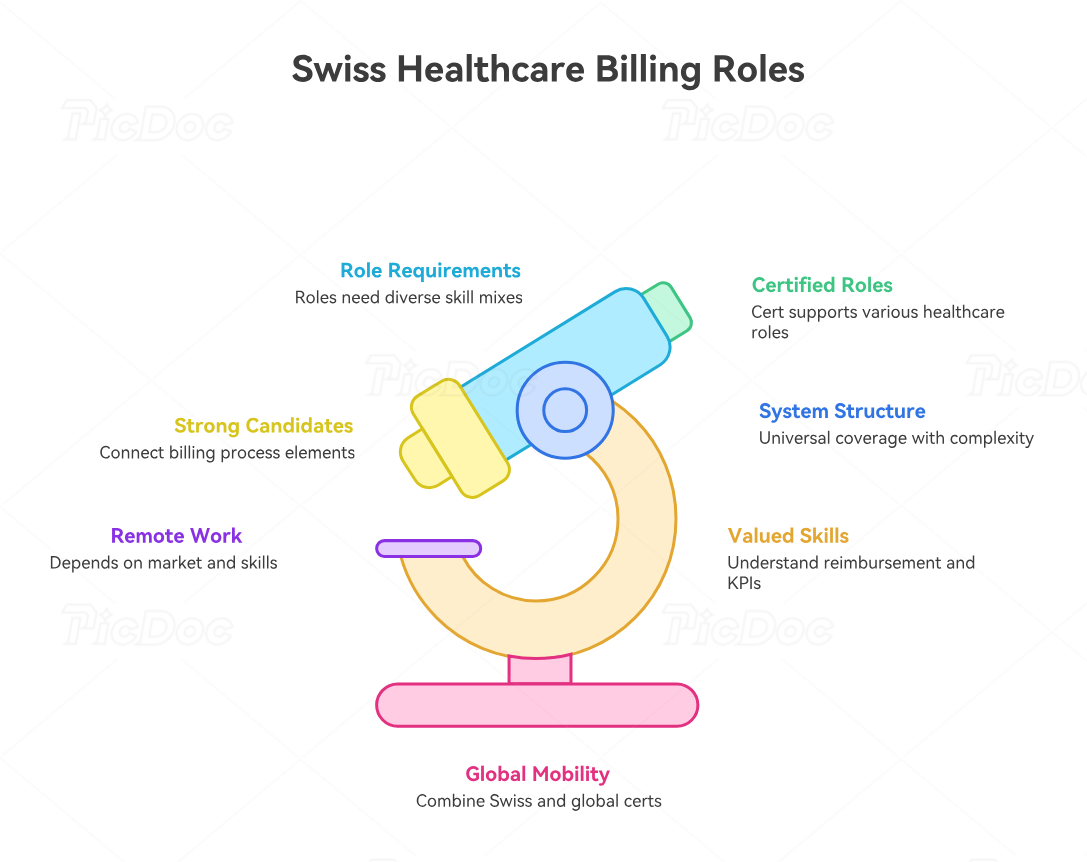
In Switzerland, certification can support roles such as medical coder, clinical coding specialist, outpatient billing coordinator, revenue cycle analyst, claims specialist, CDI assistant, billing quality reviewer, healthcare data analyst, and coding audit support. For each role, employers look for a different mix of HIM terms, utilization review, claims management, commercial insurance billing, and coordination of benefits. The strongest applicants can explain how documentation quality, code assignment, tariff selection, claim edits, and payment posting connect.
Switzerland’s healthcare system has universal coverage through compulsory basic insurance purchased from private nonprofit insurers, with premiums shaped by insurer choice and canton. That structure creates serious billing complexity because providers work inside a regulated, decentralized, insurer-facing system where payment accuracy depends on both clinical evidence and administrative precision. Candidates who understand payer reimbursement, physician fee schedule terms, cost reporting, revenue cycle KPIs, and billing software directories can speak the language of both compliance and operations.
Remote work is realistic when you define the market correctly. Swiss-based remote roles may require local language ability, employer-system access, data privacy discipline, and Swiss tariff knowledge. International remote roles may lean more heavily on CPT, ICD, HCPCS-style workflows, U.S. payer rules, denial management, and specialty billing. If you want global mobility, combine Switzerland readiness with medical billing certification in the UK, medical billing certification in Australia, medical billing certification in India, medical billing certification in the Philippines, and medical billing certification in the UAE.
5. Mistakes That Make Switzerland Coding Applicants Look Unprepared
The first mistake is treating certification as a certificate-collection exercise. Hiring teams need evidence that you can work through records, detect missing information, apply rules, communicate cleanly, and reduce payer friction. Replace generic claims with practical proof: “I reviewed 40 sample encounters, identified documentation gaps, created query drafts, mapped denial causes, and summarized expected correction steps.” Build that proof with coding apprenticeship terms, career development terms, CEU guidance, certification renewal, and credentialing organization guidance.
The second mistake is ignoring specialty depth. General coding knowledge helps you enter the field, while specialty fluency helps you survive production pressure. A cardiology claim, dialysis record, infusion encounter, ambulance transport, sleep medicine visit, and palliative care case all create different documentation risks. Use focused refreshers such as dialysis coding, infusion and injection billing, ambulance coding, sleep medicine billing, and hospice and palliative care coding to build practical range.
The third mistake is weak denial thinking. A denial is a diagnostic test for your billing system. It can expose missing prior information, incomplete documentation, coding mismatch, eligibility defects, payer edits, authorization gaps, or posting mistakes. A Switzerland-ready professional should classify the denial, confirm the evidence, correct the claim, prevent recurrence, and show the financial impact. Train with EOB explanations, CARC directories, RARC dictionaries, workers compensation billing, and electronic claims submission until denial review becomes structured.
The fourth mistake is ignoring technology. Encoder tools, EHR integrations, analytics dashboards, claim scrubbers, and automation workflows increasingly shape production coding. Tools accelerate good judgment and expose weak judgment faster. Coders who can read a dashboard, challenge an edit, verify a system mapping issue, and explain a trend become more valuable than coders who only process queues. Strengthen this side through data analytics terms, clinical decision support terms, EDI billing terms, CMS-1500 form terms, and UB-04 billing terms.
6. FAQs About Medical Billing and Coding Certification in Switzerland
-
Yes. Certification is useful when it proves practical skill in clinical documentation review, coding logic, billing workflow, compliance, and claim problem-solving. For Switzerland, pair AMBCI-style billing and coding fundamentals with SwissDRG, CHOP, ICD-10-GM, TARDOC, outpatient flat rates, and local employer training. Strengthen your base with medical coding certification terms, clinical documentation improvement, medical coding workflow, regulatory compliance, and coding ethics.
-
For Switzerland-focused work, prioritize SwissDRG for inpatient reimbursement, CHOP for procedures, ICD-10-GM for diagnoses, and TARDOC plus outpatient flat rates for outpatient physician billing. For international remote work, add CPT, modifiers, payer edits, remittance review, and denial management. A balanced study plan should include CPT modifiers, coding edits, claim adjustment codes, payment posting, and claims reconciliation.
-
A focused learner can build certification-level foundations in a few months, then spend additional time on Swiss-specific tariff and classification practice. Job readiness depends on case exposure, audit practice, specialty knowledge, language ability, and documentation judgment. Track progress through weekly drills: diagnosis coding, procedure coding, tariff selection, denial review, and query writing. Use coding assessment terms, exam prep communities, coding education accreditation, CEU planning, and career development guidance.
-
Remote work is possible when your skills match the payer environment you serve. Swiss remote work usually requires local language comfort, Swiss tariff knowledge, privacy discipline, and employer-specific workflow access. International remote work often requires CPT, ICD, payer edits, denial management, and U.S.-style billing workflow. Build a cross-border profile with CPC certification directories, CCS certification directories, CBCS certification course guidance, CBCS exam terms, and healthcare data security.
-
Include de-identified case reviews, diagnosis rationale, procedure rationale, documentation query samples, denial root-cause worksheets, audit findings, payment variance notes, and a short dashboard of accuracy metrics. Add specialty samples if you want hospital, outpatient, cardiology, radiology, pathology, emergency medicine, or behavioral health roles. Build the portfolio with audit terms, medical necessity criteria, charge capture terms, revenue leakage prevention, and RCM KPI definitions.
-
Start with core billing and coding education, then layer Swiss tariff and classification awareness on top. Your first 30 days should cover medical terminology, anatomy, diagnosis coding, procedure coding, documentation quality, billing workflow, and denial categories. Your next 60 days should add SwissDRG, CHOP, ICD-10-GM, TARDOC, outpatient flat rates, multilingual documentation habits, and case-based practice. Use medical billing and coding certification in Pakistan, medical billing certification in Bangladesh, medical billing certification in Saudi Arabia, medical billing certification in Qatar, and medical billing certification in Kuwait to compare international pathways while building Switzerland-specific readiness.
