
Medical Billing and Coding Certification in Kuwait: Complete Guide for 2026-2027
Kuwait is a serious market for medical billing and coding because healthcare payment depends on clean documentation, accurate codes, insurance discipline, and fast claim correction. Certification can help you enter the field, but employers want proof that you can protect reimbursement, reduce denials, and understand how codes behave inside real billing systems.
This guide gives you the 2026-2027 path: what to study, which certification skills matter, how Kuwait healthcare settings shape the work, and how to become employable instead of merely course-complete.

1. What Medical Billing and Coding Certification Means in Kuwait
Medical billing and coding certification in Kuwait should be treated as career preparation, not as a certificate collection exercise. A coder who understands medical coding certification terms, medical coding workflow terms, healthcare billing acronyms, revenue cycle management terms, and accurate billing and reimbursement can explain how clinical documentation becomes a claim, how a payer reads that claim, and why one weak line in the record can delay payment.
For Kuwait learners, the strongest certification path usually starts with ICD diagnosis coding, CPT procedure coding, anatomy, medical terminology, documentation review, and billing-cycle logic. CPC-style training is useful for outpatient clinics and physician services, CBCS-style training helps candidates aiming at billing and claims roles, and CCS-style preparation supports deeper hospital documentation review. The best candidates combine CPC certification program research, CBCS exam terms, CCS certification options, coding credentialing organizations, and coding education accreditation terms before choosing a course.
The pain point many learners face is simple: they pass practice quizzes but freeze when a real note has missing specificity, unclear medical necessity, unsupported modifier use, or a payer rejection. That gap is fixed through practical study of clinical documentation improvement terms, SOAP notes and coding, coding query process terms, medical necessity criteria, and coding edits and modifiers. Kuwait employers value coders who can prevent rework before it becomes a revenue problem.
| Skill Area | Why It Matters In Kuwait | What To Practice | AMBCI Resource |
|---|---|---|---|
| CPC Foundation | Supports outpatient clinic, physician-service, and procedure-heavy coding roles. | ICD, CPT, HCPCS, anatomy, guidelines, and compliance basics. | Online CPC certification programs |
| CBCS Pathway | Useful for billing, insurance, claims follow-up, and patient-account roles. | Claim forms, payer communication, reimbursement, denials, and posting. | CBCS exam terms |
| CCS-Style Readiness | Helpful for hospital coding, HIM, audit, and complex record review. | Facility documentation, inpatient abstraction, and audit-ready coding. | CCS certification directory |
| ICD Diagnosis Coding | Diagnosis specificity supports claim acceptance and medical necessity. | Specificity, laterality, chronicity, severity, and encounter context. | ICD coding standards |
| CPT Procedure Coding | Procedure selection drives reimbursement and payer review. | Code descriptors, parent notes, bundled services, and service scope. | CPT coding guide |
| Modifier Accuracy | Wrong modifiers trigger denials, underpayment, and audit risk. | Modifier 25, 59, 24, 52, 76, bilateral logic, and documentation support. | CPT modifiers dictionary |
| E&M Coding | Clinic revenue depends on defensible visit-level selection. | MDM, time, same-day services, follow-up visits, and provider note quality. | Physician fee schedule terms |
| Medical Necessity | Services become vulnerable when diagnoses do not support care provided. | Clinical indication, diagnosis linkage, payer logic, and evidence review. | Medical necessity guide |
| SOAP Note Review | Real coding depends on locating evidence inside provider notes. | Subjective, objective, assessment, plan, linked diagnoses, and procedures. | SOAP notes and coding |
| CDI Awareness | Thin documentation causes coding uncertainty and payer vulnerability. | Specificity gaps, query triggers, compliant wording, and provider education. | CDI terms dictionary |
| Query Process | Unsafe queries weaken compliance and audit defensibility. | Open-ended questions, clinical indicators, tracking, and escalation. | Coding query terms |
| Claim Forms | Field errors can break clean claims even when codes are correct. | CMS-1500, UB-04, diagnosis pointers, identifiers, and service lines. | CMS-1500 terms |
| Facility Billing | Hospitals need coders who understand facility claim structure. | UB-04 fields, revenue codes, accommodation, and facility charges. | UB-04 billing guide |
| Charge Capture | Missed charges cause revenue leakage before denial appears. | Encounter reconciliation, performed services, supplies, injections, and orders. | Charge capture terms |
| Revenue Leakage Control | Under-coding and missed documentation reduce collections silently. | Leakage checks, charge review, denial trends, and corrective education. | Revenue leakage prevention |
| Denial Management | Billing teams need coders who can stop repeat rejection patterns. | Root cause review, resubmission notes, payer feedback, and appeals. | Denial management services |
| CARC Interpretation | Adjustment reasons explain why payment changed or failed. | Denial codes, adjustment mapping, correction paths, and payer trends. | CARC guide |
| RARC Interpretation | Remark codes add detail to payer decisions and next steps. | Remark-code reading, appeal notes, and claim correction instructions. | RARC dictionary |
| EOB Reading | Billing staff must explain payment outcomes and patient responsibility. | Allowed amount, adjustment, deductible, copay, coinsurance, and denial notes. | EOB guide |
| Payment Posting | Incorrect posting hides underpayment and denial patterns. | ERA review, manual posting, contractual adjustment, and reconciliation. | Payment posting guide |
| Claims Reconciliation | Unreconciled claims create aging, write-offs, and cash confusion. | Open balances, payer response, underpayment, refunds, and corrections. | Claims reconciliation terms |
| Clearinghouse Workflow | Electronic rejections often happen before payer adjudication. | Front-end edits, routing, validation, acknowledgments, and rejected claims. | Clearinghouse terminology |
| EDI Basics | Digital claim exchange requires transaction vocabulary. | 837, 835, eligibility, remittance, acknowledgments, and mapping. | EDI billing terms |
| EHR Fluency | Coders need to locate documentation quickly inside electronic records. | Templates, orders, problem lists, notes, results, and audit trails. | EHR coding terms |
| Encoder Software | Encoders help productivity, yet coders must validate suggestions. | Code validation, edits, crosswalks, prompts, and guideline checks. | Encoder software terms |
| Compliance | Clean coding protects payer trust and facility reputation. | Ethics, documentation integrity, corrections, audits, and escalation. | Coding compliance guide |
| Audit Readiness | Weak evidence turns small errors into formal findings. | Samples, workpapers, findings, education logs, and corrective action. | Coding audit terms |
| Career Positioning | Kuwait employers need proof of work-readiness. | Portfolio cases, specialty examples, denial fixes, and interview language. | Coding career development |
2. Best Certification Path For Kuwait Learners In 2026-2027
The best certification path depends on the job you want. If you want outpatient coding, prioritize CPC-style preparation with strong CPT, ICD, modifiers, anatomy, and E&M. If you want billing, claims, or insurance operations, add CBCS-style knowledge of claim submission, follow-up, reimbursement, and payer communication. If you want hospital coding, HIM, or audit-heavy work, add deeper facility coding and documentation review. Use online CPC certification programs, CBCS certification course options, CCS certification pathways, coding competency assessment terms, and professional development terms to plan the route before paying for training.
A Kuwait learner should study in layers. First, master diagnosis coding through ICD coding standards, ICD cardiovascular coding, ICD respiratory disease coding, ICD oncology coding, and ICD infectious disease coding. Second, connect diagnosis choices to procedures, visits, labs, imaging, medications, and supplies. Third, test every coding decision against documentation support.
The mistake that damages many candidates is studying exam questions without studying claim behavior. A real employer wants you to know why a claim failed, why a service lacks medical necessity, why a modifier is unsupported, why a duplicate charge appears, and why a diagnosis pointer matters. Build this thinking through CPT modifiers, coding edits, claim adjustment reason codes, remittance advice remark codes, and healthcare claims management.
Kuwait job applicants should also build a small portfolio. Create one outpatient E&M example, one radiology report, one denied claim correction, one medical necessity review, and one coding query example. Support those examples with radiology CPT coding, lab and pathology coding, emergency medicine CPT coding, preventive medicine coding, and coding query process terms. That portfolio makes interviews stronger because it proves you can think through actual billing risk.
3. Kuwait Healthcare Settings: Where Certified Coders Can Fit
Kuwait coders may work across private hospitals, specialty clinics, billing companies, insurance teams, healthcare groups, outsourcing operations, and revenue-cycle departments. The work changes by setting. A clinic coder may focus on E&M, procedures, modifiers, and documentation gaps. A hospital coder may handle larger records, facility billing, inpatient documentation, and audits. A billing or claims role may require more exposure to commercial insurance billing, coordination of benefits, patient responsibility terms, collections and bad debt, and billing reconciliation.
Specialty clinics are a strong opportunity because Kuwait healthcare demand includes recurring outpatient services, diagnostic work, chronic disease management, and procedure-based care. A coder who understands cardiology CPT coding, gastroenterology CPT coding, dermatology CPT essentials, orthopedic surgery CPT coding, and pediatric CPT coding can apply to more roles because specialty coding exposes real documentation patterns faster than generic theory.
Insurance-facing roles demand a different muscle. You need to read payer responses, identify preventable denials, support corrected claims, explain missing documentation, and track repeated errors. That requires EOB knowledge, advanced claims reconciliation, payment posting terms, directory of insurance denial management services, and revenue cycle metrics. This is where certified candidates become valuable: they reduce avoidable repetition.
Technology also matters. Kuwait employers do not want a coder who can only work from printed examples. You should understand where documentation sits in an EHR, how encoder suggestions should be validated, how claim queues are managed, how electronic submission errors appear, and how billing software affects workflow. Study EHR coding terms, EMR documentation terms, EHR integration terms, RCM software terms, and medical coding automation terms before you claim software readiness.
4. Documentation, Denials, And Reimbursement: The Skills That Decide Employability
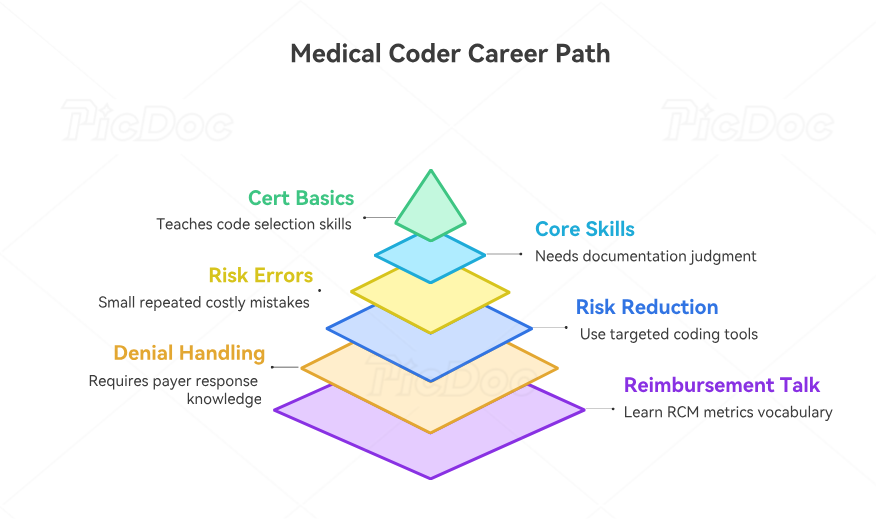
Certification teaches code selection, but employability comes from documentation judgment. A medical coder in Kuwait must know when a diagnosis is supported, when a procedure lacks evidence, when a provider note needs clarification, and when a billed service fails medical necessity. This is why medical necessity criteria, clinical documentation improvement, problem list documentation, medical record retention, and coding ethics standards are practical career tools.
The highest-risk coding errors are rarely dramatic. They are small, repeated, and expensive: missing diagnosis specificity, unsupported E&M levels, wrong modifier use, duplicate services, mismatched diagnosis pointers, weak procedure evidence, missing order details, and services coded from assumptions. Coders can reduce that risk through modifier usage examples, surgical coding compliance, anesthesia billing terms, infusion and injection therapy billing, and allergy and immunology coding.
Denial handling is where weak training becomes visible. A coder who cannot read payer responses depends on others to explain what went wrong. A coder who understands CARCs, RARCs, EOBs, claims reconciliation, and payment posting can identify root causes, help correct the claim, and prevent the same denial from returning next week.
Reimbursement awareness also helps coders speak to management. Managers care about clean-claim rate, denial rate, aging, underpayment, missing documentation, coding productivity, payer trends, and leakage. Build that vocabulary through RCM metrics and KPIs, cost reporting terms, physician fee schedule terms, medical billing reconciliation, and healthcare data analytics terms. This makes your certification sound connected to business outcomes.
5. Kuwait Job-Readiness Plan For 2026-2027
A practical four-month plan works better than vague studying. In month one, learn terminology, anatomy, ICD, CPT, HCPCS, claim forms, and billing vocabulary. Pair medical abbreviations for coders, medical coding education terms, online coding exam prep resources, continuing education units, and certification renewal terms with daily coding drills.
In month two, move into specialty practice. Rotate through radiology, cardiology, dermatology, emergency medicine, gastroenterology, pediatrics, lab, and behavioral health. Use radiology billing terms, cardiology CPT coding, dermatology CPT coding, behavioral health billing terms, and sleep medicine billing terms. Specialty exposure builds pattern recognition and makes interviews easier.
In month three, practice full claim thinking. Take a chart, code the diagnosis, code the service, check modifiers, verify medical necessity, imagine payer edits, then write a denial-prevention note. Use clearinghouse terminology, EDI billing terms, practice management system terms, RCM software terms, and electronic claims submission platforms so your process matches real billing departments.
In month four, build your application package. Your resume should mention coding systems, specialty exposure, documentation review, EHR familiarity, denial analysis, medical necessity, modifiers, claim forms, and audit awareness. Add a portfolio summary using coding apprenticeship terms, career development terms, health information management terms, utilization review terms, and audit terminology. Employers should see proof before they ask for it.
International learners comparing Kuwait with other markets should review related AMBCI country guides. The Kuwait path shares skills with medical billing and coding certification in UAE, medical billing and coding certification in Saudi Arabia, medical billing and coding certification in Qatar, medical billing and coding certification in Pakistan, and medical billing and coding certification in India, but local payer workflows and employer expectations still decide final readiness.
6. FAQs About Medical Billing And Coding Certification In Kuwait
-
CPC-style certification is strong for outpatient coding, clinic coding, and physician-service roles. CBCS-style preparation helps billing, claims, and insurance-focused candidates. CCS-style training supports hospital coding, HIM, and audit-heavy work. Match your certification to job postings, then strengthen it with CPC program research, CBCS exam terms, CCS certification options, coding credentialing organizations, and coding competency terms.
-
Beginners can compete better when they show practical proof rather than course completion alone. A resume should include coding practice, specialty exposure, documentation review, medical necessity checks, modifier decisions, and denial analysis. Use SOAP note coding, medical necessity criteria, coding edits, EOB guidance, and claims management terms to build job-ready examples.
-
Clinical knowledge is essential because coders must understand provider notes, diagnoses, procedures, lab results, imaging reports, and treatment plans. You do not need to be a physician, but you must understand enough anatomy, pathophysiology, terminology, and documentation structure to code safely. Build that base through medical abbreviations, ICD respiratory coding, ICD cardiovascular coding, lab coding essentials, and radiology CPT reference.
-
The biggest mistake is memorizing codes without learning claim outcomes. A coder must know how documentation, medical necessity, modifiers, claim forms, payer edits, denials, payment posting, and reconciliation connect. Study claim adjustment reason codes, remittance advice remark codes, payment posting, claims reconciliation, and revenue leakage prevention until coding decisions feel financially grounded.
-
Use skills that prove operational readiness: ICD coding, CPT coding, E&M, modifiers, medical necessity, documentation review, claim forms, EHR navigation, denial analysis, payment posting awareness, audit support, and specialty coding exposure. Support those skills with EHR coding terms, encoder software terms, coding audit terms, regulatory compliance, and career development terms. A strong resume reads like a workflow, not a keyword dump.
-
A focused learner can build a strong foundation in several months, but job readiness depends on chart practice, specialty exposure, denial understanding, and billing workflow confidence. Plan beyond the exam: code real-style notes, review claim outcomes, study payer-response vocabulary, and prepare interview cases. Use online coding exam prep resources, CEU guidance, coding education terms, apprenticeship terms, and professional development terms to stay structured.
