
Medical Billing and Coding Certification in Qatar: Complete Guide for 2026-2027
Qatar-based learners entering medical billing and coding in 2026-2027 need a certification path that builds real claim judgment, documentation confidence, and revenue-cycle fluency. The strongest candidates understand how medical coding workflow terms, accurate medical billing and reimbursement, medical necessity criteria, and coding regulatory compliance connect inside everyday billing decisions. Certification becomes more valuable when it prepares you for payer language, documentation gaps, denials, forms, audits, and remote healthcare support roles.

1. Why Medical Billing and Coding Certification Matters in Qatar in 2026-2027
Medical billing and coding certification in Qatar matters because healthcare employers, outsourcing partners, clinics, billing vendors, and remote revenue-cycle teams need people who can work accurately across documentation, coding, claims, and payer follow-up. A beginner who only memorizes terms will struggle when a provider note lacks detail, a modifier changes reimbursement, an EOB shows an adjustment, or a payer response requires correction. A stronger learner connects charge capture terms, clearinghouse terminology, payment posting terms, and claims reconciliation terms into one practical workflow.
Qatar candidates often aim for hospital support, clinic billing, insurance coordination, medical coding support, revenue-cycle operations, or remote work with international teams. Those routes require a working command of CMS-1500 form terms, UB-04 billing form terms, EOB interpretation, and CARC definitions. The real pressure begins when a claim is delayed, denied, underpaid, rejected, bundled, or flagged for documentation support.
A certification should therefore train the learner to prevent costly errors before they enter the claim stream. That means understanding clinical documentation improvement terms, medical coding audit terms, coding edits and modifiers, and healthcare data security terms. Qatar learners who can explain the “why” behind coding and billing decisions become far easier to trust in real production environments.
Qatar Certification Roadmap: 25+ Skills to Build Before Applying
| Skill Area | What It Means | Why It Matters for Qatar Candidates | Best AMBCI Resource |
|---|---|---|---|
| Coding foundation | Understanding how diagnoses and procedures become reportable codes | Employers need candidates who can justify code choices under pressure | Medical coding certification terms |
| Revenue cycle flow | How registration, coding, billing, payment, and follow-up connect | Qatar candidates need full workflow awareness for hospital, clinic, and remote roles | RCM terms |
| ICD knowledge | Diagnosis coding for condition reporting and medical necessity | Weak diagnosis specificity can create claim, authorization, and audit problems | ICD-11 coding standards |
| CPT procedure coding | Procedure coding for physician services and clinical encounters | Procedure-code weakness leads to underbilling, denials, and correction queues | CPT code listing |
| Modifier accuracy | Using modifiers to clarify service circumstances | One modifier error can affect edits, payment, compliance, and payer trust | CPT modifier usage |
| Medical necessity | Linking the service to a clinically supported reason | Services with weak support are vulnerable to denial and audit review | Medical necessity criteria |
| Documentation review | Checking whether clinical notes support billed services | Documentation judgment helps prevent denials before claims leave the system | EMR documentation terms |
| CDI awareness | Improving documentation clarity for coding and billing accuracy | Clearer documentation reduces query delays and claim vulnerability | CDI terms dictionary |
| Coding query process | Clarifying missing or conflicting documentation | Poor queries create compliance risk and slow billing release | Coding query process terms |
| EOB interpretation | Reading payer payment, denial, adjustment, and patient responsibility details | Billing staff must know what happened after claim adjudication | EOB guide |
| CARC reading | Understanding claim adjustment reason codes | CARCs help identify denial and underpayment root causes | CARC guide |
| RARC reading | Understanding remark codes that add payer context | RARCs often show the next documentation or correction step | RARC dictionary |
| Claim forms | Understanding professional and facility claim form fields | Field-level mistakes can cause rejection before payer review | CMS-1500 terms |
| Facility billing | Understanding institutional billing language and form structure | Hospital support roles require facility billing literacy | UB-04 terms |
| EDI basics | Electronic claim and payment data exchange | Remote billing teams often expect basic EDI vocabulary | EDI billing terms |
| Clearinghouse workflow | Claims checking, routing, and rejection handling before payer review | Many claim problems appear at clearinghouse level first | Claims submission platforms |
| Denial management | Correcting and preventing unpaid or incorrectly paid claims | Denial skill is highly visible in billing interviews and production work | Denial management services |
| Audit readiness | Keeping coding choices defensible during review | Audit logic protects providers, employers, and billing teams | Medical coding audit terms |
| Compliance discipline | Following coding, payer, privacy, and documentation rules | Compliance mistakes damage trust faster than ordinary production errors | Coding ethics standards |
| Revenue leakage prevention | Finding lost revenue from missed charges, delays, and errors | Revenue protection makes a candidate more valuable to billing teams | Revenue leakage prevention |
| Specialty coding range | Understanding rules across clinical departments | Specialty knowledge helps Qatar candidates compete beyond entry-level queues | Cardiology CPT coding |
| Emergency medicine coding | Coding urgent and high-volume emergency encounters | Emergency coding tests speed, documentation reading, and modifier judgment | Emergency CPT examples |
| Radiology billing | Coding imaging studies, reports, and billing rules | Radiology queues are common in outsourced and facility-adjacent workflows | Radiology billing terms |
| Telemedicine coding | Coding virtual care, remote services, and related documentation | Virtual care requires careful place-of-service and documentation thinking | Telemedicine coding terms |
| Practice management systems | Software used for claims, scheduling, payments, and follow-up | Software fluency helps candidates move faster during onboarding | Practice management terms |
| EHR integration | How documentation, coding, and billing data connect | Disconnected EHR knowledge slows coding review and claim correction | EHR integration terms |
| Exam readiness | Preparing for certification questions and real workflow scenarios | Good preparation links exam knowledge to practical claim decisions | CBCS exam terms |
| Continuing education | Keeping skills current after certification | Rules, code sets, payer edits, and documentation expectations keep evolving | CEUs for coders |
| Career development | Planning growth toward specialist, auditor, denial, or RCM roles | Career growth requires proof of judgment, accuracy, and communication | Coding career development terms |
2. How to Choose the Right Medical Billing and Coding Certification Path in Qatar
The right certification path starts with the work you want to perform. A learner aiming for coding support should focus on anatomy language, ICD structure, CPT selection, modifiers, documentation support, specialty rules, and audit logic. A learner aiming for billing operations should focus on eligibility, claim forms, EDI, clearinghouses, EOBs, patient balances, denial management, and payment posting. A learner aiming for broader revenue-cycle work should connect both sides through RCM software terms, data analytics and reporting terms, revenue cycle metrics, and healthcare claims management terms.
Qatar learners should avoid choosing a program based only on speed, price, or a certificate logo. The better question is whether the course teaches real claim pressure. Can you explain why a modifier applies? Can you read an EOB and identify the adjustment? Can you identify missing documentation before billing? Can you write a clean query? Can you track why revenue leaked from a claim? These questions connect directly to coding query process terms, patient responsibility terms, commercial insurance billing terms, and coordination of benefits definitions.
A practical certification pathway should contain four layers. The first layer is vocabulary: healthcare billing acronyms, medical abbreviations, HIM terms, and coding education terms. The second layer is coding judgment. The third layer is billing workflow. The fourth layer is interview-ready evidence through sample denial notes, audit checklists, modifier explanations, and de-identified case breakdowns.
Certification value increases when the learner can keep growing after the exam. Qatar candidates should compare credential expectations, renewal rules, continuing education, and competency assessments before committing. AMBCI resources on coding credentialing organizations, coding competency assessment, certification renewal terms, and professional development terms help you evaluate whether a program supports career growth beyond first certification.
3. Core Skills Qatar Candidates Must Prove Before Applying for Billing or Coding Roles
The first skill is documentation judgment. Qatar candidates should be able to read provider notes and identify whether the record supports the diagnosis, service, procedure, laterality, severity, time, route, frequency, medical necessity, and modifier use. This skill protects claims from preventable rework. Build your foundation with SOAP notes and coding, problem lists in medical documentation, encounter forms and superbills, and electronic medical record documentation terms.
The second skill is denial thinking. Many entry-level learners can define a claim denial, yet only stronger candidates can explain the denial root cause, correction route, appeal logic, payer evidence, and prevention step. This is where employers notice real readiness. Practice with claim adjustment reason codes, remittance advice remark codes, advanced claims reconciliation terms, and collections and bad debt terms. Denial fluency shows that you understand revenue protection, not just code assignment.
The third skill is specialty coding range. A candidate who can discuss emergency medicine, radiology, cardiology, dermatology, pediatrics, gastroenterology, anesthesia, lab, and behavioral health has more practical range than a candidate trained only on generic examples. Begin with high-volume resources such as emergency medicine CPT codes, radiology CPT coding, cardiology procedure coding, and behavioral health billing terms. Specialty awareness helps you answer interview questions with sharper examples.
The fourth skill is clean professional communication. Billing and coding work often involves explaining a problem to providers, payers, supervisors, auditors, or clients. A strong message identifies the issue, cites the missing support, explains the risk, and recommends the next step. Study utilization review terms, clinical decision support terms, coding ethics and standards, and medical record retention terms. Accuracy matters, and communication determines whether your accuracy becomes useful to the team.
Quick Poll: What is your biggest billing and coding career blocker in Qatar?
4. A Practical 2026-2027 Study Plan for Medical Billing and Coding Certification in Qatar
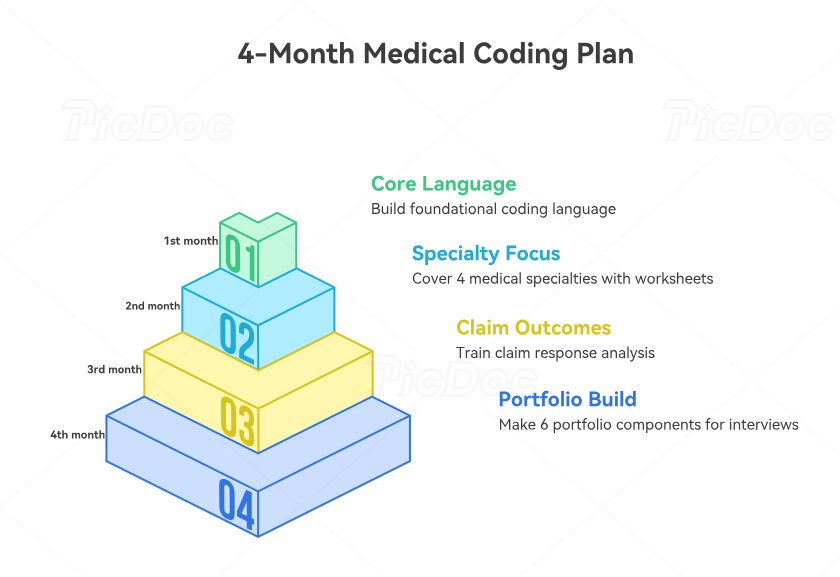
The first month should build your core language. Study diagnosis coding, procedure coding, billing forms, claim stages, payer responses, patient responsibility, and medical documentation structure. Use medical coding certification terms, healthcare billing acronyms, ICD-11 mental health coding, and ICD-11 neurological disorder codes. Your goal is to understand the language of charts, claims, payers, and audit trails before moving into speed practice.
The second month should focus on specialty coding and documentation support. Pick four specialties and build a one-page working sheet for each: common code families, documentation requirements, modifier concerns, medical necessity risks, denial triggers, and common billing questions. Start with respiratory disease coding, oncology coding, infectious disease coding, and lab and pathology coding. This specialty layer helps Qatar candidates build confidence beyond entry-level terminology.
The third month should train claim-outcome thinking. Read sample EOBs, identify adjustment reasons, connect CARCs and RARCs to next steps, write corrected-claim notes, and explain whether a claim needs documentation, coding correction, appeal support, or patient balance review. Study EOB interpretation, CARC directories, RARC terminology, and payment posting in medical billing. This month should make payer responses feel readable, structured, and actionable.
The fourth month should turn study into evidence. Create a small portfolio with one documentation review, one modifier explanation, one EOB breakdown, one denial correction plan, one specialty coding comparison, and one compliance checklist. Use coding audit terms, coding edits and modifiers, Stark Law and Anti-Kickback terms, and coding apprenticeship and internship terms. A portfolio gives your certification practical weight during interviews.
5. Career Options After Medical Billing and Coding Certification in Qatar
Medical coding support is a strong path for learners who enjoy clinical details, documentation review, diagnosis specificity, procedure selection, modifiers, and compliance. This route may include outpatient coding, specialty coding, pre-bill review, coding edits, provider queries, audit support, and quality checks. Build practical range with orthopedic surgery CPT coding, dermatology procedure coding, pediatric CPT coding, and gastroenterology CPT codes.
Billing operations is a strong route for candidates who enjoy claims, payer follow-up, patient balances, denials, corrected claims, and payment posting. It can also be a practical entry point because billing operations exposes you to the full financial path of a claim. Study commercial insurance billing, patient responsibility and copay terms, Medicare billing tools, and physician fee schedule reimbursement to strengthen payer and reimbursement fluency.
Denial management and accounts receivable follow-up can be especially valuable because the work exposes whether a candidate understands root cause. A denial specialist must know whether the claim requires coding correction, documentation, appeal support, eligibility review, authorization follow-up, or patient-balance action. Prepare with denial management resources, claims reconciliation terms, collections and bad debt, and revenue cycle KPIs. Strong denial thinking turns billing work into measurable revenue protection.
Compliance, audit, and quality support suit learners who are careful, detail-driven, and comfortable defending coding decisions with documentation. These roles require discipline because small shortcuts can create payer issues, audit findings, and client trust problems. Strengthen this path with medical coding regulatory compliance, coding ethics and standards, healthcare data security, and medical coding system updates. This path can grow toward auditor, trainer, quality reviewer, or RCM analyst responsibilities.
Qatar learners can also compare regional and global certification expectations. AMBCI’s guides for medical billing and coding certification in the UK, medical billing and coding certification in Australia, medical billing and coding certification in India, and medical billing and coding certification in Pakistan help candidates understand how training priorities shift across domestic healthcare, outsourcing, international billing support, and remote revenue-cycle work.
6. FAQs About Medical Billing and Coding Certification in Qatar
-
Yes. Certification is useful when it proves that a Qatar-based learner understands coding systems, billing workflow, documentation support, payer language, claim corrections, denials, compliance, and reimbursement. The strongest certification plan should connect medical coding workflow, accurate billing and reimbursement, RCM terms, and coding career development.
-
Start with ICD coding, CPT coding, modifiers, medical necessity, documentation review, claim forms, EOBs, CARCs, RARCs, denial management, payment posting, and compliance. These areas appear in daily billing and coding decisions. Use CPT modifier examples, medical necessity guidance, CMS-1500 terms, and EOB explanations.
-
Qatar candidates can pursue remote work when they can show accuracy, documentation judgment, payer-response fluency, secure data handling, and clear written communication. Remote employers often value candidates who can explain claim issues with minimal supervision. Build proof using practice management system terms, EHR coding terms, EDI billing terms, and healthcare data security terms.
-
A focused beginner can build a practical foundation in three to six months with consistent study, case practice, documentation review, and claim-outcome training. Job readiness depends on how well you handle documentation, coding, claims, payer responses, and denials. A strong preparation plan should include coding audits, claim adjustment codes, payment posting, and claims reconciliation.
-
Choose based on your strengths. Coding suits learners who enjoy clinical notes, diagnosis logic, procedure selection, modifiers, and documentation. Billing suits learners who enjoy claims, EOBs, payer follow-up, payment posting, denials, and patient balances. RCM suits learners who want broader workflow control. Compare medical coding automation terms, RCM software terms, revenue cycle metrics, and data analytics terms.
-
The biggest mistake is treating certification as the entire career plan. Employers need people who can prevent errors, reduce denials, protect revenue, document decisions, and keep learning as codes and payer expectations change. Continue building after certification through continuing education units, certification renewal, professional development, and coding apprenticeship terms.
