
Medical Billing and Coding Certification in Singapore: Complete Guide for 2026-2027
Medical billing and coding certification in Singapore is becoming more valuable because healthcare administration now demands clean documentation, accurate claim handling, strong privacy discipline, and better digital workflow knowledge. A strong certification helps learners understand medical coding certification terms, revenue cycle management terms, accurate medical billing and reimbursement, and healthcare data security terms. For Singapore-based learners, the winning skill is practical judgment: reading clinical notes, protecting patient data, understanding payer logic, preventing claim delays, and explaining billing outcomes clearly.

1. Why Medical Billing and Coding Certification Matters in Singapore in 2026-2027
Singapore has a highly organized healthcare environment where documentation, digital records, subsidies, insurance workflows, and patient billing all connect. That makes medical billing and coding training especially important for clinic staff, hospital support teams, insurance coordinators, remote RCM workers, and healthcare administration learners. A person who only memorizes code descriptions will struggle when a claim fails because the provider note lacks specificity, the wrong patient-responsibility amount is communicated, an EOB is misunderstood, a modifier changes the payment logic, or a record does not support medical necessity. Certification should connect medical necessity criteria, clinical documentation improvement terms, medical coding workflow terms, healthcare claims management terms, and payment posting terms.
For 2026-2027, Singapore learners should think of certification as a workflow credential, not a decorative certificate. Employers and healthcare teams need people who can reduce avoidable errors across registration, documentation review, code selection, charge capture, claim submission, denial handling, payment posting, reconciliation, and reporting. The pressure is especially high in a system where patients may interact with public schemes, private insurance, employer coverage, and out-of-pocket balances. A certified learner should understand EOB interpretation, patient responsibility and copay terms, coordination of benefits, clearinghouse terminology, and EDI billing terms.
Singapore Certification Roadmap: Skills, Billing Risk, and Best Action Plan
| Skill Area | What You Must Learn | Why It Hits Billing in Singapore | Best Practice Action |
|---|---|---|---|
| Medical terminology | Clinical language, abbreviations, body systems, procedure phrases | Weak terminology causes wrong coding decisions and poor provider queries | Start with medical abbreviations |
| ICD foundations | Diagnosis specificity, sequencing, exclusions, condition status | Diagnosis quality supports reporting, billing logic, and medical necessity | Use ICD-11 coding standards |
| CPT foundations | Procedure categories, service descriptions, bundled work, code families | Procedure coding mistakes create payment delays and audit exposure | Practice with a CPT coding guide |
| Modifier logic | Payment-impacting modifiers, documentation support, edit behavior | One modifier error can change claim payment or trigger review | Study CPT modifiers |
| Medical necessity | Diagnosis-to-service support, payer expectations, clinical rationale | Unsupported services create denials and patient-billing disputes | Audit claims using medical necessity criteria |
| Clinical documentation | Provider note completeness, laterality, severity, timing, rationale | Vague records make coding and claims unstable | Review EMR documentation terms |
| CDI basics | Compliant queries, specificity improvement, contradiction resolution | Documentation improvement prevents downstream claim rework | Use CDI terms |
| Charge capture | Missed services, encounter forms, department handoffs, late charges | Revenue can disappear before the coder receives the record | Map workflow with charge capture terms |
| Claims submission | Claim fields, attachments, payer edits, eligibility logic | Clean data reduces rejections and manual follow-up | Study claims management terms |
| EDI literacy | Electronic transactions, acknowledgments, rejections, file flow | Digital claim exchange depends on accurate electronic data | Learn EDI billing terms |
| Clearinghouse workflow | Front-end edits, rejection queues, payer routing, batch status | Many claims fail before formal payer review | Use clearinghouse terminology |
| EOB reading | Allowed amount, adjustment, deductible, copay, coinsurance | Payment confusion creates patient-service friction and posting errors | Train with an EOB guide |
| CARCs | Claim adjustment reason codes and denial categories | Reason-code literacy speeds denial correction | Build scripts from CARC directory |
| RARCs | Remark codes and payer instruction language | Remark details often reveal missing proof or next action | Reference RARC definitions |
| Payment posting | Payments, adjustments, transfers, underpayments, balance movement | Incorrect posting hides denial patterns and payer behavior | Follow payment posting terms |
| Reconciliation | Claim, remittance, deposit, adjustment, and balance matching | Unreconciled accounts weaken financial reporting | Use billing reconciliation terms |
| Patient responsibility | Copay, deductible, coinsurance, cash balance, billing explanation | Patients need clear explanations before balances become disputes | Study patient responsibility terms |
| Compliance | Audit trails, documentation support, privacy, accurate reporting | Digital healthcare requires defensible billing behavior | Review coding regulatory compliance |
| Data security | Access control, confidentiality, minimum necessary use, breach awareness | Patient data protection is central to Singapore healthcare administration | Train with healthcare data security terms |
| EHR integration | System mapping, identifiers, data fields, encounter flow | System mismatch can break billing even when coding is accurate | Learn EHR integration terms |
| Revenue leakage | Missed charges, undercoding, denials, late filing, write-offs | Small process failures create large hidden cash loss | Track leaks with revenue leakage prevention |
| RCM KPIs | Clean claim rate, denial rate, AR days, net collection rate | Certified staff must explain performance using numbers | Use RCM metrics and KPIs |
| Specialty coding | Service-line documentation, payer risk, procedure detail | Specialties create different billing failure points | Practice with radiology billing terms |
| Telemedicine coding | Remote visit documentation, service location, payer policy proof | Digital care requires clear evidence of service delivery | Study telemedicine coding terms |
| Risk adjustment | Chronic condition capture, specificity, annual validation | Clinical complexity reporting affects value-based workflows | Review risk adjustment coding |
| Value-based care | Quality reporting, outcome measures, cost awareness, care gaps | Preventive-health models need cleaner data and stronger documentation | Read value-based care terms |
| Certification exam prep | Exam domains, coding scenarios, time management, terminology | Applied judgment matters more than passive reading | Use CBCS exam terms |
| Career planning | Entry roles, portfolio, continuing education, interview readiness | Employers want proof of workflow readiness | Build with coding career terms |
2. How to Choose the Right Medical Billing and Coding Certification Path in Singapore
The best certification path depends on the role you want. A clinic billing assistant needs eligibility checks, patient-responsibility language, EOB reading, claim follow-up, and basic payment posting. A medical coder needs anatomy, terminology, ICD, CPT, modifiers, documentation review, compliance, and specialty logic. A revenue cycle analyst needs denial trends, reconciliation, reporting, payer behavior, and KPI interpretation. A remote RCM learner needs stronger international workflow knowledge, especially commercial insurance billing terms, CMS-1500 form terms, UB-04 billing terms, advanced claims reconciliation terms, and medical billing acronyms.
Singapore learners should avoid choosing a course only because the name sounds official. A valuable program should teach how claims actually fail. Can the learner identify missing diagnosis support? Can they recognize when a provider note needs clarification? Can they explain why a balance moved to patient responsibility? Can they connect a denial code to the right corrective action? Can they protect patient information inside digital systems? These practical questions matter more than a long syllabus. A stronger certification journey should combine medical coding audit terms, complete coding ethics and standards, health information management terms, medical record retention terms, and healthcare data analytics terms.
A staged path works best. Start with medical terminology, anatomy, documentation structure, and billing vocabulary. Move into ICD and CPT concepts. Add modifiers, medical necessity, charge capture, claims, EDI, EOBs, CARCs, RARCs, and appeals. Then study payment posting, reconciliation, data security, reporting, and specialty cases. This sequence prevents the common beginner problem where the learner can define codes yet cannot explain the workflow around them. AMBCI learners can strengthen specialty readiness through cardiology CPT coding, emergency medicine CPT codes, radiology procedure coding, gastroenterology CPT codes, and lab and pathology coding.
3. Core Skills Singapore-Based Billing and Coding Learners Must Master
The first essential skill is documentation judgment. In real billing work, the coder often becomes the person who notices that the provider note is too vague, the procedure detail is incomplete, the diagnosis does not support the service, or the problem list contradicts the assessment. Clean coding begins with clean documentation. Learners should know when to code from the record, when to ask for clarification, when to hold a claim, and when to escalate a recurring documentation issue. This requires fluency in SOAP notes and coding, problem list documentation, coding query process terms, clinical decision support terms, and Medicare documentation requirements.
The second essential skill is claim lifecycle control. A biller should understand how an encounter becomes a charge, how a charge becomes a claim, how a claim becomes a remittance, and how a remittance becomes either a posted payment, a patient balance, an appeal, or a write-off. Many teams lose money because every department sees only its own task. Certified learners should see the whole chain. A learner who understands encounter forms and superbills, practice management systems, RCM software terms, encoder software terms, and medical coding automation terms can spot workflow risk earlier.
The third essential skill is denial analysis. A denial queue should not feel like random punishment from payers. It should function like a map showing where the process is breaking. Repeated medical-necessity denials may reveal weak provider documentation. Eligibility denials may reveal registration gaps. Modifier denials may reveal coder training issues. Coordination-of-benefits denials may reveal missing insurance sequencing. Payment variance may reveal contract or posting problems. Learners can build real confidence through denial management services, claim adjustment reason codes, remittance advice remark codes, coordination of benefits, and collections and bad debt terms.
4. How to Build a Job-Ready Study Plan for Singapore in 2026-2027
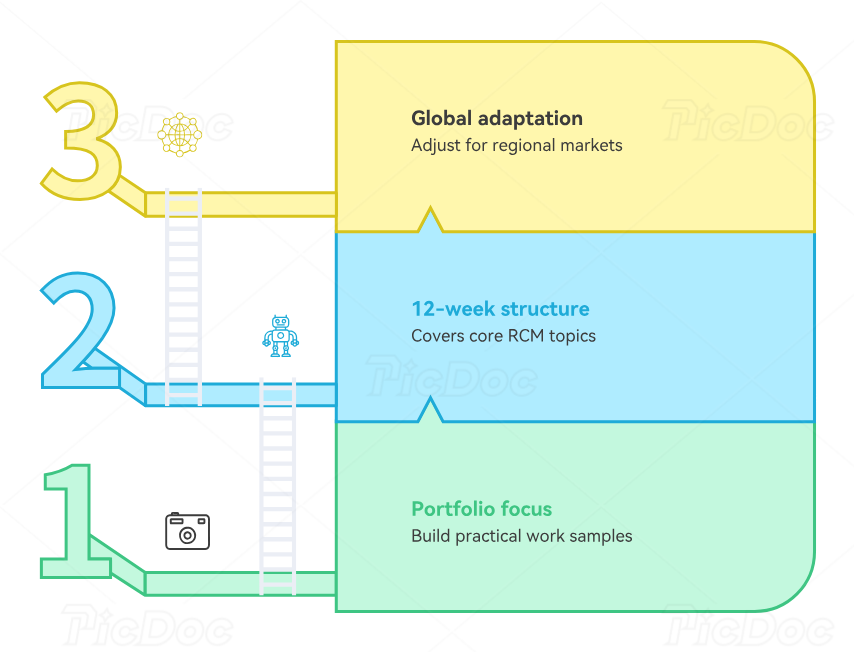
A job-ready study plan should create proof that you can perform, not just proof that you attended lessons. Build a small portfolio with sample documentation reviews, coding rationales, medical-necessity checks, denial scenarios, EOB explanations, payment posting examples, and KPI summaries. For every case, write the reason behind your decision. That habit trains the exact skill employers need: defensible judgment. Use coding competency assessment terms, coding apprenticeship and internship terms, professional development terms, continuing education units, and certification renewal terms to keep the plan measurable.
A practical 12-week structure works well for many Singapore learners. Weeks 1-2 should cover medical terminology, anatomy, documentation structure, abbreviations, and insurance vocabulary. Weeks 3-4 should cover ICD concepts, diagnosis specificity, medical necessity, and problem-list quality. Weeks 5-6 should cover CPT concepts, modifiers, bundled services, and specialty examples. Weeks 7-8 should cover claims, EDI, clearinghouse rejections, EOBs, CARCs, RARCs, and appeals. Weeks 9-10 should cover payment posting, reconciliation, patient balances, privacy, and RCM KPIs. Weeks 11-12 should focus on mock exams, case audits, and portfolio polish using ICD-11 cardiovascular codes, ICD-11 oncology reference, infectious disease coding, respiratory disease coding, and neurological disorder coding.
For learners thinking beyond Singapore, the same foundation can support regional or remote RCM work, but each market has different rules, payer behavior, systems, and claim habits. A Singapore clinic role, a Gulf-based billing team, a U.S.-focused remote RCM role, and an international coding support role can share terminology while demanding different operational details. Build transferable knowledge first, then layer market-specific requirements. AMBCI learners can compare pathways through medical billing and coding certification in Singapore, medical billing and coding certification in UAE, medical billing and coding certification in Saudi Arabia, medical billing and coding certification in India, and medical billing and coding certification in Philippines.
5. Common Mistakes That Make Certification Less Valuable in Singapore
The biggest mistake is studying coding as memorization. Real billing work rewards people who can explain why a claim is clean, why a code is supported, why a payer may reject the service, why the patient balance changed, and why the documentation creates risk. Memorized definitions collapse when a case includes multiple diagnoses, missing procedure detail, unclear service location, repeated visits, conflicting provider language, or payer-specific edits. Learners should add medical coding audit terms, surgical coding compliance terms, coding ethics and standards, Stark Law and Anti-Kickback terms, and regulatory compliance terms to build audit-ready thinking.
The second mistake is ignoring patient billing communication. In Singapore, patients may encounter subsidies, insurance coverage, employer arrangements, MediSave-linked concepts, or out-of-pocket responsibility. Even when another department calculates the final balance, billing and coding professionals should understand why patients become confused. A badly explained balance can turn a normal claim into a service complaint. A certified learner should be able to explain allowed amounts, adjustments, copays, deductibles, coinsurance, remittance language, and balance transfers in clean operational language. Strengthen that skill with patient responsibility terms, EOB guidance, commercial insurance billing terms, COB definitions, and collections and bad debt terms.
The third mistake is treating systems as somebody else’s problem. When EHR fields, billing software, charge capture tools, patient identifiers, claim forms, and reporting dashboards do not align, claims fail in ways that look like human error. A certified professional should know enough system language to describe the problem clearly: missing field, wrong mapping, duplicate account, invalid provider selection, broken interface, unsupported attachment, or mismatched encounter type. This is where EHR coding terms, EHR integration terms, RCM software terms, medical coding automation terms, and data analytics terms become valuable.
The fourth mistake is choosing a certificate without a role plan. Clinic billing, coding support, claims follow-up, payment posting, insurance coordination, auditing, and RCM reporting require overlapping skills, yet each one has a different priority stack. A learner targeting clinic billing should prioritize claim lifecycle, EOBs, patient responsibility, denials, and posting. A learner targeting coding should prioritize documentation, ICD, CPT, modifiers, specialty cases, and compliance. A learner targeting RCM analytics should prioritize reconciliation, KPIs, data quality, and leakage prevention. Build the plan with coding credentialing organizations, medical coding education accreditation terms, CBCS certification course directory, CCS certification program directory, and online CPC certification programs.
6. FAQs About Medical Billing and Coding Certification in Singapore
-
Yes. Certification is useful for Singapore learners who want structured skills in coding, billing, documentation review, insurance workflows, patient responsibility, privacy, denial handling, and revenue cycle operations. The strongest value comes when certification is paired with practical workflow knowledge from medical coding workflow terms, accurate reimbursement guidance, RCM terms, and healthcare billing acronyms.
-
Start with medical terminology, anatomy, documentation structure, diagnosis coding, procedure coding, insurance vocabulary, and the claim lifecycle. Then move into modifiers, medical necessity, EOBs, CARCs, RARCs, denials, appeals, payment posting, reconciliation, and data security. Build the base with medical abbreviations, SOAP notes and coding, ICD-11 best practices, and CPT modifiers.
-
Remote work is possible when a learner can prove accuracy, productivity, privacy discipline, payer-rule awareness, clean communication, and denial-resolution skill. Remote teams often test whether candidates can handle real claim scenarios instead of only defining terms. Prepare with commercial insurance billing terms, clearinghouse terminology, EDI billing terms, and payment posting terms.
-
Many beginners can build a serious foundation in 10-12 focused weeks, depending on healthcare background, English medical vocabulary, study hours, and exam type. A stronger plan uses cases, mock audits, denial scenarios, and documentation reviews. Support the study plan with coding competency assessment, coding exam prep resources, continuing education units, and certification renewal terms.
-
Employers value candidates who can protect the claim, read documentation carefully, explain payer responses, communicate with providers, handle patient-balance questions, and protect patient data. Specialty exposure also helps because clinics and hospitals face different coding risks. Build that edge with preventive medicine CPT coding, allergy and immunology codes, infusion and injection billing, and sleep medicine billing terms.
-
Both are valuable for broad career readiness. ICD knowledge supports diagnosis reporting and clinical specificity, while CPT knowledge supports procedure-based billing environments and international RCM work. The exact system required depends on employer, payer, country, and workflow. Strengthen both sides with ICD-11 mental health coding, ICD-11 neurological codes, orthopedic CPT coding, and emergency medicine CPT coding.
-
The biggest beginner mistake is studying codes separately from documentation, billing, insurance, payment, privacy, and reporting. Real claim quality depends on the full workflow. Beginners should learn why claims fail at registration, documentation, charge capture, coding, claim edits, payer review, posting, and follow-up. Fix that gap with charge capture terms, revenue leakage prevention, denial management services, and RCM metrics.
